Entrusted to Our Care: The Story of Thomas L. Corbett
A small package arrives at the museum. Sometimes it contains a handful of medals. Other times it is a set of worn dog tags, an old photograph, a letter, or a few personal belongings that somehow survived decades after the war ended.
July 2, 2026

 It happens far more often than many people realize.
A small package arrives at the museum. Sometimes it contains a handful of medals. Other times it is a set of worn dog tags, an old photograph, a letter, or a few personal belongings that somehow survived decades after the war ended. These items may seem simple to an outside observer, but to us they represent something far greater. Every artifact carries a story, and every story belongs to a person who once laughed, dreamed, served, and sacrificed.
Today, one of those stories belongs to Thomas L. Corbett of Hampton, Virginia.
Thomas Corbett was a young American who answered his country's call during the Vietnam War. Like thousands of other young men of his generation, he left home and traveled halfway around the world to serve in a conflict few truly understood. His destination was Vietnam, where the war had become increasingly violent and costly by 1967.
 Corbett was assigned to the 173rd Airborne Brigade, one of the Army's premier airborne combat units. The "Sky Soldiers" had already established a reputation for aggressive operations and difficult assignments in the Central Highlands of South Vietnam. Their missions frequently placed them in some of the war's most dangerous areas, where North Vietnamese forces were determined to challenge American units in large-scale battles.
By November 1967, the fighting around Dak To in the Central Highlands had intensified dramatically. American intelligence indicated that several North Vietnamese Army regiments had moved into the region, setting the stage for one of the bloodiest battles of the Vietnam War. The rugged mountains, dense jungle, and steep hills surrounding Dak To became the scene of fierce combat as American airborne, infantry, and cavalry units fought to drive enemy forces from their positions.
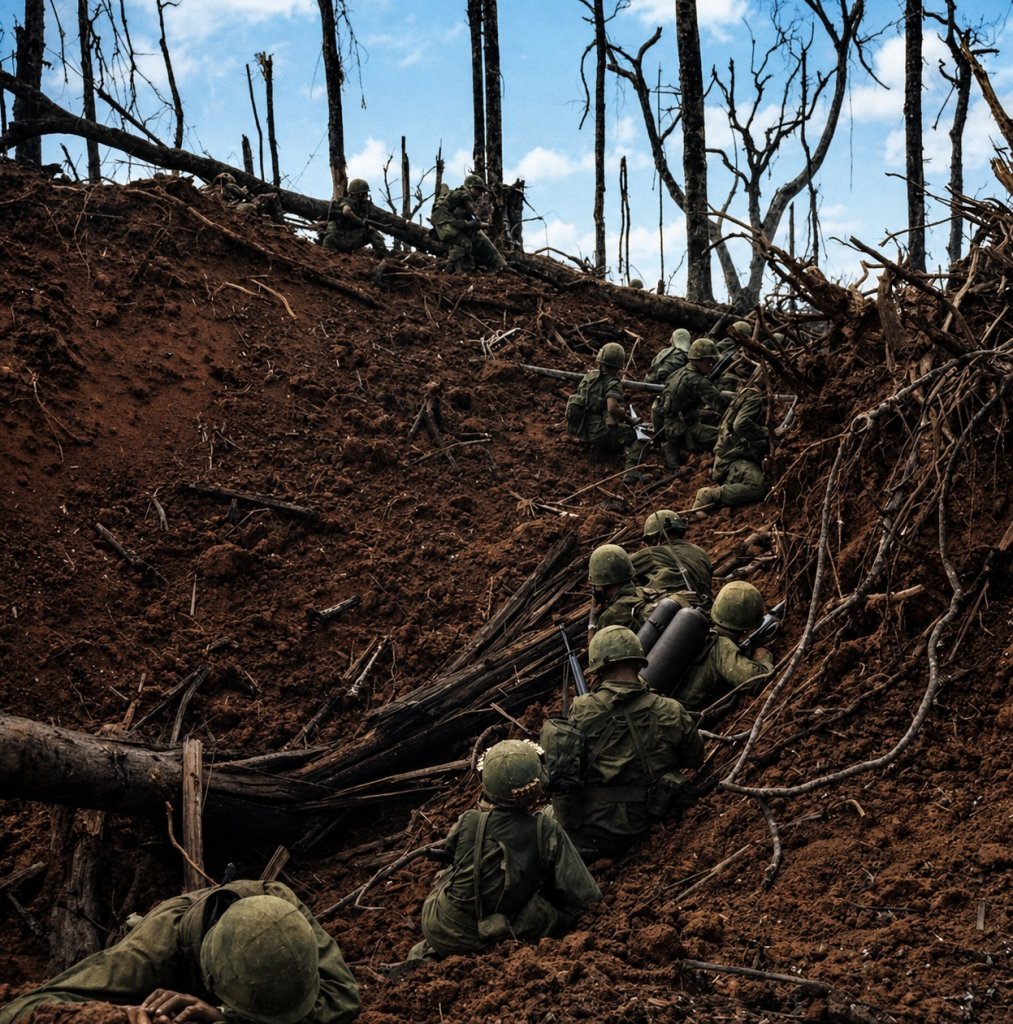
Among those hills was Hill 875.
The battle for Hill 875 began on November 19, 1967, when paratroopers of the 173rd Airborne Brigade encountered heavily fortified North Vietnamese positions. The enemy had constructed elaborate bunkers, trenches, and fighting positions that were concealed within thick jungle growth. As the Americans advanced uphill, they came under devastating machine-gun, mortar, and small-arms fire.
Thomas Corbett had been in Vietnam for only about two weeks.
Like many young replacements arriving in country, he had scarcely had time to adjust to the realities of combat before finding himself in one of the most intense battles of the war. On the second day of fighting on Hill 875, he was killed during the desperate struggle for the hill.
The battle itself was chaotic and extraordinarily costly. Thick vegetation, difficult terrain, and continuous enemy fire complicated every effort to evacuate casualties and recover the fallen. In the confusion of the fighting, Corbett's body could not immediately be recovered, and for a period he was listed as missing in action.
For his family back home in Hampton, Virginia, this uncertainty added another painful burden to an already devastating loss. While soldiers continued to fight on the hill, loved ones waited for answers that often came slowly and painfully during the Vietnam War.
Eventually, Thomas Corbett was recovered and returned to his family, but his story became one of many from Hill 875—a battle that claimed the lives of dozens of American soldiers and left lasting scars on those who survived.
Today, decades later, his medals and dog tags have been entrusted to our care.
When these artifacts arrived, they represented much more than military decorations and identification tags. They represented a young man whose life ended almost before his service in Vietnam had truly begun. They represented a son, a friend, and a soldier who traveled thousands of miles from Hampton, Virginia, only to lose his life on a distant jungle hillside.
Museums often preserve equipment, vehicles, weapons, and uniforms. These artifacts help tell the larger story of war. Yet some of the most powerful objects we receive are also the smallest. A set of dog tags carried close to the heart. A medal presented to grieving parents. A photograph tucked into a wallet. These personal items connect us directly to the individual behind the history.
Thomas L. Corbett's medals and dog tags are now part of that mission.
They serve as reminders not only of his sacrifice, but also of the countless young Americans whose lives were forever altered by the Vietnam War. Visitors who see these artifacts may never have known him, but through these objects they can understand that behind every name on a memorial wall was a real person with hopes, plans, and a future that was never realized.
This is why we preserve these items.
Not because of the metal they are made from, the ribbons they carry, or the value they may hold as collectibles. We preserve them because they are tangible connections to the men and women who served. They allow future generations to learn, remember, and understand the human cost of war.
The memory of Thomas L. Corbett has now been entrusted to our care.
We accept that responsibility with gratitude, humility, and respect. His story will continue to be told, his sacrifice will continue to be remembered, and his place in history will not be forgotten.
For as long as these artifacts remain, so too will the memory of the young paratrooper from Hampton, Virginia, who arrived in Vietnam only weeks before finding himself on Hill 875, where he gave his life in service to his country.
His watch has ended. Meet Thomas Corbett and discover the story behind the artifacts preserved in our collection.
Ours continues. Every artifact has a story. Click here to help us save the next one.