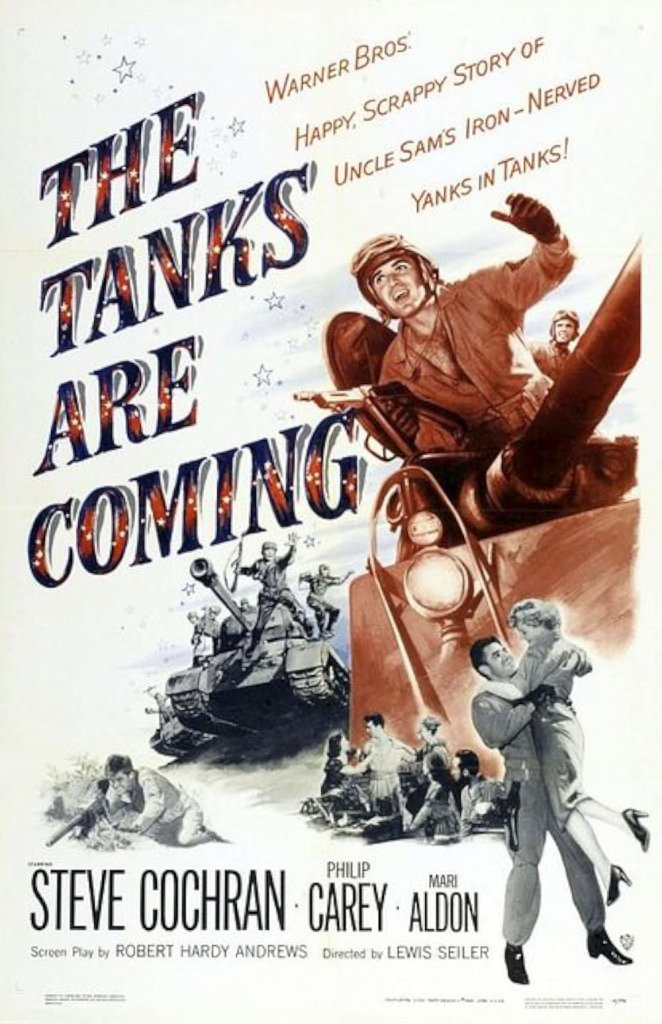
War in the Movies: The Tanks Are Coming — Hokey, Loud, and Worth Watching for the Armor
The Tanks Are Coming gives viewers something that is increasingly valuable today: long sequences of real American armored vehicles moving, firing, climbing obstacles, crossing rough terrain and operating together in large formations.
July 19, 2026

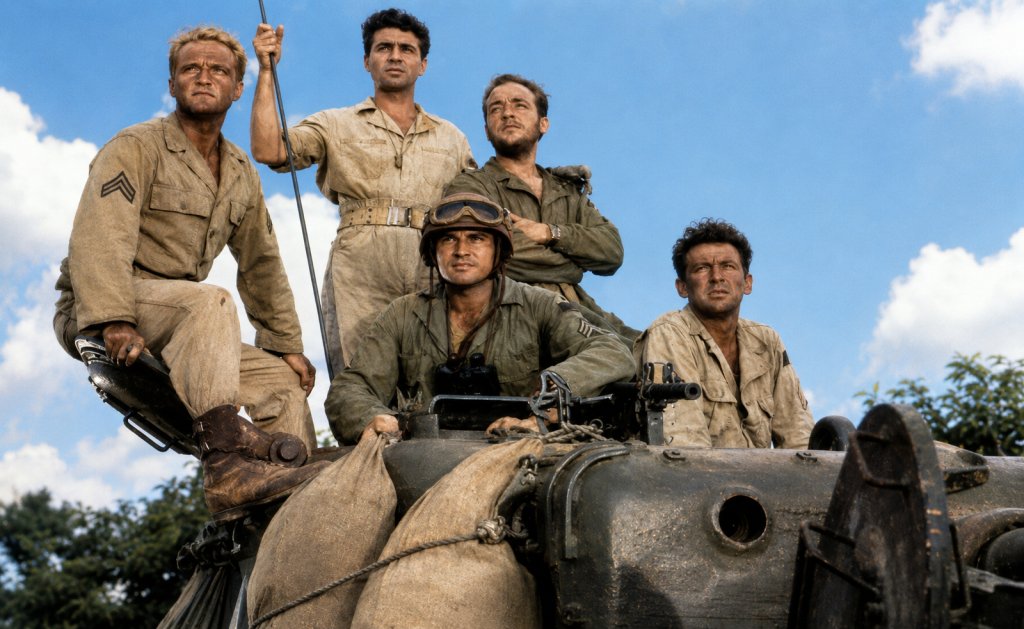
Released in 1951, The Tanks Are Coming is not one of the great masterpieces of World War II cinema. It is loud, overly patriotic(The Army Historical Foundation)ly hokey. Its characters are painted in broad strokes, its dialogue frequently sounds like something from a wartime comic book, and its version of armored warfare is often more concerned with excitement than strict historical accuracy.
Yet for anyone interested in American tanks, tank crews or the armored advance across Europe, it remains an absolutely fascinating movie.
Whatever its faults as drama, The Tanks Are Coming gives viewers something that is increasingly valuable today: long sequences of real American armored vehicles moving, firing, climbing obstacles, crossing rough terrain and operating together in large formations. The picture was filmed with extensive cooperation from the United States Army at Fort Knox, Kentucky, then the home of the Army’s Armored School. Real tanks, troops and military facilities were used throughout the production, while genuine wartime newsreel footage was inserted into several sequences. (Tank Encyclopedia)tank enthusiast, that alone makes the film worth watching.
The 3rd Armored Division Goes to War
The film follows a fictional tank platoon serving with the U.S. Army’s 3rd Armored Division, the famed “Spearhead” Division, during its advance from Normandy toward Germany in 1944.
The story begins near Saint-Lô shortly after the Allied breakout from the Normandy beachhead. A platoon of five Sherman tanks prepares to spearhead the division’s advance. At the head of the formation is a tank named California Jane, commanded by Master Sergeant Joe Davis.
During an early engagement, the platoon is ambushed by German armor. Davis is badly wounded and his driver is killed. His replacement is Staff Sergeant Francis Aloysius “Sully” Sullivan, played by Steve Cochran.
Sullivan immediately establishes himself as the movie’s central figure. He is aggressive, arrogant and almost impossibly confident. He bullies his crew, insults his superiors and acts as though every mistake made by a soldier is the result of weakness or carelessness. He claims that nearly all battlefield deaths are caused by mistakes—and, naturally, Sully does not believe that he makes any.
The men dislike him almost immediately.
Sullivan’s harshness creates much of the movie’s drama. His crew believes he is an uncaring glory hunter who will eventually get them all killed. Lieutenant Rawson, played by Philip Carey, repeatedly questions Sullivan’s judgment and methods. Yet every time Sully appears to have gone too far, he performs some daring action, saves one of his men or demonstrates that his brutal standards have a purpose.
It is a familiar Hollywood formula: the hard-driving sergeant who secretly cares deeply about his men but refuses to show it.
Subtle it is not.
The Crew of California Jane
Like many war films of the period, The Tanks Are Coming builds its fictional tank crew from a collection of recognizable American types.
There is the tough veteran, the temperamental driver, the young and inexperienced crewman, the loyal mechanic, the German American soldier and the wisecracking radio operator. Each man has an easily identifiable personality and usually one dominant characteristic.
The approach can feel artificial today, but it reflects how Hollywood frequently presented military units during and immediately after World War II. The crew was meant to represent a miniature version of America—men from different regions and backgrounds forced together inside a steel fighting vehicle.
Their tank becomes both their weapon and their home.
 The crew eats beside it, sleeps near it, repairs it, argues inside it and depends upon it for survival. When one California Jane is lost or damaged, the name is transferred to another vehicle. Over the course of the film, the crew operates three tanks bearing the name: California Jane, California Jane II and eventually California Jane III.
That repeated naming gives the tank an identity beyond its serial number. Men may be wounded, killed or transferred, and the vehicle itself may be destroyed, but the crew and its name continue moving forward.
This is one of the film’s better ideas. Tank units often developed intense attachments to their vehicles. Crews lived in and around them for weeks or months, decorating them with names, slogans and personal markings. A tank was not merely government equipment. It could become a member of the crew.
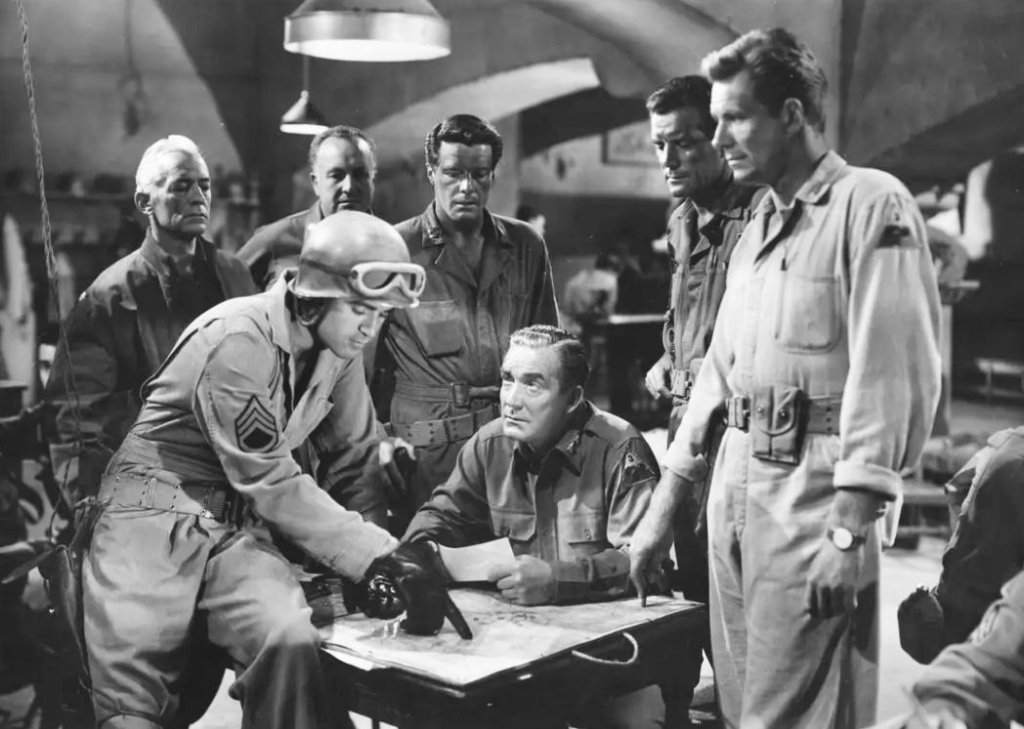
Across France and Belgium
The film follows the 3rd Armored Division as it drives through France and Belgium toward the German frontier. The advance is depicted as rapid, exhausting and relentless. Tanks roll for miles with little rest while mechanics struggle to keep them operational.
The real 3rd Armored Division did earn its “Spearhead” nickname during its rapid advance across northern France and Belgium. After fighting through Normandy and helping close the Falaise Pocket, the division crossed the Seine and pushed toward the German border. By September 1944, it had reached the defenses of the Siegfried Line.
The movie turns that advance into an almost continuous series of armored engagements. German guns lurk around every bend. Enemy tanks appear from concealed positions. Roads are blocked, bridges are damaged and every village seems to contain another ambush.
As military history, these scenes should not be taken too literally. The action is compressed, simplified and rearranged for dramatic purposes. The film has little interest in logistics, combined-arms planning or the wider operational situation. Infantry, artillery, engineers, tank destroyers and air support appear when the story needs them, but the tank crew remains at the center of nearly everything.
The result sometimes makes it appear that five determined tankers are personally winning the war.
That is part of the hokiness—but also part of the fun.
 The Real Stars Are the Tanks
 The Real Stars Are the Tanks
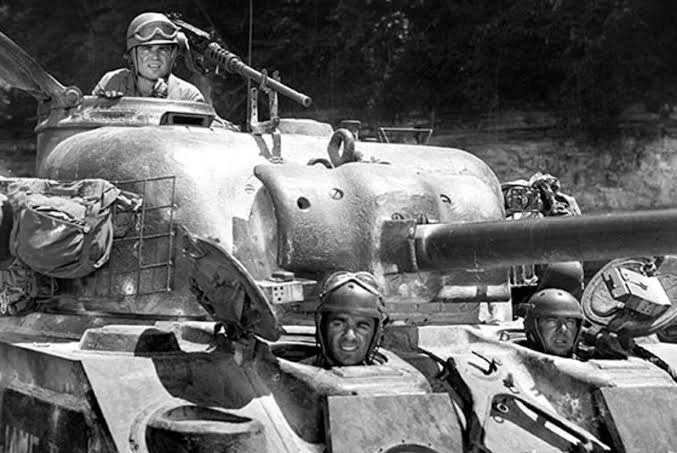
The actors receive top billing, but the real stars of The Tanks Are Coming are the armored vehicles.
Large numbers of genuine American tanks appear throughout the film. These include several versions of the M4 Sherman, among them M4A3s armed with 75mm and 76mm guns. Sherman-based recovery and engineering vehicles also appear, including an armored recovery vehicle and a Sherman equipped with a bulldozer blade.
These are not tiny models or tanks shown only in carefully framed close-ups. The viewer sees formations of American armor moving across open terrain, advancing down roads, maneuvering around obstacles and negotiating the concrete “dragon’s teeth” of the Siegfried Line.
The production’s use of Fort Knox gave it access to a concentration of armor that would be extraordinarily difficult and expensive to assemble for a movie today. The Army supplied vehicles, personnel and technical assistance, allowing the filmmakers to place genuine tanks directly in front of the cameras. (Tank Encyclopedia)ything shown is historically correct.
The supposed German Panther is a prop constructed on the chassis of an American M36 tank destroyer. Its shape may suggest a German tank to a casual viewer, but anyone familiar with the real Panther will quickly recognize that something is wrong.
Likewise, some of the American vehicles were newer than the tanks they were portraying. The movie was filmed only six years after World War II, but armored-vehicle development had continued rapidly. The Korean War was already underway, and vehicles such as the M46 Patton were entering service.
Nevertheless, the film preserves remarkable footage of American armored vehicles from the immediate postwar period. Even when a particular tank is standing in for another model, the footage still shows real machinery being operated by real soldiers.
For historians, restorers and modelers, there is a tremendous amount to study: crew positions, vehicle movement, track behavior, suspension movement, turret operation, engine-deck access, recovery procedures, equipment storage and the simple physical presence of tanks moving together.
The Problem With the Sherman
One of the movie’s recurring themes is the frustration felt by American tankers when facing heavier German armor.
The Sherman was reliable, mobile and available in enormous numbers. It was also adaptable enough to perform many battlefield roles. However, earlier Shermans armed with the 75mm gun could be badly outmatched in frontal engagements against German Panther and Tiger tanks.
The film presents this problem in dramatic terms. American shells bounce away from German armor while enemy guns tear into Shermans. The German 88mm gun is treated almost like a supernatural weapon—something feared by every American tanker.
After witnessing the apparent superiority of German armor, a young mechanic’s assistant nicknamed “Ike” leaves his unit and approaches the division commander to complain about the inadequacy of American tanks. Instead of having him arrested, the general listens sympathetically and promises that the first new American tank he receives will be sent to Ike’s platoon.
It is one of the movie’s more far-fetched episodes. Enlisted men generally did not wander into a general’s headquarters, complain about equipment and walk away with a promise that the Army’s newest tank would be personally delivered to them.
But the scene introduces the movie’s most historically interesting subject: the arrival of the new American 90mm-gun tank that became known as the M26 Pershing.
“One of Them New 90s”
Near the film’s climax, the platoon finally receives one of the mysterious “new 90s.”
Compared with the Sherman, the vehicle appears larger, more modern and more heavily armed. Its 90mm gun is presented as the answer to the powerful guns and heavy armor of Germany’s Panthers and Tigers. The crew eagerly transfers into the new tank, which becomes California Jane III.
This portion of the movie loosely references the real arrival of the T26E3 Pershing in the European Theater of Operations.
The historical story, however, occurred later than the movie suggests.
The real 3rd Armored Division reached and attacked the Siegfried Line in September 1944. The first twenty T26E3 Pershings did not arrive in Europe until January 1945 as part of the special “Zebra Mission.” Those tanks were divided between the 3rd and 9th Armored Divisions so they could be tested under combat conditions. The 3rd Armored Division first employed them in battle in late February 1945. The T26E3 was standardized as the M26 the following month. (The Army Historical Foundation)e, the movie moves the Pershing’s arrival forward by several months and associates it with events that occurred before the tank was actually available in Europe.
There is another interesting bit of Hollywood substitution involved. The tank shown portraying the new Pershing is not actually an M26. It is an M46 Patton, the improved postwar descendant of the Pershing. To most moviegoers in 1951, the difference would have been meaningless. Both had a similar basic silhouette and carried a 90mm gun. For modern armor enthusiasts, however, the M46’s appearance is immediately recognizable. (Tank Encyclopedia)titution does not ruin the scene. In fact, it adds another reason to watch the movie. Instead of merely showing Shermans, The Tanks Are Coming provides clear footage of an early Cold War M46 operating alongside older World War II vehicles.
It is historically wrong—but mechanically fascinating.
The Real Pershings in Europe
The real story of the Pershing’s introduction was far more complicated than the movie suggests.
American officers had spent years debating the need for a heavier tank with greater armor and firepower. Some Army leaders feared that a heavier vehicle would be difficult to transport, maintain and move across European bridges. Others believed the Sherman remained adequate when supported by tank destroyers, artillery and airpower.
Combat experience demonstrated that the situation was not always so simple. Shermans could defeat German heavy armor, particularly through maneuver, superior numbers or attacks against the side and rear. But when forced into direct frontal engagements, American crews could find themselves at a serious disadvantage.
After the Battle of the Bulge, the first twenty T26E3s were rushed to Europe. Ten went to the 3rd Armored Division and ten to the 9th Armored Division.
The Pershing carried the powerful 90mm M3 gun and had substantially thicker frontal armor than the standard Sherman. It was not invulnerable, and it suffered from mechanical and mobility limitations. One of the first Pershings to enter combat, Fireball, was knocked out by a German Tiger during fighting near Elsdorf on February 26, 1945. Its gunner and loader were killed. The tank was later recovered, repaired and returned to service.
Other Pershings proved their worth. A 3rd Armored Division Pershing famously destroyed a German Panther during the fighting in Cologne. Pershings later participated in the advance through Germany, but they arrived too late and in numbers too small to have a decisive effect upon the European war. (The Army Historical Foundation)ks Are Coming* turns this complicated history into a much simpler message: American tankers were struggling against superior German armor, the soldiers demanded something better, and the new 90mm tank arrived just in time.
It is not an accurate chronology, but it reflects a genuine wartime controversy.
Breaking the Siegfried Line
The final portion of the film centers upon the tankers’ attempt to penetrate the Siegfried Line.
The defenses include bunkers, artillery, minefields and rows of concrete antitank obstacles known as dragon’s teeth. The new tank becomes trapped while attempting to cross the barrier. Sullivan and his men then commandeer a Sherman dozer and use it to move earth over the obstacles, creating a crude pathway for the armored column.
It is the sort of finale one expects from a 1950s war picture. Artillery explodes everywhere, tanks charge forward, the commander exposes himself to enemy fire and individual heroism solves a problem that would ordinarily require a much larger engineering operation.
The scene is exaggerated, but the footage of the tanks and obstacles remains impressive. Viewers can see the size of the dragon’s teeth in relation to the vehicles and appreciate why such barriers could delay armored formations when protected by mines, artillery and antitank guns.
The conclusion reinforces the film’s basic message. No single man wins a battle. Tank commanders, drivers, gunners, loaders, radio operators, mechanics, engineers and supporting troops all contribute to the advance. Even Sullivan, who has spent much of the movie acting as though he alone understands warfare, eventually recognizes that he is only one part of a much larger machine.
It is not the most subtle lesson ever placed on film, but it is appropriate for a story about tanks and tank crews.
Hokey—but Still Worth Watching
There is no getting around it: The Tanks Are Coming is hokey.
Its patriotism is laid on thick. Its narrator speaks as though announcing a newsreel. The soldiers trade wisecracks while under fire. Sullivan is so confident and abrasive that he occasionally seems less like a human being than a recruiting-poster character brought to life.
The plot depends upon coincidences, unlikely meetings and acts of heroism that stretch credibility. German soldiers are usually anonymous targets, and German tanks exist primarily as nearly invincible monsters waiting to be destroyed by American determination.
Yet criticizing the film only for its historical shortcomings misses what makes it valuable.
It was made at a time when thousands of World War II veterans were still serving in the Army. Many of the soldiers and technical advisers involved had direct experience with the equipment being portrayed. Fort Knox still contained large numbers of wartime tanks, and the filmmakers could place entire armored formations before the camera without relying upon digital effects.
Modern films can create hundreds of tanks with computers, but they cannot reproduce the weight, vibration, exhaust, track movement and physical violence of genuine armored vehicles crossing the ground.
In The Tanks Are Coming, when a Sherman climbs an embankment, the suspension actually compresses beneath its weight. When a column moves down a road, the tracks grind against the surface and the engines fill the scene with noise and smoke. When a tank pushes earth over an obstacle, one can see how much effort the machine requires.
Those details are real, even when the story surrounding them is not.
A Moving Time Capsule of American Armor
The Tanks Are Coming may never be remembered as one of Hollywood’s greatest World War II films. It lacks the emotional depth of Twelve O’Clock High, the tension of The Enemy Below or the later realism of films such as Patton.
What it offers instead is a moving time capsule.
It preserves American Shermans and supporting armored vehicles at a moment when they had only recently passed from front-line wartime service. It shows genuine Army personnel operating those vehicles at Fort Knox. It includes a postwar M46 Patton masquerading as the newly arrived Pershing, inadvertently capturing the transition from the armored force of World War II to that of the early Cold War.
Its treatment of the M26 is historically loose and several months out of sequence, but it introduces viewers to the real problem that led to the Pershing’s deployment: the desire to give American tank crews a vehicle with greater armor and a 90mm gun capable of meeting Germany’s heavier tanks on more equal terms.
So yes, The Tanks Are Coming is corny. It is melodramatic. It is frequently implausible.
But when the engines start, the tracks begin turning and a column of real American tanks fills the screen, none of that matters quite as much.
For anyone who loves the history of American armor, the movie remains worth watching—not necessarily for its acting or its accuracy, but for the machines themselves. Explore the history of the Sherman, from its development and combat debut to the crews, logistics, strengths, and compromises that made it America’s armored workhorse of World War II.