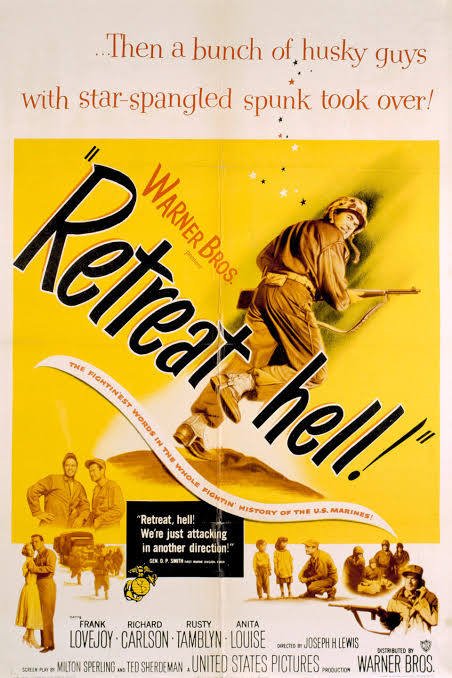
War in the Movies; Retreat, Hell! — A Forgotten Movie About America’s Forgotten War
That makes Retreat, Hell! particularly worthy of rediscovery. Unlike later productions looking back on the conflict, it was made while the Korean War was still being fought.
July 12, 2026

 There is something both appropriate and deeply unfortunate about the fact that Retreat, Hell! has largely disappeared from American popular memory. Released in 1952, the film tells the story of United States Marines fighting their way from the beaches at Inchon to the frozen mountains surrounding the Chosin Reservoir. It is a forgotten movie about what has become known as the Forgotten War.
I have often thought that, perhaps inevitably, the Korean War’s disappearance from popular memory carried its movies with it. Hollywood produced a respectable number of Korean War films during the 1950s, including The Steel Helmet, Fixed Bayonets!, The Bridges at Toko-Ri, Men in War, Battle Hymn and Pork Chop Hill. Several are excellent films, and some rank among the most honest war pictures of their period. Yet outside military-history circles and communities of classic-film enthusiasts, nearly all of them have been forgotten.
The great exception is MASH*. Through Robert Altman’s 1970 motion picture and the enormously successful television series that followed from 1972 to 1983, MASH* became one of the most recognizable titles in American entertainment. Ironically, although it was set during the Korean War, much of its cultural power came from the way audiences associated its antiwar humor, frustration and disillusionment with Vietnam. For millions of Americans, the most enduring fictional representation of Korea became a story that was frequently understood as being about another war. (The New Yorker)
That makes Retreat, Hell! particularly worthy of rediscovery. Unlike later productions looking back on the conflict, it was made while the Korean War was still being fought. Production took place during September and October 1951, and the film opened in New York on February 19, 1952, before receiving its wider release four days later. American servicemen were still fighting and dying in Korea when audiences entered theaters to watch a dramatization of events that had occurred only a little more than a year earlier.
A War Still in Progress
Directed by Joseph H. Lewis and produced by Milton Sperling, Retreat, Hell! was distributed by Warner Bros. and runs approximately 95 minutes. Sperling developed the story and wrote the screenplay with Ted Sherdeman. The principal cast includes Frank Lovejoy as Lieutenant Colonel Steve Corbett, Richard Carlson as Captain Paul Hansen, Russ Tamblyn—credited as Rusty Tamblyn—as young Marine Jimmy McDermid, Anita Louise as Hansen’s wife Ruth and Nedrick Young as Sergeant Novak. (AFI Catalog)
The movie’s working title was You Can’t Stop the Marines, a name that reveals much about its original purpose. This was not intended to be an ambiguous meditation on geopolitics. It was designed as a tribute to the Marine Corps, particularly the 1st Marine Division, and to the extraordinary fighting withdrawal from the Chosin Reservoir.
The title eventually chosen was far better. Retreat, Hell! refers to the famous declaration traditionally associated with Major General Oliver P. Smith during the Chosin campaign: “Retreat, hell! We’re just advancing in a different direction.” Variations of the remark have been repeated for generations, but its meaning remains unmistakable. The withdrawal from Chosin was not a rout. It was an organized movement by surrounded forces that fought through enemy roadblocks, carried their wounded and brought out much of their equipment while inflicting terrible losses upon the forces attempting to destroy them. The film gives a version of the line to Frank Lovejoy’s Colonel Corbett. (AFI Catalog)
The production received substantial cooperation from the Department of Defense and the Marine Corps. Portions were filmed at Camp Pendleton and near Oceanside, California, while actual combat footage was incorporated into the completed picture. The closing credits thank the Department of Defense and the Marine Corps for allowing the filmmakers to use combat film and for assisting the production. This combination of staged action, authentic equipment, Marine locations and documentary footage gives the picture a visual credibility that many contemporary war films lacked. (AFI Catalog)
From Civilian Life to Camp Pendleton
The story begins not on a battlefield, but with mobilization. The sudden outbreak of war in Korea forces the United States to gather available Marine units, reservists and recruits for immediate service. Captain Paul Hansen is a World War II veteran and Marine reservist who has returned to civilian life with his wife and two daughters. When recalled to active duty, he arrives at Camp Pendleton uncertain about his own readiness and uncomfortable with the knowledge that he must leave his family again.
Hansen is a communications and electronics specialist, but Lieutenant Colonel Steve Corbett assigns him command of Baker Company. Corbett is a hard, demanding career Marine who privately questions whether the older reservist still possesses the instincts required to command troops in combat. Hansen has already survived one war and now has a wife and children waiting at home. Corbett fears that this will make him cautious—that his desire to survive and return to his family could interfere with his responsibilities as a company commander.
This tension gives the movie one of its more interesting human dimensions. Hansen is not presented as a coward. He is a responsible husband and father who understands exactly what war can cost. He represents thousands of reservists who believed their fighting days had ended in 1945, only to find themselves recalled a few years later for another conflict on the opposite side of the world.
Alongside the veterans is 17-year-old Jimmy McDermid. Jimmy comes from a proud Marine family. One brother was killed on Iwo Jima, while another is already serving in Korea. He enters the Corps eager to prove himself and determined to live up to the example established by his brothers. At Camp Pendleton, his enthusiasm appears almost innocent. He thinks of war in terms of family tradition, courage and personal honor because he has not yet experienced its physical or emotional reality. (AFI Catalog)
The training sequences allow the film to establish the men before sending them into battle. They run, climb, crawl and conduct mock combat exercises in the California hills. The scenes also emphasize the desperate speed of America’s mobilization. These men are not being prepared through a lengthy peacetime training cycle. They are being assembled and hardened as rapidly as possible because other Americans are already fighting for survival around the Pusan Perimeter.
Before departure, the officers spend a final evening with their families. The film does not linger sentimentally over these farewells, but the domestic scenes are important. The men are not anonymous uniforms. They have wives, children, homes and unfinished civilian lives. Korea has interrupted the peace they thought they had won during World War II.
Inchon and the Liberation of Seoul
The battalion sails for Korea and participates in the amphibious assault at Inchon. Historically, the landing on September 15, 1950, was one of the most daring operations of the war. United Nations forces struck behind North Korean lines, threatening enemy supply routes and helping reverse the desperate situation around Pusan.
 In the movie, the landing marks the sudden end of Jimmy’s romantic ideas about combat. When a Marine is killed directly in front of him, Jimmy freezes. His eagerness vanishes under the shock of seeing a man die. Ashamed of his reaction, he falls behind and avoids meeting his brother, who is serving nearby with a reconnaissance unit.
This moment is significant because the film allows its young Marine to be frightened. Jimmy does not enter combat as a natural hero. He is overwhelmed, recovers and gradually learns to function under fire. His development is not simply a journey from fear to courage. It is a transformation from innocence to emotional hardness.
As the Marines fight toward Seoul, Jimmy begins proving himself. During fighting in the city, an enemy machine gunner fires from an upper-story position and pins down the Americans. Jimmy works his way forward through the gunfire and destroys the position with a grenade. The frightened boy from Inchon begins becoming the Marine he had imagined himself to be.
His achievement brings no lasting celebration. When Jimmy finally goes looking for his brother, he discovers that the man has been killed. The war that had already taken one brother at Iwo Jima has now claimed another in Korea. Jimmy’s motivation changes. His desire to honor his family begins turning into something darker—anger, grief and a hunger for battle.
Colonel Corbett notices the change. Jimmy is becoming brave and effective, but he is also losing the youthful personality that first entered Camp Pendleton. Corbett makes him his driver partly as a reward and partly to protect him from his own growing recklessness. (AFI Catalog)
North Toward the Chosin Reservoir
After Inchon and Seoul, the Marines receive orders to continue north. Rumors circulate that the men will be home by Christmas, reflecting the dangerous confidence that followed the collapse of North Korean resistance. Instead of returning home, the Marines move deeper into North Korea toward the Manchurian frontier.
The tone of the film changes noticeably. The rapid victories at Inchon and Seoul give way to uncertainty. Enemy forces seem to shadow the Marines from the surrounding hills. Patrols encounter soldiers who do not appear to be North Koreans. Hansen and Corbett gradually realize that Communist Chinese forces have entered the war.
Historically, China’s intervention transformed the conflict. Chinese forces struck United Nations formations in late November 1950, overturning predictions that the war was nearly over. Around the Chosin Reservoir, Marines, soldiers, sailors, British commandos and South Korean troops found themselves fighting in isolated positions against overwhelming attacks while enduring extreme cold. The campaign became one of the most celebrated episodes in Marine Corps history. (Naval History and Heritage Command)
The movie presents the Chinese intervention as an ominous revelation. Enemy troops emerge from the darkness and attack in waves, often accompanied by whistles or bugles. The Marines’ firepower cuts down attackers, but more continue advancing. Ammunition begins running low, fog and weather interfere with air support, and the Americans realize they are facing an enemy far larger than anything anticipated.
The film’s depiction is powerful, although unmistakably shaped by its early Cold War perspective. Chinese troops are generally presented as a mass rather than as individuals. They emerge from hills, darkness and snow as an almost faceless force. The Americans receive families, personalities and emotional conflicts; the Asian combatants are largely denied the same humanity. This was common in American war films of the era and is one of the picture’s most obvious limitations when viewed today. (Association for Asian Studies)
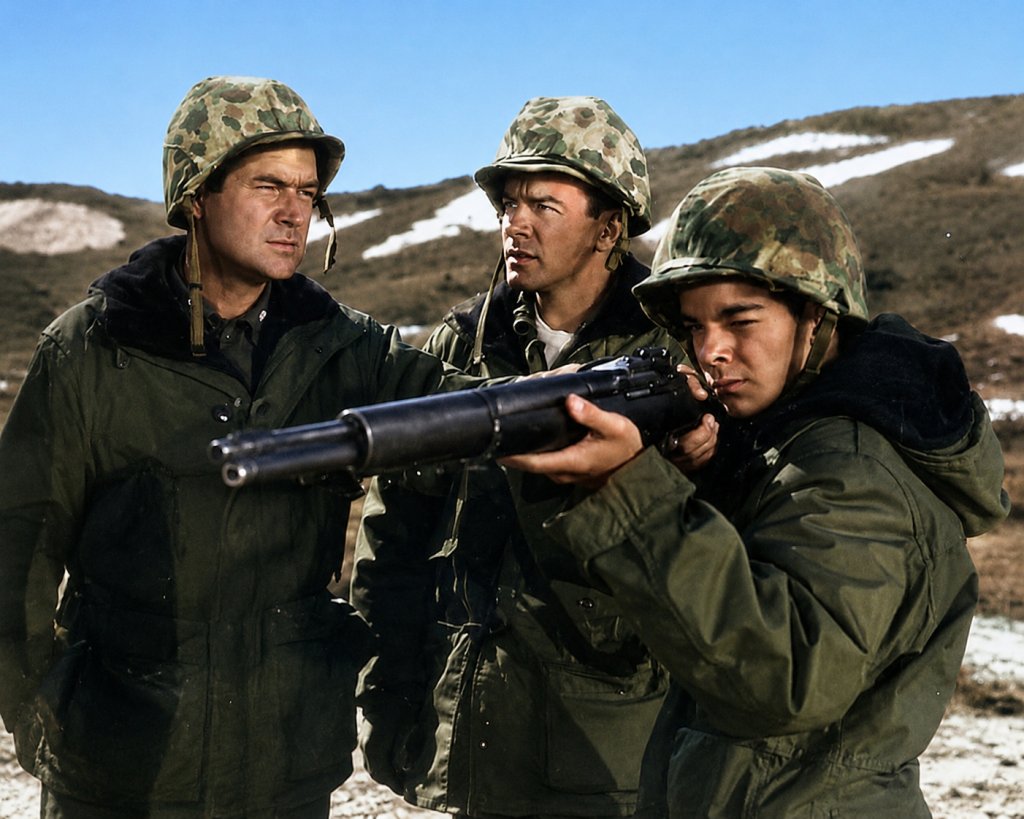
“Advancing in a Different Direction”
The battalion is eventually ordered to retrace its route and fight toward the sea. When one of the men asks whether they are retreating, Corbett responds with the line that gives the movie its title: “Retreat, Hell! We’re advancing in a different direction!”
It is a defiant moment, but the film does not pretend that determination alone can erase the situation. The Marines are surrounded, exhausted, low on ammunition and responsible for large numbers of wounded men. Snow and subzero temperatures become nearly as dangerous as enemy fire. Weapons malfunction, bodies freeze and every mile of road offers another possible ambush.
Corbett insists that the wounded will not be abandoned. Hansen leads volunteers into the hills to recover isolated casualties and encounters British Royal Marines operating with the Americans. This reflects the participation of 41 Independent Commando, Royal Marines, which fought alongside American forces during the Chosin campaign. (USMC University)
The rescue party becomes separated from the main body while Corbett’s column continues down the road under repeated attack. Corbett is wounded, and for a time it appears that Hansen, Jimmy and the other missing men have been lost. When they finally emerge and rejoin the column, their arrival provides the film with its emotional resolution.
The men who return are not the same men who left California. Hansen has proven himself as a combat commander. Corbett has learned that the reservist’s love for his family did not make him weak. Jimmy has passed through fear, grief and battle, emerging as a hardened survivor. Around them are the remnants of a battalion that has survived not because it avoided retreat, but because it maintained its discipline and identity while moving through conditions that could easily have destroyed it.
The ending is openly proud and unapologetically Marine. When the exhausted survivors are asked to identify themselves, the answer comes back: they are the 1st Battalion of the United States Marines. The Marine Corps Hymn rises on the soundtrack as they continue forward. (Association for Asian Studies)
A Film of Its Time
Retreat, Hell! is undoubtedly a patriotic film. It was produced with Marine Corps assistance during an active war, and it presents the conflict through the political language of the early Cold War. The communist enemy is threatening, numerous and largely anonymous. The strategic decisions that placed the Marines in such a dangerous position receive little examination. The suffering of Korean civilians and the complicated political history of the peninsula remain mostly outside the story.
Nevertheless, the film is more thoughtful than a simple recruiting picture. Hansen’s reluctance to leave his family is treated seriously. Jimmy’s fear at Inchon is shown without contempt. Combat does not merely reveal courage; it damages the men and strips away their innocence. Victory is not presented as a clean charge across an objective. It means preserving the unit, recovering the wounded and surviving long enough to reach the next defensive position.
The film also captures something essential about Korea: the uncertainty of a war that changed character with astonishing speed. American forces went from near defeat at Pusan to apparent triumph at Inchon, from the liberation of Seoul to an advance toward the Chinese border, and then into a massive fighting withdrawal—all within a few months.
Released while the war continued, Retreat, Hell! had no ability to place those events within a comfortable historical conclusion. There was no final victory scene available because the final outcome remained unknown. Truce negotiations had begun, but American troops continued fighting and dying. The armistice would not be signed until July 27, 1953. (U.S. Army)
The Forgotten Films of the Forgotten War
The Korean War occupies an uncomfortable position in American memory. It came only five years after the overwhelming global victory of World War II and was followed by the divisive national experience of Vietnam. It ended without a traditional victory parade or peace treaty. The front eventually settled into fortified hills and trenches while negotiations dragged on, creating the impression of a war without movement or resolution.
Even official United States Army histories acknowledge that Korean War veterans have often felt forgotten, their service overshadowed by the size and triumph of World War II and the political and cultural turmoil surrounding Vietnam. (U.S. Army Center of Military History)
The same fate befell the war’s movies.
People still watch World War II films made in the 1940s and 1950s. Titles such as Twelve O’Clock High, The Longest Day, Sands of Iwo Jima, The Great Escape and Patton became permanent parts of American culture. Vietnam produced its own enduring body of cinema, including The Deer Hunter, Apocalypse Now, Platoon, Full Metal Jacket and We Were Soldiers.
Korea’s films largely vanished between them.
Most Americans have never seen Retreat, Hell! Many have never heard of it. The same can be said of Fixed Bayonets!, Men in War, The Steel Helmet and even Pork Chop Hill, despite the presence of major actors and respected directors. They survive among veterans, historians and classic-film collectors, but they rarely receive the widespread attention routinely given to films about World War II or Vietnam.
MASH* escaped that fate because it became larger than the conflict in which it was set. Its humor, characters and criticism of military bureaucracy allowed it to speak to Vietnam-era audiences and later generations. Korea remained its physical setting, but the series became a commentary on war in general.
Retreat, Hell! never had that opportunity. It remained tied directly to Korea—to Inchon, Seoul, Chinese intervention, the frozen roads and the Marines fighting their way out of Chosin. When the nation forgot the war, it also forgot the movie.
That is precisely why the film deserves to be watched today.
It is not a flawless history of the Korean War, nor is it free from the patriotic conventions and racial attitudes of its time. It simplifies operations, compresses events and presents the campaign almost entirely through American eyes. But it preserves a contemporary impression of the war before Korea had become “forgotten.” It shows how Americans understood the conflict while it was still unfolding and how the Marine Corps wanted the sacrifice of its men to be remembered.
More than seven decades later, Retreat, Hell! stands as a cinematic memorial hiding in plain sight—a forgotten film about a forgotten war and about men who deserved far better than to be forgotten with it.