Heather"s Screening Room: At War with the Army :Memorable Moments in a Movie That Never Quite Comes Together
At War with the Army Memorable Moments in a Movie That Never Quite Comes Together
August 30, 2026

 Released in 1950, At War with the Army is less a traditional war movie than a comedy about soldiers struggling against the Army itself. There are no major battles or scenes of men under enemy fire. Instead, the film finds humor in paperwork, regulations, difficult officers, repetitive duties, and the endless confusion of military life.
Dean Martin plays First Sergeant Vic Puccinelli, while Jerry Lewis portrays Private First Class Alvin Korwin. Puccinelli wants to escape his desk assignment and transfer to a combat unit. Korwin has a simpler goal. He wants a weekend pass to visit his pregnant wife. Both men discover that getting anything accomplished in the Army can become a battle of its own.
The movie works best when it focuses on recognizable military frustrations. Orders are given without explanation, information spreads through rumors, and simple requests become nearly impossible because of regulations and bureaucracy. One particularly relatable joke involves the commanding officer’s wife, who seems to understand what is happening around the post better than many of the officers themselves.
There are also scenes involving soldiers communicating through confusing numbers, codes, and military shorthand that seem perfectly understandable to those inside the system but nearly meaningless to everyone else. These moments remain funny because military organizations have always developed their own language, routines, and unofficial ways of getting things done.
The mess hall, duty assignments, inspections, passes, and relationships between officers and enlisted men all provide material for the comedy. The movie exaggerates Army life, but many of its jokes come from frustrations that veterans from almost any era would recognize.
I first saw At War with the Army while attending a World War II reenactment at the Gap in Pennsylvania. Surrounded by uniforms, military vehicles, and people bringing the era back to life, it was probably the perfect setting in which to discover the film.
Certain moments have remained with me ever since. I still smile and laugh when I think about the “Beans, beans, beans” routine. It is simple, repetitive, and ridiculous, but perhaps that is why it works so well. It captures the boredom of seeing the same Army food served again and again while turning that complaint into a musical performance.
I can also still hear the distinctive way one character says, “Dat don’t make no difference.” In some of my sillier moments, I even find myself repeating it the same way. Those little lines and performances have stayed with me far longer than most of the actual story.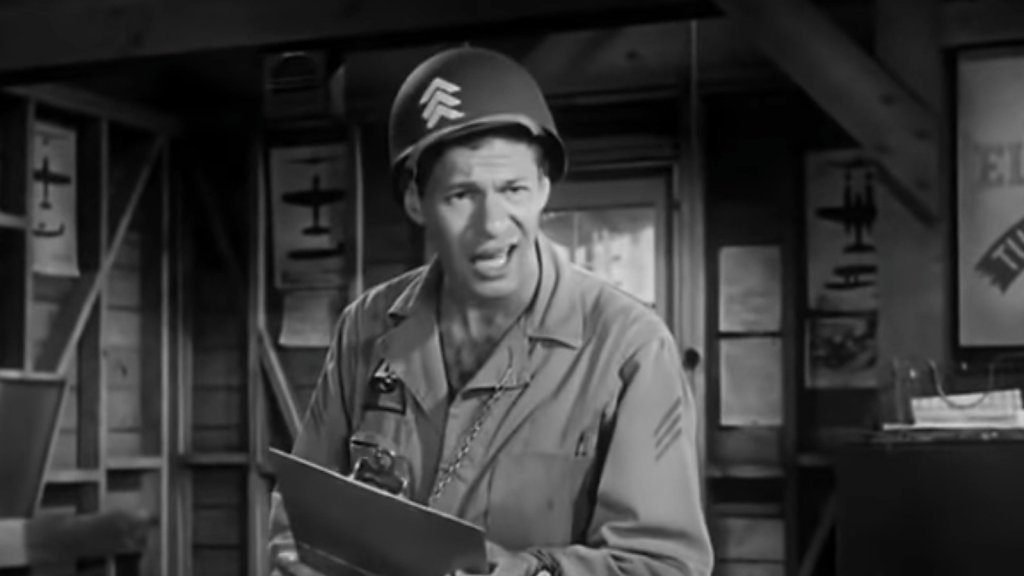
That may be the greatest strength of At War with the Army. It contains isolated moments that are genuinely funny and surprisingly memorable.
Unfortunately, as much as I would like to say that I enjoy the movie, I really do not like it as a whole.
The film feels extremely disjointed. At times, it seems to continue without much of a plot, direction, or purpose. Many scenes play more like separate comedy routines loosely connected by Army uniforms than parts of one complete story.
The movie often appears to exist simply to move Martin and Lewis from one performance to another. There are songs, slapstick routines, misunderstandings, romantic complications, disguises, mess-hall jokes, and encounters with superior officers, but very little holds everything together.
Some individual scenes are enjoyable, yet the film never develops much momentum. It begins, wanders through a collection of routines, and eventually reaches an ending without feeling as though the story has gone anywhere.
Jerry Lewis’s style of comedy also plays a major role in whether the movie works for a viewer. His performance is loud, frantic, exaggerated, and intentionally childish. He turns ordinary duties into complete disasters and reacts to minor problems as if the world is ending.
 That style can be hilarious in small doses, but over the course of the entire film it sometimes becomes exhausting. Dean Martin provides an important balance as the calmer and more frustrated member of the partnership. His expressions and relaxed delivery help keep Lewis’s performance under control, but even their chemistry cannot completely overcome the weakness of the story.
I sometimes wonder whether At War with the Army was made quickly to capitalize on the growing popularity of Martin and Lewis. At times, it feels less like a carefully constructed motion picture and more like an attempt to place their nightclub routines on screen while audiences were eager to see them.
 Its military setting may also have been chosen because the memories of World War II were still fresh. The film reached audiences only five years after the war ended. Millions of veterans and their families would have recognized the barracks, mess halls, officers, repetitive meals, passes, paperwork, and absurd regulations.
After years of sacrifice and uncertainty, audiences may also have been ready to laugh at military life. The war was over, and the frustrations that had once been endured out of necessity could now become harmless entertainment.
That does not necessarily make At War with the Army a successful movie. It does, however, help explain why it appealed to audiences at the time. It offered popular stars, familiar Army frustrations, musical performances, and a version of military service in which the greatest threats were paperwork, bad food, and an impossible chain of command.
For me, At War with the Army remains a movie made up of good pieces that never quite form a satisfying whole. I enjoy the relatable jokes about military bureaucracy, the officer’s wife who seems to know more than the officers, the confusing Army language, and the routines built around the frustrations of daily service.
I still laugh at “Beans, beans, beans,” and I still sometimes repeat, “Dat don’t make no difference.”
But memorable moments do not automatically make a good movie.
Sometimes the parts stay with us much longer than the film itself.