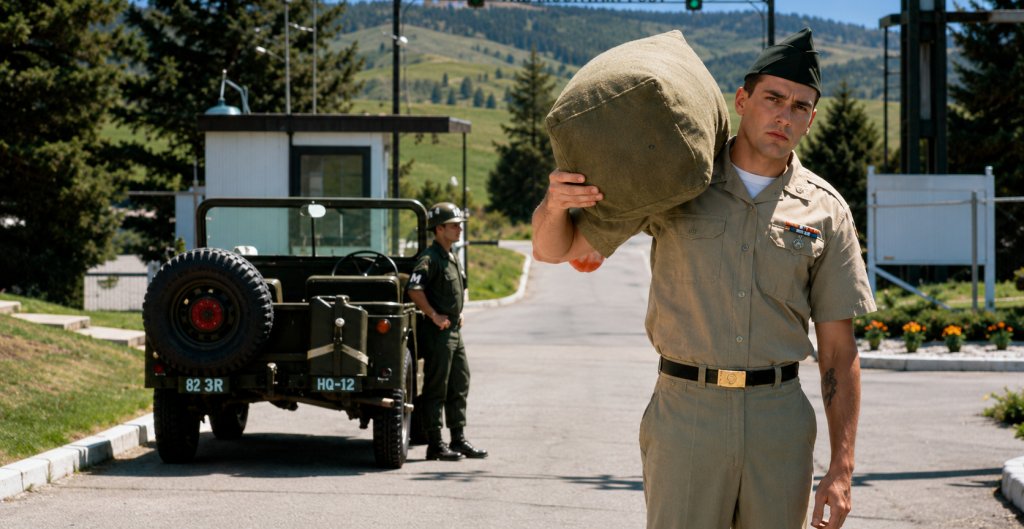
Cadence — Fathers, Sons, Race, Rebellion, and the Long Shadow of Vietnam
Set in 1965, Cadence follows a troubled young soldier awaiting the uncertain future that lies beyond the gates of the stockade. The war is still distant enough to remain largely unseen, but close enough that every soldier understands it.
July 28, 2026

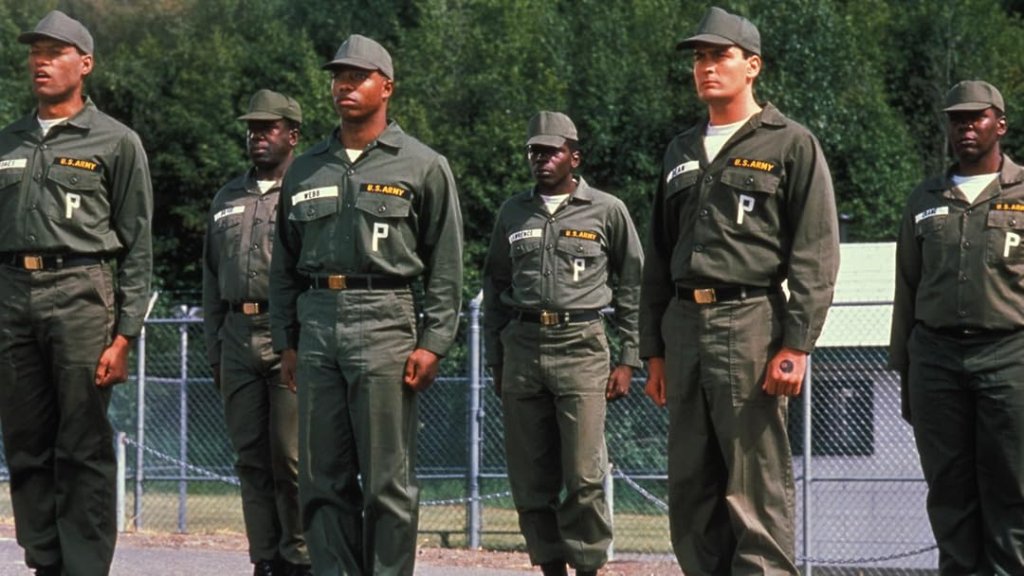
Some military films are remembered for enormous battle scenes, famous speeches or historically significant campaigns. Cadence is different. Almost the entire story unfolds inside a small United States Army stockade on an isolated American post in West Germany. There are no major battles, no tanks crossing Europe and no helicopters descending into jungle clearings.
Yet Vietnam hangs over nearly every scene.
Set in 1965, Cadence follows a troubled young soldier awaiting the uncertain future that lies beyond the gates of the stockade. The war is still distant enough to remain largely unseen, but close enough that every soldier understands it may soon determine whether he lives or dies. Beneath the film’s humor, marching songs and barracks arguments is the growing realization that these men may soon be sent into a conflict from which some of them will never return.
Released theatrically in the United States in 1991 after premiering at the Deauville American Film Festival in 1990, Cadence was Martin Sheen’s feature-film directorial debut. He also appeared in the movie opposite his real-life son Charlie Sheen, creating one of those relatively rare occasions when a famous father and son confront each other directly onscreen. A third member of the family, Ramon Estevez, appears as Corporal Gerald Gessner. (AFI Catalog)
That family connection adds an unusual weight to the story because Cadence is, in many ways, a film about fathers and sons. It deals with unresolved childhood wounds, grief, rebellion, failed communication and the damage caused when authority is confused with love. It is also a film about racism, friendship and the slow process through which men divided by prejudice learn to recognize one another as individuals.
It is sometimes sentimental, sometimes heavy-handed and occasionally too neat for the subjects it addresses. Yet it has a sincerity that is difficult to dismiss.
I have also always loved the setting.
The little military outpost, with its barracks, fences, guard posts, motor pool, aging buildings, family quarters and unmistakable Army atmosphere, feels like a complete world unto itself. It is the kind of place where generations of American service members lived, worked, raised families, stood guard and waited for orders far from home.
I hope beyond hope that Ghosts of the Battlefield might someday have a piece of property like that—a former military compound or small collection of buildings where people could live and work among the museum’s vehicles and exhibits. A place with quarters, barracks, workshops, flagpoles and that unmistakable Army-post appearance. Not merely a building filled with artifacts, but an environment that still feels alive with military history.
Every time I watch Cadence, that small West German post reminds me of that dream.
A Story That Waited More Than Twenty Years
Cadence was adapted from Gordon Weaver’s 1968 novel Count a Lonely Cadence. The screen rights were acquired near the end of that year, and plans were initially made to begin production in 1969. Robert Blake was later associated with the project as a possible director and star, but the proposed movie remained unmade for nearly two decades. (AFI Catalog)
The project finally resurfaced in 1988 with Charlie Sheen attached to star and Martin Sheen preparing to direct. Filming eventually began in British Columbia in 1989. The fictional American installation in West Germany was created using locations around Kamloops and Ashcroft, Canada. Some of the filming made use of the recently closed Canadian Forces Station Kamloops, a former Cold War radar installation whose military buildings gave the production the authentic appearance of an isolated service post. (AFI Catalog)
That location was an inspired choice.
The post does not look like an elaborate Hollywood construction. It feels worn, practical and institutional. The buildings appear to have been placed there because the military needed them, not because a production designer wanted an attractive background. The roads, fences, barracks and quarters possess the plain functionality common to military installations throughout the world.
The production never attempts to turn the base into something grand. Its smallness is part of its character.
This is not a sprawling American installation filled with thousands of troops. It feels like an outpost at the edge of something larger—a place where a small group of soldiers has been temporarily deposited by an enormous military system.
That atmosphere becomes essential to the film. The stockade is isolated from the civilian world, but it is also separated from the main current of the Army. Its prisoners march, dig ditches, repair machinery and wait for their sentences to expire while the United States moves steadily closer to full-scale war in Vietnam.
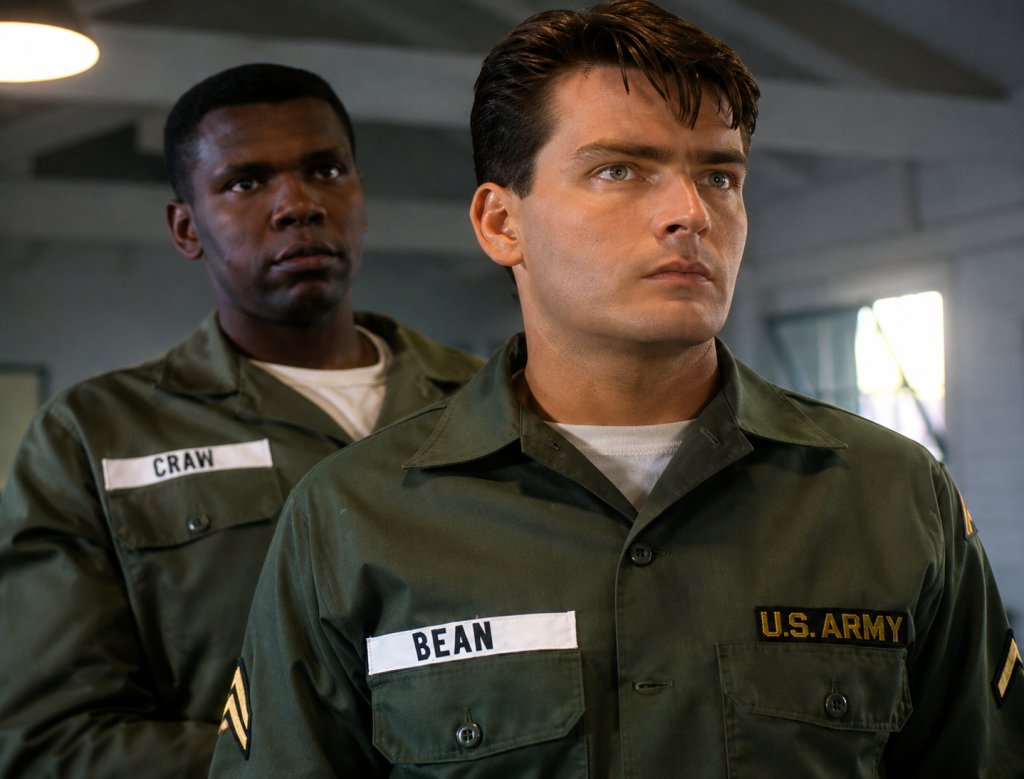 Franklin Bean Comes Home
 Franklin Bean Comes Home
Charlie Sheen plays Private Franklin Fairchild Bean, a young soldier from Montana with a long history of rebellion.
The film begins in 1965 with Bean returning home for his father’s funeral. Their relationship had been troubled, and Bean is left confronting all the words that were never spoken and all the apologies that arrived too late. At the funeral, he remembers his younger years and the belief that military service might finally discipline him.
Bean’s father is gone before the main story begins, but his presence remains with his son. Bean takes a gold cigarette lighter from his father’s possessions and carries it back to Germany. The lighter becomes one of the film’s most important objects—not because it is valuable, but because it represents the unresolved relationship Bean can no longer repair. (AFI Catalog)
Bean’s grief soon turns into self-destruction.
After returning to his post in the fictional town of Wittsburg, West Germany, he becomes heavily intoxicated. During the resulting spree, he has eight-ball tattoos placed on the backs of his hands, gets into an altercation with a military policeman and crashes through the window of a local drinking establishment.
The Army responds exactly as one would expect.
Bean is offered the choice of fighting the charges or accepting a 90-day sentence in the stockade, along with reduced pay and a required period of sobriety. He reluctantly accepts confinement. (AFI Catalog)
His behavior is irresponsible, but the film does not present it as meaningless delinquency. Bean is angry at his father, angry at himself and angry at a military system that believes obedience can solve every problem inside him. He reacts to grief through alcohol and violence because he lacks the emotional language to do anything else.
That does not excuse what he does, but it helps explain it.
Bean’s childhood and adolescence appear to have been defined by repeated confrontations with authority. His father, school officials and eventually the Army all attempted to force him into compliance. Every attempt seems to have strengthened his resistance.
He has come to believe that giving in—even when he is clearly wrong—would mean surrendering the only part of himself he still controls.
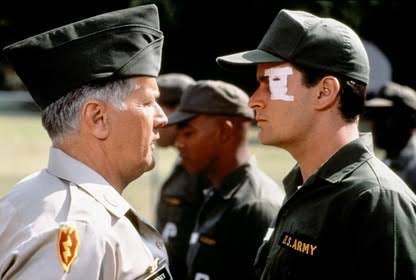 A Father and Son at War With Each Other
 A Father and Son at War With Each Other
The stockade is commanded by Master Sergeant Otis McKinney, played by Martin Sheen.
McKinney initially claims that Bean will receive fair treatment if he follows the rules. It quickly becomes clear, however, that the sergeant does not simply want obedience. He wants submission.
Bean immediately challenges him.
The tension between the two men gives Cadence much of its energy. Martin and Charlie Sheen are not playing father and son, but that relationship is always present beneath their performances. McKinney is old enough to be Bean’s father, and Bean reminds him painfully of his own estranged son, John. As McKinney becomes increasingly unstable, he occasionally addresses Bean by his son’s name. (AFI Catalog)
The casting makes those moments more unsettling.
We are watching an actual father confronting his actual son in a story about failed fathers, rebellious sons and the inability of two generations to communicate. Martin Sheen’s McKinney attempts to impose authority through humiliation and fear. Charlie Sheen’s Bean responds with sarcasm, disobedience and open contempt.
Each man recognizes something of himself in the other, and neither likes what he sees.
Cadence was not the first time Martin and Charlie Sheen had appeared together. Martin played the father of Charlie’s character in Wall Street, and the two later shared the screen in other productions. What distinguishes Cadence is that Martin was directing Charlie while also portraying his principal antagonist. The production therefore placed their real family relationship behind both the camera and the central dramatic conflict. (People.com)
The result is not subtle, but it is compelling.
McKinney represents the kind of authority Bean has resisted throughout his life. Bean represents the defiant son McKinney cannot understand or control. Their struggle becomes far more personal than military discipline.
Both men are carrying old wounds into a situation where neither has the ability to heal them.
The All-Black Barracks
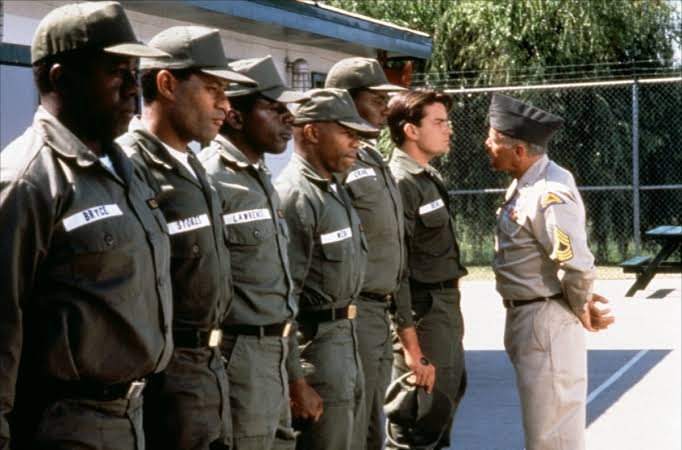
McKinney decides to punish Bean by placing him in a barracks occupied entirely by Black prisoners.
His intention is openly racist. He assumes that racial hostility will create conflict, isolate Bean and perhaps force him to beg for protection. The men in the barracks understand exactly what McKinney is doing, and they are no happier about the arrangement than Bean.
Their leader is Corporal Roosevelt Stokes, played by Laurence Fishburne, who was still credited as Larry Fishburne at the time. Stokes is intelligent, disciplined and careful. He explains that Bean will work, march and live under the same rules as everyone else. Being the only white prisoner does not entitle him to special treatment. (Los Angeles Times)
The other prisoners include Edward James Webb, a former boxer played by Michael Beach; Eugene “Spoonman” Bryce, played by Blu Mankuma; Andrew Lawrence, played by John Toles-Bey; and Harry “Sweetbread” Crane, played by Harry Stewart.
The film’s treatment of race begins with suspicion on both sides.
Bean enters the barracks guarded and uncertain. The prisoners regard him as an intruder who may receive privileges unavailable to them. McKinney expects both sides to confirm his belief that Black and white soldiers cannot live together without violence.
For a time, it appears that his plan may succeed.
When Bean’s father’s lighter disappears, he accuses Webb of stealing it. Their confrontation leads to a fight in which Bean is knocked unconscious and cut above the eye. Yet when McKinney questions him, Bean refuses to identify Webb.
That decision does not immediately earn friendship, but it begins changing the relationship.
Bean could have used the authority of a white sergeant against the Black prisoners. Instead, he protects the man who struck him. His choice suggests that, whatever his other faults, he will not participate in McKinney’s attempt to divide them.
Trust develops slowly from there.
The Men Behind the Uniforms
One of the strengths of Cadence is that the Black prisoners are allowed to become individuals.
They are not presented as an anonymous group waiting to teach the white protagonist an easy lesson about tolerance. Each man has a personality, a history and a different reason for being confined.
Stokes possesses natural authority and keeps the barracks functioning as a unit. Webb is physically formidable but far more thoughtful than Bean initially assumes. Spoonman carries the bitterness of a man who believes he acted in self-defense but was condemned by a system that refused to believe him. Sweetbread is gentle, innocent and musically gifted, with a beautiful singing voice that becomes central to the group’s identity.
The film’s treatment of these characters is not perfect. Bean remains the audience’s principal point of entry, and the story sometimes risks using the Black prisoners primarily to complete his moral education. Some of the dialogue and racial lessons can feel overly direct.
Nevertheless, the movie makes an important point: the Army uniform has not erased the racial divisions of civilian America.
The armed forces had been formally desegregated years before the events depicted in Cadence, but official policy did not instantly remove prejudice from individuals or institutions. The film places Black and white soldiers inside the same Army while showing that they may still experience that Army very differently.
McKinney sees the Black prisoners as naturally inferior and dangerous. Bean initially knows little about their lives beyond stereotypes. The prisoners assume that Bean will ultimately side with white authority.
All of them must decide whether they will accept the roles assigned to them.
 Earning Acceptance
 Earning Acceptance
Bean does not earn acceptance through a grand speech.
He earns it by living and working beside the other men.
The prisoners are sent to a nearby farm, where they perform manual labor under guard. Bean notices a damaged windmill and becomes determined to repair it. The windmill initially gives him something practical to concentrate on—something broken that might actually be fixed.
McKinney denies permission, but Bean bypasses him and appeals to the base commander. The request is approved, further enraging the sergeant.
At first Bean works largely alone. Gradually, the others join him.
The repair of the windmill becomes a symbol of their growing unity. These are men whom the Army has labeled as problems, criminals and failures, yet together they are capable of creating something useful. They restore machinery while slowly restoring a measure of dignity to one another.
Bean’s relationship with Webb changes during a one-on-one basketball game. The scene could easily have become a predictable racial contest, but its real purpose is to establish mutual respect. Bean competes without asking for special treatment, and Webb begins to recognize that the new prisoner is willing to stand beside them rather than above them. Contemporary reviewers particularly noted the film’s ability to redirect some apparently familiar racial situations away from their most predictable conclusions. (Los Angeles Times)
The men eventually teach Bean their distinctive marching routine, the “Stockade Shuffle.”
Performed to the rhythm of Sam Cooke’s “Chain Gang,” the shuffle is more than entertainment. It transforms compulsory movement into something the prisoners own. The Army can order them to march, but it cannot dictate the spirit with which they march.
Their cadence becomes an act of identity and quiet resistance.
Bean initially struggles to follow it. When he finally moves in step with the group, he has not abandoned his individuality. He has learned how to belong without surrendering himself.
Authority Without Leadership
McKinney grows increasingly furious as Bean becomes accepted by the prisoners.
The sergeant believes that authority is proven by the ability to make others suffer. He issues arbitrary demerits, humiliates the men during inspections and punishes entire groups for the actions of individuals. His discipline is not designed to improve soldiers. It exists to confirm his control over them.
There is an important distinction between military authority and leadership, and Cadence repeatedly places that distinction before the audience.
A good noncommissioned officer uses discipline to create a functioning unit. McKinney uses it to satisfy his anger. He follows regulations when they serve him and ignores them when they do not. He demands respect but behaves in ways that make genuine respect impossible.
Bean’s trouble with authority therefore becomes complicated.
He is clearly insubordinate. He makes bad decisions, refuses lawful instructions and frequently challenges superiors simply because he resents being told what to do. Yet McKinney is also abusive, prejudiced and increasingly dangerous.
The film does not offer the comfortable choice between a completely innocent prisoner and a completely legitimate authority figure. Bean needs discipline, but McKinney is incapable of providing it responsibly.
Both men are damaged. Only one possesses the power to punish the other.
McKinney’s Own Broken Family
Away from the prisoners, McKinney’s personal life begins collapsing.
On his birthday, he telephones his wife and son in the United States. The conversation becomes an argument, exposing the distance between him and the family he believes he should be able to command from across the Atlantic.
The call reveals that McKinney’s behavior is not confined to the stockade.
He has attempted to run his family through the same rigid authority he uses against prisoners. His son has rejected him, and McKinney cannot understand why. Instead of recognizing the fear and pain he causes, he sees disobedience as betrayal.
Bean reminds McKinney of that son.
The sergeant begins approaching him not merely as a prisoner but as a substitute child. He wants Bean’s obedience to prove that he could still repair his own family. He sometimes attempts a strange kind of reconciliation, but he cannot separate affection from domination.
Bean rejects him.
From Bean’s perspective, McKinney is simply another older man demanding respect he has not earned. Bean has already lost his own father without resolving their differences. He is in no condition to become a replacement son for the man tormenting him and his friends.
Their inability to connect drives McKinney further into alcohol, rage and mental collapse.
The father-and-son theme therefore runs in both directions. Bean is haunted by the dead father to whom he can no longer apologize. McKinney is haunted by a living son who no longer wants him. Each man sees in the other a final opportunity to correct the past, but neither possesses the maturity to do it.
Vietnam Beyond the Fence
While all of this unfolds, Vietnam moves closer.
Bean receives a visit from his friend Sam Sager and learns that, after completing his stockade sentence, he will probably be sent to Vietnam. (AFI Catalog)
The news changes the meaning of his remaining days.
Until then, Bean has treated the stockade as the central crisis of his life. Suddenly, 90 days of confinement appear temporary. Beyond the fence lies a war whose consequences are impossible to predict.
The film never takes Bean to Vietnam. It does not need to.
The audience understands what awaits American soldiers in 1965. Bean may leave Germany, join a new unit and find himself in a country where his rebelliousness is no longer merely a disciplinary problem. In combat, mistakes can kill friends. Authority may be flawed, but survival can depend upon learning to function within a group.
His friendship with the Black prisoners therefore gains another meaning.
The men tell Bean that when he reaches Vietnam, he will serve alongside Black soldiers. The racial divisions McKinney attempts to create inside the stockade will become deadly liabilities in combat. Soldiers who refuse to trust one another because of race may not survive.
Acceptance is not presented merely as a moral achievement. It is preparation for the reality of war.
Vietnam also creates a sense of impending doom. Bean’s sentence will end, but freedom does not necessarily await him. He is marching from one form of confinement toward something far more dangerous.
The little West German post becomes a waiting room between youth and war.
Sweetbread
The film’s darkest turn centers upon Sweetbread.
Sweetbread is vulnerable, gentle and trusting. His singing provides moments of beauty inside the stockade, and the other prisoners protect him. He represents the part of their small community that remains innocent despite confinement.
McKinney’s mental condition deteriorates until he wakes the prisoners during the night and forces them, improperly dressed, onto a truck. He takes them to the farm and marches them through the mud while carrying a rifle.
He unloads the weapon and invites them to escape, placing the prisoners inside a cruel and dangerous game.
McKinney then begins addressing Bean as John, the name of his estranged son. The authority figure has now lost his ability to distinguish the prisoner before him from the child he believes he has lost.
Sweetbread wanders toward the restored windmill. McKinney reloads his rifle and opens fire. Sweetbread turns and runs toward him, and McKinney shoots him in the head before the others can overpower the sergeant. (AFI Catalog)
The scene destroys any possibility that the film’s conflicts can be solved harmlessly.
The windmill, which had represented cooperation and repair, becomes the setting for an irreversible act. The men were able to repair machinery, but they could not repair McKinney before his hatred, grief and instability killed someone.
Sweetbread’s death also gives the film’s earlier warmth a tragic edge. The marching, music, basketball and friendship were real, but they existed under the control of a man whose unchecked authority could destroy them at any moment.
Truth, Guilt, and an Uncomfortable Decision
After McKinney is arrested, Bean’s sentence is commuted.
At the sergeant’s court-martial, however, Bean gives testimony that angers his former barracks mates. He acknowledges hearing McKinney say “help” while reloading his rifle and suggests that Sweetbread’s movement toward the sergeant may have appeared threatening.
Bean is not attempting to excuse the killing. He is trying to tell the complete truth as he understood it.
Stokes and the others see the testimony as a betrayal. Their friend is dead, and once again a Black victim appears in danger of being blamed for his own death. Bean’s attempt at honesty sounds painfully similar to the excuses institutions have long used to protect white authority.
The film refuses to make the conflict entirely comfortable.
Bean recognizes McKinney’s guilt, but he also believes he contributed to the sergeant’s collapse by deliberately provoking him. That belief may be misplaced—McKinney alone is responsible for firing the rifle—but Bean cannot simply dismiss the older man as a monster unrelated to himself.
He has spent the film learning to see people as more than categories. That lesson must apply even when the person before him is hateful and guilty.
Understanding McKinney does not absolve him.
It does, however, prevent Bean from lying.
Falling in on the Cadence
Before leaving Germany, Bean visits McKinney in a psychiatric ward.
The sergeant is stripped of his uniform, rank and authority. He sits in his underwear painting an image of the windmill. The man who believed control could solve everything has lost control of himself.
Bean cannot repair him.
He also cannot repair the relationship with his dead father, restore Sweetbread’s life or undo the pain caused by his own actions. What he can do is leave the stockade changed by the men he met there.
As Bean prepares to depart for Vietnam, the prisoners initially pass him without acknowledgment. Webb then breaks formation, returns the cigarette lighter belonging to Bean’s father and tells him that he will find dependable Black comrades in his future unit.
Stokes orders Bean to “fall in on the cadence.”
Bean joins the Stockade Shuffle one final time, moving in step with the men who had once regarded him as an intruder. He then salutes and leaves the post for Vietnam. (AFI Catalog)
The ending is hopeful, but only to a point.
Bean has found acceptance. He has learned that belonging does not require blind obedience and that discipline can come from loyalty to the men beside him rather than fear of the man above him.
But he is still going to war.
The cadence carries him to the gate. It cannot tell us what happens after he passes through it.
A Rare Family Collaboration
The presence of Martin and Charlie Sheen gives Cadence an emotional undercurrent that would not exist with unrelated actors.
Martin Sheen was directing for the first time while playing a father figure who becomes obsessed with controlling Charlie Sheen’s character. Charlie was playing a young man unable to reconcile with his own father before the older man’s death. Ramon Estevez, Martin’s son and Charlie’s brother, played one of the guards caught between McKinney and the prisoners. (AFI Catalog)
The Sheens were not portraying their actual family, and it would be unfair to treat the movie as disguised autobiography. Yet audiences cannot completely separate the performances from the relationships behind them.
When McKinney stares at Bean and sees his estranged son, Martin Sheen is looking at his own son.
When Bean rejects McKinney’s attempt at paternal connection, Charlie Sheen is rejecting his own father’s character.
That knowledge adds tension even when the screenplay becomes heavy-handed. It makes the scenes feel more intimate and slightly dangerous, as though the film is using a real family bond to explore the consequences of a fictional family’s collapse.
Martin Sheen’s direction occasionally emphasizes emotion too strongly. Contemporary reviews noted his fondness for flashbacks, close-ups and slow motion during moments of anguish. Yet reviewers also praised the empathy shown toward the performers and the way the supporting prisoners emerged as distinct characters. (Los Angeles Times)
The film may not always be restrained, but it cares deeply about its people.
That Unmistakable Army-Post Look
For me, the physical world of Cadence remains nearly as memorable as its story.
The small post has the unmistakable appearance of a Cold War military installation: plain barracks, narrow roads, fences, utility buildings, simple family quarters and structures built for usefulness rather than beauty. Soldiers move through a landscape that feels isolated but lived in.
There is history in places like that.
Millions of American service members and their families once lived on installations scattered across West Germany, guarding the frontier of the Cold War. Children grew up in government quarters. Soldiers reported for formation beneath gray skies. Mechanics worked in motor pools. Families shopped at commissaries, attended post churches and waited for reassignment orders.
The post shown in Cadence is fictional, and the movie was filmed in Canada rather than Germany. Yet the setting captures something emotionally true about those communities. It feels temporary and permanent at the same time. Everyone knows the Army may send them elsewhere, but life continues inside the gates.
That is why I always return to the dream of Ghosts of the Battlefield someday having a place like it.
Imagine a property with several former military buildings rather than one conventional museum structure. One building could contain galleries. Another could become a restoration shop. Barracks could house visiting veterans, researchers, volunteers or living-history participants. Former quarters could provide homes for those who care for the collection. Vehicles could sit in a genuine motor-pool setting rather than being squeezed into a modern warehouse.
The flag could rise each morning over a place that still looks and feels like a military post.
Visitors would not simply walk through history. They would enter an environment where the buildings, roads, fences, quarters and machinery all contributed to the experience.
It is probably an enormous dream. Property, preservation, maintenance and daily operation would require resources far beyond anything simple.
But museums begin with dreams.
Every time I see the little post in Cadence, I can imagine Ghosts of the Battlefield in a place like that: volunteers living and working on the grounds, historic vehicles moving between buildings, veterans gathering in former quarters and visitors stepping through the gate into a preserved piece of American military life.
I hope beyond hope that someday it becomes possible.
More Than a Stockade Movie
Cadence is sometimes described simply as a military-prison drama.
That description is accurate, but incomplete.
It is a film about a young man carrying the wounds of childhood into the Army. It is about a senior noncommissioned officer whose private failures corrupt his public authority. It is about racism used deliberately as a weapon and friendship developing in defiance of it.
It is about fathers who cannot reach their sons and sons who discover too late that time for reconciliation is limited.
It is about men whom the Army has labeled as criminals discovering discipline and loyalty among themselves. It is about the difference between commanding obedience and earning respect.
Above all, it is about soldiers standing at the edge of Vietnam.
The war remains mostly offscreen, but its shadow covers the entire film. Bean’s 90-day sentence is counting down toward a deployment that may demand everything he has learned inside the stockade. His acceptance by the men around him is not the end of his journey. It is preparation for the next one.
That gives the title its full meaning.
Cadence is the rhythm that keeps soldiers moving together. It is the voice that turns separate footsteps into the movement of a unit. Bean begins the film determined to march only to his own rhythm. He leaves understanding that sometimes survival, friendship and even freedom depend upon knowing when to fall in beside others.
The film is imperfect. Some of its lessons are stated too openly, its symbolism can be heavy and its handling of race remains shaped by the period in which it was made.
Yet its heart is in the right place.
Cadence recognizes that acceptance is not created by pretending differences do not exist. It develops when people live together, work together, argue, compete, fail and finally choose to stand beside one another.
It also reminds us that the smallest military posts can contain enormous human stories.
Behind those fences were fathers and sons, prejudice and friendship, authority and rebellion, fear and duty. Beyond the gate waited Vietnam.
Inside, for a brief time, six very different soldiers learned to march to the same cadence.