Heather's Screening Room: Battleground
"Battleground" (1949) is one of the most definitive and realistic war films ever made, setting a high standard for World War II movies.
January 23, 2025

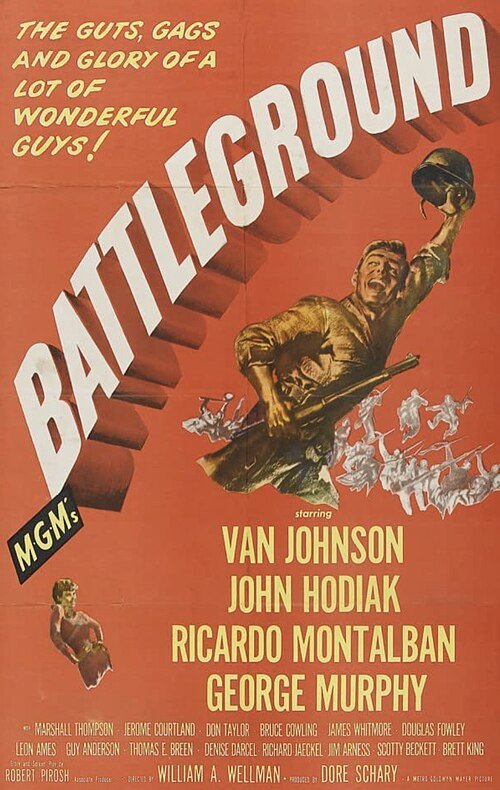 The film introduces us to the 101st Airborne Division through Pvt. Jim Layton, a replacement who arrives carrying some of the mythology attached to the airborne. These are supposed to be elite soldiers, different from ordinary infantrymen. There is pride in the patch and the reputation that comes with it.
Bastogne strips that away almost immediately.
Once the men reach the Ardennes, nobody cares very much about the romance of being airborne. They are cold, hungry, exhausted, digging holes in frozen ground and trying not to get killed. Artillery does not care what patch is sewn onto your shoulder. Frostbite does not care either. The supposedly glamorous paratroopers have become what soldiers in combat usually become: grunts trying to make it through another day.
The movie even turns the 101st patch into a recurring joke. Patches are sewn on, ripped off, and sewn on again as circumstances change. It is funny, but there is something deeper underneath it. At first the patch represents an identity Layton wants. By the end, belonging to the unit means something entirely different because he has suffered alongside the men wearing it.
He learns very quickly that being assigned to a squad does not automatically make him one of the guys. The scene in the tent makes that painfully clear. The men already have relationships, jokes, histories, and loyalties. Layton is physically among them, but emotionally he is still a stranger. What makes his story work is that he does not earn acceptance through one enormous act of heroism. He becomes one of them simply by being there. He freezes with them, walks with them, loses people with them, and becomes frightened with them. Shared hardship gradually does what the patch cannot.
The individual personalities make that transformation matter. These men never feel interchangeable. One is a family man who keeps his watch set to the time back home, a small detail that says almost everything. While he sits freezing outside Bastogne, part of him remains with his wife and child. There is the athlete, the ladies' man, the older soldier who thought he might finally be going home, the man forever dealing with his false teeth, and the soldier experiencing snow with almost childlike wonder. Those details are not filler. They are why we remember them.
Battleground understands that soldiers do not stop being people because they are wearing uniforms.
That same idea appears when the men first pass through Bastogne. The town seems warm and safe compared with whatever might be waiting ahead. Someone remarks that it looks like the sort of place they will remember. He is right. They simply have no idea why.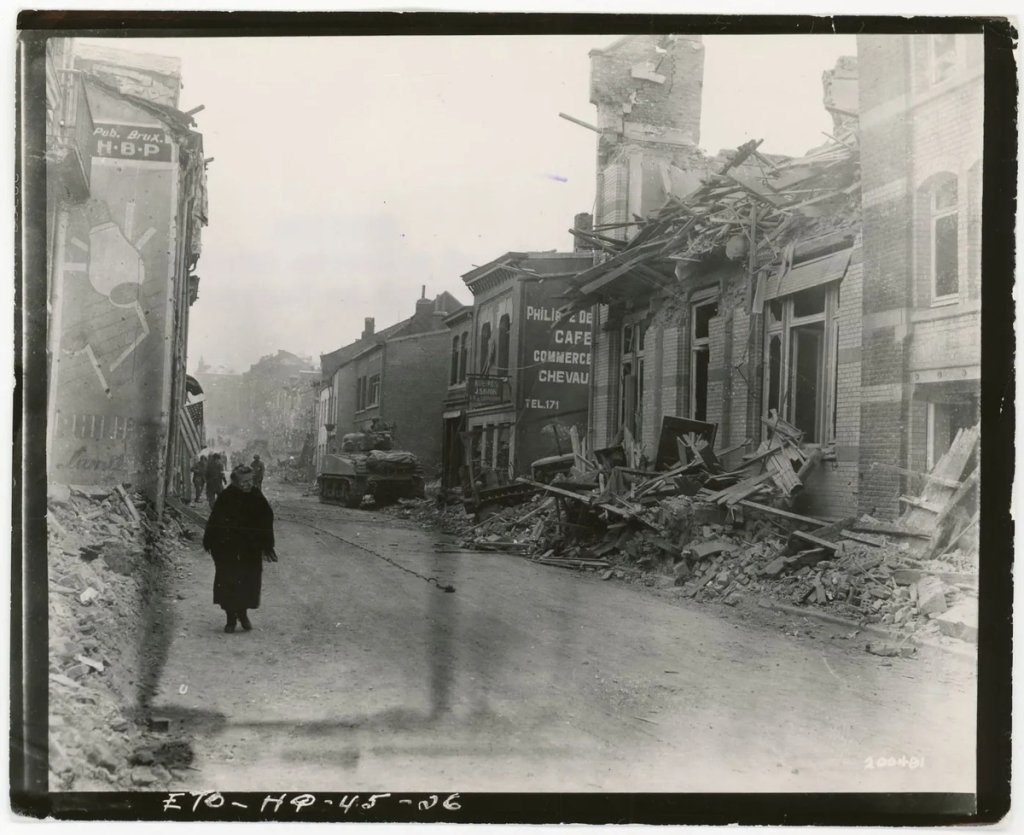
The soldiers give candy to children, joke with civilians, and enjoy a brief return to something resembling normal life. Then later the house is destroyed. What had represented warmth and safety becomes another casualty of the battle.
The film constantly does this. It gives the men something small and human, then reminds us how fragile it is.
 The German propaganda leaflets are another brilliant example. The American soldiers barely understand the scale of what is happening around them. Information comes in fragments and rumors. Then German aircraft drop leaflets welcoming the 101st Airborne to Bastogne. Imagine what that means to the men on the ground. The Germans know who you are. They know where you are. Apparently they knew you were coming while you barely understood where you were going.
That limited knowledge is one of the film's greatest strengths. Today we can look at maps of the Battle of the Bulge and understand what was happening. We know Bastogne was surrounded. We know Patton's Third Army would eventually break through. The men did not. For them there was only the next road, the next patch of woods, and the next hour.
That uncertainty becomes even more disturbing when German soldiers disguised as Americans begin infiltrating the lines. Suddenly even an American uniform cannot be trusted. Holley and Layton encounter infiltrators without initially realizing what they have seen. When word later spreads about Germans moving through the lines, the two men suddenly want nothing to do with admitting they encountered them. It is a wonderfully human scene because it is not heroic. They realize how close they came to disaster and recoil from it.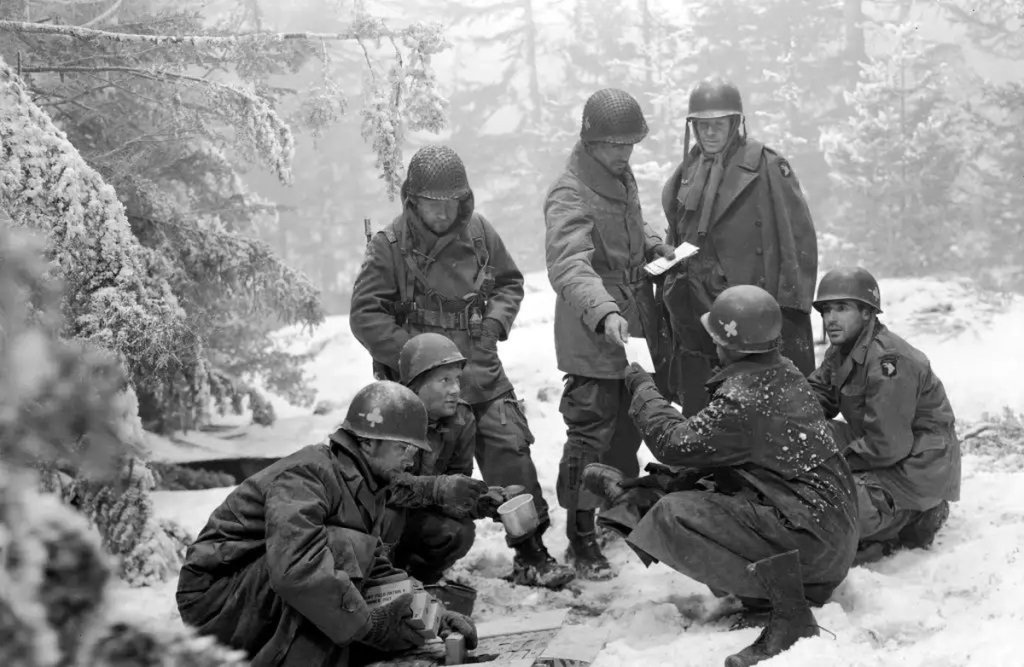
Battleground repeatedly allows its soldiers to be afraid without automatically calling them cowards. Holley eventually reaches his own breaking point. Cold, exhaustion, danger, and uncertainty begin to overwhelm him. A lesser war movie might treat the moment as disgraceful or use it as an excuse for some dramatic redemption. Instead, he is simply scared.
Then Layton, the man who once wondered whether he belonged, is there for him. That is Layton's real transformation. Not becoming a better killer. Not earning a medal. He becomes someone another frightened man can depend upon. He has become one of the guys.
His search for an old friend makes that idea even more painful. Layton learns that his friend's company is nearby and goes looking for him. In this strange world, here is someone who knew him before the war, someone to whom he is not merely "the replacement." Then he discovers that his friend was killed the night before. Worse, the soldiers around him barely knew the man. That scene quietly raises one of the deepest questions in the film: if I die here, does anyone know who I was? Do these men know my name? Do they know about my family? Would anyone remember me tomorrow?
Gradually, the answer changes for Layton. These men begin knowing him, just as he begins knowing them through all their ridiculous little details.
And sometimes those little details become deadly. One soldier cannot find rubber overshoes large enough for his feet. It seems almost comic until he removes his boots in his foxhole and cannot get them back on quickly enough when danger comes. Something as ordinary as oversized feet and bad footwear becomes part of a man's death.
That is very Battleground.
 War does not always kill people dramatically. Sometimes boots matter. The snow works the same way. It can create wonder and even moments of play, but it is also freezing feet, soaking clothing, hiding the enemy, and slowly exhausting everyone around it. Even the famous egg cooked in a helmet belongs to this same world. In the middle of one of the most desperate battles of the European war, somebody is still worried about breakfast. It is funny because it is absurd. It is also deeply human. Sometimes civilization in wartime is nothing more than dry socks, candy for a child, a cigarette, or an egg cooking in a steel helmet.
That is why the humor never weakens Battleground. It strengthens it. These men joke because laughter is sometimes the only normal thing they have left.
The film's greatest accomplishment may be what it ultimately does to the legend of the 101st Airborne. At the beginning there is the reputation, the patch, and the belief that these men are somehow different.
Bastogne burns most of that mythology away.
They freeze like everyone else. They become frightened like everyone else. They grieve like everyone else. They die like everyone else.
Their courage matters precisely because they are not superhuman.
Eventually the siege is broken and relief comes, but Battleground refuses to give these men the kind of ending we expect. For us, Bastogne has a beginning and an end. We know when the battle started. We know when the town was surrounded. We know when relief arrived. We can close the history book and say, "That was Bastogne."
The men could not. For them, Bastogne was not a complete story. It was simply another miserable place in an ongoing war. They had been somewhere before Bastogne. They survived Bastogne. And someone would eventually tell them where they were going next.
History divides wars into neat chapters because that is how we make them understandable. Normandy. Holland. Bastogne. Germany. The soldiers did not experience clean chapter breaks. There was just today. Then tomorrow. Another road. Another town. Another foxhole.
That is why the ending of Battleground works so well. The survivors are still tired, dirty, joking, and complaining. Some of the men who entered Bastogne with them are gone. And then they start walking again. Layton is no longer the replacement walking at the edge of the group. He has lost someone, been frightened, endured the cold, and learned what these men are really like. He belongs now. Not because somebody told him he did. Because he went through it with them.
Perhaps that is the final little tragedy hidden inside Battleground. Layton wanted to become one of these men. Now he has. But the price of belonging was Bastogne.
That is why Battleground is more than a realistic war movie. It is one of the most human war films ever made.
Its greatness is found in watches, patches, false teeth, oversized boots, candy, snow, eggs cooked in helmets, frightened men, lost friends, bad jokes, and the gradual realization that the strangers around you have somehow become your people.
History remembers Bastogne as one of the great American stands of World War II.
 Battleground remembers that before Bastogne became history, it was simply a freezing town in Belgium filled with exhausted men trying to survive another lousy day of a war that seemed to have no end.
And when Bastogne was finally behind them, there was no closing title. There was another road ahead. So they shouldered their weapons, fell back into line, and kept walking. From frozen foxholes to thoughts of home, discover why something as simple as a slice of pie could mean so much to a serviceman.
They Were Surrounded. The Answer Was “NUTS!” See Our Battle of the Bulge Tribute Shirt.