USS Thetis Bay: More Than an Old Ship, More Than a Pile of Wood
The Forgotten Carrier That Helped Change Marine Warfare, and the Surviving Pieces Carrying Her Story Into a New Generation
August 27, 2026

 This is not just a pile of old wood. These weathered boards were once part of a ship where sailors worked, Marines prepared to go ashore, aircraft crossed the Pacific, helicopters lifted into the sky, and ideas were tested that would help change the way the United States fought wars from the sea. Today, USS Thetis Bay is gone. Her steel was cut apart decades ago, her name has largely faded from public memory, and to most people she would probably seem like just one of the hundreds of American warships that served and disappeared during the twentieth century. Even what remains of her can easily be mistaken for discarded material: old boards stacked together, separated from the ship that once carried them across the ocean. But history does not reside only in monuments, famous battlefields, or objects behind museum glass. Sometimes it survives in something as ordinary as a piece of wood.
Men once walked across these boards. Generations of sailors maintained the ship beneath them. Aircraft were moved around them. Marines later stood on her deck preparing to climb aboard helicopters that would carry them away from the ship and toward objectives ashore. Helicopters launched from Thetis Bay also carried food and medicine to civilians after natural disasters, while during the Cuban Missile Crisis Marines and aircraft waited aboard her as the world stood frighteningly close to nuclear war. What makes all of this even more remarkable is that Thetis Bay had already lived an entirely different life before anyone imagined using her to help reinvent amphibious warfare.
Built for a World at War
 USS Thetis Bay, CVE-90, was a Casablanca-class escort carrier built by the Kaiser Shipbuilding Company at Vancouver, Washington. Her keel was laid on December 22, 1943, and she was commissioned on April 21, 1944, with Captain Donald E. Wilcox in command. She belonged to a remarkable class of small escort carriers produced in great numbers during World War II. They lacked the size, speed, and fame of fleet carriers such as Enterprise, Yorktown, or Essex, but wars are not won by famous ships alone. Behind every great carrier task force was a vast logistical network carrying replacement aircraft, pilots, mechanics, supplies, spare parts, and men across thousands of miles of ocean.
That became much of Thetis Bay's wartime mission. After her shakedown cruise, she headed into the Pacific carrying aircraft and passengers between the West Coast, Pearl Harbor, and bases scattered across the Pacific. She carried men and machines into a war that was steadily moving westward toward Japan and returned damaged aircraft that needed repair. By the summer of 1945 she had moved closer to the striking power of the Pacific Fleet and was assigned as a replenishment carrier supporting Task Force 38. Rather than launching the great air strikes that filled newspaper headlines, Thetis Bay helped keep the carriers conducting those attacks supplied with replacement aircraft and personnel. Her contribution was quieter, but essential. She carried what other men needed to keep fighting.
Then the war ended, and the nature of her passengers changed. Beginning in September 1945, Thetis Bay joined Operation Magic Carpet, the enormous effort to return American servicemen home from overseas. For months she crossed the same Pacific she had traveled during the war, except now the voyage was pointed toward home. Men who had spent years wondering whether they would survive climbed aboard knowing that the war was finally over. Her final Magic Carpet voyage left Yokosuka, Japan, in January 1946. The ship that had carried men and aircraft toward the war finished her first career carrying Americans away from it.
In August 1946, with the wartime Navy rapidly shrinking, Thetis Bay was decommissioned and placed in reserve at Bremerton, Washington. There she waited for almost a decade. Many ships of her generation would never sail again. They had been built for one enormous emergency, served their purpose, and were gradually sold, scrapped, or forgotten.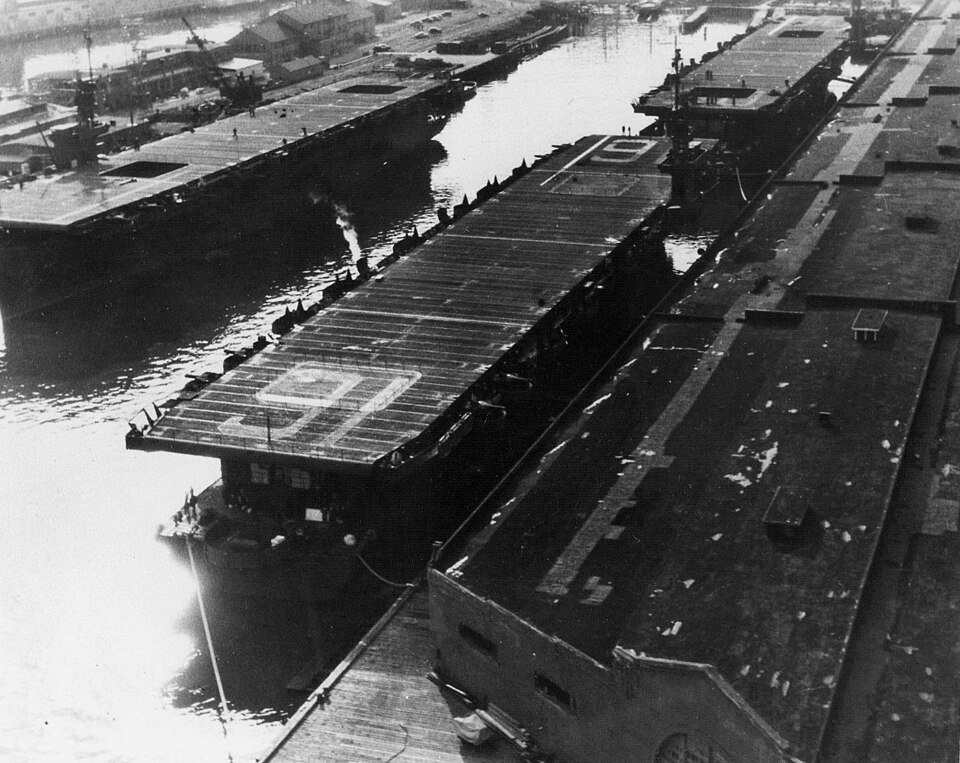
Thetis Bay was different.
An Old Ship and a New Idea
By the 1950s, the Marine Corps was confronting a fundamental problem. Generations of Marines had perfected amphibious warfare, but World War II had demonstrated just how deadly a defended beach could become. At the same time, helicopters were evolving from curiosities into practical military aircraft. That created an extraordinary possibility: what if Marines did not have to fight their way inland beginning at the water's edge? What if helicopters could carry them directly from ships at sea, over beaches and coastal defenses, and place them farther inland?
Today that concept seems completely normal. Modern Marines routinely deploy from amphibious ships aboard helicopters and tiltrotor aircraft. In the 1950s, however, there were no decades of doctrine, specialized ships, established flight-deck procedures, or experienced crews showing everyone how it should be done. Someone had to turn the idea into reality. Pilots had to learn to operate helicopters repeatedly from moving ships. Sailors had to support aircraft their ships had never been designed to accommodate. Marines had to determine how men, weapons, fuel, ammunition, equipment, and helicopters could all be packed aboard one vessel and then moved ashore as a fighting force.
For that experiment, the Navy reached back into the reserve fleet and selected a small World War II escort carrier.
Conversion of Thetis Bay began at San Francisco Naval Shipyard in 1955, and on July 20, 1956, she returned to service as CVHA-1, an assault helicopter aircraft carrier. It was an extraordinary second life. The carrier that had hauled replacement aircraft across the Pacific during World War II would now help determine whether helicopters could carry Marines from the sea directly into battle.
 The Marine Corps used Thetis Bay as a floating laboratory for the emerging concept of vertical envelopment. She could carry Marines and helicopters together aboard a single ship and gave the Navy and Marine Corps something they desperately needed: a place to find out what worked in the real world. Every landing, launch, movement of equipment, refueling operation, and exercise added another piece to a body of knowledge that barely existed when the program began.
On September 24, 1956, Colonel Frederick R. Payne landed an HRS-3 helicopter aboard Thetis Bay, becoming the first Marine helicopter pilot to land aboard an actual LPH-type assault helicopter carrier. Captain Thomas W. South II, the ship's commanding officer, was there to greet him. It was one helicopter landing on one relatively small ship, but looking backward it represents something much larger. The men watching that helicopter settle toward the flight deck could not see the massive amphibious assault ships that would one day carry Marine helicopters, Harriers, Ospreys, and F-35Bs around the world. They were simply trying to determine whether a new idea worked.
It did.
The Marines who operated aboard Thetis Bay even developed an affectionate nickname for her. Her radio call sign led pilots and Marines to call the little carrier the “Teddy Bear.” It was a remarkably gentle nickname for a ship helping to transform how Marines might be delivered into combat, but somehow it fit. She was small by carrier standards, already a veteran of another war, and never intended for the job she was now being asked to perform.
Yet she proved remarkably good at it.
Learning How Marines Would Fight From the Sea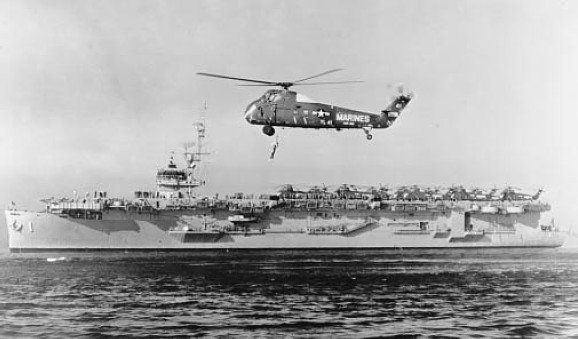
Throughout the late 1950s and early 1960s, Thetis Bay became part of the process of turning vertical envelopment from theory into practical military doctrine. Marine helicopter units practiced operating from her flight deck while sailors learned how to support them. The ship participated in amphibious exercises and deployed to the western Pacific, and in 1959 she was redesignated LPH-6, placing her formally among the emerging generation of amphibious assault ships centered on helicopter operations.
In May 1960, Thetis Bay participated in an especially important exercise off Camp Pendleton. During a large-scale nighttime operation, helicopters transported approximately 1,300 troops and 33 tons of cargo ashore. It was the first large-scale night landing of ground forces by carrier-based helicopters. Marines were demonstrating that they were no longer tied exclusively to daylight or to the beach itself. A force could remain at sea, launch helicopters from a ship, cross the shoreline through the air, and place Marines and equipment farther inland.
 The technology would change dramatically in the decades that followed, but the basic idea would endure. More importantly, Thetis Bay gave sailors and Marines the opportunity to discover the hundreds of practical details no drawing board could answer. How should troops move through the ship? How quickly could helicopters be launched and recovered? How should aircraft, men, fuel, ammunition, and supplies be arranged? How could a ship originally designed for propeller-driven World War II aircraft be adapted to support an entirely different type of aviation operation?
Human ingenuity turned an aging escort carrier into an experimental warship, and then sailors, Marines, engineers, and aviators figured out how to make that experiment work. There was no modern amphibious assault ship to copy and no decades of operating experience waiting to provide the answers. They experimented, solved problems, made mistakes, adjusted, and tried again. They took something old and began creating part of the future with it.
More Than a Weapon of War
 The helicopters of Thetis Bay did not carry only armed Marines. In August 1959, catastrophic flooding struck Taiwan while the ship was serving with the Seventh Fleet. Ordered from Hong Kong to assist, Thetis Bay became a floating base for humanitarian relief. Her helicopters flew hundreds of mercy missions, carrying food, medical supplies, and other necessities into flooded areas while evacuating people who could not otherwise escape. Approximately 1.6 million pounds of relief supplies were delivered and more than 850 people were evacuated.
There is something particularly revealing in that chapter of her history. The same machinery and techniques being developed to place Marines behind enemy defenses could also cross floodwaters and reach isolated civilians. Technology does nothing by itself. People decide what to do with it. Sailors loaded the aircraft. Pilots flew them. Crews worked exhausting schedules. Food and medicine replaced ammunition as cargo. Human ingenuity had created a new military capability, but human compassion found another use for it.
Three years later, Thetis Bay entered one of the most dangerous moments of the Cold War. During the Cuban Missile Crisis in October 1962, she moved toward the quarantine area carrying a Marine landing force and helicopter squadron, prepared to participate if President John F. Kennedy ordered military action against Cuba. The Marines aboard did not know whether that order would come. Their families at home did not know how the confrontation would end. Helicopter amphibious assault, which only a few years earlier had been an experimental concept practiced from an old escort carrier, was now part of an operational American force standing ready during a confrontation between nuclear superpowers.
Fortunately, the order to invade never came.
 The following year, Thetis Bay again demonstrated the other side of her capabilities after Hurricane Flora devastated Haiti. Her helicopters flew relief missions carrying food, supplies, and medical assistance while evacuating people from areas damaged by the storm. Once again, a ship built for war became a platform for saving lives.
By then, however, Thetis Bay was nearing the end. On March 1, 1964, she was decommissioned and struck from the Naval Vessel Register. Her hull was later sold for scrap. There would be no third commissioning and no ceremonial preservation as a museum ship. The little carrier that had crossed the Pacific during World War II and later helped create a new form of amphibious warfare disappeared beneath cutting torches.
But what she helped create did not disappear with her.
The Forgotten Root of a Modern Marine Corps
 The Marine Corps did not abandon vertical envelopment when Thetis Bay vanished. It embraced it. Experience aboard her helped demonstrate the value of ships specifically designed around helicopter assault. Larger conversions followed, and then came vessels built from the keel up for the mission, beginning with USS Iwo Jima. The concept evolved through Vietnam and continued developing through successive generations of amphibious warfare.
Today's amphibious assault ships dwarf Thetis Bay. Their aircraft, sensors, weapons, communications systems, and capabilities would have been almost unimaginable to the sailors and Marines who stepped aboard CVHA-1 in 1956. A modern Marine may leave an amphibious assault ship aboard an MV-22 Osprey or watch an F-35B lift from its flight deck, but beneath all that technology is an idea that the men aboard Thetis Bay would immediately recognize: bring sailors, Marines, and aircraft together aboard a ship, carry that force across the ocean, and then use aviation to reach beyond the shoreline.
The official history of Marine Corps helicopter aviation looked back at the tiny Thetis Bay from the perspective of the much larger amphibious ships that eventually followed her. Compared with those ships, she appeared almost insignificant.
Then Marine Corps historians described what she actually represented: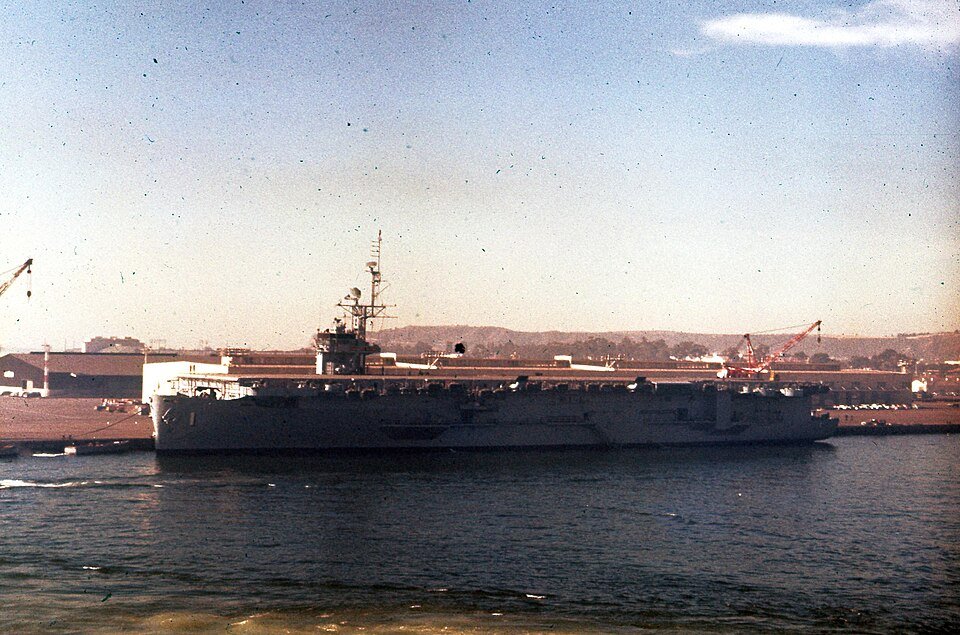
“The forerunner of all that would come after her.”
Few sentences better explain why this largely forgotten ship matters.
There is a direct line between the sailors who took Thetis Bay across the Pacific during World War II, the servicemen who stood aboard her while finally heading home, the Navy crews who brought an aging carrier back from reserve, the Marine pilots learning to land helicopters on her deck, the Marines experimenting with new ways to reach the battlefield, and the sailors and Marines standing aboard America's amphibious assault ships today.
Different generations served aboard different ships with different aircraft in different wars, but the lineage remains.
That is perhaps the greatest legacy of Thetis Bay. She was built for one war and one purpose, then an entirely different generation looked at her and imagined what else she could become. The Navy did not simply see an obsolete escort carrier. Sailors, Marines, engineers, designers, and aviators saw a possibility. They transformed her, learned from her, and in the process helped create a type of warfare and a family of ships that still exist today.
 A Different Kind of Restoration
 A Different Kind of Restoration
At Ghosts of the Battlefield, restoration does not always mean rebuilding something until it looks the way it did when it first left a factory or shipyard. Sometimes the object itself is too large, too damaged, or simply no longer exists. USS Thetis Bay cannot be restored as a ship. Her hull was broken apart more than half a century ago, and no amount of work can put her back together again.
But perhaps there is another kind of restoration.
When a surviving piece of her deck is identified, preserved, and connected once again to the sailors and Marines who walked across it, something that had been reduced to discarded material regains part of its identity. The wood does not become a flight deck again, but its story is restored. Its connection to the men who served aboard Thetis Bay, to the development of Marine helicopter assault, to humanitarian missions, to World War II, and to the generations of sailors and Marines who followed them is restored with it.
That may be restoration on a very small scale, but it is restoration nonetheless.
USS Thetis Bay will never sail again. We cannot preserve the entire ship, but we can preserve pieces of what remains and make certain they do not become anonymous boards whose history disappears with the people who remember where they came from. By placing those pieces into the hands of people who understand what they represent, another part of the ship's story continues beyond the scrapyard.
In that sense, preserving a piece of Thetis Bay is not simply saving old wood.
It is restoring a connection between an artifact and the people who touched it, between an almost forgotten ship and the modern Marine Corps it helped shape, and between one generation of Americans and another that still serves aboard the descendants of the ships and ideas tested aboard her.
This Is Not Just a Pile of Wood
Which brings us back to these boards.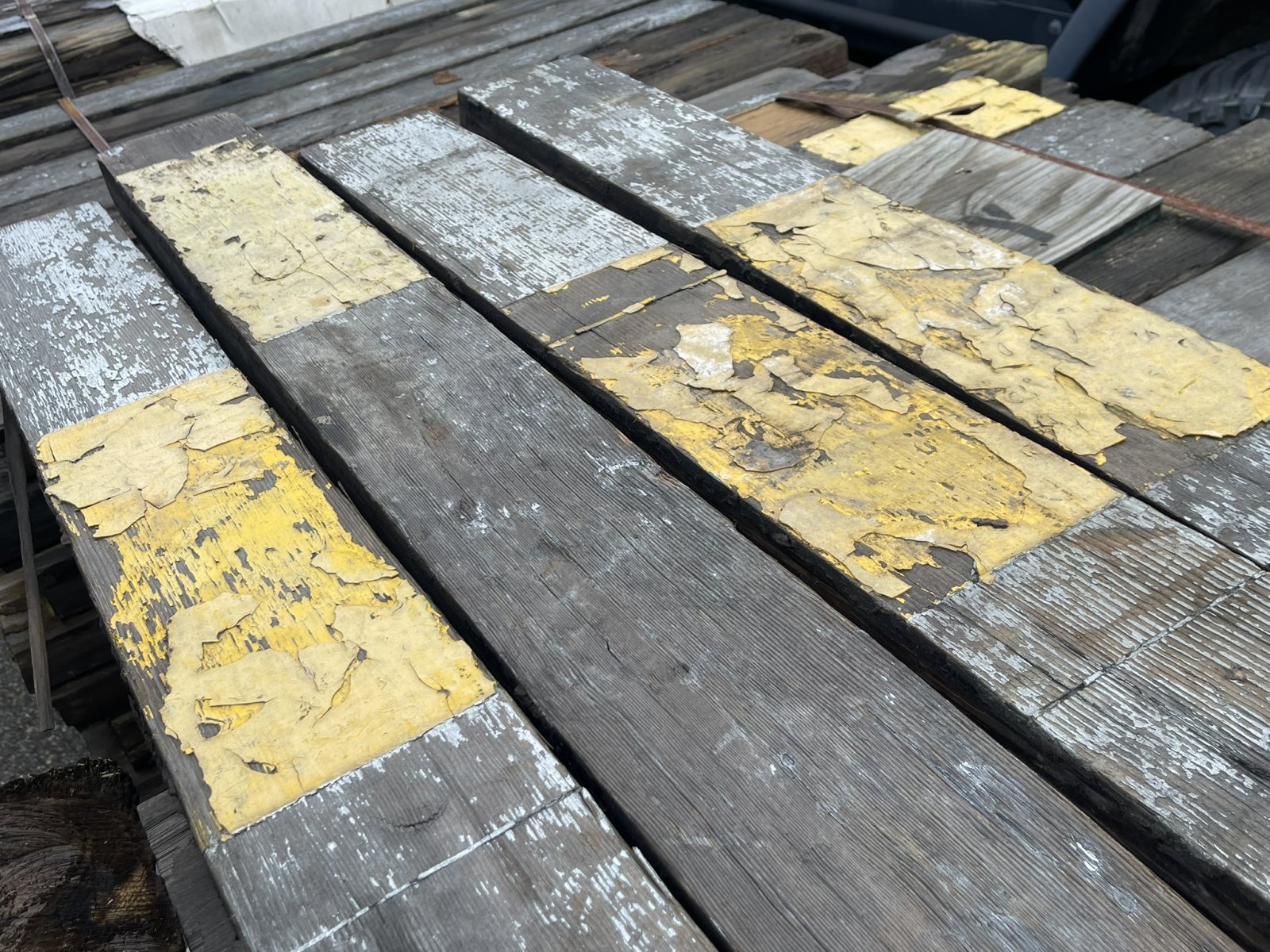
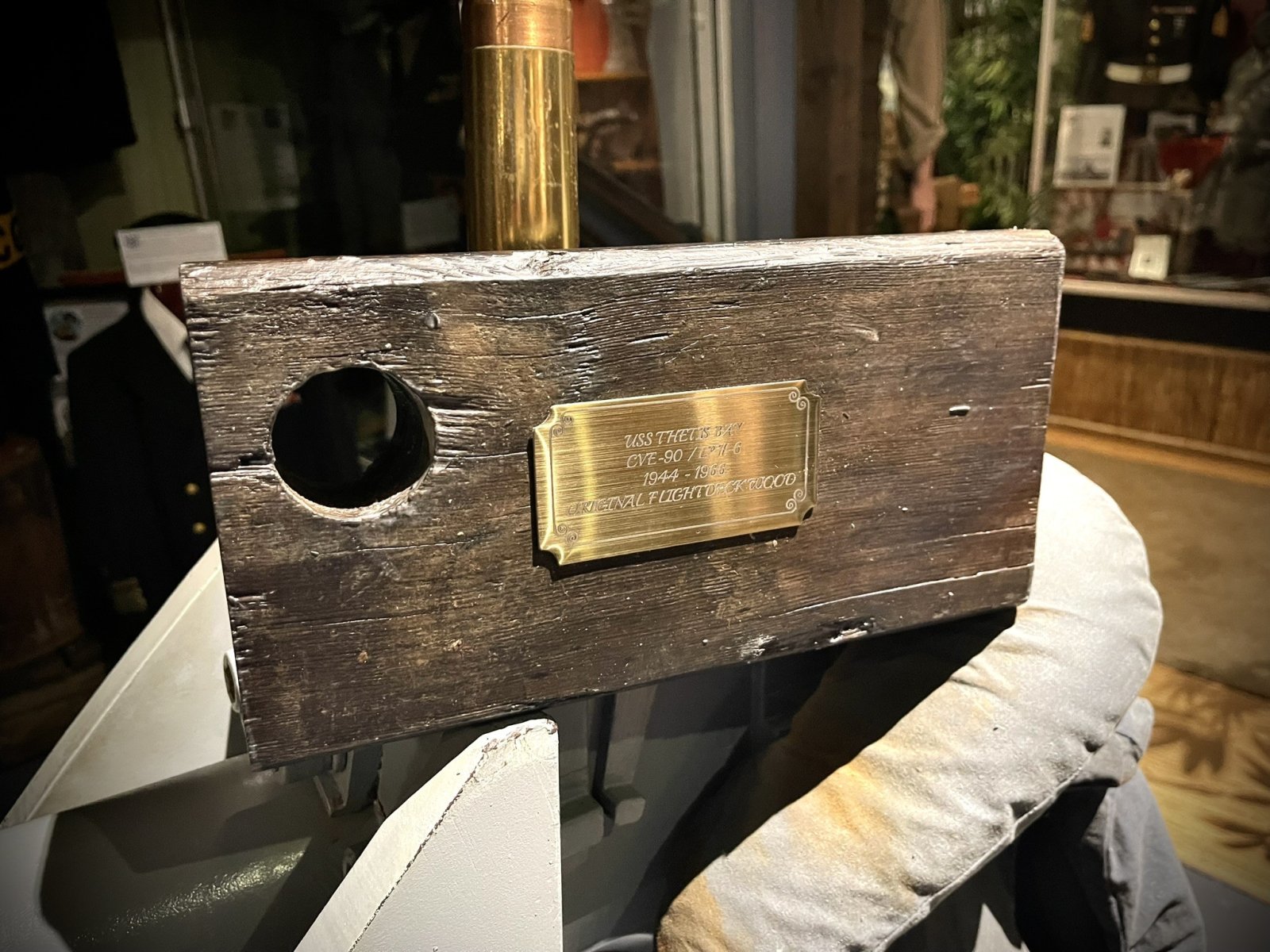
Portions of USS Thetis Bay's deck survive today at Ghosts of the Battlefield. Standing alone, they are pieces of old wood. They are weathered, imperfect, and removed from the enormous structure that once gave them context. Without their story, someone could walk past them without giving them another thought.
But once you know where they came from, they become something entirely different.
They are a physical connection to sailors crossing the Pacific during World War II and to Americans finally sailing home when that war ended. They connect us to the Navy crews who brought a forgotten carrier out of reserve and to Marines standing aboard her deck while their service was learning an entirely new way to fight. They connect us to pilots bringing early helicopters down onto a moving ship, to sailors and Marines carrying aid to strangers after devastating natural disasters, and to the men waiting offshore during thirteen frightening days in October 1962 without knowing whether they would soon be ordered into Cuba.
Most importantly, they connect those generations to the sailors and Marines serving today.
Ships are built, commissioned, worn down, decommissioned, and eventually discarded. Steel is cut apart. Machinery disappears. Names that once appeared on orders, letters home, cruise books, and uniforms slowly fade from public memory.
The people disappear too.
But what they accomplished does not become meaningless simply because the ship that carried them is gone.
Sometimes something survives. Sometimes it looks like nothing more than a pile of old boards. And sometimes, when we take the time to understand where those boards have been, we discover that we are not preserving wood at all.
We are preserving a piece of the people, the ideas, and the history that once stood upon it.