Rediscovering a Forgotten Chapter of Military Innovation
Ghosts of the Battlefield acquires a rare Sandair/Chenowth TOV, preserving a forgotten chapter in early military unmanned technology.
July 12, 2026

Some days remind us exactly why we do what we do.
At Ghosts of the Battlefield, restoring military vehicles has become one of our passions. Every restoration begins with a simple question: what story does this vehicle have to tell? We are currently undertaking the restoration of our tenth military vehicle, each one requiring years of research, preservation work, and historical documentation. Unlike automotive restorations, military vehicle restorations are often archaeological exercises. Layers of paint are examined. Welds are documented. Mounting brackets are measured and compared to period photographs and technical documents. Historical context is just as important as mechanical restoration because our mission is not simply to preserve machines—it is to preserve the history they represent.
And yet, our newest restoration project may prove to be even rarer and, in many respects, even more historically significant.
 After months of research and documentation, we now believe we have acquired one of the earliest surviving examples of a United States military unmanned ground vehicle development platform—a vehicle that helped lay the foundation for virtually every military unmanned ground system operating today.
Long before the world knew the names Predator, Reaper, Switchblade, or even PackBot, the United States Marine Corps was experimenting with remotely operated battlefield vehicles during the early 1980s. This was a time when unmanned military technology was still in its infancy. Modern UAVs did not yet exist. The MQ-1 Predator would not fly for another decade. Small reconnaissance drones carried by infantry soldiers were still science fiction. The concept of remotely operating a military vehicle while safely separated from the battlefield was revolutionary.
The military's interest in unmanned systems is actually older than most people realize. Experimental radio-controlled aircraft date back to World War I. During World War II, target drones and remote-controlled aircraft were used for training and experimentation. The Cold War saw the development of increasingly sophisticated reconnaissance drones, particularly during Vietnam, where unmanned aircraft performed dangerous photographic missions over hostile territory. Yet these early systems remained largely limited to the air.
The ground battlefield presented an entirely different challenge.
Building a remotely operated vehicle capable of traversing rough terrain, avoiding obstacles, carrying sophisticated sensors, and providing its operator with an accurate sense of its surroundings was an enormously difficult engineering problem. In many ways, it was significantly more challenging than simply flying an unmanned aircraft along a predetermined route. Engineers had to solve problems involving remote vision systems, human-machine interfaces, communications, navigation, vehicle control, and sensor integration years before modern computers made such tasks commonplace.
That is where this vehicle enters the story.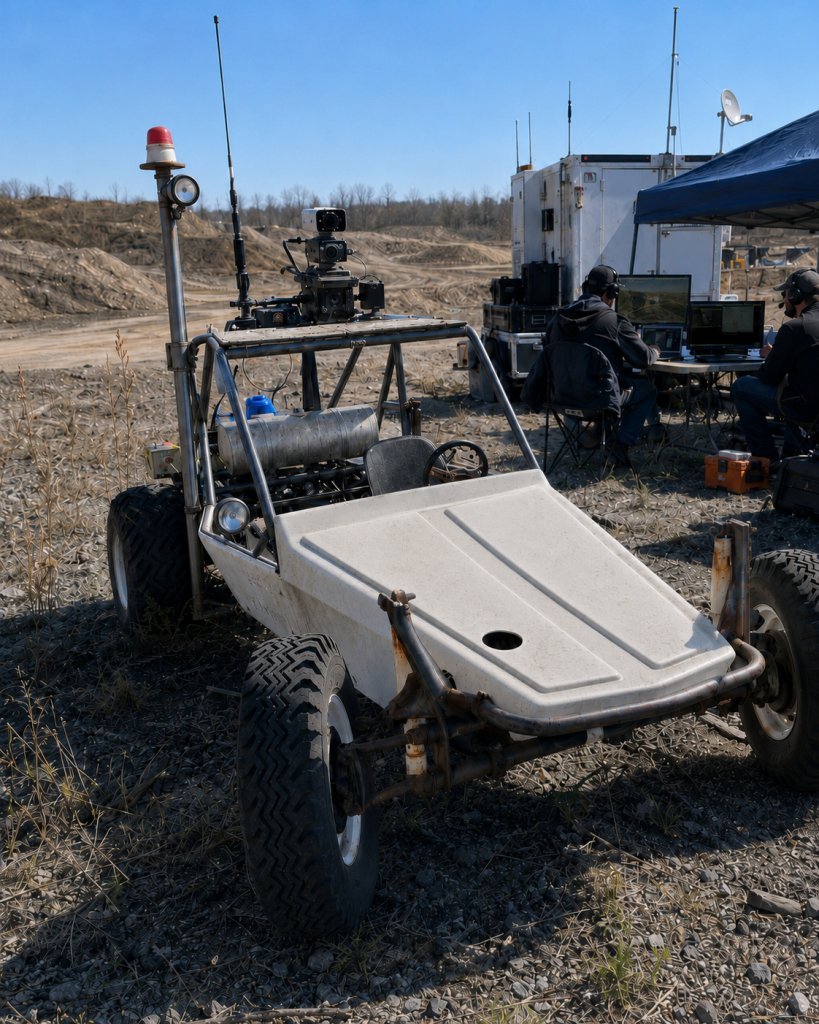
Documentation uncovered during our research links this Chenowth-based vehicle to the United States Marine Corps' Advanced Teleoperator Technology (ATT) program conducted at the Naval Ocean Systems Center in Hawaii during the early 1980s. The ATT program utilized a highly modified Chenowth dune buggy chassis as a developmental testbed to explore technologies that are now fundamental components of modern unmanned systems.
 The vehicle incorporated concepts such as stereo visual displays that provided operators with depth perception, head-coupled viewing systems that allowed operators to look around the battlefield remotely, binaural audio systems that recreated directional sound, and isomorphic vehicle controls that mimicked those found in conventional military vehicles. Most remarkably, the program successfully demonstrated the remote operation of vehicle-mounted weapons systems while traversing complex natural terrain at speed.
In other words, engineers were attempting to create a battlefield robot more than forty years ago.
The success of the ATT program directly led to the Marine Corps' Ground/Air TeleRobotic Systems (GATERS) program and subsequently the TeleOperated Vehicle (TOV). These vehicles evolved from simple technological demonstrations into sophisticated battlefield concepts designed to carry sensor packages that included day and night cameras, thermal imaging systems, laser range finders and designators, chemical weapons detectors, and reconnaissance equipment mounted atop extendable masts. Operators could effectively see, hear, and maneuver through the battlefield without ever physically occupying the vehicle itself.
Today, this sounds remarkably familiar.
Replace the 1980s television cameras with modern digital sensors, swap fiber optic communications for encrypted wireless datalinks, and substitute artificial intelligence-assisted navigation for early remote control systems, and you have the basic operating concepts employed by today's military unmanned ground vehicles.
This vehicle is, quite literally, part of the evolutionary tree that eventually produced the unmanned systems now employed throughout the United States military.
Every remotely operated explosive ordnance disposal robot. Every small reconnaissance robot carried by infantry units in Iraq and Afghanistan. Every armed unmanned ground combat vehicle currently under development. Every autonomous convoy vehicle being tested by the Army. Even many of the concepts employed in today's unmanned aerial systems can trace their philosophical origins back to programs such as ATT and TOV that sought to remove soldiers and Marines from dangerous situations through the use of remotely operated technology.
It is not an exaggeration to say that this vehicle represents the earliest chapter of a technological revolution that continues to reshape warfare today.
One source suggests that only twelve examples of these Chenowth-based vehicles were produced, with six reportedly residing in another museum collection. If further research confirms our findings, this places our example among the rarest surviving military experimental vehicles from the Cold War era. Unlike production military vehicles that may have been manufactured by the thousands, experimental developmental vehicles are often scrapped once their programs conclude. Very few survive long enough for historians and museums to tell their stories.
The vehicle itself retains numerous unique structural modifications associated with its developmental role. Mast mounting brackets remain intact, along with specialized mounting points and modifications related to its remote operating systems. Every component is currently being documented as part of our ongoing preservation efforts.
 As with all of our restoration projects, this vehicle will undergo a complete historical restoration. We are committed not only to preserving the physical artifact but also to preserving the remarkable story behind it. The restoration process will likely take years as we continue researching its service history, locating additional documentation, and identifying missing components (the missing camera mast seen here). Our goal is to present the vehicle exactly as it appeared during its service as a pioneering military unmanned ground system.
Military museums often preserve the weapons and vehicles that fought America's wars. Occasionally, however, we have the privilege of preserving the machines that helped invent the future.
Before there were drones flying over battlefields halfway around the world, before unmanned systems became commonplace in military operations, before robotic vehicles accompanied American troops into combat, there was a small group of engineers in Hawaii experimenting with a modified dune buggy and asking a simple question:
"What if we could send a machine instead of a Marine?"
More than forty years later, that question has fundamentally changed warfare.
And sitting in our restoration shop is one of the vehicles that helped provide the answer.
Every artifact has a story. Click here to help us save the next one.
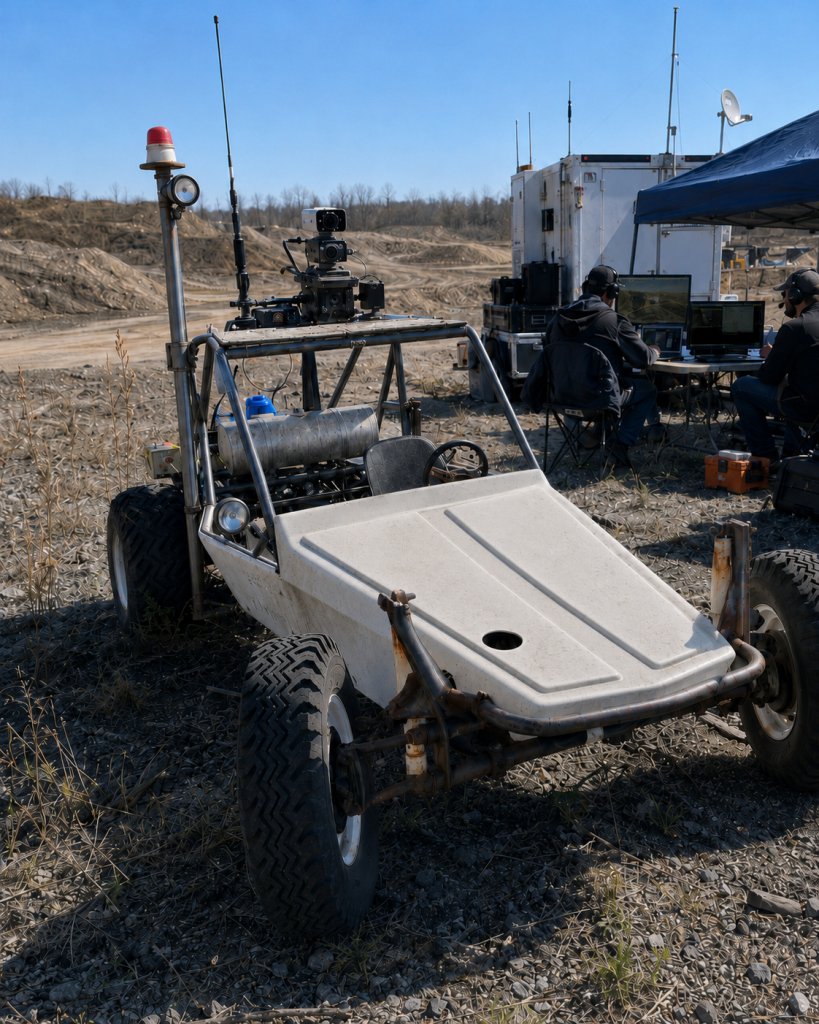
( Computer Generated Artists Impression)
If you would like to support this work please consider making a purchase from our internet store. All proceeds go directly to this work. Shop And Support Here.