Walt Sides and the Rogues: Building the Marine Sniper in Vietnam
Before the Marine sniper became a familiar figure of the Vietnam War, somebody had to determine how those men would be selected, trained, equipped, organized, and actually used on a battlefield.
August 10, 2026

When the story of Marine Corps snipers in Vietnam is told, a handful of names dominate it. Carlos Hathcock became a legend. Chuck Mawhinney eventually became recognized for the extraordinary number of confirmed kills credited to him. Eric England earned a fearsome reputation of his own. Their accomplishments deserve their place in Marine Corps history, but concentrating only on the men with the largest numbers can obscure another part of the story. Before the Marine sniper became a familiar figure of the Vietnam War, somebody had to determine how those men would be selected, trained, equipped, organized, and actually used on a battlefield unlike anything most of them had previously experienced. One of the Marines standing in the middle of that transformation was Staff Sergeant Walt Sides.
 Sides was not the man who single-handedly created Marine sniping in Vietnam, and describing him that way would diminish the work of the other Marines who were rebuilding the capability at the same time. His importance lies somewhere more interesting. He became platoon sergeant of one of the earliest organized Marine sniper platoons in Vietnam, helped train its men, went into the field with them, and helped turn ideas being developed by the 3d Marine Division's pioneering sniper instructors into something that could actually function with an infantry regiment in combat. His Marines would eventually call themselves the “Rogues.” The Marine Corps later described them as the first Marine scout-sniper platoon trained entirely in a combat zone.
The story had begun before Sides arrived. When large Marine combat forces entered South Vietnam in 1965, the Corps possessed a long tradition of exceptional rifle marksmanship but did not arrive with the kind of standardized sniper organization, weapon system, and training establishment that later generations would associate with Marine scout snipers. Vietnam quickly exposed the gap. Viet Cong fighters and observers could exploit terrain, vegetation, villages, rice paddies, and long distances to watch Marine positions or fire from beyond the practical reach of ordinary riflemen. The Marines began relearning a lesson American forces had repeatedly learned in earlier wars: there were situations in which volume of fire could not replace one trained man capable of delivering one accurately placed rifle shot.
The official Marine Corps history for 1965 records one of the earliest experiments on October 14 in the Hue-Phu Bai Tactical Area of Responsibility. A Marine sniper team equipped with .30-06 Winchester Model 70 rifles and 8-power Unertl telescopic sights engaged and killed two Viet Cong at more than 700 yards during the first use of the new tactic in that area. The same record notes that scoped M1D Garands were subsequently used as well. By late 1965, Marine sniper teams were operating around the major Marine enclaves, and the experiment was producing enough promise that the Corps began moving toward a more permanent organization.
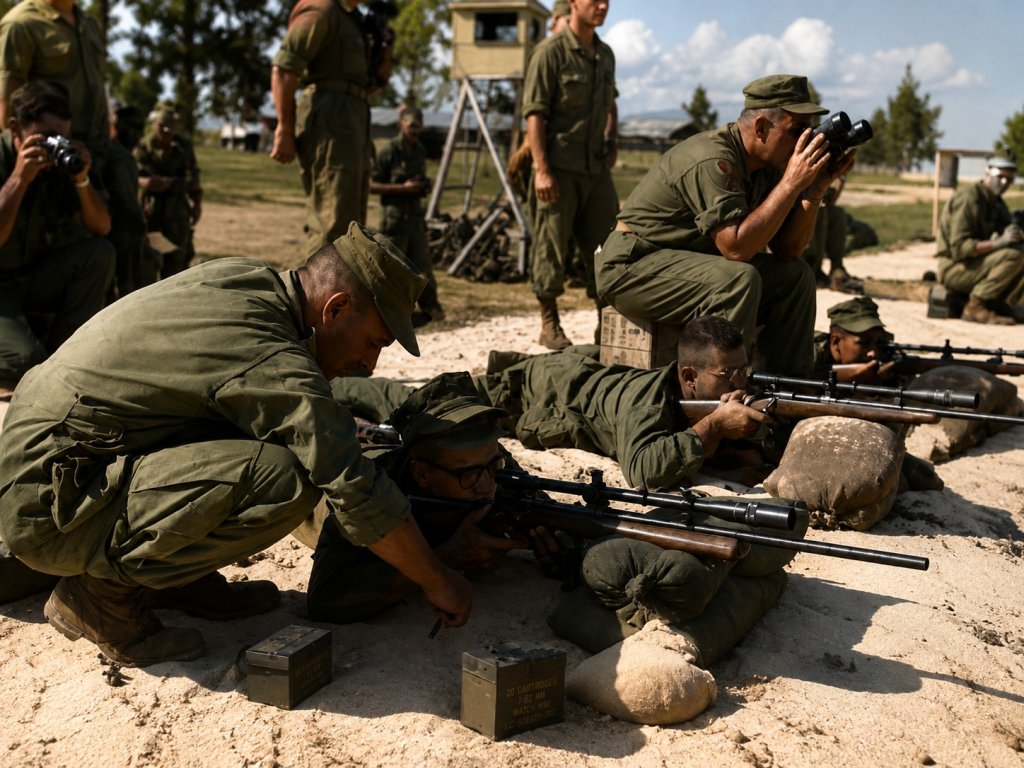
There was nothing particularly polished about the beginning. Rifles, scopes, instructors, ranges, ammunition, and doctrine had to be assembled while the war was already underway. The 3d Marine Division established sniper training at Da Nang, while instructors traveled and worked around Da Nang, Chu Lai, and Phu Bai. Some of the men involved were outstanding competitive marksmen, but competitive shooting and combat sniping were not the same occupation. They had to learn how accurate long-range rifle fire could best be integrated with patrols, reconnaissance units, infantry companies, and blocking forces. They were not merely teaching sniping. In a very real sense, they were discovering how Marine sniping should work in Vietnam while actually doing it.
That was the world Walt Sides entered in January 1966.
Walter Sides had been born in Mustang, Oklahoma, on December 31, 1939. He joined the Marine Corps on January 26, 1956, while only sixteen years old, having lied about his age to enlist. He left active service in 1958, attended the University of Oklahoma and played football, then returned to the Marine Corps in late 1959. By the time Vietnam drew him into the emerging sniper program, Sides had become an accomplished competitive marksman. He was exactly the sort of Marine the fledgling program needed: an experienced NCO who understood precision shooting but was also an infantry Marine capable of translating shooting ability into fieldcraft and combat employment.
Sides arrived in Vietnam as a staff sergeant and served from January 1966 until March 1967 with the 4th Marine Regiment, 3d Marine Division. Members of the original division sniper effort quickly recognized his marksmanship background. He became platoon sergeant of the 4th Marines sniper platoon, an organization of roughly forty Marines. The men received their sniper training in Vietnam rather than arriving as graduates of an established stateside sniper school. That distinction is what later led the Marine Corps to describe Sides' organization as the first Marine scout-sniper platoon trained entirely within a combat zone.
 The men eventually acquired their unofficial name from within the platoon itself: the Rogues. It fit a unit born in an unusual moment. They were specialists before the specialty had completely settled into its later form, operating with rifles that had often begun life on competitive shooting ranges and scopes whose designs dated back to another war. Sides later reduced their identity to a wonderfully unromantic description: “We were basically grunts with long guns.” Those long guns are an important part of Sides' story.
A surviving photograph of Sides taken near Phu Bai in the spring of 1966 shows him with a heavy-barreled Winchester Model 70 target rifle chambered in .30-06. The rifle has the heavy barrel and marksman-style stock associated with Marine competition rifles and, in that particular photograph, carries one of the commercial 3-9 power variable scopes obtained during the early scramble for suitable optics. Other Model 70s in the 4th Marines sniper platoon were equipped with the much more recognizable 8-power Unertl telescopic sight. The platoon also possessed M1D Garand sniper rifles fitted with the 2.2-power M84 scope. The Rogues therefore did not go to war with one neatly standardized “sniper rifle.” They used several systems while the Marine Corps figured out what its future sniper weapon should become.
The Winchester was an especially curious weapon to find fighting a war in Southeast Asia. The Model 70 had never been formally adopted as the standard Marine sniper rifle. Many of the rifles sent to Vietnam had originally been procured for Marine Corps competitive shooting. Some had heavy match barrels and substantial target stocks; others were configured with heavy barrels fitted into modified sporter-style stocks. When the demand for precision rifles suddenly became urgent, rifles belonging to Marine competitive marksmanship inventories were diverted into combat service. A weapon intended to punch tiny groups into paper at a rifle match could suddenly find itself carried through rice paddies and jungle in Vietnam.
The most famous optic associated with these rifles was almost an antique. The 8-power Unertl had roots stretching back to the Second World War. Some of the scopes being used in Vietnam were literally equipment from an earlier generation of Marine sniping. Yet the combination could be extremely effective. The heavy-barreled .30-06 Winchester offered excellent practical accuracy, and the high magnification of the Unertl gave Marines the ability not simply to shoot farther but to observe more effectively. That mattered enormously in a war in which finding the enemy was often more difficult than hitting him.
 The Marines also experimented with commercial variable-power scopes. A limited number of Japanese-made 3-9 power optics had been purchased as supplemental equipment, and one of them appears on the rifle Sides is photographed holding. These should not be confused with the later Redfield 3-9 power scope supplied on the M40. They belonged to the improvised first generation of the Vietnam sniper program. The fact that Sides can be seen with one is a wonderful visual representation of the period: a Marine competitive marksman in combat, holding a Winchester target rifle wearing a commercially sourced Japanese scope while the Marine Corps was simultaneously inventing the organization that would eventually become a formal sniper establishment.
Even the ammunition reflected the emphasis on precision. Model 70s were used with .30-06 M72 match ammunition firing a 173-grain boat-tail projectile. This was not simply standard infantry ammunition placed into a particularly accurate rifle. Marine armorers worked on rifles to improve their consistency, while match-grade ammunition offered the uniformity needed to exploit that accuracy at extended ranges. The emerging sniper program understood an important distinction that sometimes disappeared in discussions about weapons: the purpose was not simply to possess a rifle capable of producing a small group on a range. A combat rifle needed to retain its zero and place the first shot where the shooter expected it to go. The sniper might never receive the luxury of a second opportunity.
Vietnam was an extraordinarily hostile environment for equipment built around fine tolerances and optical instruments. Heat, rain, humidity, mud, and constant movement were enemies in their own right. Old Unertl scopes required care. Wooden stocks could react to moisture. Rifles that performed beautifully on a controlled range had to perform after being carried through vegetation, soaked in rain, exposed to dirt, and subjected to the ordinary abuse of an infantryman's life. The sniper therefore had to understand his equipment at a much deeper level than merely knowing how to fire it.
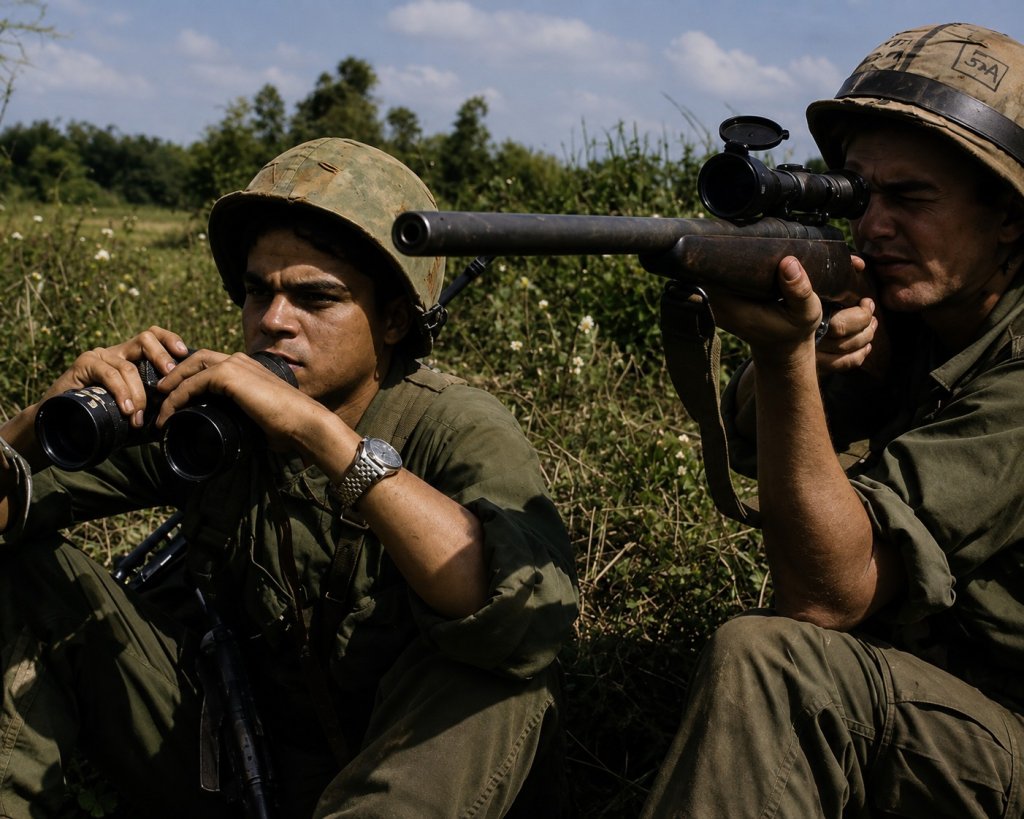
Sides' contribution went beyond marksmanship. One of the principles he stressed was that his snipers did not operate as solitary gunmen wandering through the countryside. He emphasized teams. The romantic image of the completely isolated sniper has survived because it makes for wonderful movies and terrible military doctrine. A sniper had to observe, navigate, communicate, maintain security, detect threats, estimate range, and remain concealed while accomplishing his mission. Another Marine could observe while the shooter concentrated on the rifle, watch areas the shooter could not see, provide security, assist with corrections, and help get the team out when things went wrong.
 Accounts preserved from the early program describe Sides using two-man teams and, when circumstances demanded, larger groups of six. He was adamant that his men were not simply turned loose individually. He also went into the field himself rather than restricting his role to the firing line. One account of his efforts to develop effective tactics records a period of forty-seven days spent in the field. The important point is not the number of days. It is what those days represented. The doctrine of the Marine sniper platoon was being written in experience before much of it was ever written on paper.
Training reflected the same mixture of precision and improvisation. The 4th Marines used a 1,000-yard range at a South Vietnamese Army training center near Phu Bai. Marine sniper training during this period placed heavy emphasis on knowing the rifle, judging distance, observing, using cover and concealment, and putting accurate fire on targets at ranges that ordinary infantrymen rarely practiced. Early courses could be brutally short because the need for trained men was immediate. As experience accumulated, the instruction became more sophisticated. Lessons brought back from patrols were folded into the training of the next group of Marines. Combat was essentially rewriting the syllabus.
The rifle was only one part of what made those teams useful. Consider the tactical problem that had confronted the Marines at Phu Bai in 1965. Enemy observers could position themselves hundreds of yards from Marine positions, watch American movement, and disappear when artillery was called against them. Artillery required time. A patrol attempting to close the distance could alert the observer. A trained marksman with a scoped rifle offered another answer. If the observer exposed himself within the sniper's effective range, one rifle could solve the problem before the enemy knew a response had begun.
That ability changed more than casualty figures. Snipers could make exposed movement dangerous. An enemy soldier who believed an unseen rifleman might be watching a road, trail, opening, ridgeline, or river crossing had to behave differently. Movement became slower. Observation positions became more difficult to use. Individuals who might otherwise stand in the open had to remain concealed. A sniper did not have to fire continuously to influence an area. Sometimes merely knowing that the sniper existed was enough to change behavior. A contemporary 1967 account of Marine sniping specifically emphasized this psychological effect, noting how the presence of unseen precision fire could alter enemy movement and morale.
That is part of the reason reducing snipers to confirmed-kill totals tells such an incomplete story. There is no reliable official personal tally for Walt Sides that should be slapped into a headline beside his name, and there does not need to be one. His importance was not that he competed with Hathcock, Mawhinney, or England for a place on a scoreboard. Sides was a platoon sergeant. His responsibility was to make other Marines effective, keep them alive, develop ways to use them, and ensure that commanders understood what these strange new specialists could actually provide.
This was not always easy. Infantry doctrine naturally emphasized massed fires, maneuver, artillery, mortars, machine guns, and aggressive patrolling. A sniper team operated differently. Its strength came precisely from avoiding the noise and movement associated with conventional combat. Commanders unfamiliar with sniper employment could waste the capability or, worse, put the team into a position where concealment and surprise disappeared. The early sniper NCOs therefore had to educate not only the men behind the rifles but sometimes the officers requesting their support.
Meanwhile, the Marine Corps was moving quickly toward standardization. By 1967, a new table of organization called for a regimental sniper platoon built around multiple two-man teams. The Corps also adopted a new bolt-action rifle based on the Remington Model 700. Designated the M40, it was chambered for 7.62 NATO and initially equipped with a Redfield 3-9 power scope. The M40 would become inseparable from the history of Marine sniping and, through later rebuilds and evolutions, would remain part of that history for decades.
That development makes Sides and the Rogues especially important. They belong to the transition. Their photographs show Model 70 Winchesters, old Unertls, commercial scopes, and scoped Garands because they were working before standardization had caught up with battlefield need. By the time later Marine snipers arrived in Vietnam, they increasingly inherited a recognized organization, established methods of employment, dedicated training, and eventually a standardized weapon. Sides and the other pioneers had operated while much of that still had to be discovered.
Sides remained in Vietnam until March 1967. During that first tour he served in some of the increasingly dangerous country of northern South Vietnam, including operations in the region remembered as the Street Without Joy. He later recalled serving there under Lieutenant Colonel P. X. Kelley, who would eventually become Commandant of the Marine Corps. When Sides left Vietnam after that first tour, Marine sniping was already very different from what it had been when he arrived little more than a year earlier.
He returned.
Sides' second Vietnam tour ran from January 1969 until April 1970. This time he served as company gunnery sergeant of Company C, 1st Battalion, 3d Marines, 3d Marine Division. His official Marine Corps profile credits him with two Purple Hearts, three Navy Commendation Medals, a Bronze Star, and the Republic of Vietnam Gallantry Cross with Palm over the course of his Vietnam service. He eventually retired from the Marine Corps as a first sergeant on January 27, 1977, after a career that had begun with a sixteen-year-old Oklahoma kid lying about his age because he wanted to become a Marine.
The war did not end for Sides simply because he stopped carrying a rifle.
Years later, he admitted that the emotional weight of Vietnam had taken a long time to reach him. He said he had gone through twenty-eight months in Vietnam without crying, only to find years later that even hearing Vietnam discussed could make him leave the room. It is an important part of his story because the photographs of the young staff sergeant with a scoped Winchester do not show what eventually followed him home. Like so many veterans, the man who had functioned effectively in combat had to deal later with things that combat had not given him time to process.
Sides eventually devoted much of his postwar life to another mission rooted in the same principle that had defined his responsibility for Marines in Vietnam: do not leave your people behind. He became one of the founders of Rolling Thunder's Washington, D.C., organization and spent decades pressing for greater attention to American prisoners of war and servicemen still listed as missing in action. The first Rolling Thunder demonstration run took place in Washington in 1988 and grew into an enormous annual gathering, but for Sides the motorcycles were never supposed to be the point. Accountability was.
There is a certain symmetry in that life.
In Vietnam, Walt Sides had been responsible for men who often worked beyond the immediate protection of the main force. He insisted that his snipers operate as teams and that they look after one another. Decades later, he was still arguing that Americans had a responsibility to account for the men who had not returned from war.
Today, Marine sniper history is often told through extraordinary shots, remarkable missions, and confirmed kills. Those stories are dramatic and easy to remember. Building a platoon is harder to turn into legend. Teaching a Marine how to observe, stalk, communicate, protect his partner, care for an aging scope, understand his rifle, and know when not to fire does not produce the same kind of headline.
But armies are not built from headlines.
When Walt Sides arrived in Vietnam in January 1966, Marine sniping was still being reconstructed on the battlefield. Rifles were being pulled from competition inventories. Decades-old optics were being brought back into service. Commercial scopes were being purchased to fill shortages. Training programs were being created while instructors themselves were still learning how best to employ snipers against the Viet Cong. The men involved were developing an answer to a battlefield problem largely through experience.
When Sides left his first tour in March 1967, the sniper was becoming an established part of the Marine infantry regiment. A standardized organization was emerging. The M40 was arriving. Lessons learned in the paddies, hills, villages, and jungles of Vietnam were being converted into doctrine that would influence generations of Marines who followed.
Walt Sides did not do that alone.
Neither did Carlos Hathcock, Eric England, Robert Russell, E. J. Land, George Hurt, or any of the other Marines involved in rebuilding the craft.
That may be the most important part of the story.
The Marine sniper of Vietnam was not created by one legendary man with a rifle. He emerged from a group of Marines who experimented, improvised, trained, fought, failed, learned, and tried again while a war was already raging around them.
Among those men was a staff sergeant from Oklahoma named Walt Sides.
And among the first Marines who helped prove what the modern Marine sniper could become were the men who called themselves the Rogues.
Carry the Story Forward
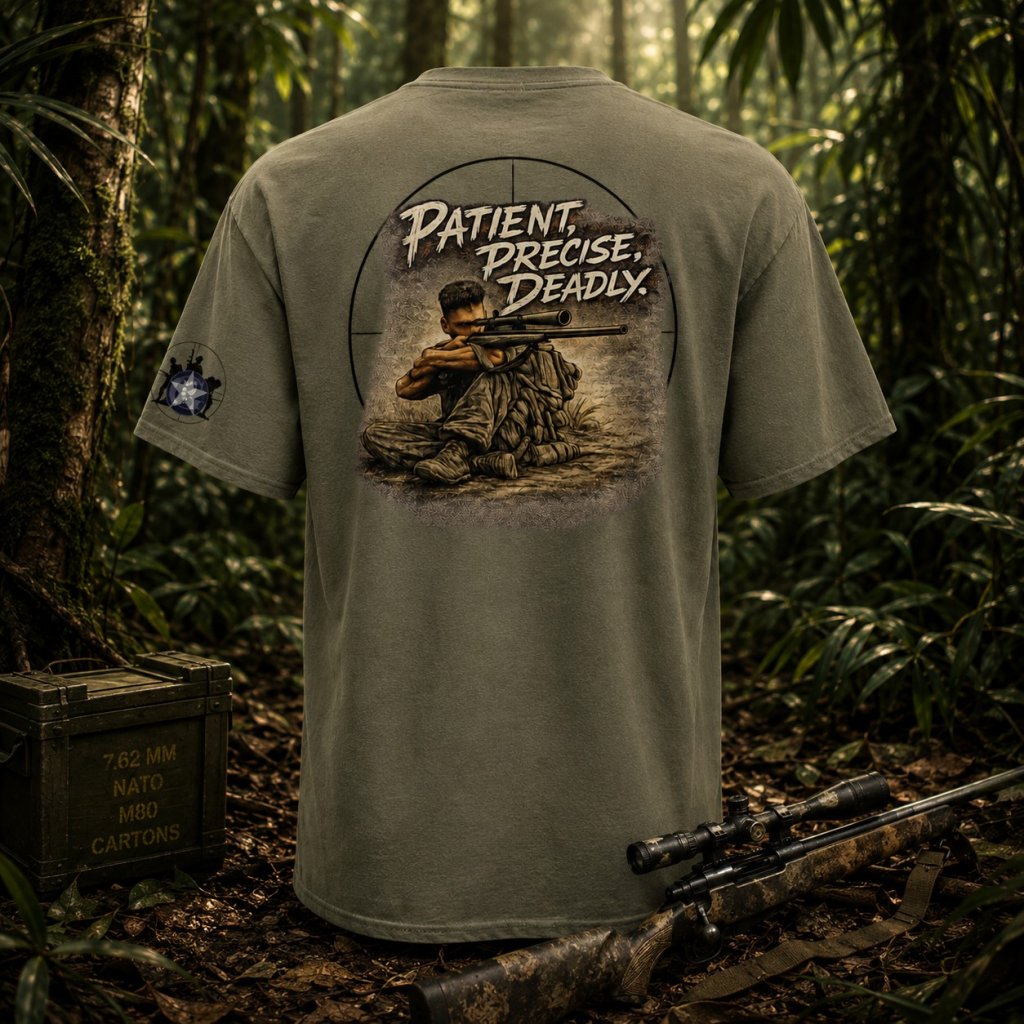
Our sniper shirt was created to honor the skill, patience, and discipline of the men who served behind the scope. Every purchase helps support Ghosts of the Battlefield and our mission to preserve the artifacts, photographs, and stories that keep their history alive.
Click here to shop the sniper shirt and help us keep telling their stories.