The Power of the Ordinary
Worn gloves preserve the memory of Marine Sgt. Nicole Gee, who gave her life helping others during the desperate evacuation from Kabul in 2021, at 23.
August 27, 2026

 They are just gloves.
Worn. Used. Ordinary.
There is nothing about them that immediately demands attention. They have no polished metal, elaborate engraving or obvious connection to a famous battle. In a museum setting, it would be easy to walk past something like them without understanding what they represent.
But these gloves belonged to Sergeant Nicole L. Gee of the United States Marine Corps.
That changes everything.
The wear in their fabric came from the hands of a young Marine who worked, trained and served in them. They are not powerful because they are rare or valuable in the traditional sense. They are powerful because they preserve a direct connection to a life of service that ended far too soon.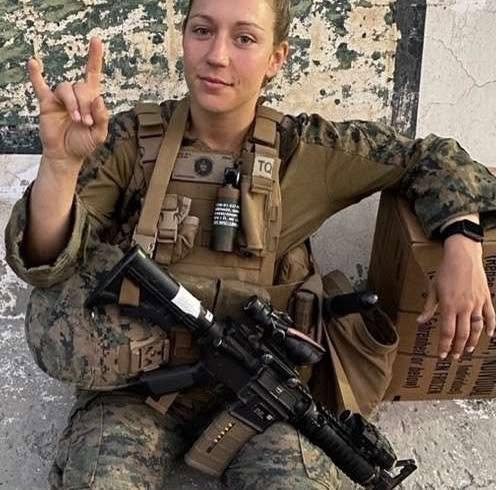
Nicole Leeann Gee was born on May 1, 1998, and grew up in California. She joined the Marine Corps in 2017 and became a maintenance technician responsible for ground electronics transmission systems. It was highly technical work that helped keep communications equipment and other essential systems operating. By 2021, she was serving with Combat Logistics Battalion 24 and the 24th Marine Expeditionary Unit.
Her military occupational specialty may have been maintenance, but the final mission of her life placed her in the middle of one of the largest and most desperate evacuation efforts in modern American history.
In August 2021, Afghanistan collapsed with astonishing speed as Taliban forces advanced across the country and entered Kabul. Thousands of American citizens, allied personnel and Afghan civilians who feared retaliation rushed toward Hamid Karzai International Airport, hoping to escape before the final withdrawal of United States forces.
The mission became known as Operation Allies Refuge.
The airport was surrounded by chaos. Families pressed toward the gates. Parents lifted children above the crowds. Marines and other American service members worked under extreme pressure, attempting to identify those eligible for evacuation while also protecting the airfield against possible attack.
Gee was among the Marines assigned to support the evacuation. Her responsibilities moved far beyond repairing equipment. She searched and processed evacuees, helped control the crowds and cared for vulnerable women and children trying to reach safety.
One photograph came to define how many Americans remember her.
It showed Gee in full combat equipment holding an Afghan infant in her arms. Surrounded by uncertainty, exhaustion and danger, she looked down at the child with care and concentration. She shared the photograph with four simple words.
“I love my job.”
The image captured something larger than a single moment. It showed that military service is not defined only by combat. It can also mean carrying a frightened child, calming a desperate family or standing between vulnerable people and danger. Gee understood the seriousness of the mission, yet she still found purpose in helping those around her.
Six days after sharing that photograph, on August 26, 2021, a suicide bomber affiliated with ISIS-K attacked Abbey Gate at the Kabul airport.
The explosion tore through the crowded entrance. Thirteen American service members were killed, including eleven Marines, one Navy corpsman and one Army soldier. Many Afghan civilians also died in the attack.
Sergeant Nicole Gee was among the fallen.
She was only 23 years old.
 Her death transformed the photograph of her holding the infant into one of the most enduring images of the final days of the war in Afghanistan. It preserved not only what she did, but who she was. She was a Marine performing a dangerous mission, yet she had not lost her ability to show compassion amid the confusion.
Congress later authorized the Congressional Gold Medal to honor the thirteen American service members killed in the attack. The medal recognized their courage and their efforts to protect American citizens and allies during an extraordinarily dangerous evacuation.
National honors preserve sacrifice on the largest scale. Personal belongings preserve it differently.
That is what makes these gloves important.
A medal tells us that Nicole Gee served with courage. A photograph shows us a moment from her final mission. Her gloves bring us closer to the person herself. They remind us that before she became a name carved into a memorial, she was a young Marine who reported for duty, worked with her hands and carried ordinary equipment through ordinary days.
Perhaps these gloves helped her grip tools while maintaining communications systems. Perhaps they were worn during training, aboard ship or while preparing equipment for another mission. Even when every detail of their use cannot be known, the signs of wear remain evidence of a life that was being actively lived.
That is one of the most important purposes of preserving personal artifacts.
Military history is not found only in the grand machinery of war. It also survives in small objects that reveal the human beings who wore the uniforms and operated the equipment. A pair of boots can show the miles someone walked. A handwritten letter can preserve a voice. A faded photograph can return a face to a name.
A pair of gloves can preserve the memory of a Marine who once held a child in the middle of chaos.
Without the story, they might appear insignificant. With the story, every crease and worn surface becomes meaningful. They ask us to pause and recognize that history was not made by machines or governments alone. It was lived by individual people, many of whom carried little more than their issued equipment and a willingness to serve.
The gloves also demonstrate why personal artifacts are so difficult to replace. Another pair from the same manufacturer might appear identical, but it would not carry the same history. These gloves were hers. They existed beside her, traveled with her and remain after she is gone.
They are evidence that Nicole Gee was here.
She served.
She helped others.
She loved her job.
At the age of 23, she gave her life while standing between danger and those desperately searching for safety.
History is not always found in the grand. It is not always made of steel, protected by armor or announced through the roar of machinery. Sometimes history survives quietly in fabric and stitching.
Sometimes the most ordinary objects are all that remain of extraordinary people.
Support the Museum and Its Mission