He Was “Chan”: Remembering Lawrence Chandler Baldwin
A West Point uniform and 1938 yearbook preserve the life of Lawrence “Chan” Baldwin, who endured years as a Japanese prisoner of war.
August 14, 2026

 Before he was an Army officer, a prisoner of war, or a name recorded among the dead of World War II, Lawrence Chandler Baldwin was simply “Chan.”
He was a cadet at the United States Military Academy, a young husband, a new father, and a man preparing to enter a profession that would define—and ultimately consume—his life. Today, his West Point cadet uniform and personal copy of the 1938 Howitzer yearbook are preserved in the Ghosts of the Battlefield collection. Together, they allow us to remember him not only for the suffering he endured, but for the life he lived before war took so much from him.
Baldwin graduated from West Point with the Class of 1938. The gray cadet uniform preserved in our collection represents a period of discipline, study, friendship, and preparation. Its rows of brass buttons, dark piping, and carefully tailored wool reflect the traditions of the academy, but they also belonged to a real young man standing at the beginning of his adult life. His yearbook, bearing his name on the cover, provides another connection to that time. Within its pages is the world Baldwin knew before captivity—a world of classmates, ceremonies, training, ambitions, and possibilities.
He entered military service as the United States and the wider world moved steadily toward war. His assignments eventually carried him from the coastal defenses of Fort Monroe, Virginia, to the Philippines, where American and Filipino forces faced the full force of the Japanese invasion. On Corregidor, the fortified island guarding the entrance to Manila Bay, Baldwin became part of a desperate defense that continued long after hope of reinforcement had faded.
When Corregidor fell in May 1942, Baldwin disappeared into the vast and brutal Japanese prisoner-of-war system. The young officer once photographed in the immaculate uniform of a West Point cadet was now subjected to hunger, disease, forced labor, violence, and years of uncertainty. He passed through places whose names became synonymous with suffering: Bilibid, Cabanatuan, and Davao.
Each transfer carried new dangers. Food was desperately scarce, medical care was almost nonexistent, and prisoners weakened steadily beneath tropical disease and deliberate mistreatment. Survival often depended upon luck, endurance, and the willingness of prisoners to care for one another when nearly everything else had been taken from them.
Late in 1944, Baldwin was among the Allied prisoners forced aboard the Oryoku Maru, one of the Japanese vessels later remembered as “hell ships.” Men were crowded into dark, suffocating holds without adequate food, water, ventilation, or sanitation. Because the ship carried military personnel and equipment and was not clearly marked as transporting prisoners, it became a target for American aircraft.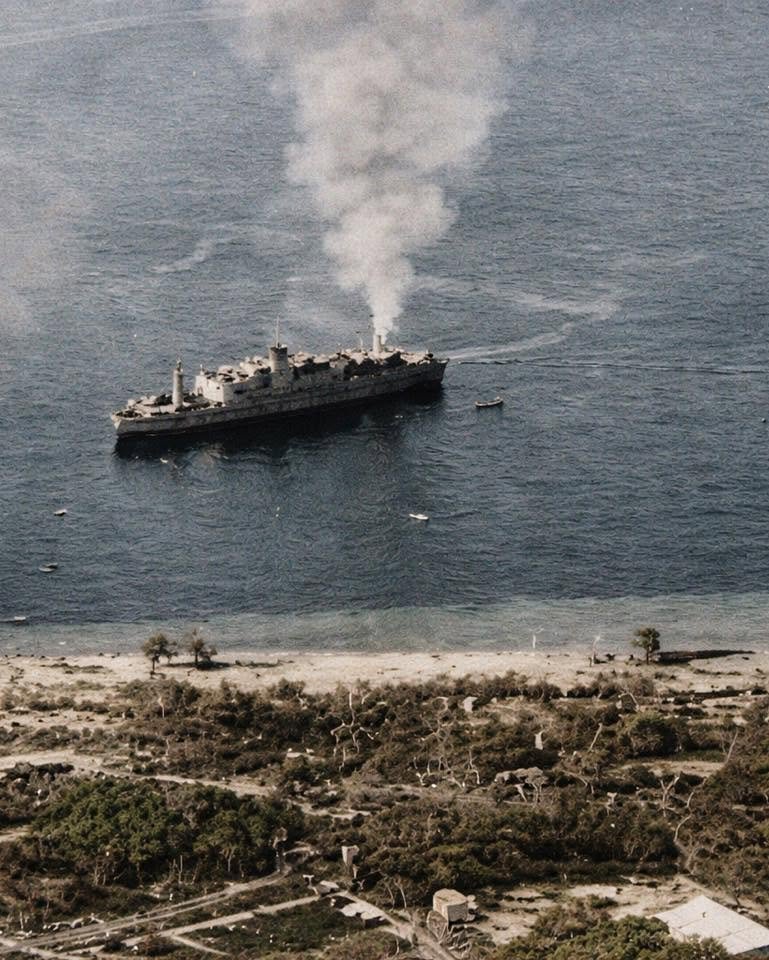
Baldwin survived the bombing and sinking of the Oryoku Maru. He survived another attack during the prisoners’ continued journey. Again and again, he endured circumstances that killed many of the men around him. Yet every stage of captivity took something from him. Years of starvation, illness, exposure, and brutality gradually destroyed the strength of the man who had once stood proudly among his fellow cadets.
On March 4, 1945, far from home, Baldwin died as a prisoner of war. He was separated from his wife, Kay, and from the daughter he would never have the opportunity to watch grow up. His death did not come during a charge or in a celebrated battlefield action. It came through the slow, grinding cruelty of prolonged captivity.
That reality makes the objects he left behind especially powerful.
The cadet uniform does not represent the broken prisoner he became. It represents the man he had been: young, disciplined, hopeful, and preparing for a future he believed still lay ahead. The 1938 Howitzer does not document starvation or imprisonment. It preserves the community in which he studied, trained, laughed, and was known by his classmates as “Chan.”
 These artifacts are not merely examples of a West Point uniform and yearbook. They are witnesses to a life. Their value does not come only from their age or military association, but from their ability to restore individuality to someone whose final years might otherwise be reduced to a list of prison camps, ship movements, and a date of death.
At Ghosts of the Battlefield, preservation means protecting more than objects. It means preserving the people connected to them. A uniform allows us to imagine the young cadet who once wore it. A name embossed on a yearbook reminds us that he had friends, dreams, responsibilities, and a place within a family. Together, these pieces resist the anonymity that so often surrounds wartime loss.
Lawrence Chandler Baldwin deserves to be remembered for his courage and endurance, but his captivity was only part of his life. Before the prison camps and the hell ships, he was a student, an officer, a husband, a father, and a friend.
He was “Chan.”
We preserve his uniform and yearbook so that future generations will understand not simply how he died, but who he was—and why his life mattered.