From the la Drang Valley to the South Tower - A soldiers sacrifice
Rick Rescorla's distinguished military career, particularly during the Battle of Ia Drang, made him a notable figure in both military history and popular culture. During the 9/11 attacks, Rick Rescorla's quick and decisive actions saved many lives.
September 11, 2024

Cyril Richard “Rick” Rescorla lived a life defined by an unusual consistency. Long before September 11, 2001, made his name known to millions, he had already spent decades preparing himself and those around him for moments when fear, confusion, and danger could overwhelm ordinary people. From the battlefields of Vietnam to the stairwells of the World Trade Center, Rescorla repeatedly demonstrated the same kind of leadership: prepare before the crisis, stay calm when it arrives, and take responsibility for the people depending on you.
 Rescorla was born in Hayle, Cornwall, England, on May 27, 1939. His military experience began years before he ever wore an American uniform. He joined the British Army in 1957, trained as a paratrooper, and served during the Cyprus Emergency. After leaving the Army, he served with the Northern Rhodesia Police before eventually making his way to the United States. In 1963, Rescorla enlisted in the U.S. Army, completed basic training at Fort Dix, and then attended Officer Candidate School and airborne training at Fort Benning, Georgia.
Commissioned as an officer, Rescorla was assigned to the 2nd Battalion, 7th Cavalry Regiment, 1st Cavalry Division and deployed to Vietnam. In November 1965, his unit became involved in the Battle of Ia Drang, one of the first major engagements between U.S. Army forces and regular troops of the North Vietnamese Army. Elements of Bravo Company, 2nd Battalion, 7th Cavalry reinforced the hard-pressed American perimeter at Landing Zone X-Ray, placing Rescorla and his men in the middle of some of the most intense fighting of the early Vietnam War.
Rescorla quickly earned a reputation as an aggressive and dependable combat leader. His soldiers called him “Hard Core,” but the nickname only captured part of the man. His toughness was matched by genuine concern for the men he commanded. Lt. Col. Hal Moore would later describe him as “the best platoon leader I ever saw.” Rescorla received the Silver Star, Bronze Star with an oak leaf cluster, Purple Heart, and Vietnamese Cross of Gallantry for his military service.
One of the more unusual characteristics of Rescorla’s leadership was his willingness to sing when others were frightened. During the fighting in Vietnam, he sometimes used songs to steady his soldiers during moments of tremendous stress. It was not simply entertainment. Rescorla understood that fear could spread quickly through a group and that a leader’s voice, confidence, and behavior could influence everyone around him. Decades later, surrounded by smoke and thousands of frightened civilians rather than soldiers, he would use exactly the same technique.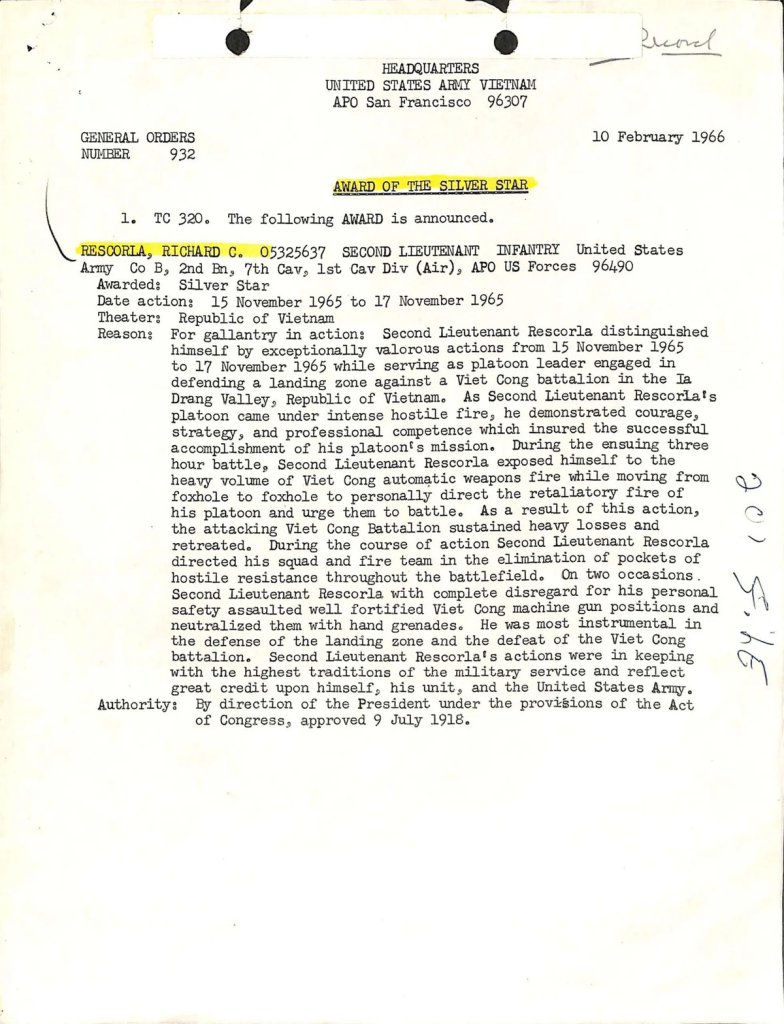
Rescorla left active Army service in 1967 but continued serving in the Army Reserve, eventually retiring as a colonel. He also pursued an education, earning degrees in English and law and later teaching criminal justice at the University of South Carolina. Eventually he moved into corporate security, joining Dean Witter Reynolds at the World Trade Center and later becoming a senior security official with Morgan Stanley.
It was there that another side of Rescorla’s military experience became critically important. He did not believe security began when something went wrong. Security meant preparing people beforehand so they would know what to do when there was no time to debate it. After the 1993 bombing of the World Trade Center, Rescorla became increasingly concerned that the complex remained a terrorist target. He reportedly recommended that the company move its operations away from the World Trade Center, but when that did not happen, he concentrated on preparing employees to survive another attack. He instituted regular evacuation drills and insisted that employees actually participate. Executives were not exempt. Workers learned where to go, which stairways to use, how to move together, and what was expected of them during an emergency. To some employees, the drills could probably seem excessive. On September 11, 2001, they became the reason thousands of people already knew what to do.
At 8:46 that morning, American Airlines Flight 11 struck the North Tower of the World Trade Center. Rescorla could see the burning tower from the South Tower, where Morgan Stanley occupied numerous floors. An announcement over the building's public-address system initially advised occupants of the South Tower that the building was secure and that they could remain or return to their offices. Rescorla rejected that advice. He began ordering Morgan Stanley employees to evacuate immediately. Because his people had rehearsed the procedure repeatedly, thousands were not encountering their evacuation plan for the first time during an actual catastrophe. They began moving toward the stairwells. Rescorla moved among them carrying his bullhorn and communications equipment, directing people toward safety and maintaining order. And once again, as he had with frightened soldiers in Vietnam, he sang. In an environment filled with uncertainty, smoke, alarms, and rumors, his voice gave people something recognizable to concentrate on while they continued downward.
 At 9:03 a.m., United Airlines Flight 175 struck the South Tower. The evacuation continued. Rescorla's preparation and refusal to accept the initial instruction to remain inside are credited with saving thousands of lives. U.S. Army accounts have credited him with helping save 2,687 Morgan Stanley employees, while the National September 11 Memorial & Museum describes more than 2,500 employees being evacuated from the South Tower. Nearly the entire Morgan Stanley workforce at the World Trade Center survived. Thirteen Morgan Stanley employees and contractors were killed in the attacks.
Rick Rescorla could have been among those already safely outside. Instead, he went back.
After helping move others toward safety, Rescorla returned into the South Tower to search for people who might still be inside. When a colleague urged him to leave, Rescorla replied, “As soon as I make sure everyone else is out.”
He was last seen on approximately the 10th floor, moving upward through the building.
At 9:59 a.m., the South Tower collapsed. Rick Rescorla never came out. His remains were never identified.
The remarkable thing about Rescorla's actions on September 11 is that they were not completely unexpected when viewed against the rest of his life. The man walking upward through the South Tower was the same leader who had stood with soldiers in Vietnam decades earlier. The surroundings had changed. The people following him were office workers instead of infantrymen. The danger came from fire and structural collapse instead of enemy gunfire. But his responsibility, as he understood it, had not changed. Take care of your people.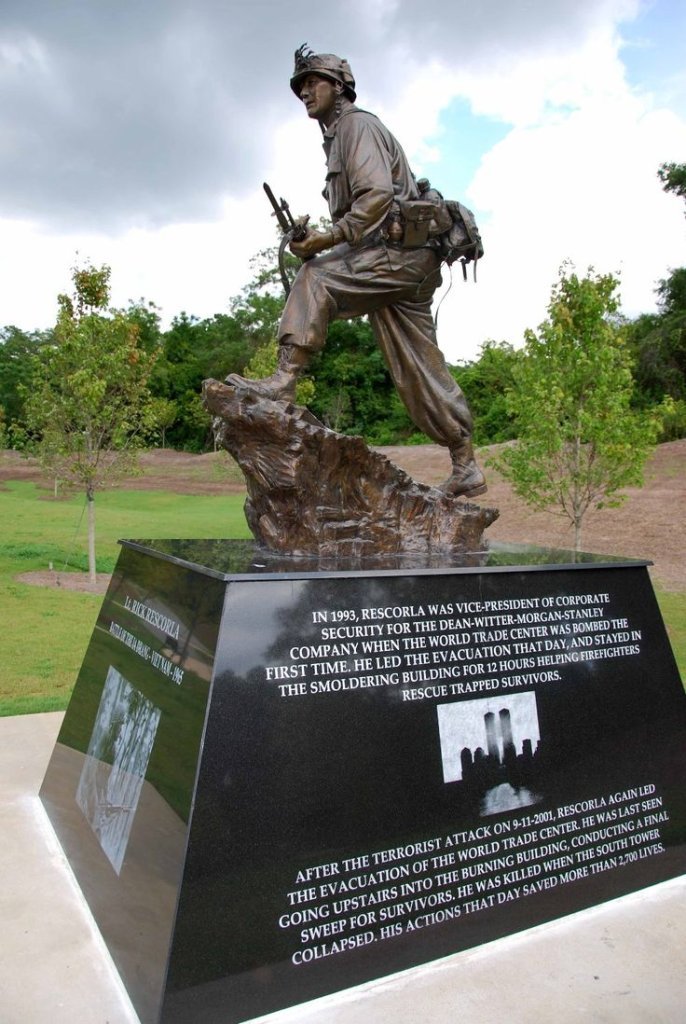
Rescorla was inducted into the Officer Candidate School Hall of Fame in 2001, recognition of a military career that had already made him an extraordinary figure before September 11. In 2019, he was posthumously awarded the Presidential Citizens Medal for his actions at the World Trade Center. Memorials to him now stand both within the military community and at the National September 11 Memorial.
Rick Rescorla is sometimes described as a hero of Ia Drang and a hero of September 11, as though those were two separate stories separated by thirty-six years. In many ways, they were the same story. In Vietnam, he learned that frightened people look toward someone who appears to know what must be done. He learned that preparation made survival more likely, that leadership meant being present when danger was greatest, and that sometimes a familiar song could steady people when little else could. On September 11, 2001, thousands of people discovered what Rick Rescorla's soldiers had learned decades earlier.
When everything began falling apart, follow Rick.
The ghosts of the battlefield are counting on us to remember them. Help preserve their stories.