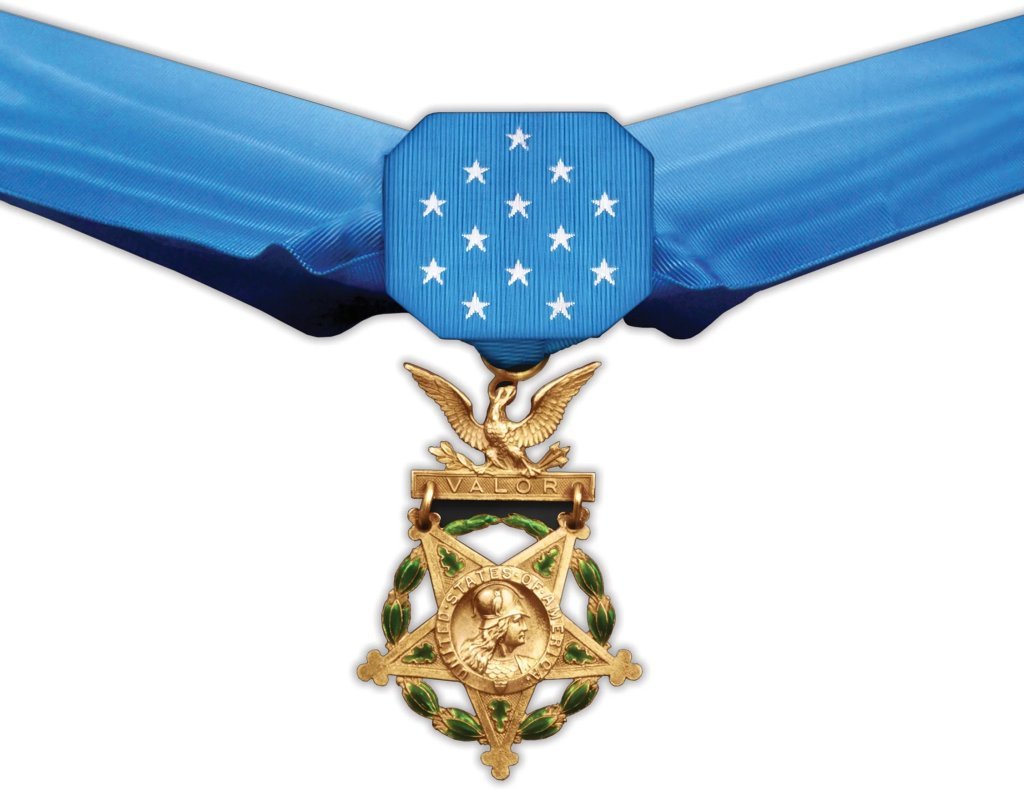
Medal of Honor - Joe M. Nishimoto - World War II
Joe M. Nishimoto broke through heavily defended German positions near La Houssière, France, on November 7, 1944, attacking multiple machine-gun positions alone. His extraordinary assault ultimately earned him the Medal of Honor.
August 16, 2026

For three days, the men of Company G, 442nd Regimental Combat Team, had tried to force the Germans from a strongly defended ridge near La Houssière, France. The fighting had taken place in the miserable conditions of the Vosges Mountains, where dense forests, steep terrain, mines, and concealed enemy positions made even short advances dangerous. By November 7, 1944, repeated attempts to break the German defenses had failed.
Private First Class Joe M. Nishimoto decided to try something different.
Nishimoto was serving as an acting squad leader when he began moving forward alone. Ahead of him lay ground known to contain mines and booby traps, while German machine guns protected the ridge. Crawling carefully through the danger, he worked his way toward the enemy positions without waiting for the rest of his squad to follow.
Eventually he spotted a German machine-gun emplacement.
Nishimoto closed on the position and threw a grenade into it, destroying the nest and eliminating one of the strongpoints that had helped hold Company G in place.
He did not stop there.
Moving around the battlefield, Nishimoto approached a second German machine-gun position from the rear. This time he closed to extremely short range and opened fire with his submachine gun. One German gunner was killed and another wounded.
Two enemy riflemen attempted to escape.
Nishimoto pursued them.
He killed one of the fleeing soldiers while the other retreated from the area. Still pressing the attack, Nishimoto moved against yet another German machine-gun crew and forced the men to abandon their position.
What had begun as the action of a single infantryman now had consequences across the German defensive line. The positions Nishimoto attacked were not isolated targets. They were key strongpoints supporting the enemy's hold on the ridge. As those positions disappeared one after another, the German defenders lost the ability to maintain their line.
They withdrew from the sector.
After three days in which Company G had been unable to dislodge the enemy, Joe Nishimoto's individual assault had broken through the defenses that had stopped them.
The official record is striking for how simple the sequence appears on paper: crawl through a mined area, destroy one machine gun, circle behind another, attack at point-blank range, pursue enemy riflemen, then drive another gun crew from its position.
There was nothing simple about actually doing it.
Every movement forward exposed Nishimoto to German fire and to explosives hidden beneath or around the ground he crossed. He had no guarantee that the next position he approached was unprotected or that another enemy weapon was not already covering it. Once he began the assault, however, he continued moving from one threat to another until the defenses confronting his company began to collapse.
Nishimoto survived the action on November 7, but only briefly.
Approximately one week later, the twenty-five-year-old soldier was killed in combat in France. The men who had watched him attack the ridge would return home without him.
For his extraordinary actions near La Houssière, Nishimoto was initially awarded the Distinguished Service Cross, the United States Army's second-highest decoration for valor. His courage had been recognized, but decades later the Army reconsidered whether Japanese American soldiers such as Nishimoto had received the level of recognition their actions deserved.
In the 1990s, a review examined awards presented to Asian American servicemen during World War II to determine whether racial prejudice had affected Medal of Honor decisions. Nishimoto's actions on November 7 were among those reconsidered.
The review concluded that his heroism met the standard for the Medal of Honor.
On June 21, 2000, President Bill Clinton conducted a White House ceremony recognizing Asian American World War II veterans whose decorations had been upgraded. Joe Nishimoto had been dead for more than fifty-five years. His eldest sister, Akie, accepted the Medal of Honor on his behalf.
The medal finally placed Nishimoto among the twenty-one Medal of Honor recipients associated with the extraordinary combat history of the 100th Infantry Battalion and 442nd Regimental Combat Team.
Yet the decoration did not change what happened on that ridge in France.
For three days the Germans had held.
Then Joe Nishimoto crawled forward.
He destroyed one position, attacked another from behind, pursued the retreating enemy, and drove another machine-gun crew from its emplacement.
By the time his assault ended, the German defenders were leaving the ridge.
Joe M. Nishimoto would not survive the war, but on November 7, 1944, one soldier's determination accomplished what repeated attacks had been unable to do.
He broke the line.
Medal of Honor Citation:
Private First Class Joe M. Nishimoto distinguished himself by extraordinary heroism in action on 7 November 1944, near La Houssiere, France. After three days of unsuccessful attempts by his company to dislodge the enemy from a strongly defended ridge, Private First Class Nishimoto, as acting squad leader, boldly crawled forward through a heavily mined and booby-trapped area. Spotting a machine gun nest, he hurled a grenade and destroyed the emplacement. Then, circling to the rear of another machine gun position, he fired his submachine gun at point-blank range, killing one gunner and wounding another. Pursuing two enemy riflemen, Private First Class Nishimoto killed one, while the other hastily retreated. Continuing his determined assault, he drove another machine gun crew from its position. The enemy, with their key strong points taken, were forced to withdraw from this sector. Private First Class Nishimoto's extraordinary heroism and devotion to duty are in keeping with the highest traditions of military service and reflect great credit on him, his unit, and the United States Army.