Medal of Honor: James Lewis Day – World War II – May 14–17, 1945
On Sugar Loaf Hill, Corporal James Lewis Day and a handful of Marines held an exposed position for three days against repeated Japanese attacks. Wounded and exhausted, Day refused to give up a single yard.
August 18, 2026

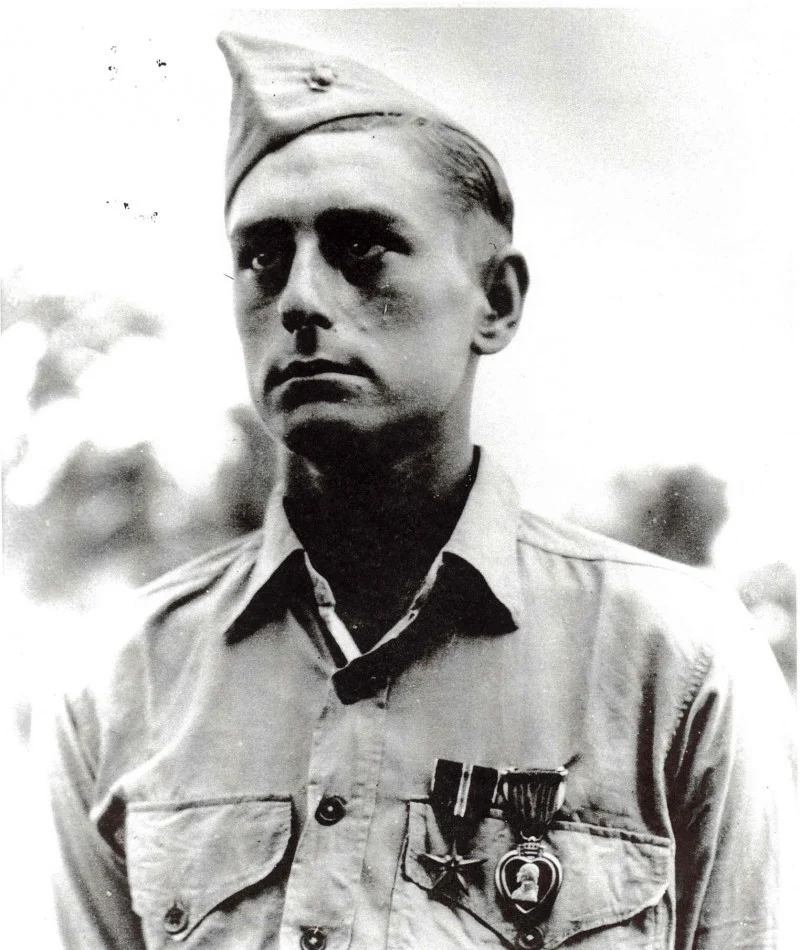 Name: James Lewis Day
 Name:
Name:Rank at Time of Action: Corporal
Highest Rank: Major General
Branch: United States Marine Corps
War: World War II
Unit: 2nd Battalion, 22nd Marines, 6th Marine Division
Dates of Action: May 14–17, 1945
Location: Okinawa, Ryukyu Islands
Summary of Action
During the Battle of Okinawa, Sugar Loaf Hill became one of the most fiercely contested positions in the Pacific War. The Japanese had constructed an elaborate defensive system of bunkers, tunnels, machine-gun positions, and artillery sites across the surrounding terrain.
Corporal James Lewis Day was serving as a squad leader with the 2nd Battalion, 22nd Marines, 6th Marine Division when his unit became locked in the brutal struggle for the hill.
On the first day of the action, Day rallied his own squad along with survivors from another unit and led them into a critical position forward of the Marine lines.
Almost immediately, they came under intense Japanese mortar and artillery fire.
The bombardment was followed by a powerful ground assault involving approximately forty enemy soldiers.
Despite losing half of his men, Day refused to give ground. Remaining at the front of the position, he threw grenades, directed rifle fire, and shouted encouragement to the Marines around him until the enemy assault was broken.
Six Marines later reinforced the position.
During the night, Day led his small force in repelling three additional enemy attacks. Five of the reinforcements were killed and another Marine was wounded.
When Day heard nearby wounded Marines calling for a corpsman, he repeatedly left the relative protection of his position and moved through enemy fire to assist them.
One at a time, he escorted four seriously wounded Marines to safety.
Then he returned to the fight.
With the assistance of another wounded Marine, Day manned a light machine gun and stopped yet another nighttime assault.
During that engagement, the machine gun was destroyed and Day suffered multiple white phosphorus and fragmentation wounds.
He continued fighting.
Despite his injuries and the loss of most of the men around him, Day reorganized the defensive position and prepared for another attack.
The Japanese came again.
Using small-arms fire at extremely close range, Day and the remaining Marines stopped the assault. On three separate occasions enemy soldiers advanced to within only a few feet of his foxhole, and Day personally killed them before they could overrun the position.
The following day brought more attacks.
Enemy troops repeatedly swarmed the exposed Marine position, but Day continued to hold.
When the fighting momentarily subsided, more than seventy Japanese dead were counted around his position.
Day was wounded, exhausted, and almost completely isolated.
He still refused to withdraw.
On the third day, the enemy launched one final assault.
Day again engaged them at close range, killing approximately twelve enemy soldiers during the attack.
When the battle finally ended, Corporal James Lewis Day had held his position for three days without yielding ground.
More than one hundred enemy dead lay around the Marine defenses.
His extraordinary stand preserved the lives of fellow Marines and contributed significantly to the eventual defeat of the Japanese defenses around Sugar Loaf Hill.
Medal of Honor Citation
JAMES LEWIS DAY
Rank and organization: Corporal, United States Marine Corps.
Unit: 2nd Battalion, 22nd Marines, 6th Marine Division.
Place and date: Okinawa, Ryukyu Islands, May 14–17, 1945.
Citation:
For conspicuous gallantry and intrepidity at the risk of his own life above and beyond the call of duty as a Squad Leader in sustained combat operations against Japanese forces.
On the first day, Corporal Day rallied his squad and the remnants of another unit and led them to a critical position forward of the front lines of Sugar Loaf Hill.
Soon thereafter, they came under an intense mortar and artillery barrage that was quickly followed by a ferocious ground attack by some forty Japanese soldiers.
Despite the loss of one-half of his men, Corporal Day remained at the forefront, shouting encouragement, hurling hand grenades, and directing deadly fire, thereby repelling the determined enemy.
Reinforced by six men, he led his squad in repelling three fierce night attacks but suffered five additional Marines killed and one wounded, whom he assisted to safety.
Upon hearing nearby calls for corpsman assistance, Corporal Day braved heavy enemy fire to escort four seriously wounded Marines, one at a time, to safety.
Corporal Day then manned a light machine gun, assisted by a wounded Marine, and halted another night attack.
In this ferocious action, his machine gun was destroyed, and he suffered multiple white phosphorous and fragmentation wounds.
He reorganized his defensive position in time to halt a fifth enemy attack with devastating small arms fire.
On three separate occasions, Japanese soldiers closed to within a few feet of his foxhole, but were killed by Corporal Day.
During the second day, the enemy conducted numerous unsuccessful swarming attacks against his exposed position.
When the attacks momentarily subsided, over 70 enemy dead were counted around his position.
On the third day, a wounded and exhausted Corporal Day repulsed the enemy's final attack, killing a dozen enemy soldiers at close range.
Having yielded no ground and with more than 100 enemy dead around his position, Corporal Day preserved the lives of his fellow Marines and made a significant contribution to the success of the Okinawa campaign.
By his extraordinary heroism, repeated acts of valor, and quintessential battlefield leadership, Corporal Day inspired the efforts of his outnumbered Marines to defeat a much larger enemy force, reflecting great credit upon himself and upholding the highest traditions of the Marine Corps and the United States Naval Service.