Barney Hajiro: The Fighter Who Went for Broke
Barney Hajiro rose from a Maui plantation to become a 442nd RCT hero, earning the Medal of Honor for extraordinary courage during the rescue of the Lost Battalion.
October 22, 2025

 Long before Barney Fushimi Hajiro charged a German-held hillside in France with a Browning Automatic Rifle in his hands, the United States Army had decided that a man of his ancestry should not be trusted with a weapon. That makes what happened later difficult to ignore.
Hajiro was born on September 16, 1916, in Puʻunene on the Hawaiian island of Maui, the son of Japanese immigrants Shiroichi and Satsuyo Hajiro. His family had little money, and Barney left school after the eighth grade to help support them. He worked in the sugar fields and later in the pineapple industry, but there was another side to the small, wiry young man from Maui. He loved athletics, ran competitively, and dreamed at one point of going to college and becoming a track star.
Life had other plans. By 1940 Hajiro had moved to Honolulu. He registered for the draft that October and entered the Army on February 1, 1942, less than two months after the Japanese attack on Pearl Harbor changed Hawaii and the lives of Japanese Americans forever. Hajiro was an American soldier, but because he was of Japanese ancestry, the Army did not initially treat him like other American soldiers. Assigned first to the 298th Infantry and later to the 370th Engineers, he remembered training without weapons. Instead of learning to fight, the Japanese American soldiers built barbed-wire obstacles, constructed pillboxes, performed labor, and watched others carry the rifles they were not allowed to have.
For a man like Hajiro, it was maddening. When the Army announced the creation of the 442nd Regimental Combat Team in 1943 and called for Japanese American volunteers, Hajiro stepped forward. He was one of thousands of young men from Hawaii who volunteered for a unit that would be asked to prove something no American soldier should have had to prove: that ancestry did not determine loyalty.
 The men sailed from Hawaii in April 1943 and traveled across the country to Camp Shelby, Mississippi. There Hajiro was assigned to M Company, the heavy-weapons company of the 442nd's 3rd Battalion. He trained as a messenger and runner and became known among the men for another talent. Hajiro could box. Veterans later remembered him as a genuinely skilled boxer, not merely one of the soldiers who occasionally settled arguments with his fists. Camp life also revealed a less heroic but wonderfully human side of him. Hajiro admitted that he frequently could not afford trips into nearby Hattiesburg because other soldiers had relieved him of his pay at the crap tables.
He was not yet the figure who would someday stand in the White House wearing the Medal of Honor. He was Barney, a plantation kid from Maui, a runner, a boxer, occasionally broke, occasionally troublesome, and very eager to prove himself.
The 442nd sailed for Europe in May 1944 and entered combat in Italy the following month. Hajiro served through the Rome-Arno Campaign with M Company. Then an incident occurred that changed the direction of his war. While the regiment was resting near Vada, Italy, Hajiro encountered a fight between an Italian civilian and another soldier from the 442nd. Although he did not know the soldier, Hajiro could not stand by while another American was being beaten, so he jumped into the fight. Military police arrived. The other participant escaped. Hajiro did not.
He was returned to M Company, where his commander had apparently had enough of Barney's talent for finding trouble. Hajiro received a summary court-martial and was transferred out of the heavy-weapons company into I Company, a rifle company where the opportunities for fighting would be considerably less recreational. The punishment would become one of the strange turning points of Hajiro's life.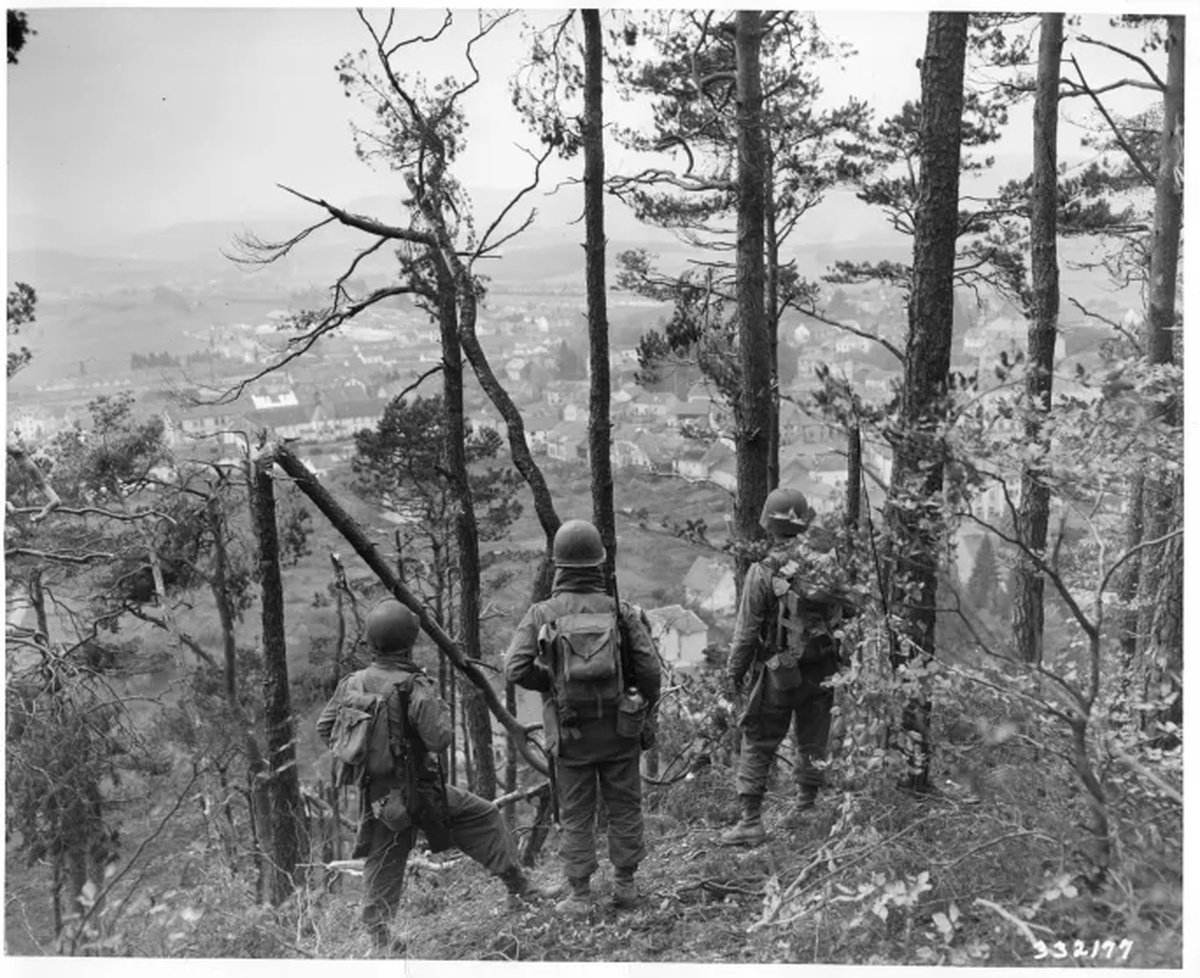
When he reported to I Company, Hajiro tried to explain himself. He had not joined the fight simply because he wanted trouble, he insisted. He had stepped in because one of their own men was being beaten. Then he made something resembling a promise. Someday, he would show them he was not a bad guy.
Hajiro asked to join Tech Sergeant Kazumi Matsunami's squad as a Browning Automatic Rifleman. The BAR was a heavy weapon for an infantryman to carry, weighing roughly twenty pounds before ammunition and other equipment were considered. It provided a squad with mobile automatic fire, and the man carrying it could quickly attract the attention of the enemy. Hajiro wanted it. He received the weapon and had only about a week to become comfortable with it before returning to combat. The man who had begun his Army service prohibited from carrying a rifle was now carrying one of the most powerful individual weapons in an American infantry squad.
In September 1944, the 442nd left Italy for southern France. By October, the regiment was fighting through the Vosges Mountains, an environment completely unlike the sunny countryside the men had known in Italy. Cold rain soaked their summer uniforms. Forests restricted visibility. German positions were concealed among trees and steep ridges. Artillery exploding in the treetops showered soldiers below with fragments and splintered timber. Foxholes filled with water. Men fought, ate, slept, and sometimes died in a landscape that seemed designed to exhaust them.
Hajiro excelled there. On October 19, near Bruyères, he deliberately exposed himself on an embankment while firing his BAR against a German strongpoint and enemy snipers. Three days later, while on outpost duty, Hajiro and another soldier encountered an eighteen-man German patrol. Hajiro waited until the enemy was close, opened fire, and helped force the surviving Germans to surrender. His platoon sergeant later remembered Hajiro bringing the prisoners back through the mist, BAR ready, as though escorting a heavily armed enemy patrol into American lines were an entirely ordinary way to finish a shift on security.
Those actions would later become part of his Medal of Honor citation, but the defining moment was still ahead. Late in October, the exhausted soldiers of the 442nd were ordered back into the Vosges to rescue a battalion of the 141st Infantry Regiment, 36th Infantry Division, that had become surrounded by German forces. The trapped soldiers became known as the Lost Battalion. Reaching them meant attacking through miserable terrain against deeply entrenched German defenders. The fighting became a brutal contest measured in individual trees and yards of forest. The 442nd suffered terribly as it pushed forward.
On October 29, Hajiro's battalion encountered a German position strong enough to stop the advance. Attempts to flank it failed. Men were pinned down. Machine guns and snipers covered the approaches. Soldiers trying to rise were quickly hit. Hajiro's comrades were being wounded and killed around him.
Then Barney Hajiro stood up.
With his BAR firing, he began moving toward the German positions. He ran approximately one hundred yards uphill through enemy fire, moved ahead of the men around him, located concealed machine-gun positions and attacked them. He destroyed two machine-gun nests and killed enemy snipers as the men of I and K Companies began rising and following him. Men who had been pinned down moments before were suddenly charging. The attack became a wave.
Hajiro later remembered surprisingly little about parts of it. When asked years afterward why he had done it, his explanation stripped away any attempt to make the moment sound grand. His buddies were being killed. Someone had to do the job.
During the charge, German bullets struck Hajiro in the left side, shoulder, cheek, and wrist. Other rounds knocked away his helmet and smashed his BAR. Bleeding heavily and stunned, he continued trying to move forward until medical personnel finally forced him down and evacuated him. The hill was taken. The following day, the men of the 442nd reached the trapped soldiers of the Lost Battalion. The rescue became one of the defining actions in the history of the regiment, purchased at a terrible cost. Hajiro, James Okubo, and George Sakato would eventually receive Medals of Honor for actions connected with the battle.
Hajiro would not return to the fight. His wounds were too severe. He was moved through military hospitals and eventually returned to the United States. His damaged wrist continued to cause problems, and his recovery lasted long after the shooting in Europe had ended. He did not finally return to Hawaii until February 1946.
His wartime commander had recommended him for the Medal of Honor. Instead, Hajiro received the Distinguished Service Cross, the Army's second-highest decoration for valor. The recognition did not end there. In 1948 Britain presented him with the Military Medal for his wartime service. Decades later, France would make him a member of the Légion d'honneur.
But after the parades and ceremonies, Hajiro returned to something much more ordinary. He married Esther Yurie Yamada. They raised two sons. Hajiro worked as a guard and eventually spent many years as a security guard at Pearl Harbor Naval Base before retiring. The former BAR man who had once charged through German machine-gun fire spent much of his postwar working life quietly protecting the naval installation that had helped pull America into the war in the first place.
By the 1990s, the United States government had begun reviewing the cases of Asian American servicemen whose extraordinary World War II valor had not resulted in Medals of Honor. The review concluded that racial discrimination had affected the wartime awards process. On June 21, 2000, President Bill Clinton presented Medals of Honor to seven living recipients during a White House ceremony and recognized others posthumously. Barney Hajiro was among the men standing there. More than half a century had passed since the Vosges. His Distinguished Service Cross was upgraded to the Medal of Honor.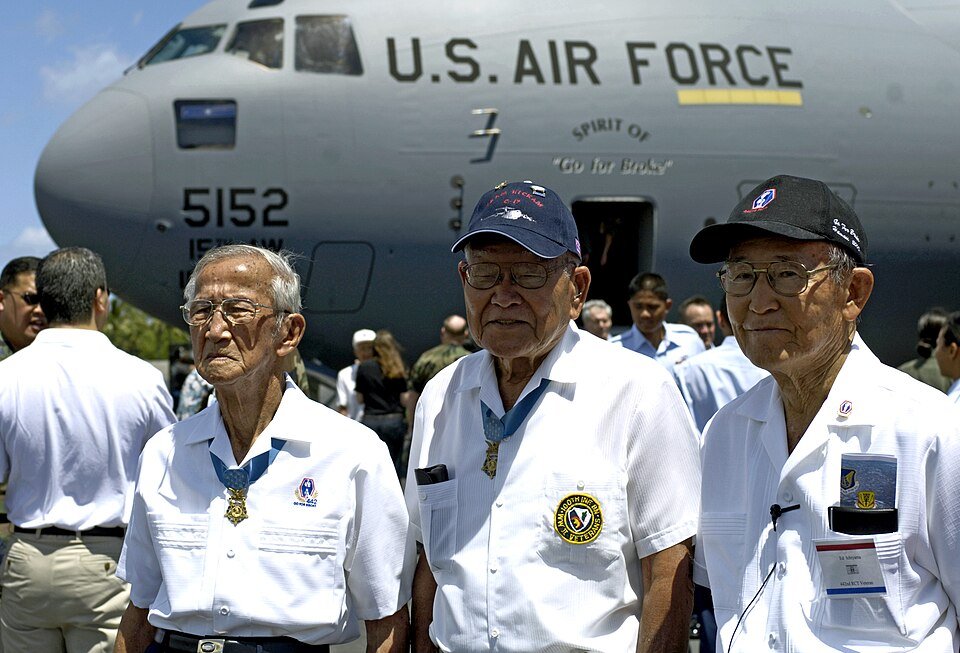
Yet Hajiro consistently resisted the idea that the story belonged only to him. When France awarded him the Légion d'honneur in 2004, he emphasized that the fighting had been a team effort, that all of them had fought the battle together. That may be the most fitting way to understand him. The Medal of Honor hangs around one man's neck, but Hajiro remembered the men who had been standing beside him.
Barney Fushimi Hajiro died on January 21, 2011, at the age of 94. At the time of his death, he was the oldest living Medal of Honor recipient. He was buried with full military honors at the National Memorial Cemetery of the Pacific at Punchbowl in Honolulu. His grave bears the words that had come to define the soldiers of the 442nd: Go For Broke.
Those words fit Hajiro unusually well. He had grown up poor on a Maui plantation and left school to help his family. He entered an Army that initially would not trust him with a rifle because his parents had been born in Japan. When finally given the opportunity to fight for his country, he carried a BAR into some of the worst combat the 442nd experienced. He was an athlete, boxer, gambler, occasional troublemaker, husband, father, and working man. He was also the soldier who stood up when everyone had good reason to stay down.
 The Medal of Honor tells us what Barney Hajiro did during three extraordinary days in October 1944. The rest of his story tells us who the man was. And that is why Barney Hajiro belongs not only among the Medal of Honor recipients of World War II, but at the heart of the story of the 442nd Regimental Combat Team.