Joe Hayashi: From Pasadena to the Last Battles of the 442nd *
Joe Hayashi left behind a family confined at Heart Mountain to join the 442nd in combat, giving his life in Italy only days before the German surrender.
August 16, 2026

 Joe Ryo Hayashi was born on August 14, 1920, in Salinas, California, the son of Chiukichi and Toyo Hayashi, Japanese immigrants who had come to the United States in the early years of the twentieth century. His childhood was touched by tragedy almost immediately. When Joe was only four years old, his father was killed in an electrical accident while working on a ranch in Monterey County. His mother moved the family to Pasadena, where she later married Kakichi “Jimmie” Nakawatase and expanded the household with three more children. Joe grew up surrounded by brothers and sisters in a working-class family whose life, like those of thousands of Japanese American families in California, would eventually be transformed by war.
Before the Army and the 442nd Regimental Combat Team made his name part of American military history, Hayashi was an energetic young Californian with an unusually wide range of interests. He attended schools in Pasadena and played football at John Muir Technical High School. He loved baseball, hunting, fishing, and being outdoors, belonged to Boy Scout Troop 41, studied kendo at the local Japanese cultural center, and raised pigeons. He also had the mechanical ability that would become his trade, repairing automobiles and even building his own boat. Somewhere among all of this he apparently found time to bottle homemade root beer, a wonderfully ordinary detail in the life of a man history usually remembers only in uniform.
By 1940 Hayashi was working as an automobile mechanic in Pasadena. He was small in stature, recorded on his draft registration as only five feet three and a half inches tall and weighing about 125 pounds, but nothing about the life ahead of him would be small. On May 19, 1941, seven months before the United States entered World War II, Hayashi voluntarily enlisted in the United States Army. That timing matters. Like Shizuya Hayashi, with whom he is sometimes understandably confused, Joe Hayashi was already serving his country before Pearl Harbor made Japanese American loyalty a national political issue.
Hayashi was initially stationed at the Presidio of San Francisco and later at the Port of Stockton. After the Japanese attack on Pearl Harbor on December 7, 1941, he was transferred to Fort Sheridan, Illinois. While Joe remained in uniform, the government turned against his family at home. In May 1942, his mother, stepfather, half-brother, and half-sisters were forcibly removed from Pasadena and sent first to the Pomona Assembly Center at the Los Angeles County Fairgrounds. In August they were transferred to the War Relocation Authority camp at Heart Mountain, Wyoming. Joe Hayashi was serving in the United States Army while members of his own family were confined behind barbed wire by the government he served.
When the 442nd Regimental Combat Team was organized in 1943, Hayashi was transferred to Camp Shelby, Mississippi, and assigned to Company K, 3rd Battalion. His military experience made him useful as a trainer, and he served as part of the cadre preparing the newly formed Nisei regiment for combat. Unlike many of the men arriving at Camp Shelby, Hayashi had already spent almost two years in uniform. He helped turn volunteers and new soldiers into infantrymen while the regiment prepared for deployment overseas.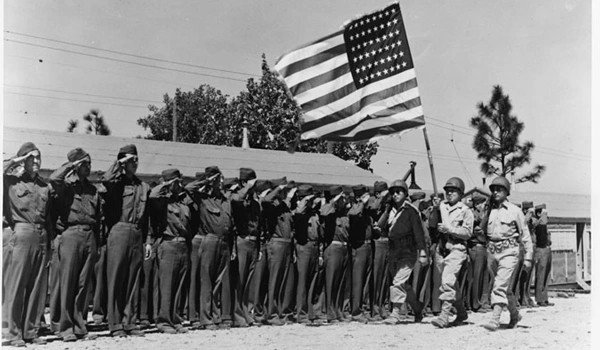
When the 442nd left Camp Shelby for Europe in April 1944, Hayashi did not go with it. According to his family history, he remained behind as part of the training cadre. He had also been able to visit his family at Heart Mountain several times. For a man whose relatives were confined in Wyoming while he wore an Army uniform, remaining in the United States might have offered at least some continued connection to them. Instead, in October 1944, Hayashi volunteered to leave the training assignment and join the 442nd in combat overseas.
He shipped for Europe and reached the regiment in November 1944, just as the terrible fighting in the Vosges Mountains was ending. The 442nd had suffered devastating casualties during the battles around Bruyères, Biffontaine, and the rescue of the so-called Lost Battalion. Hayashi joined a combat team whose ranks had been badly depleted and whose reputation had already been earned at an extraordinary price. He served with the regiment during its assignment along the French-Italian border in the Maritime Alps, where the exhausted soldiers guarded the front and rebuilt their strength after the Vosges campaign.
While Joe was overseas, another blow struck his family. His stepfather, Jimmie Nakawatase, died at Heart Mountain in December 1944. Joe's mother and younger family members remained confined there. The war had separated the family across continents: Joe was serving with the 442nd in Europe while the people he had grown up with remained incarcerated in Wyoming.
In March 1945, the 442nd was ordered back to Italy. Allied commanders wanted the regiment for an assault against the western end of the Gothic Line, the formidable German defensive system across northern Italy. The Nisei soldiers were initially intended to conduct a diversion that would draw German reserves away from the main Allied offensive. Instead, the 442nd accomplished far more. Moving secretly through mountainous terrain and climbing steep slopes at night, its soldiers broke positions that had resisted previous attacks for months. The diversion became a breakthrough, and the Germans began retreating through northern Italy.
 Hayashi was now fighting with Company K during the final weeks of the European war. The photographs from those days show exactly the country the 442nd faced: steep mountains, narrow roads, stone villages, German prisoners moving toward the rear, and American infantrymen scrambling for cover beneath artillery fire. By mid-April the Germans were withdrawing, but retreat did not mean the fighting had become safe. Enemy troops still occupied commanding hills and villages and continued to defend routes needed for their escape.
On April 20, near the village of Tendola, Hayashi was ordered to lead men against a strongly defended hill controlling the approaches to the village. He brought his patrol to within approximately seventy-five yards of the German positions before enemy fire erupted. When several of his men were wounded, Hayashi pulled them to safety. He then returned alone into exposed ground and deliberately placed himself under small-arms fire so he could observe the German positions and direct mortar fire onto them. When Hayashi and the remaining soldiers finally attacked the hill, they discovered that the mortar fire he had directed had neutralized three machine guns, killed twenty-seven enemy soldiers, and wounded others.
Two days later, on April 22, Company K was again attacking near Tendola. Hayashi maneuvered his squad up a steep terraced hillside until they were within approximately one hundred yards of German defenses. Under intense fire he crawled toward an enemy machine gun and attacked it with a grenade, killing one of the crew and forcing the others to surrender. From that position he saw four additional German machine guns firing on other elements of his platoon. Hayashi attacked again, destroying one machine-gun nest with a grenade before crawling toward the flank of another position. There he killed four German soldiers and forced the remaining defenders to flee.
Hayashi pursued them.
A burst of German machine-pistol fire struck him.
Joe Hayashi died on the hillside near Tendola on April 22, 1945. He was twenty-four years old. His company continued the attack and ultimately secured its objective, but Hayashi would become one of the last soldiers of the 442nd to die in combat. Only ten days later, on May 2, organized German resistance in Italy ended with the surrender of Axis forces there.
The timing gives his death a particular cruelty. Hayashi had enlisted before Pearl Harbor. He had spent years in the Army, remained behind to train other soldiers when the 442nd first deployed, and then voluntarily asked to join them overseas. His family had endured forced removal and incarceration while he served. His stepfather had died at Heart Mountain only months before Joe himself was killed. Then, with the war in Italy measured in days rather than months, Joe Hayashi died attacking the positions of an enemy already nearing defeat.
For his actions on April 20 and 22, Hayashi was posthumously awarded the Distinguished Service Cross. His official Medal of Honor record identifies him as a Private, although surviving unit and family records show that he had earlier served as a staff sergeant. Whatever rank appeared beside his name, the nature of his final actions was clear: he repeatedly placed himself in exposed positions to protect and lead the men around him, first directing mortar fire against German defenses and then personally attacking machine-gun positions during the assault on Tendola.
Hayashi was initially buried in an American military cemetery in Italy. His family later chose to bring him home, and in 1949 his remains returned to the United States. He was reinterred with military honors at Evergreen Memorial Park Cemetery in Los Angeles. His mother had survived Heart Mountain and the war, but the son who had gone into the Army before Pearl Harbor never came home alive.
More than half a century after Tendola, Hayashi's valor was reconsidered as part of the federal review of decorations awarded to Asian American servicemen during World War II. Investigators concluded that racial discrimination had affected the recognition given to a number of Nisei soldiers. Hayashi's Distinguished Service Cross was among the awards upgraded. On June 21, 2000, President Bill Clinton presented his family with the Medal of Honor at the White House. Joe Hayashi was officially placed among the twenty-one Medal of Honor recipients associated with the extraordinary combat history of the 100th Infantry Battalion and 442nd Regimental Combat Team.
The Medal of Honor is inevitably the ending most histories give Joe Hayashi, but it should not erase the young man who existed before Tendola. He was the Pasadena kid who played football and baseball, raised pigeons, repaired cars, built a boat, went hunting and fishing, and experimented with homemade root beer. He lost his father when he was four and grew up helping make a new life with his mother and extended family. He volunteered for the Army before America entered the war, watched his family lose its freedom because of its Japanese ancestry, trained other Nisei soldiers for combat, and then volunteered again when he could have remained behind.
Joe Hayashi did not have to go to Europe in the fall of 1944. He chose to go.
Six months later, on a steep hillside in northern Italy, he gave everything he had to the men of Company K and the 442nd Regimental Combat Team. He died only days before the fighting in Italy ended, leaving behind a story that reaches far beyond the Medal eventually placed beside his name.
Before Joe Hayashi became one of the 442nd's Medal of Honor recipients, he was a son, a brother, a mechanic, an athlete, a Scout, and a young American whose family was imprisoned while he served his country.
That is the man behind the medal.