Our Hero and the Man of the Hour*
A MacArthur banner and patriotic ribbon preserve how one of America’s most famous commanders became a symbol of courage, victory, and national pride.
August 19, 2026

 Some military artifacts preserve the story of battle, while others reveal how Americans at home understood the war and the men who led it. This colorful banner and patriotic ribbon badge from the Ghosts of the Battlefield collection show how General Douglas MacArthur became more than a senior Army officer. To many Americans, he represented defiance, courage, victory, and national pride.
The larger artifact is a printed satin banner dominated by MacArthur’s portrait. He appears in uniform beneath the words “OUR HERO,” framed by stars, red-and-white stripes, and a patriotic shield. His name is printed boldly across a scroll at the bottom, while the wooden hanging rod, decorative cord, tassels, and gold fringe made the banner suitable for display in a home, storefront, meeting hall, or veterans organization.
The banner was not intended to explain military strategy or provide a complete account of MacArthur’s career. Its purpose was admiration. The wording proclaimed that he was not simply a general, but our general and our hero. Similar examples are generally identified as World War II-era patriotic banners, although an exact date would require a manufacturer’s label or documented history.
MacArthur’s rise as a national hero accelerated during the desperate defense of the Philippines. Ordered by President Franklin D. Roosevelt to leave the islands in 1942, MacArthur reached Australia and publicly promised that he would return. At a time when Americans were receiving almost constant news of defeat in the Pacific, his promise offered hope that the war’s early losses would one day be avenged.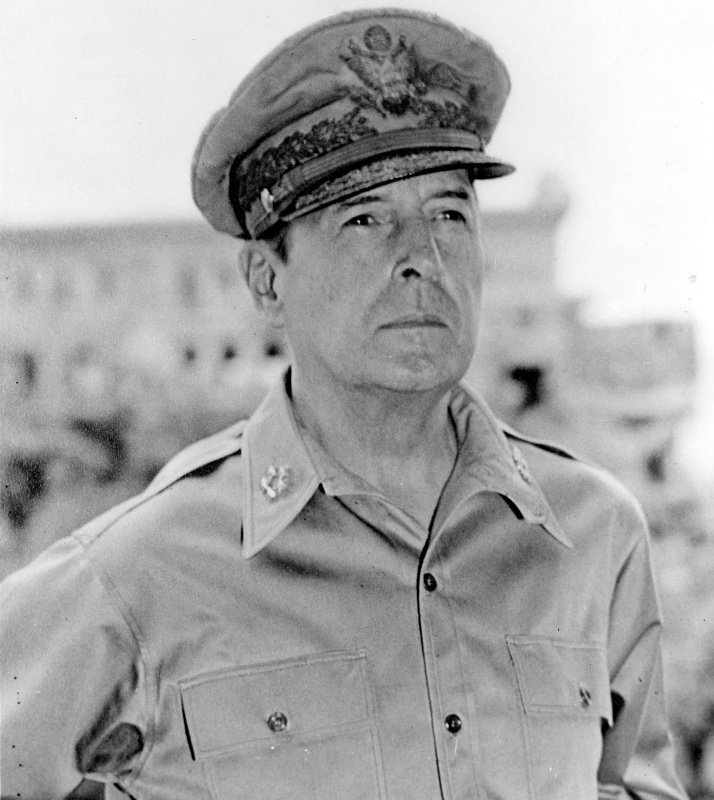
Newspapers, radio broadcasts, posters, buttons, banners, and other patriotic souvenirs helped transform MacArthur into one of the most recognizable figures of the war. When he returned to the Philippines at Leyte on October 20, 1944, the famous photographs of him wading ashore appeared to fulfill the story already presented by banners such as this one. The commander ordered to leave in 1942 had returned at the head of an advancing Allied army.
Attached to the banner is a smaller but equally revealing artifact. The circular pinback carries MacArthur’s portrait beneath the words “THE MAN OF THE HOUR.” A long red, white, and blue ribbon allowed the badge to be worn at a parade, political gathering, patriotic celebration, or public reception.
Dating the badge is more difficult because MacArthur remained an important public figure long after World War II. He supervised the occupation of Japan, commanded United Nations forces during the Korean War, and was discussed as a possible presidential candidate. Buttons bearing slogans such as “The Man of the Hour” circulated during the late 1940s and reappeared when MacArthur returned to the United States in 1951.
His 1951 homecoming followed President Harry S. Truman’s decision to remove him from command after serious disagreements over the conduct of the Korean War. Many Americans viewed MacArthur as a national hero who had been treated unfairly, while others believed Truman had correctly defended civilian control of the military. MacArthur’s return produced enormous crowds and renewed demand for souvenirs bearing his name and likeness.
Displayed together, these two objects represent different moments in the public life of Douglas MacArthur. The banner reflects the celebrated commander of World War II, closely associated with the Philippines and his promise to return. The pinback reflects the continued strength of that heroic image during the political and military controversies that followed the war.
 Neither object captures the full complexity of MacArthur. He was a highly decorated and accomplished soldier, but also an ambitious and often controversial figure. These artifacts instead preserve how his admirers chose to see him. One proclaimed him “Our Hero.” The other declared him “The Man of the Hour.”
Artifacts like these are important to Ghosts of the Battlefield because military history is preserved through more than weapons, uniforms, and battlefield equipment. Banners, buttons, ribbons, photographs, and other objects reveal how wars were understood by the people living through them. They preserve the emotions, loyalties, hopes, and public memory surrounding the individuals who shaped history. By protecting these pieces, Ghosts of the Battlefield helps ensure that both the battlefield experience and the home-front story are remembered.
The heroic image Americans built around MacArthur during World War II did not disappear when the shooting stopped. It followed him into occupied Japan and eventually into American politics. See how MacArthur's image changed after victory.
Your purchase helps preserve the stories behind the artifacts. Click here to shop and support Ghosts of the Battlefield.