From USS Wisconsin, 16-Inch Training Projectiles
USS Wisconsin and the Legacy of American Naval Firepower
May 28, 2026

 The massive projectiles displayed here are 16-inch training shells associated with the guns of the battleship USS Wisconsin (BB-64)—one of the most powerful naval warships ever built by the United States Navy.
Each shell was designed for use with the ship's enormous 16"/50 caliber Mark 7 naval guns, weapons capable of firing projectiles weighing up to 2,700 pounds across distances exceeding twenty miles. Even today, the scale of these shells reflects the staggering industrial and military power embodied by the American battleship fleet during the Second World War and the Cold War.
Training rounds like these played a critical role in preparing gun crews for combat operations.
Operating a battleship's main battery was an extraordinarily complex process involving hundreds of sailors working in coordinated teams deep within the ship's armored interior. Ammunition handlers, powder crews, turret operators, rangekeepers, and fire-control specialists all had to function with precision under demanding and often dangerous conditions. Training projectiles allowed crews to rehearse loading procedures, handling operations, and firing drills essential for combat readiness.
The USS Wisconsin herself represents one of the final chapters in the age of the battleship.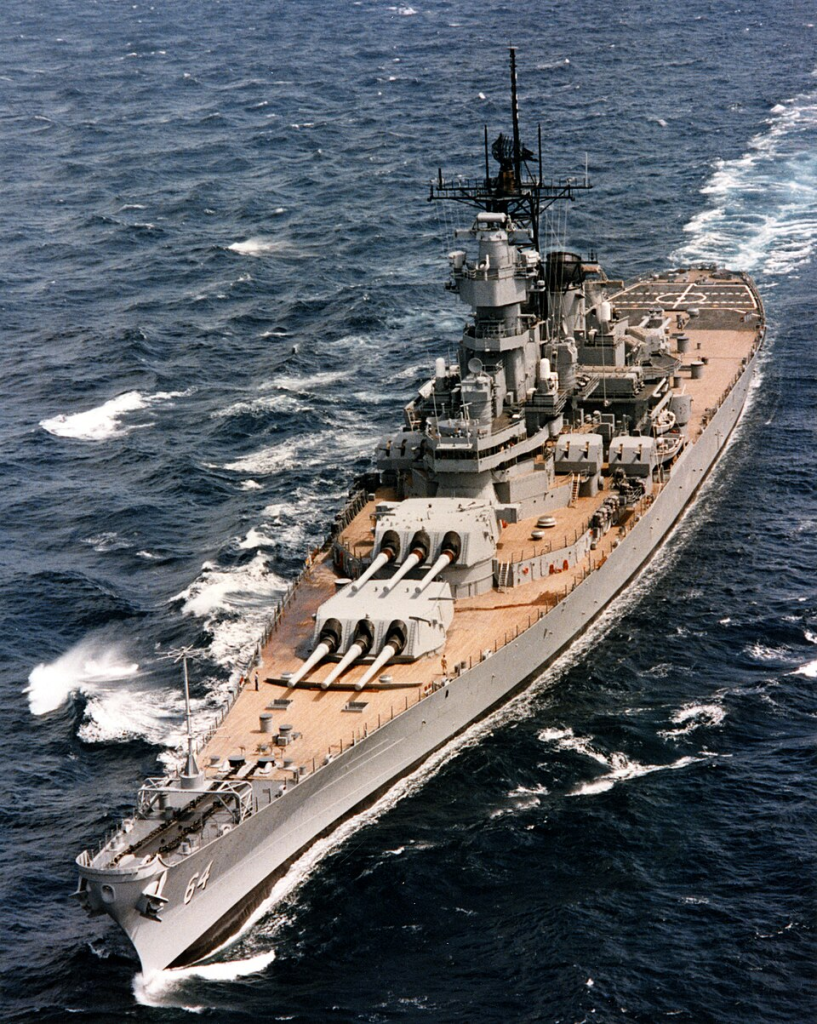
Commissioned in 1944, Wisconsin served during World War II in the Pacific, where her massive guns supported carrier operations and shore bombardments against Japanese positions. In later decades, she returned to service during the Korean War, the Cold War, and again during Operation Desert Storm in 1991—demonstrating the remarkable longevity of the Iowa-class battleships.
The shells themselves are reminders of the immense destructive capability of naval artillery.
When fired in combat, armor-piercing rounds from Wisconsin's guns could penetrate hardened defenses and enemy warships, while high-explosive shells devastated troop concentrations, bunkers, and coastal fortifications. The concussion alone from a full broadside could be physically overwhelming, shaking the entire ship while projecting firepower across miles of ocean or shoreline.
Yet these projectiles also tell a deeper story about the industrial scale of twentieth-century warfare.
Weapons of this size required vast logistical systems, specialized manufacturing, rail transport, ammunition depots, and highly trained crews simply to operate effectively. Every shell represented not only firepower, but the enormous national effort required to build, maintain, and sustain a modern battleship fleet.
 Today, the age of the battleship has passed into history.
Missiles, aircraft, submarines, and advanced guided weapons ultimately replaced the dominance once held by heavy naval guns. But artifacts like these remain powerful symbols of a period when steel, armor, and  naval artillery defined global sea power.
Preserved within the collection of Ghosts of the Battlefield, these 16-inch training projectiles connect directly to the USS Wisconsin and to the sailors who operated some of the largest naval guns ever placed aboard an American warship. They stand as enduring reminders of the scale, complexity, and raw power of twentieth-century naval warfare.