Demon Goggles: The SU-49/PAS-5, Vietnam Night Vision, and the Legend That Wouldn't Die
Long before night vision became an almost ordinary piece of American military equipment, seeing in the dark was something close to a technological miracle. In Vietnam, where darkness could transform any place into an ambush in seconds.
August 18, 2026

Long before night vision became an almost ordinary piece of American military equipment, seeing in the dark was something close to a technological miracle. In Vietnam, where darkness could transform a road, landing zone, jungle trail, or fire base perimeter into enemy territory within minutes, the ability to see after sunset promised to change the rules of the war. The United States poured enormous effort into that promise, developing Starlight scopes, infrared viewers, sensors, weapon sights, and eventually some of the first practical head-mounted night-vision systems.
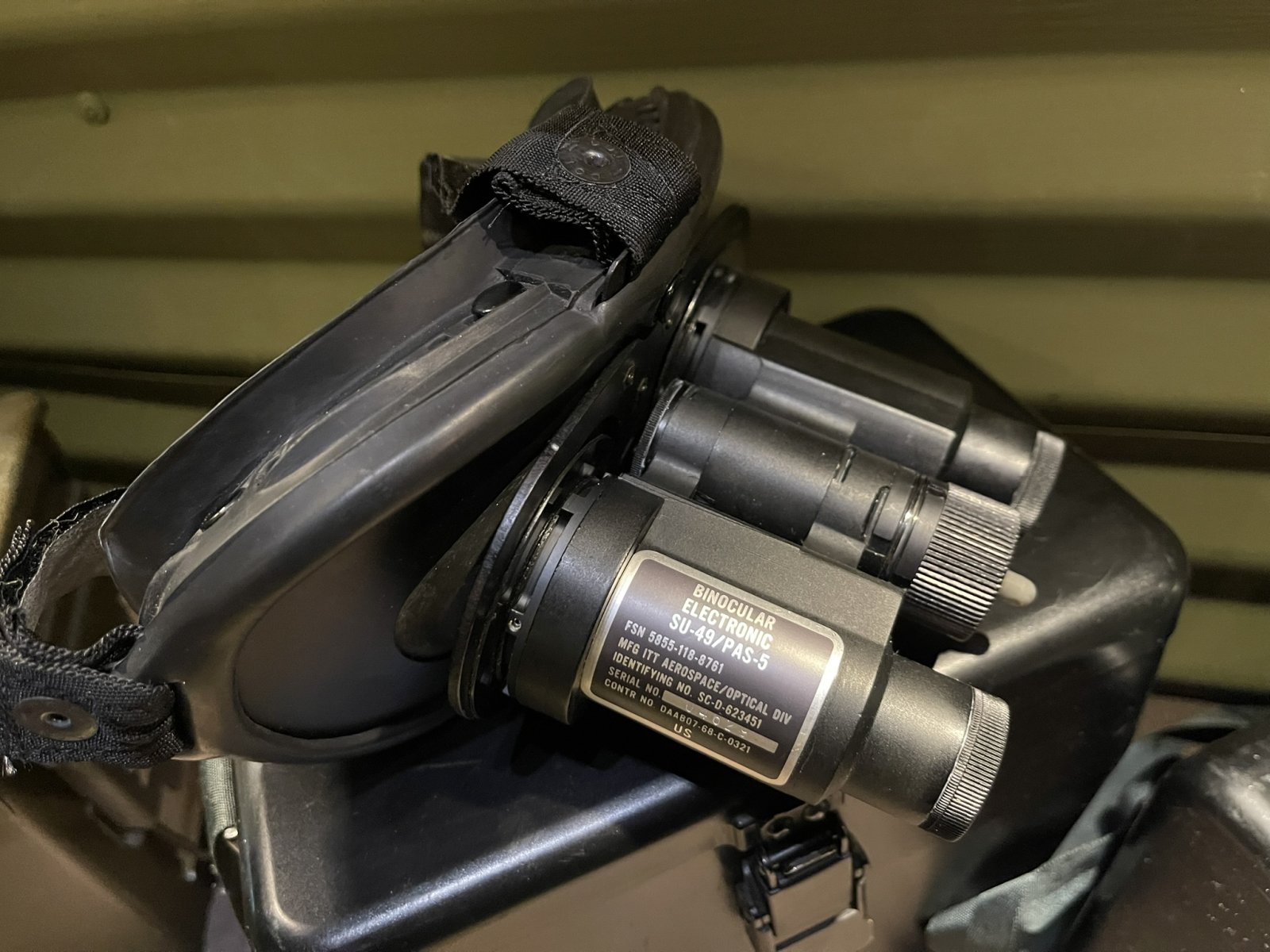
 Among the strangest survivors of that period is the SU-49/PAS-5 electronic binocular, an extraordinarily rare piece of equipment dating from the final years of the 1960s. It represents one of the experimental steps between the cumbersome night-vision equipment of the early Cold War and the familiar goggles worn by American troops today. Surviving examples made by ITT's Aerospace/Optical Division are dated 1969, and contemporary collectors have struggled to find even basic documentation concerning them.
Yet the SU-49 has acquired another history, one considerably darker than anything written on an Army equipment specification.
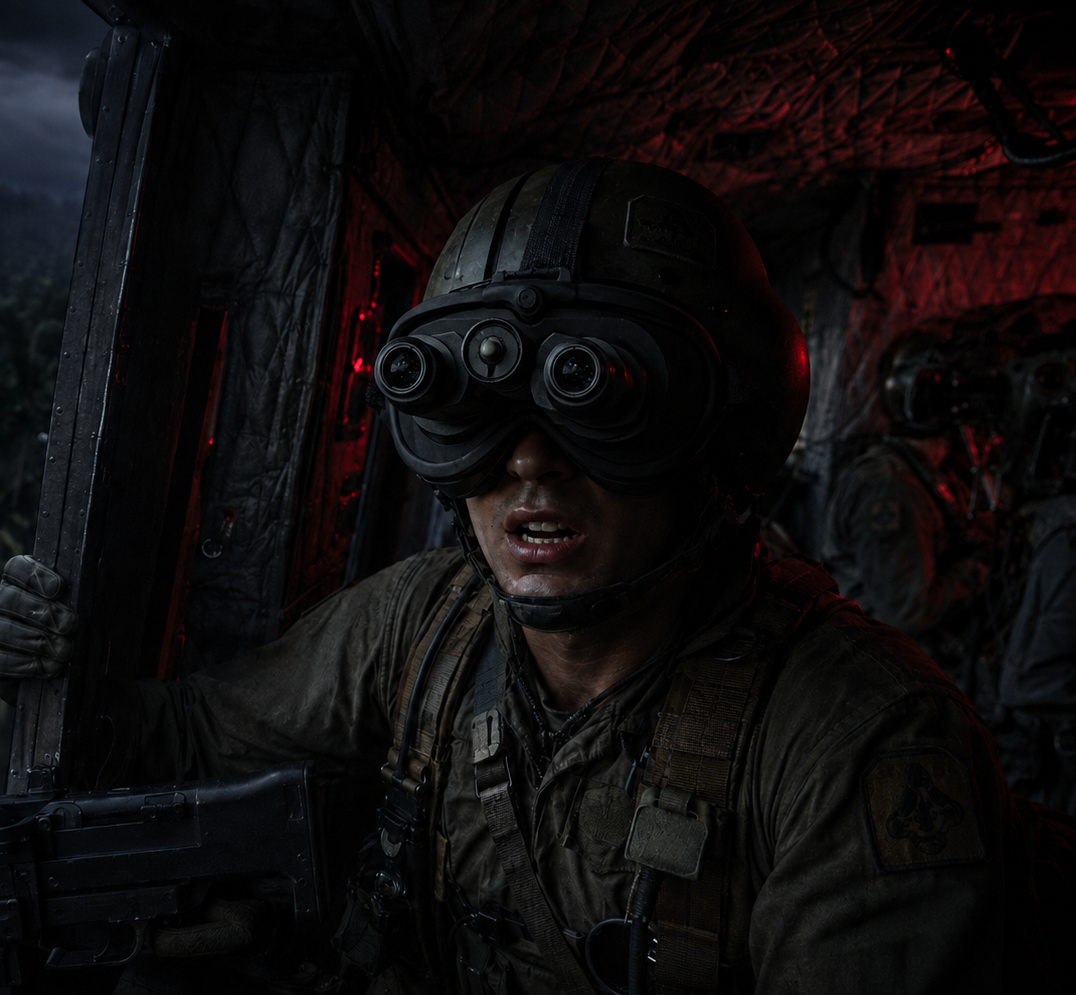
Decades after Vietnam, stories began circulating about mysterious experimental night-vision goggles supposedly issued to American troops, particularly helicopter crews. According to the legend, the devices displayed the world in an eerie red glow. Men wearing them reportedly began seeing things that should not have been there: shadowy figures, grotesque faces, flying creatures and, in the most sensational versions, literal demons. Some versions claim soldiers became terrified, unstable, or violent. Others claim the equipment was hurriedly withdrawn because the military discovered that the goggles allowed their wearers to see something human beings were never supposed to see.
It is a wonderful horror story.
The real history is more interesting.
And considerably more human.
Trying to Own the Night
Night had always presented armies with a problem, but Vietnam made that problem particularly acute. North Vietnamese Army and Viet Cong forces frequently exploited darkness to move men and supplies, approach American positions, prepare attacks, and disappear into terrain where conventional observation became extremely difficult. The Army consequently made night observation a major technological priority. Head-mounted night-vision equipment was only one part of a much larger effort that included the famous Starlight scopes used on rifles and crew-served weapons. Historian Shelby Stanton describes the head-mounted program specifically as a response to the enemy's tendency to operate and move at night.
The technology was developing rapidly. Earlier infrared systems had generally required an infrared source to illuminate the target, effectively shining an invisible flashlight that another properly equipped enemy could potentially detect. By the middle 1960s, increasingly capable image-intensification technology could amplify the tiny amount of light already present in the environment. Starlight, moonlight and sky glow could suddenly reveal men and objects that had previously vanished into darkness. First-generation passive night-vision technology became one of the notable American technological developments of the Vietnam War.
It was still primitive equipment by modern standards. Early tubes had limited resolution. Images could distort. Bright points could bloom and obscure nearby details. Depth perception, peripheral awareness and the user's sense of the surrounding environment could all be degraded. More importantly, much of the technology had been developed faster than the human beings expected to use it had learned how to interpret what they were seeing.
That distinction would eventually become important.

The SU-49/PAS-5
The SU-49 remains frustratingly obscure. A surviving example documented by the Modern Forces living-history group carries ITT Aerospace/Optical Division markings and a 1969 date, along with its original padded case. The group reports that the SU-49 required an external infrared source and that examples were associated with the specialized night operations being developed during this period. It also reports use by MACV-SOG, the 46th Special Forces Company in Thailand, and personnel associated with the Son Tay mission, although the site's authors themselves acknowledge how little firm documentation concerning the SU-49 has survived.
This is where the history becomes complicated, because the SU-49 is frequently confused with the slightly later and much better documented SU-50 Electronic Binocular. The two devices belonged to the same extraordinarily brief experimental period, and modern retellings have often blended their histories together. Even contemporary reproductions of Vietnam-era equipment histories sometimes suffer from optical-character-recognition errors that turn "SU50" into "SUSO," which has done future researchers no favors whatsoever. Apparently the technology for confusing historians was also under development.
The documentary record for the SU-50 is much stronger. The Army's head-mounted night-vision program led to an electronic binocular and the companion AN/PAS-8 weapon-mounted infrared aiming device. International Telephone & Telegraph received a contract in July 1968. Manufacturing suitable image-intensifier tubes proved difficult, however, and development began slipping behind the Army's operational demands. By August 1969 the Army wanted something usable immediately, even if it failed to meet the desired specifications.
Low-performance tubes with short operating lives were therefore accepted for testing in October 1969. Their performance was disappointing. This was not a mature weapon system being rolled ceremoniously from a factory and issued across Vietnam. It was experimental technology being pushed toward the battlefield because soldiers had a problem now and the engineers were still working toward a better answer.
The SU-49 appears to belong precisely to this transitional world.
 What About the Helicopter Gunners?
One of the most repeated parts of the modern "Demon Goggles" story is that the strange red night-vision devices were first given to helicopter door gunners. It is repeated so frequently that it has gradually acquired the appearance of established history.
The evidence does not support stating it that strongly.
Night vision absolutely was being experimented with aboard aircraft during the Vietnam War. In 1966, Navy pilot and physicist Leslie J. Horn was sent to South Vietnam to evaluate night-vision technology under operational conditions. By early 1968, the extraordinarily quiet QT-2 reconnaissance aircraft were flying nighttime missions with observers using Starlight scopes, making the project one of the earliest operational deployments of night-vision equipment aboard aircraft. Through their primitive green-and-black imagery, crews could identify sampans, vehicles, fires, and enemy activity invisible to the unaided eye.
Head-mounted devices also entered aviation experimentation as the technology developed. That provides a genuine historical foundation beneath later stories about helicopter crews using experimental goggles. What cannot presently be demonstrated is the much more specific claim that the SU-49 was originally developed for, or first issued to, helicopter door gunners.
The surviving Army account actually describes the urgent 1969 requirement differently. The Army wanted a head-mounted system for people who needed both hands free, specifically mentioning drivers and weapons handlers as examples. That certainly leaves room for experimentation by aircrews, but it does not establish helicopter gunners as the first recipients.
There is therefore a little truth buried beneath the legend. Experimental night vision reached aviation during Vietnam. Very early head-mounted systems existed. Some were used in Southeast Asia. But the familiar story of crates of red "Demon Goggles" being handed first to Huey door gunners is not something the surviving historical record presently confirms.
Son Tay: Where the History Becomes Solid
If the early operational history of the SU-49 is murky, its immediate successor has an extraordinary connection to one of the most daring American special operations of the Vietnam War.
By 1970, improved special-purpose image-intensifier tubes had become available for the SU-50. According to Stanton's account, drawing upon the annual historical summaries of the Army Electronics Command's Night Vision Laboratories, SU-50 electronic binoculars fitted with these expensive tubes were prepared in time for Task Force Ivory Coast, the force assembled to raid the Son Tay prisoner-of-war camp in North Vietnam on November 21, 1970. The same equipment was subsequently used by MACV-SOG and commandos of the 46th Special Forces Company operating in Laos.
Son Tay was precisely the kind of mission for which experimental night vision made sense. The target lay only about 23 miles west of Hanoi. Fifty-six handpicked Army Special Forces soldiers formed the ground assault element, while more than one hundred aircraft and numerous support personnel participated in the overall operation. The raiders trained repeatedly on a full-scale mockup before penetrating one of the most heavily defended regions in North Vietnam during the night of November 20-21, 1970.
The assault itself lasted only 27 minutes. The prisoners had unfortunately been moved before the raiders arrived, but the force entered the compound, fought its way through the objective area, withdrew, and returned without losing a man. The mission became a landmark in the development of American joint special operations.
For the history of night vision, Son Tay is equally significant. The SU-50 was no longer merely an interesting laboratory device. It had gone into one of the most demanding special operations imaginable.
Collector research has associated the earlier SU-49 with the raiders as well, and that possibility should not simply be dismissed. But there is an important distinction. The surviving secondary Army history specifically identifies the SU-50 as the electronic binocular prepared for Task Force Ivory Coast. Until stronger primary documentation emerges for the SU-49, attributing the raid exclusively or specifically to the SU-49 goes farther than the evidence presently permits.
The Birth of the "Demon Goggles"
Somewhere between the real experimental goggles of Vietnam and the retelling of their history decades later, another story emerged.
The goggles, the legend claims, did not display the familiar green image associated with night vision. Instead they supposedly used red phosphor. Helicopter gunners and other servicemen began seeing frightening figures moving through the darkness. Flying creatures appeared beside helicopters. Human shapes became monstrous. Men refused to wear the goggles. Some supposedly panicked or fired at things no one else could see. Eventually, according to the darker versions, the military realized the equipment was revealing supernatural entities and quietly removed it from service.
There is a substantial problem with the story.
 The documentation we have for the SU-49/SU-50 family does not establish a red-phosphor display, and contemporary descriptions of American image-intensification equipment from Vietnam consistently describe the characteristic night-vision world in shades of green. Smithsonian's history of airborne Starlight-scope operations, for example, specifically describes the primitive view as green and black. Modern night-vision manufacturers likewise explain that green phosphor became useful because the human visual system can perceive detail and contrast particularly effectively in that portion of the spectrum.
Researchers who have specifically investigated the modern red-goggle story have likewise been unable to locate evidence that the U.S. military fielded red-phosphor SU-49 or SU-50 goggles in Vietnam. Instead, the "red night vision" element appears to be a later addition to the story, possibly encouraged by confusion between infrared technology and a literally red image.
Just as importantly, no credible Army documentation has surfaced showing that the SU-49 was withdrawn because it caused hallucinations, insanity, or reports of supernatural creatures.
That does not mean soldiers never saw strange things through early night-vision equipment.
In fact, there are very good reasons why they might have.

The Problem With the Red Image
The red portion of the Demon Goggles story is perhaps its greatest weakness because it is presented today as though it were an established technical fact.
It is not.
No documentation located for this article establishes that the SU-49/PAS-5 or SU-50 used the infamous blood-red display described by modern paranormal accounts. The better-supported historical record instead places these devices within the evolving American image-intensification technology that ultimately produced the familiar green night-vision image.
This matters because the red image is frequently used as the explanation for the supposed psychological reaction. The story often proceeds backward: soldiers saw demons because the goggles were red, and we know the goggles were red because soldiers saw demons.
History needs something sturdier than a circle.
A far better explanation is also a much more powerful one. Early night vision itself was strange. Looking through it separated a man from ordinary visual reality. It compressed depth, removed normal color information, restricted peripheral vision and converted the night into a glowing electronic landscape. Equipment that seems crude today was being handed to young men who had no lifelong familiarity with digital screens, thermal cameras or night-vision footage. To them, seeing people moving in darkness through an electronic device could genuinely feel like looking into another world.
Richard Ruth's work on Vietnam-era night vision demonstrates that servicemen themselves sometimes described the experience in ghostly or spectral language. That cultural and psychological response is real. It does not require a secret red phosphor, a suppressed military experiment, or creatures inhabiting another dimension.
When the Machine Changed What a Man Saw
Night vision did more than make the darkness brighter. It created an artificial world.
Historian Richard A. Ruth has examined the psychological effect of early night vision on American servicemen in Vietnam. His research into the Starlight scope found that the technology altered the way soldiers perceived both the landscape and the people within it. These were men looking into a crude electronic representation of reality, often while exhausted, frightened and under enormous psychological pressure. The equipment offered a tremendous advantage, but its ghostlike imagery could also make familiar terrain seem alien and transform distant human figures into strange shapes mediated through electronics.
Now place that experience in Vietnam.
A man has been awake far too long. He is operating at night because the enemy operates at night. Every patch of jungle might conceal someone trying to kill him. Aircraft vibration, engine noise, weapons fire, heat and fatigue have been grinding on him for hours. He is staring through primitive optics with limited resolution and an unfamiliar monochromatic image. Movement at the edge of the field of view may appear suddenly. Foliage changes shape as the aircraft moves. An animal, branch, cloud or distant person becomes an electronic silhouette before his brain has enough information to identify it.
Under those conditions, seeing something incorrectly is hardly mysterious.
Modern research on severe sleep deprivation makes the problem even easier to understand. Studies have found that prolonged wakefulness can produce perceptual distortions, visual misinterpretations and eventually genuine hallucinations. After approximately 48 hours without sleep, perceptual disturbances and hallucinations become increasingly common in experimental literature. Anxiety, irritability, confused thinking and a deteriorating ability to correctly interpret sensory information can develop as sleep loss continues.
Combat adds something laboratory sleep studies cannot reproduce: fear.
A soldier did not stare into the Vietnamese darkness wondering whether a graduate student might eventually bring him coffee. He stared into it knowing another human being might be staring back.
Drugs, Exhaustion and the Vietnam Environment
Drug use also belongs in any serious discussion of how such legends could grow, although it should not be used as a lazy explanation for every unusual veteran account. Substance use among American personnel in Vietnam was significant enough to become a major concern for the military and federal government. VA historical research documents the use of marijuana, amphetamines, heroin and other drugs among servicemen in the theater, as well as the government's eventual efforts to confront the problem.
Amphetamines are particularly relevant to the broader environment because stimulants and lack of sleep are a miserable combination for reliable perception. A man trying to remain alert through prolonged operations could be physically exhausted while chemically prevented from sleeping. Add fear, darkness, primitive electronic imagery and the expectation that something dangerous is somewhere outside the field of view, and the human brain has more than enough ingredients to manufacture certainty from incomplete information.
None of that proves that a particular soldier's story was false. Memory is complicated, combat memory even more so. A man can truthfully remember being terrified by something he saw without the object having been what he believed it was at that instant.
That distinction is far more interesting than simply labeling Vietnam veterans as either liars or witnesses to the supernatural.
Why the SU-49 Disappeared
The real reason systems such as the SU-49 and SU-50 disappeared was considerably less dramatic than the legend.
Technology moved on.
The early electronic binoculars had been produced in small numbers while the Army was racing to solve manufacturing problems with image-intensifier tubes. The first low-performance tubes tested in 1969 had short service lives and disappointing performance. Improved tubes made the SU-50 useful enough for specialized missions, but the Army was already working toward the next generation of equipment. Further procurement of the SU-50 ceased as development of the AN/PVS-5 moved forward.
That evolutionary connection is important. The SU-49 and SU-50 were not technological dead ends. They were steps along the path toward a device that would make head-mounted night vision practical enough for much broader military use.
In other words, the Army did not abandon the concept.
It perfected it.
By the 1970s, improved image intensifiers and the AN/PVS-5 would begin moving night vision away from experimental specialty equipment and toward the increasingly familiar military capability that ultimately transformed nighttime aviation and ground combat. The ungainly electronic binoculars of Vietnam were ancestors of the systems through which later American troops would routinely maneuver, fly and fight after sunset.
 An Exceptionally Rare Survivor
That brief developmental life explains why an original SU-49/PAS-5 is so difficult to find today.
It was never a mass-issued item comparable to an M16 rifle, steel helmet, field radio, or even the far better known AN/PVS-2 Starlight scope. It belonged to a narrow period of experimentation during which technology was changing rapidly. Surviving examples bear late-1960s ITT markings, and even specialist collectors describe detailed information about the device as extraordinarily difficult to locate. Complete goggles accompanied by their original case, power components and accessories are consequently uncommon, while functioning examples are rarer still.
Fragile electronics make survival even less likely. Image tubes age or fail. High-voltage power supplies deteriorate. Batteries disappear. Wiring corrodes. Rubber components harden. Cases and accessories become separated from the goggles. Unlike a rifle or helmet that can survive decades in an attic with comparatively little intervention, a late-1960s electro-optical system contains numerous components that time is particularly good at destroying. That makes the survival of an SU-49 significant even if it never saw a demon.
Perhaps especially so.
The Artifact Behind the Legend
The SU-49/PAS-5 deserves to be remembered for what it actually represents.
It came from a period when the American military was attempting something extraordinary: giving an individual fighting man the ability to look into darkness while keeping his hands free. Engineers were struggling with tubes that did not last long enough, equipment that did not perform well enough, and an Army that needed the capability faster than the technology wanted to cooperate. Within little more than a year, improved versions of the concept would accompany American Special Forces into the heart of North Vietnam during the Son Tay raid.
Around that genuine history grew a legend about red screens, terrified helicopter gunners, apparitions and "Demon Goggles." There is presently no convincing evidence that the SU-49 displayed a red image, drove its users insane, or was withdrawn because soldiers were seeing supernatural creatures. Nor is there strong documentation establishing helicopter door gunners as its first users.
But strip away the supernatural explanation and something genuinely haunting remains.
Imagine being a young soldier in Vietnam and putting one of these devices over your eyes for the first time. The world you knew disappeared. Darkness became an artificial landscape produced inside two electronic tubes. Shapes emerged where seconds before there had been nothing. Men appeared out of blackness. Trees moved strangely. Distance became difficult to judge. Beyond the narrow view of the goggles remained a jungle containing an enemy who preferred to move at night.
Then imagine doing it hour after hour while exhausted, frightened and knowing that some of the shapes appearing in that strange glowing world really were men trying to kill you.
No demons were required.
The night itself was enough.