Then and Now: USS Abraham Lincoln, USS Enterprise, and the Sailors Who Keep a Carrier at War
USS Abraham Lincoln remains a remarkable ship because of the thousands of sailors who keep her aircraft flying, her systems operating, and her mission moving forward through an extraordinarily demanding deployment.
August 14, 2026

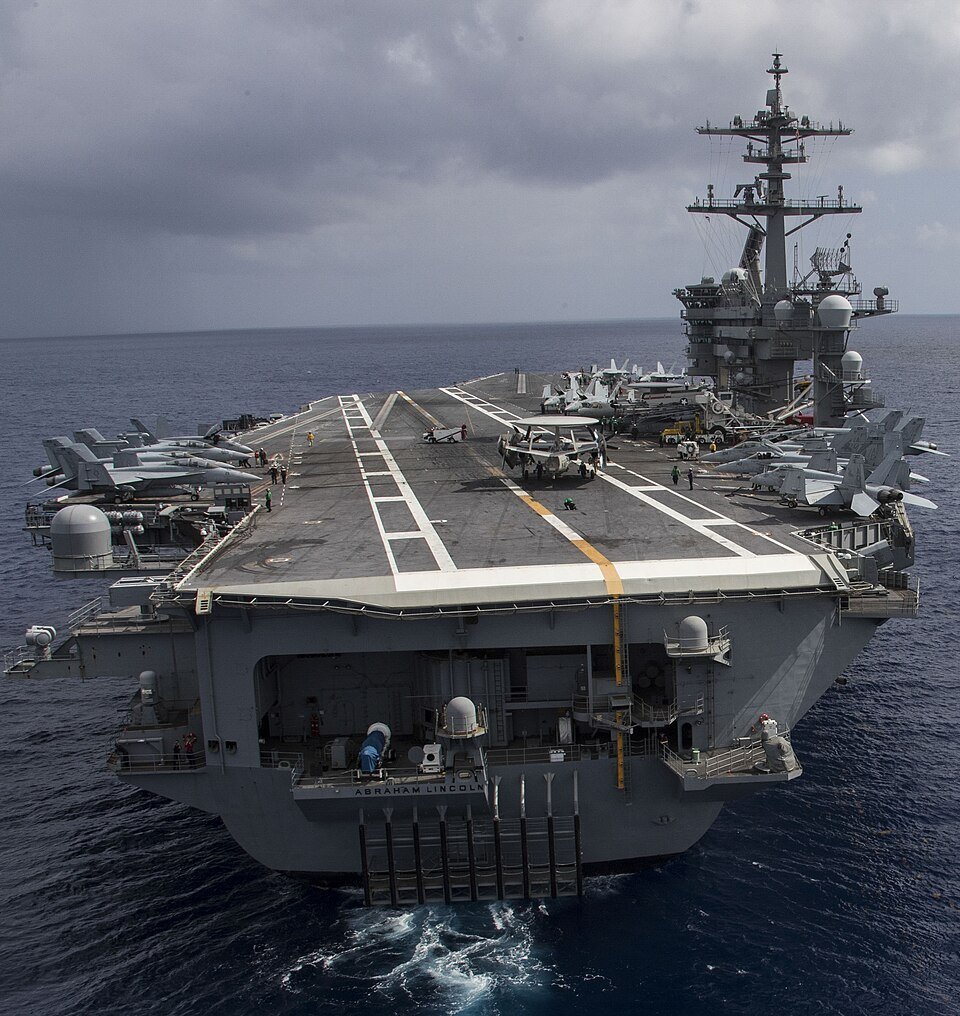
 When people see USS Abraham Lincoln in the news, they usually see the ship from several thousand feet away. The photographs show nearly 100,000 tons of gray steel cutting through blue water, fighters arranged precisely across the flight deck and destroyers positioned around her. Maps reduce the carrier to a small naval symbol somewhere in the Arabian Sea, while television graphics discuss strike ranges, missiles, Iran, deterrence and the movement of another carrier to eventually take her place. Almost none of that conveys what USS Abraham Lincoln actually is to the people aboard her. To them, CVN-72 is not a symbol on a map. It is where they sleep, eat, work, shower, argue, laugh, receive bad news from home, miss birthdays, stand watch, repair machinery and wake up to do the same thing again while the ship continues operating around the clock.
That is where the story of Abraham Lincoln in 2026 becomes much more interesting than another discussion about whether aircraft carriers remain relevant. The carrier is unquestionably relevant because the United States keeps asking Lincoln to remain where she is. She departed San Diego on November 21, 2025, and what began as another deployment became something much longer and harder when events pulled the strike group toward the Middle East. By January she was operating in the Arabian Sea, and when Operation Epic Fury began against Iran on February 28, Lincoln became an active wartime airfield. By August 13, USNI News counted 241 consecutive days at sea during a deployment approaching nine months, far beyond the normal rhythm of port calls, maintenance periods and predictable milestones around which sailors organize their lives.
 There is an older American carrier whose crew would have understood at least part of that experience. Eighty-four years before sailors aboard Abraham Lincoln watched their own ship become a regular fixture in international headlines, the men aboard USS Enterprise, CV-6, watched exactly the same thing happen to them. Enterprise was much smaller, conventionally powered, technologically primitive by modern standards and operating during a war of national survival in which enemy bombs actually struck her flight deck and killed men inside the ship. The circumstances cannot honestly be called equivalent, but the human experience contains recognizable echoes. Enterprise became famous while her crew was still living aboard her, repairing her, mourning shipmates and trying to get through another day. Lincoln's sailors are now living aboard a ship whose name is appearing in headlines around the world while they remain responsible for making sure that the enormous machine underneath those headlines continues to work.
Two carriers, two worlds, one basic idea
USS Enterprise displaced about 19,800 tons in her prewar configuration, measured a little over 809 feet long and carried a wartime complement that could approach 3,000 people. USS Abraham Lincoln is 1,092 feet long, displaces roughly 97,000 to 100,000 tons at full load and, with her embarked air wing and staffs, can carry roughly 5,000 sailors and Marines. Enterprise burned fuel oil to make steam for her turbines and aviation gasoline for her aircraft. Lincoln uses two nuclear reactors for propulsion and operates jets whose sensors, weapons and computers would have looked like science fiction to the men of CV-6.
Yet both ships exist for essentially the same reason. They carry an airfield into places where the United States either cannot or does not want to depend entirely upon airfields ashore. The carrier provides the runway, fuel, ammunition, maintenance shops, command facilities, medical spaces, spare parts and thousands of people required to keep aircraft operating. The Navy describes the carrier as an instrument of power projection and forward presence, but down on the deck plates those impressive phrases translate into something more ordinary: somebody has to fuel the airplane, somebody has to load it, somebody has to fix what broke on the last flight and somebody has to be awake at three in the morning when it comes back.
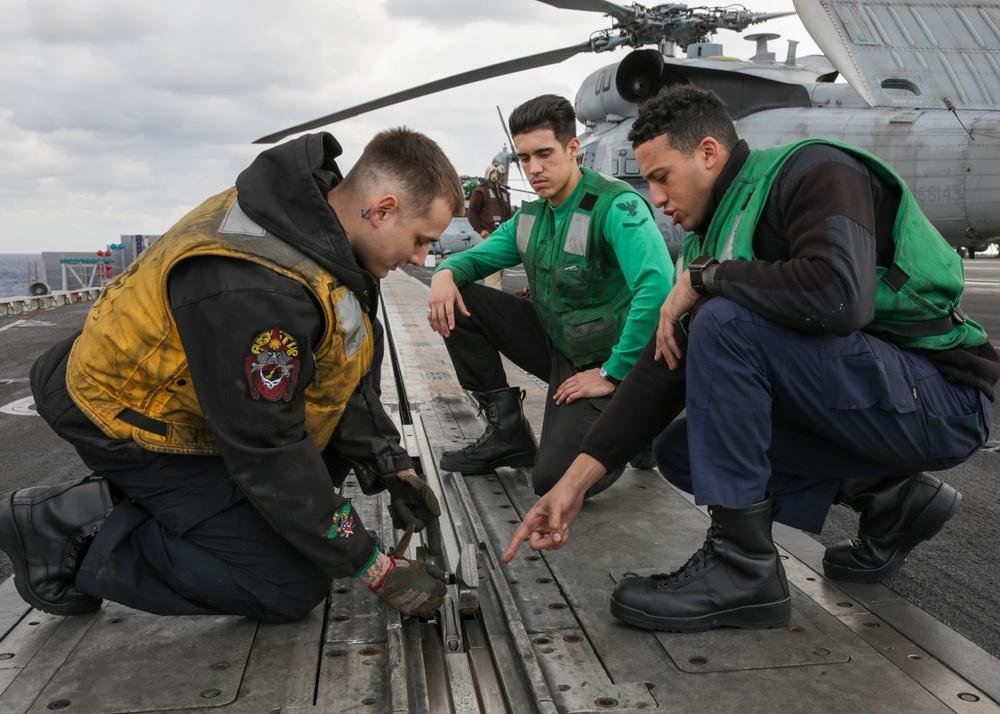
On Enterprise in 1942, those aircraft might have been F4F Wildcats, SBD Dauntlesses and TBD Devastators. On Lincoln today they include F/A-18E/F Super Hornets, F-35C Lightning IIs, EA-18G Growlers, E-2D Hawkeyes and helicopters. The machinery has advanced enormously, but carrier aviation remains a profoundly human process in which hundreds of individual jobs have to come together at exactly the right moment. CENTCOM imagery from Lincoln during the current operation shows what strategic reports cannot: sailors crouched beneath aircraft, moving weapons, servicing jets, directing airplanes and standing watches while the carrier continues generating combat sorties in the Arabian Sea.
A launch that takes seconds may represent hours of work. An aircraft returning safely aboard may immediately become another maintenance problem for a crew that already has several aircraft waiting. A flight-deck sailor does not experience a combat sortie as a statistic in a Pentagon briefing. He or she experiences jet exhaust, noise, vibration, heat, hand signals, protective equipment, moving aircraft and the knowledge that one moment of inattention around an operating flight deck can kill somebody without an enemy ever firing a shot.
That part would have been immediately familiar aboard Enterprise.
The flight deck has always been its own world
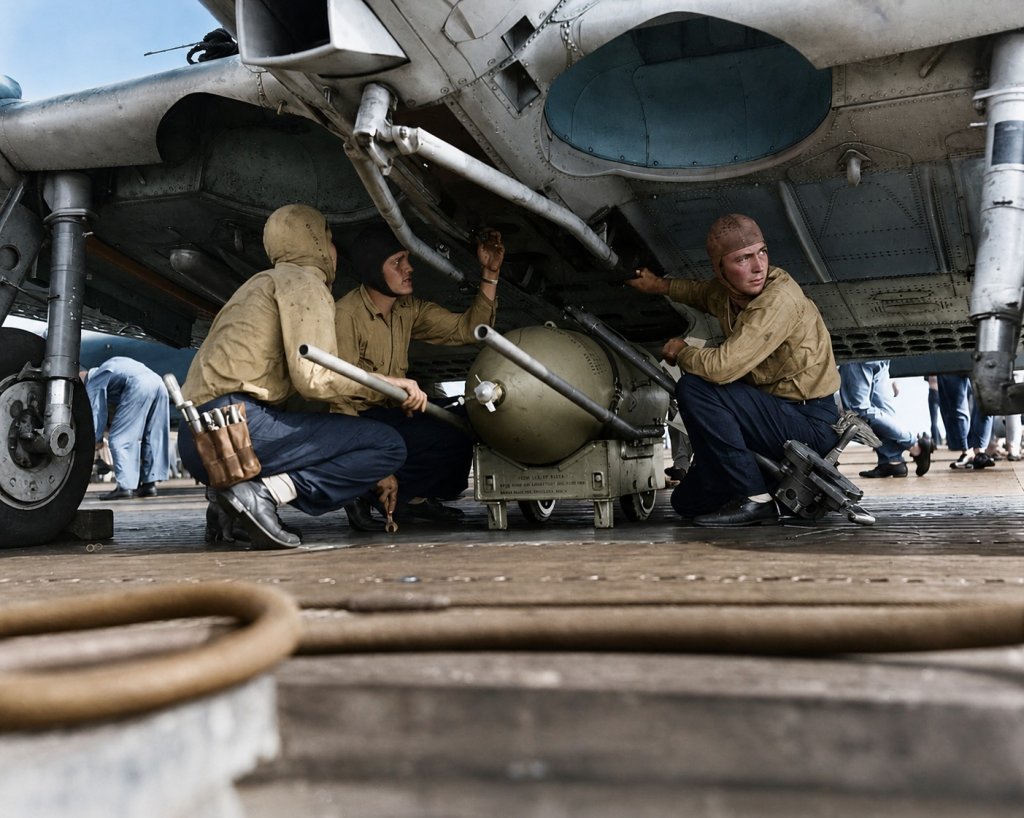
 Photographs of Enterprise during World War II show a deck that looks almost quaint beside Lincoln. The airplanes are smaller, men frequently work in clothing that would horrify a modern safety officer, propellers turn only feet from sailors and wooden planking stretches beneath the aircraft instead of the massive modern flight deck of a nuclear carrier. What the photographs cannot communicate is the noise, gasoline fumes, wind and constant movement.
The flight deck was dangerous before the enemy arrived. Aircraft could crash on landing, miss arresting wires, strike barriers or collide with airplanes parked forward. Engines had to be serviced and weapons moved while operations continued. Fuel and ammunition existed together in quantities capable of turning a mistake into catastrophe. Enterprise learned repeatedly that an aircraft carrier is an environment where ordinary accidents and enemy action can become indistinguishable very quickly.
One Enterprise sailor who embodied the strange mixture of competence, courage and irreverence common aboard carriers was Aviation Machinist's Mate Bruno Gaido. Before the war, pilot Norman “Dusty” Kleiss prepared for carrier-landing practice and discovered Gaido sitting in the rear seat of his SBD even though Kleiss thought he would be flying alone. When Kleiss pointed out the danger and tried to convince him to get out, Gaido replied, “You got wings, don't ya?” The Naval History and Heritage Command preserves the story because it says something about Gaido that no personnel record could. He trusted the pilot, accepted the danger and treated the whole matter with the kind of confidence that makes perfect sense inside a close crew and sounds slightly insane everywhere else.
In February 1942, Gaido demonstrated that the confidence was not empty bravado. During a Japanese attack on Enterprise, a damaged enemy bomber headed toward the carrier. Gaido ran across the deck, climbed into a parked SBD and opened fire from its rear guns at the approaching aircraft. The bomber narrowly missed the ship and went into the sea. Gaido would later fly at Midway, be shot down, captured and murdered by the Japanese, becoming one of the thousands of individual human stories hidden inside Enterprise's enormous wartime reputation.
 Lincoln's flight deck is safer because generations of carrier sailors learned through experience, often at terrible cost. Protective equipment is better, procedures are more formalized, firefighting capability is vastly improved and the color-coded jerseys of today's flight-deck crews create an instantly recognizable system of responsibilities. Yet safety does not turn a flight deck into an ordinary workplace. The sailor directing a Super Hornet today is standing beside a machine with enough thrust, fuel and ordnance to make errors very unforgiving, just as an Enterprise deckhand stood beside spinning propellers and loaded Dauntlesses in 1942.
When your home becomes famous
Enterprise did not begin World War II as a legend. It became one while its crew was still aboard.
She participated in the early Pacific raids, supported the Doolittle Raid and played a central role at Midway. During the Battle of the Eastern Solomons on August 24, 1942, three direct bomb hits and four near misses killed 74 men and wounded 95. Enterprise returned to Pearl Harbor, was repaired and headed back into the South Pacific. At Santa Cruz on October 26, two more bomb hits killed 44 men and wounded another 75. The carrier remained operational and took aboard aircraft and men from USS Hornet, which was lost after the battle.
The loss of Hornet left the damaged Enterprise as the only functioning American fleet carrier in the Pacific for a period. Someone aboard posted the now-famous sign, “Enterprise vs Japan.” Whether displayed on the hangar or flight deck has been described differently in later accounts, but the phrase survived because it captured something about the crew's situation better than any official communiqué could. Their ship had been battered, friends had been killed, repairs were still being performed and the Navy needed them back in the fight.
The sign was funny because it was ridiculous and frightening because it was not entirely a joke. That combination of humor and fatigue is one of the enduring features of military life. The crew could not decide where the strategic situation placed Enterprise, but they could decide how they responded to finding themselves there.
No responsible comparison should suggest that Abraham Lincoln is reliving the Guadalcanal campaign. Japanese bombs are not tearing through her decks, and the United States is not reduced to one damaged carrier standing between its forces and disaster. But there is a recognizable psychological similarity in watching the ship underneath your feet become a subject of national conversation while your personal responsibilities remain almost painfully ordinary.
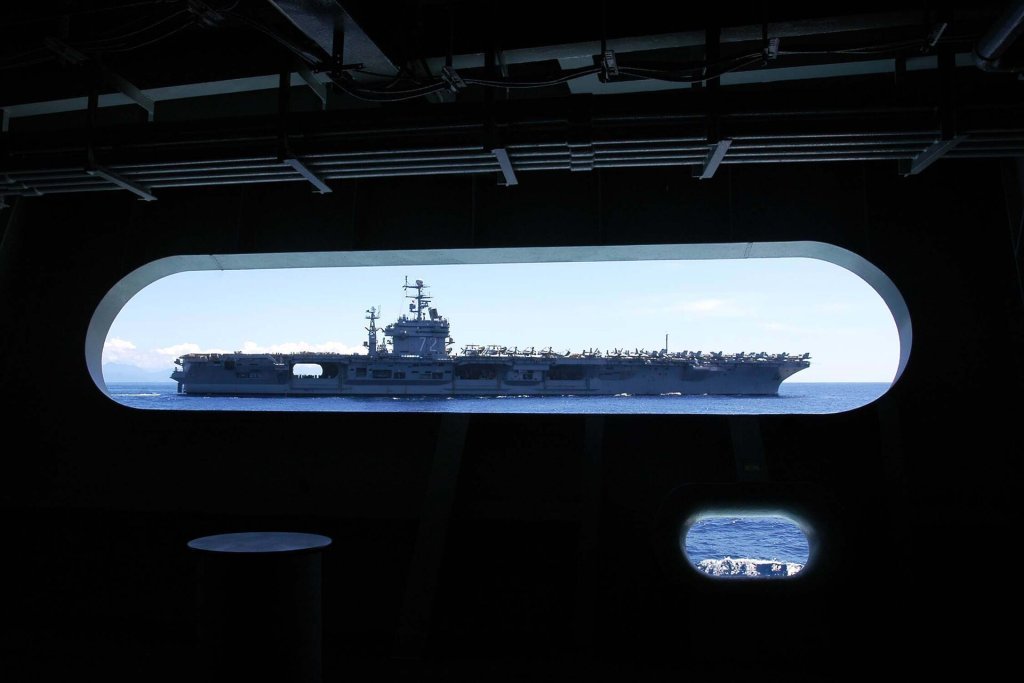
A sailor may read an article describing Abraham Lincoln as a critical instrument of American power, then close the phone and go unclog something. Another may see television footage of an aircraft launching from Lincoln without any viewer realizing that he spent hours preparing that aircraft.
Someone working in the galley may feed thousands of people through a period of sustained combat flight operations and never appear in a single photograph.
That is how famous ships actually function. Their reputations are built out of anonymous labor.
 The ship does not know that the crew is tired
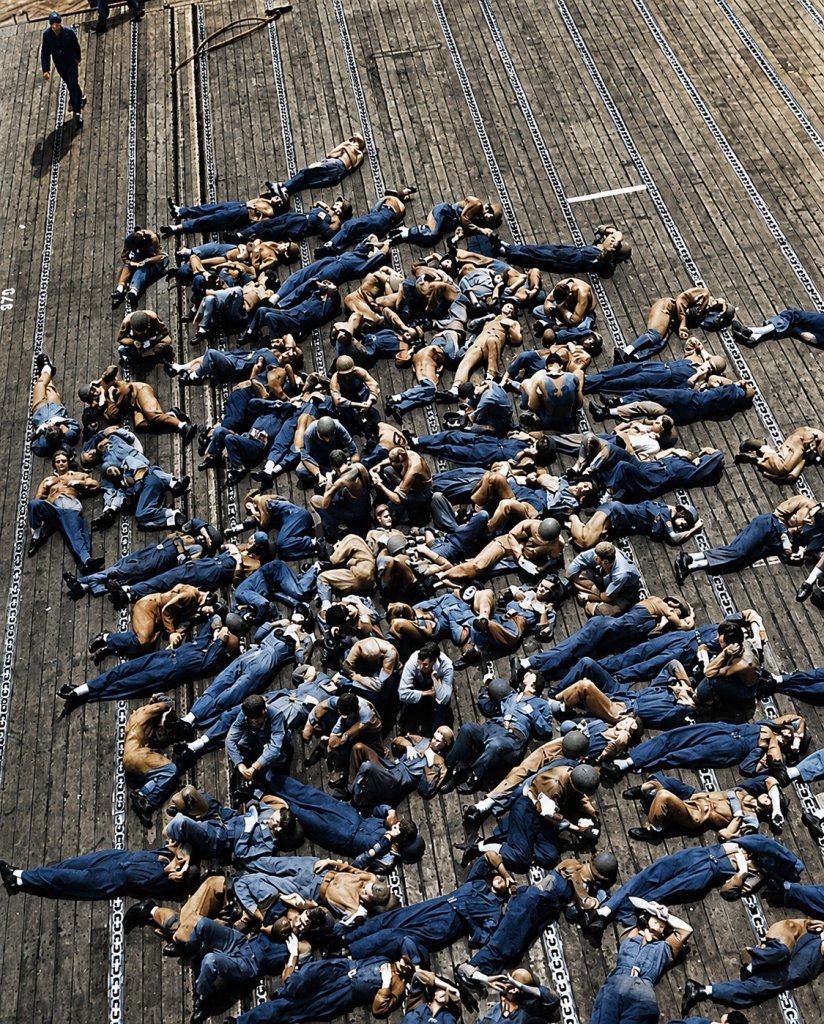
 The ship does not know that the crew is tired
One of the great technological achievements of Abraham Lincoln is also part of what makes extended deployments possible. Her nuclear propulsion plant does not require the constant replenishment of propulsion fuel that Enterprise needed. Lincoln can steam enormous distances and remain operational for extended periods without anyone having to worry about feeding oil into her boilers.
The reactor, unfortunately, has no corresponding effect on the endurance of the crew.
Sailors still need food, sleep, clean water, functioning plumbing, laundry, medical care and some contact with the people waiting for them at home. Aircraft still require aviation fuel. Weapons still disappear from magazines when combat missions are flown. Parts wear out. Pumps fail. Electronics develop faults. Saltwater keeps attacking the ship every minute she is afloat with the patient enthusiasm of chemistry doing exactly what chemistry does.
That is why the current concerns aboard Lincoln cannot be dismissed as merely questions of comfort. Reports from sailors and families have described earlier problems involving supplies, laundry, plumbing, water, mail and food during the extended deployment. Navy officials have said that a number of the reported problems were temporary or have since been corrected, and Stars and Stripes reported that sailors acknowledged improvements in several areas by August. The Navy has said logistics were disrupted by operational circumstances and that food and essential hygiene requirements were prioritized.
Both things can be true. Lincoln can remain a fully capable combat carrier while parts of daily life aboard become increasingly difficult. A ship does not have to suffer a reactor failure or lose a catapult before the crew begins feeling strain.
Laundry is a perfect example of something that sounds laughably minor ashore. Put thousands of people into steel compartments in extreme heat, surround them with machinery and aircraft operations, and keep them there for months, and clean clothing ceases to be a luxury remarkably quickly. The same applies to toilets, showers and refrigeration. A system dismissed by the public as a quality-of-life issue may be used hundreds or thousands of times each day by the people responsible for maintaining weapons, aircraft and reactors.
Enterprise sailors would have recognized the principle even if their expectations were different. Their ship offered vastly less comfort than Lincoln. Communications with home moved by letters rather than instantaneous electronic networks, medical care was primitive by modern standards, climate control was limited and wartime supply interruptions could make fresh provisions disappear. That does not mean a 1942 sailor would sneer at a 2026 sailor complaining about a broken laundry. He might be more likely to understand exactly how quickly one miserable little problem becomes everybody's problem when thousands of men are trapped aboard the same ship.
Mail, home and the calendar nobody controls
The difference between the two eras becomes especially striking when considering home.
An Enterprise sailor could write a letter without telling his family exactly where he was. The letter might travel for weeks, and the response might take weeks longer. By the time he learned about a problem at home, the problem could already have changed completely. Families might hear the name Enterprise on the radio or read about a carrier battle in the newspaper without knowing whether their son, husband or brother was safe.
Modern communications have shortened the distance without eliminating it. Lincoln sailors may sometimes be able to communicate quickly with home, and their families can follow the ship's movements and read news reports almost in real time. That creates benefits a World War II sailor would scarcely comprehend, but it also produces a new kind of strain. A sailor can know about a family problem immediately while being just as incapable of going home to solve it.
The uncertainty over Lincoln's return has become one of the most persistent themes in sailor and family accounts. One anonymous sailor told Stars and Stripes that the crew had been “turning and burning” throughout the deployment and eventually summarized what many wanted with an extraordinarily simple request: “All we want is a date home.”
That sentence contains something carrier sailors from Enterprise would recognize immediately. People can endure a great deal when they can count toward an end point. Remove the end point and time changes character. Instead of twenty more days, there is simply another day followed by another watch, another meal and another flight schedule.
A deployment extension looks clean when written in a briefing. Add thirty days to a line on a calendar and the mathematics are finished. On the ship, thirty days contain missed birthdays, anniversaries, children's events, medical appointments, delayed plans and thirty more nights sleeping inside the same steel hull.
Everybody aboard a carrier is part of damage control
The most powerful comparison between Enterprise and Lincoln may not involve aviation at all. It involves what happens when the ship itself is threatened.
Cook First Class William Pinckney was aboard Enterprise during the Battle of Santa Cruz in October 1942. The segregated Navy severely restricted the jobs available to Black sailors, which is why Pinckney served as a cook despite the broader abilities his actions would soon reveal. During battle, he was stationed in an ammunition-handling area when a Japanese bomb penetrated the ship. The explosion killed four men at his station and knocked Pinckney unconscious.
When he regained consciousness, Pinckney found another sailor trapped and unable to escape. He attempted to carry him upward, received an electrical shock and was knocked unconscious again. He recovered, went back to the injured man, got him to safety and then returned toward the damaged compartment searching for others. Pinckney received the Navy Cross for what he did aboard Enterprise that day.
His story gets at something fundamental about life aboard any warship. Your rating determines the job you perform most of the time. It does not exempt you from saving the ship.
The same principle exists aboard Lincoln. Reactor technicians, aviation maintainers, cooks, intelligence specialists, yeomen and electronics technicians all live inside the same hull. Modern damage-control organization is vastly more sophisticated than what existed aboard Enterprise in 1942, but the fundamental reality is identical. There is no fire department coming from the next town when you are hundreds of miles from land. If part of the carrier burns or floods, the people already aboard are the fire department.
That creates a particular kind of camaraderie. People who might irritate one another during an ordinary workday may also be the people holding the hose beside them when something goes wrong. Carrier life forces thousands of personalities, backgrounds, ranks and specialties into a community that cannot simply disperse when everyone has had enough of everyone else.
Sometimes the only healthy response is humor.
 The strange family created by a ship
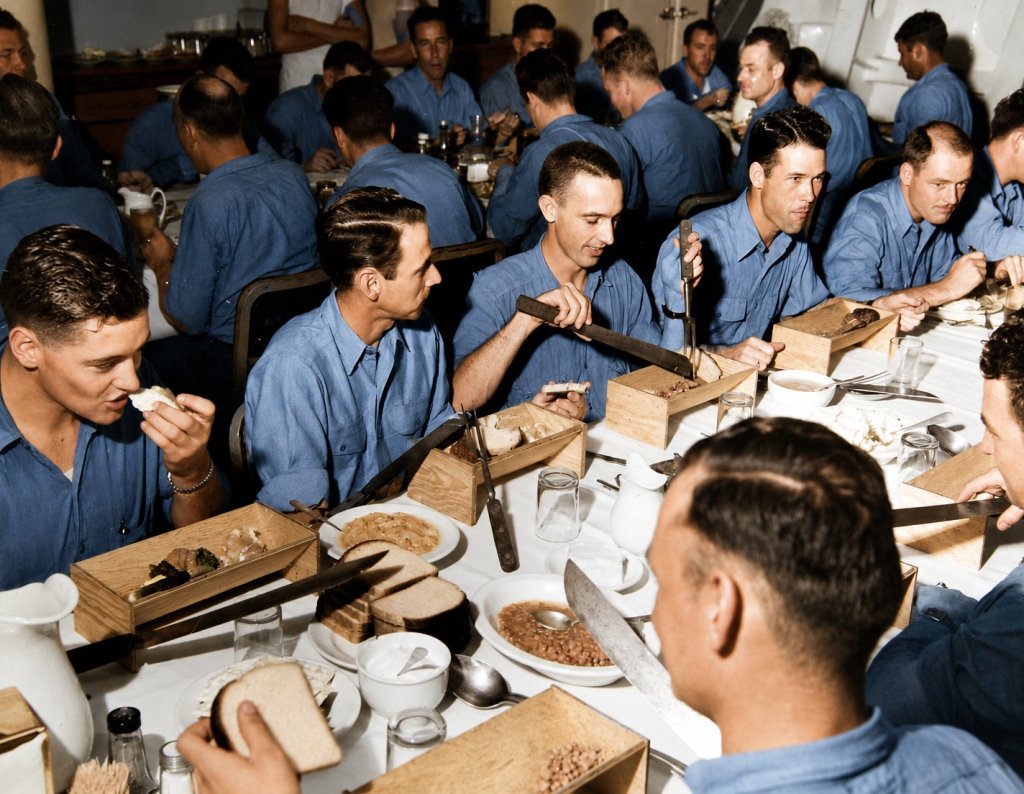
 The strange family created by a ship
Crew pride is difficult to measure because it rarely appears in readiness reports, but it matters enormously aboard famous ships. Enterprise developed a personality during the war. She became the “Big E,” then the “Grey Ghost,” and the men aboard increasingly understood that they were serving on a ship with a reputation extending far beyond the hull.
That reputation could become a burden. Every new battle added expectations. A ship that had survived before was expected to survive again. A crew that had performed before was expected to perform again. Enterprise was hit repeatedly throughout the war, repaired repeatedly and sent back. By the end she had earned 20 battle stars, more than any other American warship of World War II, and Secretary of the Navy James Forrestal would describe her as the ship that most nearly symbolized the Navy's wartime history.
The men who made that reputation did not wake up each morning feeling legendary. They were tired sailors who complained, sweated, made mistakes, repaired other people's mistakes, played jokes, worried about home and occasionally performed acts of astonishing courage because the men around them needed something done immediately.
That is a useful way to look at Abraham Lincoln.
 CVN-72 already has a substantial history of her own. She has operated from the Persian Gulf and Afghanistan to humanitarian operations after the 2004 Indian Ocean tsunami, and she has repeatedly supported combat operations during a service career stretching back to her 1989 commissioning. She returned from another combat deployment in December 2024 after operations that included the Middle East, then was back at sea on the present deployment less than a year later.
For a sailor aboard her now, that history is not an abstract résumé. The ship's name is embroidered on clothing, painted on equipment and written on orders. Sailors speak about “Lincoln” in a way outsiders speak about a workplace and a hometown simultaneously. They know which ladder wells are always crowded, which spaces are freezing, which ones are unbearably hot, which machine produces some irritating noise and which passageway to avoid when several thousand other people are trying to eat.
A carrier eventually becomes a geography known only to its crew.
 Maintenance is not something that happens after deployment
 Maintenance is not something that happens after deployment
This is also where the present discussion of maintenance becomes more human than the phrase “maintenance backlog” suggests.
Lincoln has not simply been neglected for decades and sent to sea until something finally gives up. Her maintenance history shows the opposite. She underwent a 49.5-month Refueling and Complex Overhaul completed in 2017, during which the reactors were refueled and combat systems modernized. The overhaul also made her the first carrier modified to accommodate the F-35C. She then received another seven-month Planned Incremental Availability ending in April 2021 involving approximately 230,000 man-days of labor and about $160 million in work, including combat-system modernization and improvements to crew living, refrigeration and laundry spaces. Another six-month maintenance availability followed in 2023.
The important question is therefore not whether Lincoln was maintained before this deployment. She clearly was. The question is what happens when a maintained carrier is operated harder and longer than originally anticipated.
Every aircraft launch adds another cycle to equipment. Every arrested landing places enormous forces into the recovery system. Every hour machinery operates is another hour toward an inspection or overhaul. Every day at sea exposes the ship to corrosion. Every combat period increases the burden on maintainers who must repair aircraft and ship systems while still supporting the next day's schedule.
A great deal of that maintenance is performed by the crew itself. It happens behind doors the public never sees, often at hours when most people ashore would regard being awake as a medical condition. Pumps are rebuilt, filters changed, electrical faults traced, corrosion removed, aircraft panels opened, hydraulic leaks chased and equipment inspected because there is no option to leave everything broken until the ship returns home.
Enterprise worked the same way at a more primitive level. In 1942 her crew did not simply fight the ship while shipyards repaired it. They patched damage while underway and kept systems functioning long enough to reach places where more substantial repairs could be performed. Following the Eastern Solomons, the damage-control effort was sufficient for Enterprise to return under her own power despite three bomb hits and heavy casualties. Following Santa Cruz, emergency work continued while the strategic situation demanded that she remain available.
The tools changed. The relationship between sailor and ship did not.
 When the fleet schedule reaches the deck plates
 When the fleet schedule reaches the deck plates
The broader carrier-maintenance problem eventually lands on individual sailors because there is no separate fleet made out of theoretical ships. Government Accountability Office assessments have repeatedly documented difficulty completing Navy maintenance on schedule. A 2025 GAO readiness report found that only 20 percent of maintenance phases involving carrier-strike-group ships were completed on time in fiscal year 2021 and 39 percent in fiscal year 2022. Those numbers apply to ships throughout carrier strike groups rather than aircraft carriers alone, an important distinction, but the effect is the same at the force level: when maintenance runs late, fewer ships are available for training and deployment.
The picture is also more complicated than simply declaring that every maintenance backlog is getting worse. GAO reported in March 2026 that the total backlog of sailor-led maintenance had declined for aircraft carriers and surface ships, although a subset of mission-limiting maintenance actions had worsened in the period it examined. That nuance matters because the problem is not that the Navy has stopped maintaining carriers. The problem is creating enough maintenance, training and recovery time while the operational demand for those same ships remains high.
 At headquarters that becomes force generation. On Lincoln it becomes another day underway.
If one carrier remains deployed longer than expected, another carrier eventually has to take its place. That replacement has its own sailors, maintenance history, training schedule and future deployment requirements. Extending one ship therefore does not create additional carrier capacity. It borrows capacity from somewhere else.
That is now visible in the movement of USS George Washington.
Relief is another crew sailing toward them
As of August 13, the Japan-based USS George Washington carrier strike group was moving west through the Strait of Malacca. U.S. officials said Washington was headed toward the Middle East with the intention of replacing Lincoln, while describing the movement as a planned rotation rather than an emergency response to recent reports about conditions aboard CVN-72.
From the strategic perspective, that is a carrier rotation.
From Lincoln's deck, it is another crew coming to relieve them.
There are sailors aboard George Washington now standing the watches, maintaining the aircraft and preparing their ship to assume the burden Lincoln has been carrying. Their movement westward also demonstrates the uncomfortable arithmetic of a fleet with enormous capability but limited numbers. Washington normally provides forward carrier presence in the western Pacific. Sending her toward the Middle East means moving that capability from one strategically important region toward another. AP reported that the shift could temporarily reduce American carrier presence in the Pacific.
That is why the current Lincoln story is larger than complaints about shipboard conditions, but those complaints should not be dismissed in the process. The fact that the United States considers carriers important enough to shuffle them between oceans makes the crews operating those carriers more important, not less.
What the current reports do and do not tell us
There is no credible public evidence as of August 14, 2026 that USS Abraham Lincoln is mechanically collapsing, suffering a catastrophic reactor problem or becoming incapable of performing her combat mission. She continues operating in the Arabian Sea. Public military imagery and reporting show active flight operations, and the ship remains a central part of U.S. naval operations in the region.
There are, however, documented reports of crew strain. Sailors and families have described exhaustion, difficult living conditions during portions of the deployment, supply disruptions and significant concern about mental health. Navy Times has reported family accounts of multiple sailors attempting to go overboard, while the Navy has confirmed at least one overboard incident and has said it has not identified an increase in reported suicidal ideation or suicide attempts aboard the ship based on information available to the command. Defense Secretary Pete Hegseth has said portrayals of the ship's overall conditions have been “completely misrepresented” and has emphasized the support being provided to the crew.
Those positions should be presented together rather than turning the crew into ammunition for somebody else's political argument. Families raising serious concerns deserve to be heard. Sailors describing exhaustion deserve to be heard. The Navy's account of current conditions and improvements deserves to be reported accurately as well.
What does not require much interpretation is the length of the deployment itself. Nearly nine months away from home and 241 consecutive days at sea as reported on August 13 is an extraordinary period for any carrier crew. Add sustained combat operations, a heightened defensive posture and uncertainty about the return date, and the strain is hardly mysterious.
Enterprise had bombs; Lincoln has a different kind of endurance test
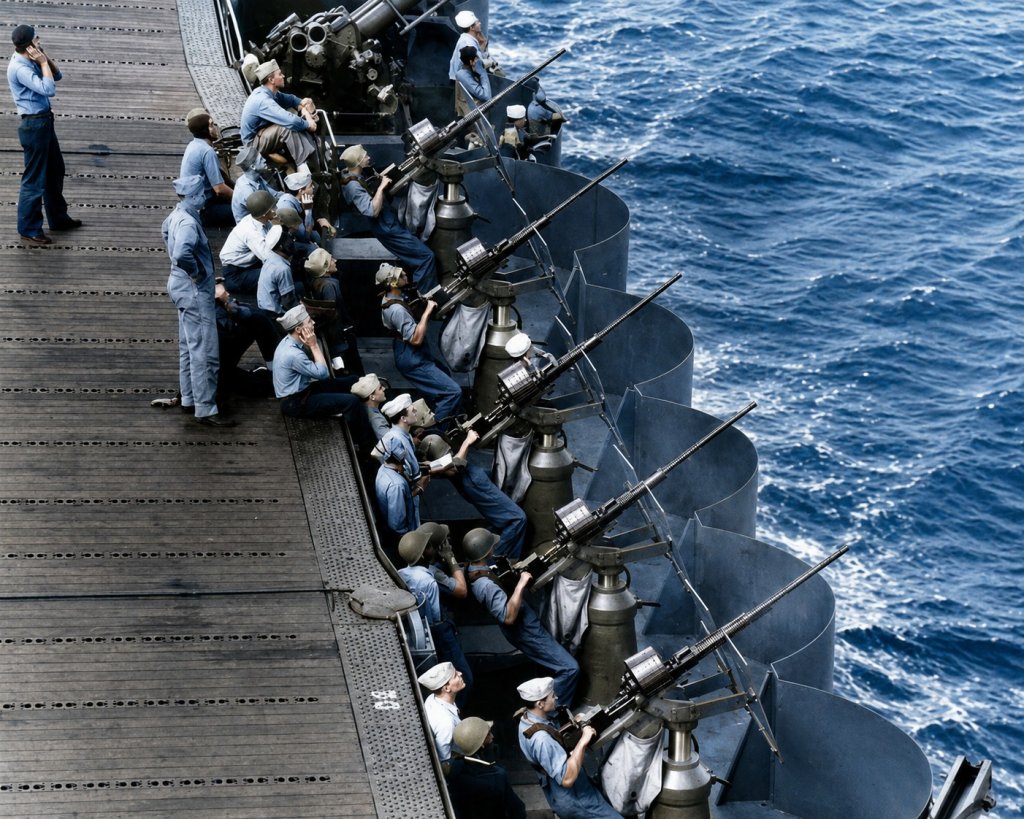
There is a danger in comparing generations of servicemen because the comparison quickly deteriorates into an argument about who suffered more. Enterprise sailors faced Japanese dive bombers, torpedo aircraft and kamikazes. Men were killed at their battle stations. Bombs penetrated decks that surviving sailors still had to repair. By the end of the war, damage from a kamikaze strike in May 1945 finally impaired Enterprise badly enough to end her combat operations.
Lincoln's sailors face a completely different environment. Their carrier has vastly better defensive systems, medical care, damage control, communications, habitability and logistical support. The dangers posed by modern missiles and drones are real, but Lincoln has not suffered anything remotely resembling the direct battle damage Enterprise endured in 1942.
That difference should not be used to erase the similarities that remain. Both crews live inside a machine that operates continuously. Both depend upon people performing ordinary jobs correctly for extraordinary lengths of time. Both experience the peculiar isolation of a ship at sea, where the same faces appear at breakfast, on watch, in passageways and again after midnight. Both discover that camaraderie is not always sentimental. Sometimes it means somebody covering a watch because another sailor needs sleep, fixing a problem outside his own specialty or producing a stupid joke at exactly the moment everyone needs one.
World War II photographs capture Enterprise sailors resting wherever space was available, working around damaged aircraft or staring across the ocean during periods when nothing dramatic appeared to be happening. Modern photographs aboard Lincoln show sailors doing much the same thing around vastly more sophisticated machinery. The photographs are separated by generations, but the human body still gets tired at roughly the same rate.
The famous ship belongs to the people aboard her
 Ships accumulate identities because people give them one. Steel does not feel pride in a battle star. A reactor does not know the name painted on the stern. The flight deck has no opinion about whether it belongs to an ordinary carrier or one that has become famous.
The crew knows.
Enterprise became famous because her sailors kept bringing her back. Damage-control teams kept her afloat, engineers kept her moving, aviation crews kept aircraft flying and thousands of sailors whose names never appeared in a history book performed enough ordinary tasks correctly that men such as Bruno Gaido and William Pinckney could perform extraordinary ones when circumstances demanded it.
Abraham Lincoln's reputation is being written the same way, although in a very different war and a very different Navy. The aircraft launching from her deck are only the visible edge of what her crew is doing. For every pilot photographed climbing into an F-35C, there are maintainers, fuel handlers, ordnance sailors and flight-deck crews who made the launch possible. Below them are engineering sailors keeping the ship powered, culinary specialists feeding thousands of people, medical teams caring for them, logistics personnel moving supplies, technicians keeping communications alive and damage-control teams prepared for the moment when something goes wrong.
They are performing those jobs aboard a carrier that has now been away from San Diego since November 2025. They are doing it while their ship appears almost daily in discussions about Iran, carrier readiness, naval strategy, mental health and the future of the fleet. They are doing it knowing another carrier is finally moving toward the region but without the kind of predictable homecoming date around which a crew normally measures the end of deployment.
The most important thing to understand about USS Abraham Lincoln is therefore not that she is 1,092 feet long, carries nuclear reactors or can launch fifth-generation fighters. Those things explain what the ship is capable of doing. They do not explain why she is still capable of doing it after months at sea.
For that, you have to look at the sailors.
The men aboard Enterprise understood that distinction long before anyone called their ship the most decorated American warship of World War II. They knew the famous carrier seen in newspapers was also the place where somebody had to cook breakfast after an air raid, repair wiring beside a bomb hole, replace damaged aircraft, carry a wounded shipmate and get ready for the next launch. The legend eventually belonged to history, but first it belonged to exhausted sailors doing their jobs.
The same is true aboard Abraham Lincoln today. She is a powerful ship, a modernized Nimitz-class carrier capable of projecting American airpower across an enormous region, but her real endurance is being supplied by several thousand people who have kept her operating through a deployment that has become longer and harder than many expected. The current debate about maintenance, logistics and deployment length matters precisely because those sailors have already demonstrated what the ship and crew can endure. The objective should not be discovering how much more can be taken from them before something finally gives.
A great carrier is never just a great ship. Enterprise proved that eighty years ago, and Abraham Lincoln is proving it again today: the machinery creates the capability, but the crew gives the ship its life.