The AMC M422 Mighty Mite: The Marine Corps’ Lightweight Jeep
The AMC M422 Mighty Mite was a lightweight Marine Corps vehicle built for helicopter warfare and remembered for its rare, innovative engineering.
December 3, 2024

 The AMC M422 Mighty Mite was one of the most unusual tactical vehicles ever developed for the United States military. Compact, lightweight, and remarkably agile, it was designed specifically for the United States Marine Corps during the emerging age of helicopter-borne warfare. Built by American Motors Corporation between 1959 and 1962, fewer than 4,000 were produced. Its specialized design, brief production run, and limited military service have made surviving examples highly sought-after pieces of Marine Corps and military vehicle history.
The idea for a smaller and lighter military vehicle was not entirely new. During World War II, several prototypes were developed in an effort to create a quarter-ton vehicle significantly lighter and more compact than the standard Willys Jeep. These experimental vehicles were intended to be transported by aircraft and gliders, but none entered full production.
After the war, engineer, pilot, and automobile racer Ben F. Gregory began developing his own compact four-wheel-drive vehicle. Gregory had previously experimented with front-wheel-drive automobiles and applied many of those ideas to a small off-road design known as the MM-100. In 1951, the vehicle was demonstrated before the Marine Corps Equipment Board and performed well enough to attract serious interest.
The Mid-America Research Corporation, better known as MARCO, was formed to continue developing the design for military and possible commercial use. The Marine Corps ordered ten test vehicles, which were delivered in 1952. MARCO later hired Harold Crist, an engineer who had played an important role in the development of the American Bantam vehicle that helped lead to the famous World War II Jeep. Several other engineers from the Bantam project joined him, bringing valuable experience to the development of Gregory’s lightweight vehicle.
The early MM-100 used a Porsche engine, but military regulations required equipment to be produced domestically. Attempts to replace it with an American aircraft engine proved too expensive and difficult. A solution appeared when American Motors Corporation began developing a lightweight, air-cooled V4 engine for a proposed economy car. AMC became interested in the military vehicle project and eventually took control of its development.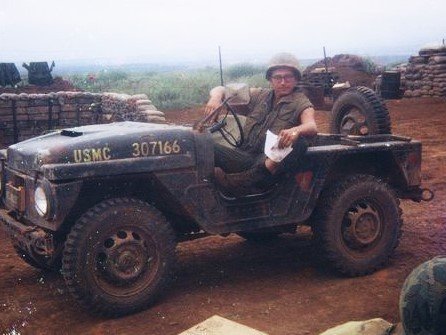
The resulting vehicle became the M422 Mighty Mite. Its lightweight, air-cooled aluminum V4 engine produced approximately 50 horsepower. Combined with four-wheel drive, independent suspension, a compact body, and an exceptionally tight turning radius, the Mighty Mite offered impressive performance for such a small vehicle. It could travel across difficult terrain, maneuver in confined spaces, and reach approximately 55 miles per hour under military specifications. American Motors claimed it was capable of reaching speeds as high as 65 miles per hour.
The Mighty Mite was designed at a time when the Marine Corps was experimenting with helicopters as a way to rapidly move troops, equipment, and vehicles across the battlefield. Standard military Jeeps were too heavy for many helicopters of the early 1950s, so the Mighty Mite was engineered to be light enough to be carried beneath aircraft such as the Sikorsky HRS. Its small size also allowed a group of Marines to manually reposition it when necessary, making it useful in locations where larger vehicles could not easily operate.
Like many vehicles designed for the Marine Corps, the Mighty Mite was also created with amphibious operations in mind. It came equipped for deep-water fording, and an experimental flotation kit was developed using large inflatable tubes positioned around the vehicle. With the kit installed, the Mighty Mite could float, while its rotating wheels provided limited propulsion and steering through the water.
After extensive testing, American Motors received a contract in 1958 to produce the first 250 M422 vehicles. Full-scale production followed in 1960. The original M422 had a 65-inch wheelbase and was the shorter and lighter of the two principal versions. After approximately 1,000 had been built, production shifted to the M422A1, which featured a wheelbase six inches longer than the original. The added length provided more room and improved stability, although it also increased the vehicle’s weight by approximately 80 pounds.
Before the M422A1 entered production, several experimental M422E1 vehicles were created by lengthening existing M422 frames. These test vehicles helped engineers evaluate the benefits of a longer wheelbase and influenced the final M422A1 design. Both production versions could also be equipped with additional features, including stronger windshields, canvas tops, and spare-tire mounting kits. However, mounting the spare tire on the rear of the vehicle prevented the tailgate from being used.
 Although the Mighty Mite was an impressive piece of engineering, it was also extremely expensive. Each vehicle reportedly cost more than $5,000 at the time, significantly more than conventional military Jeeps. Its aluminum construction, specialized drivetrain, independent suspension, and limited production all contributed to the cost.
The vehicle also faced several engineering challenges. One early attempt to reduce weight routed exhaust gases through sections of the frame instead of using a conventional exhaust system. Condensation and corrosive fumes caused premature frame deterioration, forcing changes to the design. Despite these setbacks, the Mighty Mite performed well enough to defeat competing lightweight vehicle designs and enter Marine Corps service.
Unfortunately, the Mighty Mite was created to solve a problem that was quickly disappearing. It had been designed around the limited lifting capacity of early military helicopters, but aircraft technology advanced rapidly during the late 1950s and early 1960s. More capable helicopters such as the UH-1 Huey could carry heavier loads, reducing the need for an expensive vehicle designed primarily around strict weight limitations.
Conventional quarter-ton vehicles were also less expensive, easier to maintain, and useful in a broader range of military operations. As a result, production of the Mighty Mite ended in 1962 after only 3,922 vehicles had been built.
The Mighty Mite’s short production run and specialized construction make it one of the most distinctive American military vehicles of the early Cold War. It represents an important moment when the Marine Corps was adapting to helicopter mobility and searching for new ways to move men and equipment across difficult terrain.
Although advances in aviation technology quickly reduced the need for it, the Mighty Mite remains a remarkable example of military engineering. Its lightweight aluminum body, air-cooled V4 engine, independent suspension, compact proportions, and helicopter-portable design set it apart from nearly every other tactical vehicle of its time.
Today, surviving Mighty Mites preserve the story of an ambitious vehicle created for a rapidly changing battlefield—the small but unforgettable Marine Corps Mighty Mite.
Click the link to watch and learn more about the Mighty Mite.
History survives because people choose to preserve it. Help us keep these stories alive.