The Ugly Angels: Corporal Richard Castellano Jr. and HMM-362 in Vietnam (A Fresh Look)
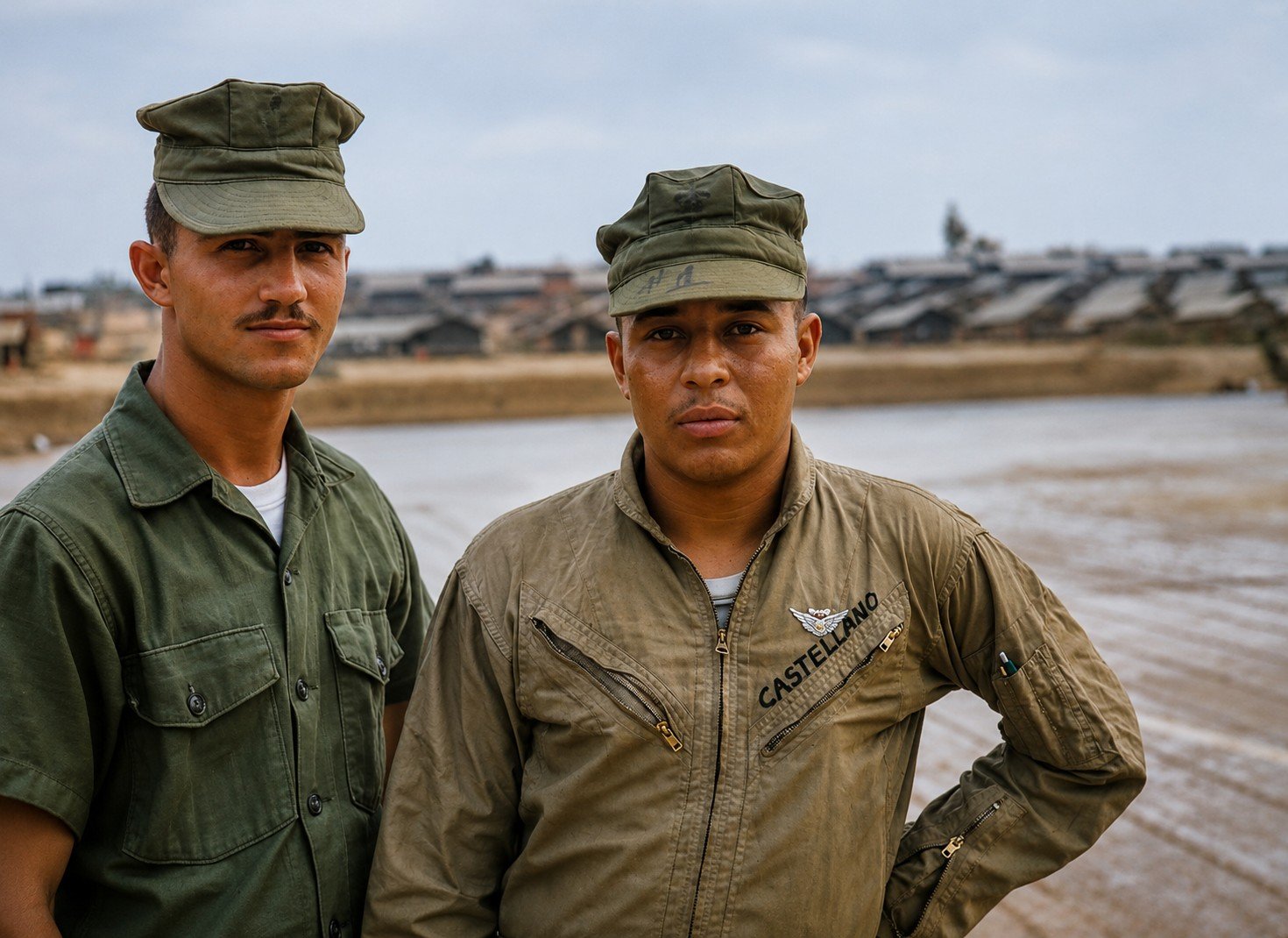
Corporal Richard Castellano Jr. takes center stage in an upcoming feature that highlights a captivating array of photographs capturing the experiences of HMM-362, famously known as the "Ugly Angels," during their impactful tour of duty in Vietnam, where t
August 17, 2026

Some histories are preserved in official reports, unit diaries, and carefully typed after-action summaries. Others survive in shoeboxes, albums, and collections of photographs carried home by the men who were there.
The photographs preserved by Corporal Richard Castellano Jr. belong to that second kind of history.
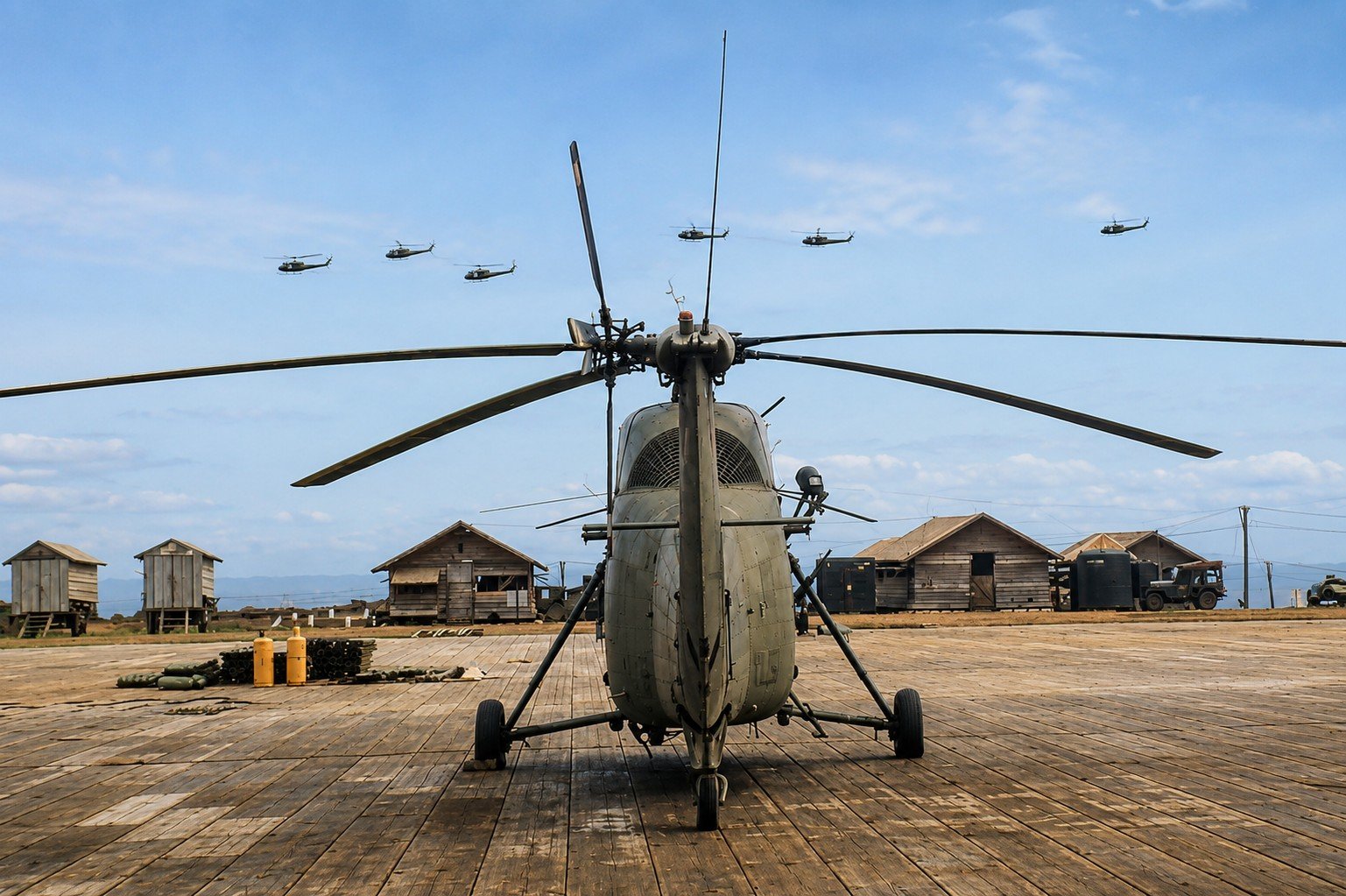
Castellano served as a door gunner aboard a Marine Corps UH-34, and his photographs offer an unusually personal look at Marine helicopter operations in Vietnam. They show aircraft on the ground and in the air, Marines at work, maintenance being performed, weapons positioned at open cabin doors, crews preparing for missions, and the unpolished daily surroundings of a helicopter squadron fighting a war far from home. They are not photographs of Vietnam as seen from a command post. They are Vietnam as it appeared to one of the young Marines riding into the sky aboard the aircraft themselves.
 The squadron represented in those photographs, Marine Medium Helicopter Squadron 362, had already made history years before Castellano photographed its men and machines. HMM-362, the "Ugly Angels," was the first Marine aviation unit deployed to the Republic of Vietnam. Its relationship with the war began when the American commitment was still small, continued through the massive expansion of Marine operations after 1965, carried the squadron through Khe Sanh and the violent fighting of 1968, and finally ended with the last Marine combat missions flown by the venerable UH-34D in August 1969.
The photographs of Richard Castellano Jr. therefore capture more than the experiences of one Marine or one helicopter squadron. They preserve part of the story of an aircraft and a way of war that helped define the Marine Corps' experience in Vietnam.
From Archie's Angels to the Ugly Angels
The squadron's history began a decade before Vietnam. It was activated at Marine Corps Air Station Santa Ana, California, on April 30, 1952, as Marine Helicopter Transport Squadron 362, HMR-362. After several changes in designation and deployments to Japan and Okinawa, the unit became Marine Medium Helicopter Squadron 362 on February 1, 1962. By then it was operating the Sikorsky UH-34, the helicopter that would become inseparable from the squadron's Vietnam story.
Only weeks later, events pulled HMM-362 into Southeast Asia.
In late March 1962, while the 1st Marine Aircraft Wing was participating in the Southeast Asia Treaty Organization exercise TULUNGAN in the Philippines, orders arrived to deploy a Marine helicopter force to South Vietnam. American advisors were already working with South Vietnamese forces, and U.S. Army helicopter companies had begun providing increasing mobility to the Army of the Republic of Vietnam. The Mekong Delta, however, still required additional helicopter support. The Marines were ordered to provide it.
The resulting task unit was built around HMM-362. The squadron fielded 24 UH-34 helicopters and was augmented by light observation aircraft, a transport aircraft, additional maintenance personnel, and a supporting element from Marine Air Base Squadron 16. Altogether, HMM-362's normal strength of roughly 200 Marines was increased by about 50 maintenance specialists. Period records refer to the observation aircraft as OE-1s or O-1Bs and the transport as an R4D or C-117D, reflecting the aircraft redesignations taking place in 1962.
The commander of HMM-362 was Lieutenant Colonel Archie J. Clapp, a combat veteran of World War II and Korea. Clapp had flown during the Iwo Jima and Okinawa campaigns, participated in the first carrier-based raid against Tokyo, and later flew both helicopters and attack aircraft during the Korean War. The Marines under his command became known informally as "Archie's Angels." In time, that name evolved into one considerably less glamorous and considerably more Marine: the "Ugly Angels."
Their destination was Sóc Trăng, about 85 miles south-southwest of Saigon in the Mekong Delta.
 The old airfield had once been used by Japanese aircraft and sat in a region where South Vietnamese government control often ended not far beyond populated areas. Clapp later described the Marine base as essentially an island surrounded by hostile countryside. South Vietnamese infantry and mortar units guarded the outer perimeter, while HMM-362's own cooks, mechanics, clerks, and other Marines provided internal security. Almost everything required to establish and operate the base had to arrive by air. Aviation fuel came by civilian truck over roads vulnerable to ambush, while Marine water trucks traveled several miles between the airfield and Sóc Trăng.
USS Princeton arrived roughly 20 miles offshore from the mouth of the Mekong River at dawn on April 15, 1962. Helicopters began moving men and equipment ashore. By midafternoon the squadron was on the ground, and by darkness the helicopter portion of the camp had been erected. Marine aviation had established itself in South Vietnam.
It was the beginning of a relationship that would last seven years.
 Learning the Helicopter War
What happened next is important because the Marines of HMM-362 were not simply carrying out established Vietnam helicopter doctrine. In many respects, they were helping create it.
Their first days revealed challenges that had nothing to do with enemy fire.
On April 18, two HMM-362 helicopters carried priority supplies from Cà Mau to Bình Hưng. After landing on ground that appeared firm, the crews watched their landing gear slowly sink into the Delta soil. Timbers were pushed beneath the axles, but the helicopters continued settling. The squadron learned quickly. Afterward, crews began carrying short sections of Marston matting that could be placed beneath the wheels when shutting down in questionable terrain.
Two days later, while practicing troop lifts with South Vietnamese soldiers, another problem appeared. The UH-34 sat high enough that many of the smaller ARVN soldiers struggled to climb into it, particularly while standing in deep mud. HMM-362's metalworkers improvised large boarding steps from wood and angle iron.
These were small solutions, but they illustrate what characterized the first Shufly deployment. Almost every mission produced a lesson. Some concerned mud, loading procedures, navigation, weather, or maintenance. Others were paid for under enemy fire.
On Easter Sunday, April 22, HMM-362 flew its first combat troop assault. During Operation Lockjaw, approximately 340 soldiers of the ARVN 7th Division were carried into landing zones around a stream-divided village while a U.S. Army helicopter company inserted a similar force on the opposite side. Opposition was light and none of the Marine aircraft were hit.
Two days later came Operation Nightingale.
HMM-362 was carrying troops of the ARVN 21st Division into eight landing zones when several aircraft encountered small-arms fire. One UH-34 was struck in an oil line. Its pilot managed to fly roughly a mile before putting the damaged helicopter into a rice paddy.
What followed demonstrated something the squadron had already planned but never tested in combat.
 A wingman landed and removed the crew. Four additional helicopters carried a repair team and reserve troops to the downed aircraft. The troops established security while the mechanics determined what they needed. A replacement part was flown from Sóc Trăng, installed in the field, and the UH-34 was flown back to base. According to Clapp, the entire process took less than two hours from the moment the aircraft was hit.
The "down-bird" procedure would become increasingly important as the squadron accumulated combat experience.
The enemy was learning too.
On May 9, HMM-362 attacked near Cai Ngay after a preparatory air strike. Instead of suppressing the Viet Cong, the strike apparently warned them that something was coming. Armed men moved from the village into surrounding ditches and dikes, many of which happened to lie near the planned helicopter landing sites.
The result was HMM-362's most punishing mission of the deployment to that point. Eight of 22 helicopters and the accompanying observation aircraft were struck by enemy fire. One South Vietnamese soldier was killed and another wounded while aboard the aircraft. The experience convinced Clapp and his officers that preparatory air strikes could sometimes sacrifice the surprise upon which helicopter assaults depended. It also strengthened their demand for escort aircraft whose pilots could communicate directly with the Marine helicopter flight leader.
When the squadron returned the following day to an area where a previous operation had succeeded, the Viet Cong were waiting. Armed men scattered into vegetation and fired upward as the helicopters passed only feet above them. Another UH-34 was hit.
Clapp drew a blunt lesson from the experience: successful tactics could not simply be repeated until the enemy developed a countermeasure. Helicopter warfare had to remain unpredictable.
Speed, deception, flexibility, and surprise became as important as firepower.
One of HMM-362's most significant developments was the airborne reserve concept that became known as the "Eagle Flight."
 Rather than committing every available soldier in the first lift, several helicopters remained airborne carrying reserve troops. When enemy personnel were seen attempting to escape the main operation, the helicopters could quickly land troops in their path. Those soldiers could then be recovered and inserted somewhere else as the situation changed.
On June 8, HMM-362 used the Eagle Flight repeatedly around an objective village. Reserve troops were inserted, recovered, and moved again as groups were spotted leaving the area. Eventually they intercepted a Viet Cong leader carrying money and documents. The concept demonstrated how helicopters could give a ground force a form of mobility that conventional infantry movement simply could not match.
The squadron continued stretching what could be done with helicopters.
On May 23, two helicopters carried out what Clapp described as the first night helicopter casualty evacuation performed for the ARVN 7th Division. They flew through rain and a ceiling of only a few hundred feet, finding the pickup point with the help of a bonfire. The mission's significance extended well beyond the men evacuated. The division commander told the Marines that knowing helicopters could come for his wounded after dark had an enormous effect on troop morale.
On July 18, HMM-362 participated in what Clapp identified as the largest helicopter lift yet attempted in Vietnam. Eighteen Marine helicopters, 12 U.S. Army helicopters, and 11 Vietnamese Air Force aircraft carried troops of the ARVN 5th Division north of Saigon.
Two days later, HMM-362 conducted what Clapp recorded as the first helicopter night troop landing in Vietnam. The formation departed Sóc Trăng before dawn and approached the objective in darkness with running lights extinguished. Crews navigated by the half moon, waterways, and reflected light. Close to the landing zone, engine exhaust and its reflection in flooded rice paddies helped the pilots maintain formation and judge the ground below them.
The troops were on the ground approximately ten minutes before first light.
By the time HMM-362 was relieved on August 1, 1962, the squadron had conducted about 50 combat troop-lift missions involving roughly 130 helicopter landings against Viet Cong opposition. Seventeen helicopters and two observation aircraft had sustained gunfire damage, many more than once. Remarkably, Clapp reported that enemy fire during that deployment had not caused a Marine casualty within his squadron.
The experience also revealed how much remained to be learned.
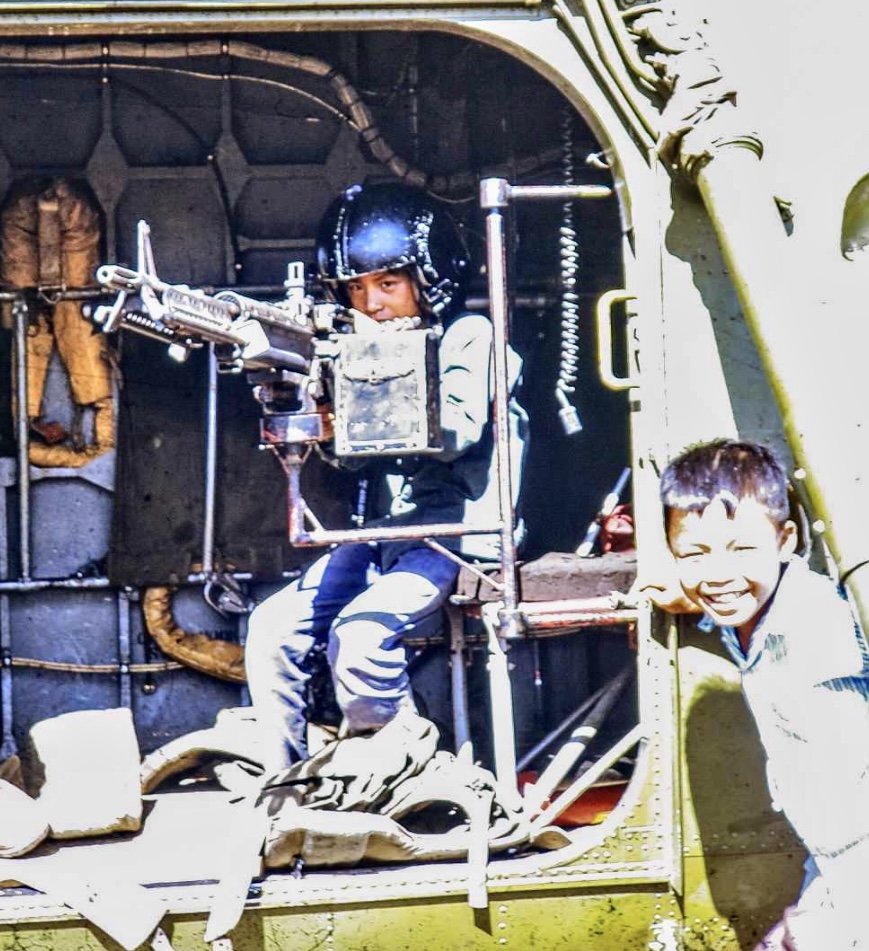
HMM-362's helicopters initially did not carry permanently installed door machine guns. Clapp believed blocking the cabin doorway with a gun would slow the rapid unloading of troops in a hostile landing zone. Instead, the copilot and crew chief carried submachine guns and fired when necessary. He argued that surprise, minimum time on the ground, escort aircraft, and rapidly changing tactics provided better protection for the troop-carrying helicopter.
Vietnam would eventually change that calculation.
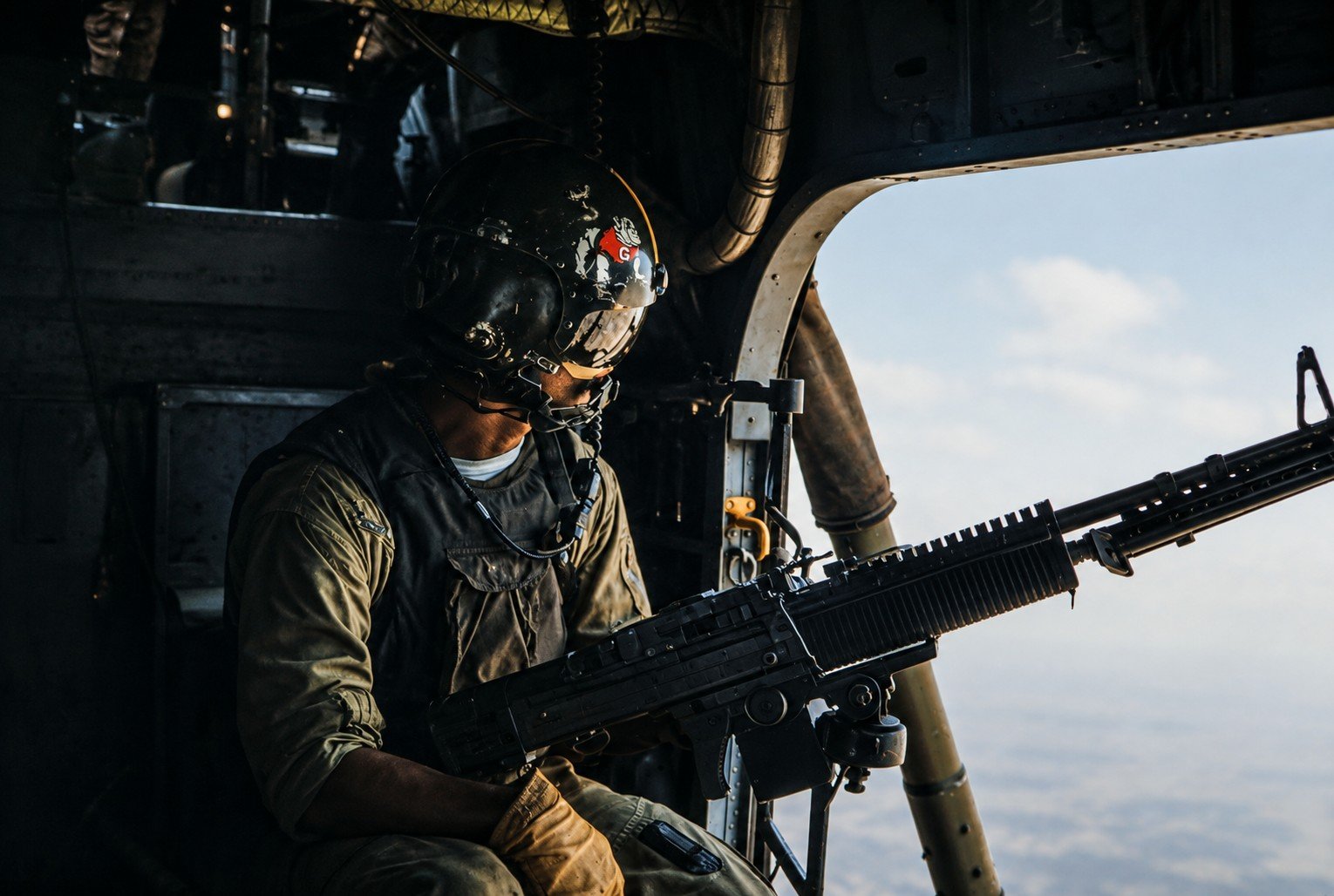
Years later, the helicopters photographed by Richard Castellano Jr. carried door gunners armed with machine guns. Castellano himself served in that role, and photographs from his collection show another crewman manning an M60 while airborne over South Vietnam. The contrast between Clapp's relatively lightly armed UH-34s of 1962 and the gun-equipped aircraft of the later war illustrates how much the battlefield had changed.
The Ugly Angels Return
HMM-362 turned its aircraft and equipment over to HMM-163 on August 1, 1962, and returned to the United States. The squadron reached Santa Ana by the end of July and in October became the West Coast Helicopter Transition Squadron, training fixed-wing Marine aviators to become helicopter pilots. It continued in that role until July 1, 1964, when it returned to operational status.
This point corrects a long-repeated error in some accounts of HMM-362. The Marine Shufly squadron that relieved HMM-361 at Da Nang in February 1964 was HMM-364, the "Purple Foxes," not HMM-362. HMM-362 was still performing its transition-training mission in California at the time. HMM-362's second Vietnam deployment did not begin until September 1965.
When the Ugly Angels returned, they entered a very different war.
The small advisory effort of 1962 had become a major American combat commitment. Marine infantry had landed at Da Nang in March 1965, airfields and combat bases were expanding across I Corps, and Marine helicopters were now moving American combat units rather than primarily supporting South Vietnamese troops.
HMM-362 deployed to South Vietnam again in September 1965. Over the next four years the squadron operated from locations including Sóc Trăng, Ky Ha, Hue/Phu Bai, and Marble Mountain. It also repeatedly served as the aviation component of the Seventh Fleet's Special Landing Force from amphibious assault ships including USS Valley Forge, USS Princeton, USS Okinawa, and USS Iwo Jima.
Almost immediately, the squadron entered a major campaign.
In December 1965, HMM-362, then commanded by Lieutenant Colonel James Aldworth, participated with other Marine helicopter squadrons in Operation Harvest Moon. Conducted in the Quế Sơn Valley region, Harvest Moon became one of the largest Marine operations of 1965 and a preview of the increasingly violent fighting to come.
The aviation effort was enormous. Seven helicopter squadrons from MAG-16 and MAG-36, together with HMM-261 of the Special Landing Force, flew 9,230 sorties, transported more than 12,000 troops, and moved 638 tons of supplies during the operation. Those totals belonged to the combined helicopter force, not HMM-362 alone, but HMM-362 was specifically listed among the MAG-36 squadrons participating. Helicopters performed troop lifts, casualty evacuation, reconnaissance, resupply, and administrative missions, often under poor weather and enemy fire. Marine helicopter pilots reported more than 100 incidents of hostile fire during Harvest Moon, with 53 helicopters sustaining battle damage across the participating force.
For the Ugly Angels, it was a dramatic return to the country where they had helped introduce Marine helicopter operations only three years earlier.
Their next chapter increasingly took them to sea.
HMM-362 became deeply involved with the Special Landing Force, or SLF, the Marine force maintained aboard Seventh Fleet amphibious shipping. A typical SLF combined a Marine battalion landing team with a Marine helicopter squadron, allowing an infantry force to remain offshore and then move rapidly into an objective area by helicopter and landing craft.
During Operation Double Eagle in early 1966, Marine forces conducted a large amphibious operation in the coastal region south of Chu Lai. HMM-362 was among the aviation units supporting the operation. The squadron's association with the SLF would continue repeatedly over the next several years, sending the Ugly Angels back and forth between ships and bases ashore as operational requirements changed. The Marine Corps' official unit history lists Double Eagle among HMM-362's significant Vietnam operations.
The pace continued into 1967.
In January, HMM-362 supported Operation Deckhouse V, a joint U.S. Marine and Vietnamese Marine operation in the Mekong Delta. Operating from USS Iwo Jima, Lieutenant Colonel Marshall B. Armstrong's HMM-362 provided a mixed force of UH-34 and CH-46 helicopters for Battalion Landing Team 1/9 and Vietnamese Marines landing in Kien Hoa Province between branches of the Mekong River.
Deckhouse V lasted from January 6 through January 15. Enemy intelligence apparently compromised the operation, and much of the anticipated Viet Cong force had left before the Marines arrived. Even so, the operation represented another striking chapter in HMM-362's story. Five years after becoming the first Marine aviation squadron based in South Vietnam at Sóc Trăng, the Ugly Angels were again flying over the Delta, now as part of an amphibious combat force operating from a helicopter assault ship.
As the Marine war shifted increasingly toward the northern provinces, HMM-362 shifted with it. The squadron operated from Phu Bai and other bases in I Corps and supported operations whose names became part of the history of the war, including Lancaster, Scotland, Napoleon-Saline, and other campaigns associated with the fighting near the Demilitarized Zone.
1968: The War Richard Castellano Photographed
By 1968, the battlefield HMM-362 faced bore little resemblance to the counterinsurgency environment encountered by Archie's Angels in 1962.
The Viet Cong remained dangerous, but Marine units in northern I Corps were also fighting well-equipped formations of the North Vietnamese Army. Helicopters confronted automatic weapons, heavy machine guns, mortars, rockets, artillery, difficult mountain terrain, monsoon weather, and landing zones covered or observed by enemy forces.
The UH-34D was no longer a new aircraft. The Boeing Vertol CH-46 Sea Knight was increasingly assuming the Marine medium-lift mission, while heavier CH-53 Sea Stallions were joining the fight. Yet the older Sikorsky continued working. In fact, the UH-34's continued usefulness became especially important during periods when problems temporarily reduced the availability of newer CH-46s.
 The photographs of Corporal Richard Castellano Jr. belong to this mature phase of the helicopter war.
By then, the role of men inside the cabin had changed along with the aircraft's tactics. Door guns had become part of the protective firepower of transport helicopters. The open doorway that Clapp had wanted unobstructed in 1962 could now contain an M60 and a Marine whose job was to watch the ground, identify threats, protect the aircraft during approaches and departures, and return fire when required.
That was the world Castellano knew.
A door gunner experienced a helicopter mission differently from nearly anyone else aboard. The pilots were looking forward and flying the aircraft. Troops in the cabin often saw only fragments of the terrain outside. The gunner lived at the opening, exposed to the wind, noise, vibration, and a sweeping view of the country passing beneath the aircraft. During an approach into a landing zone, that same open space could become the point from which the gunner searched tree lines, ridgelines, paddies, villages, and trails for the muzzle flash or movement that might mean someone below was shooting back.
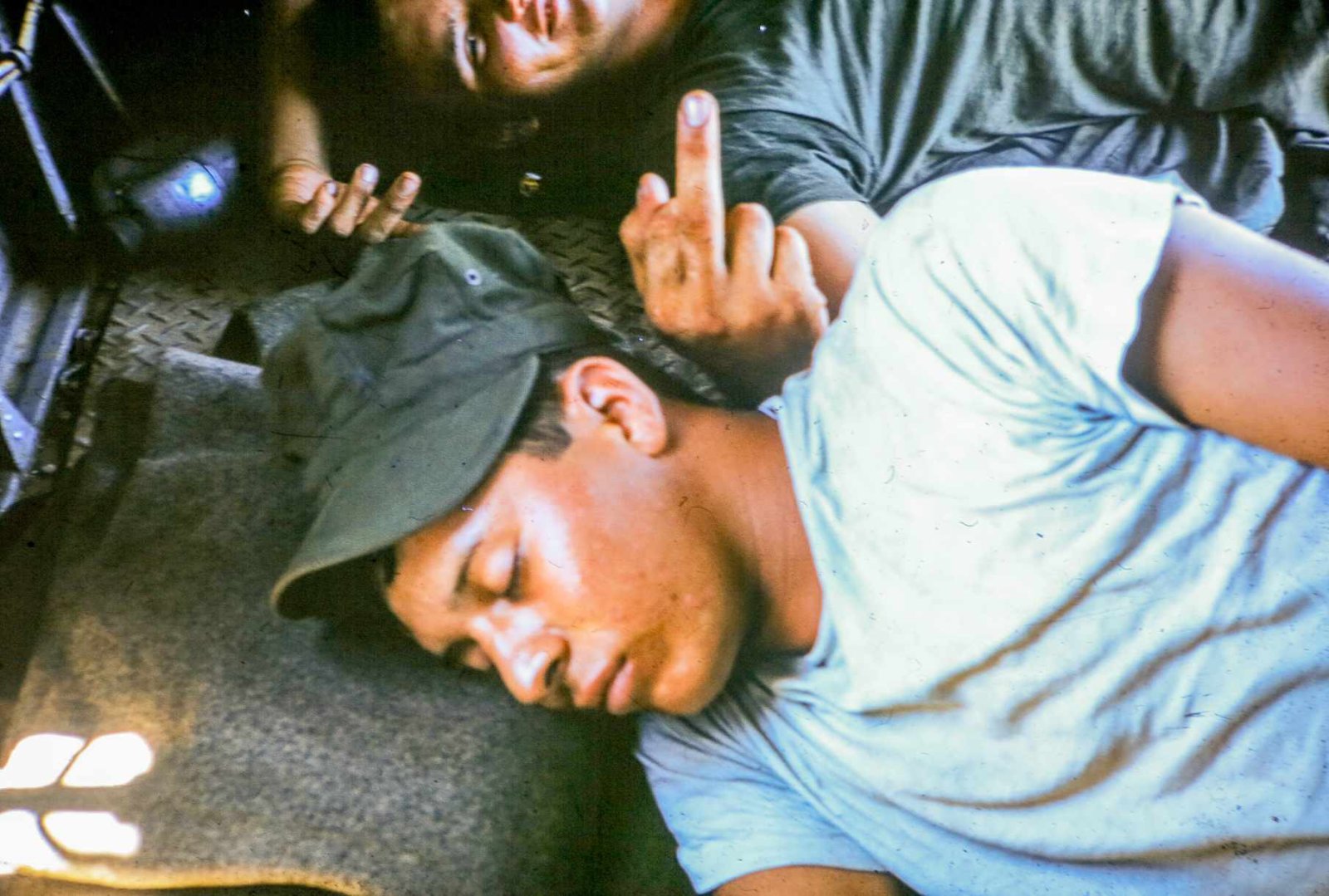
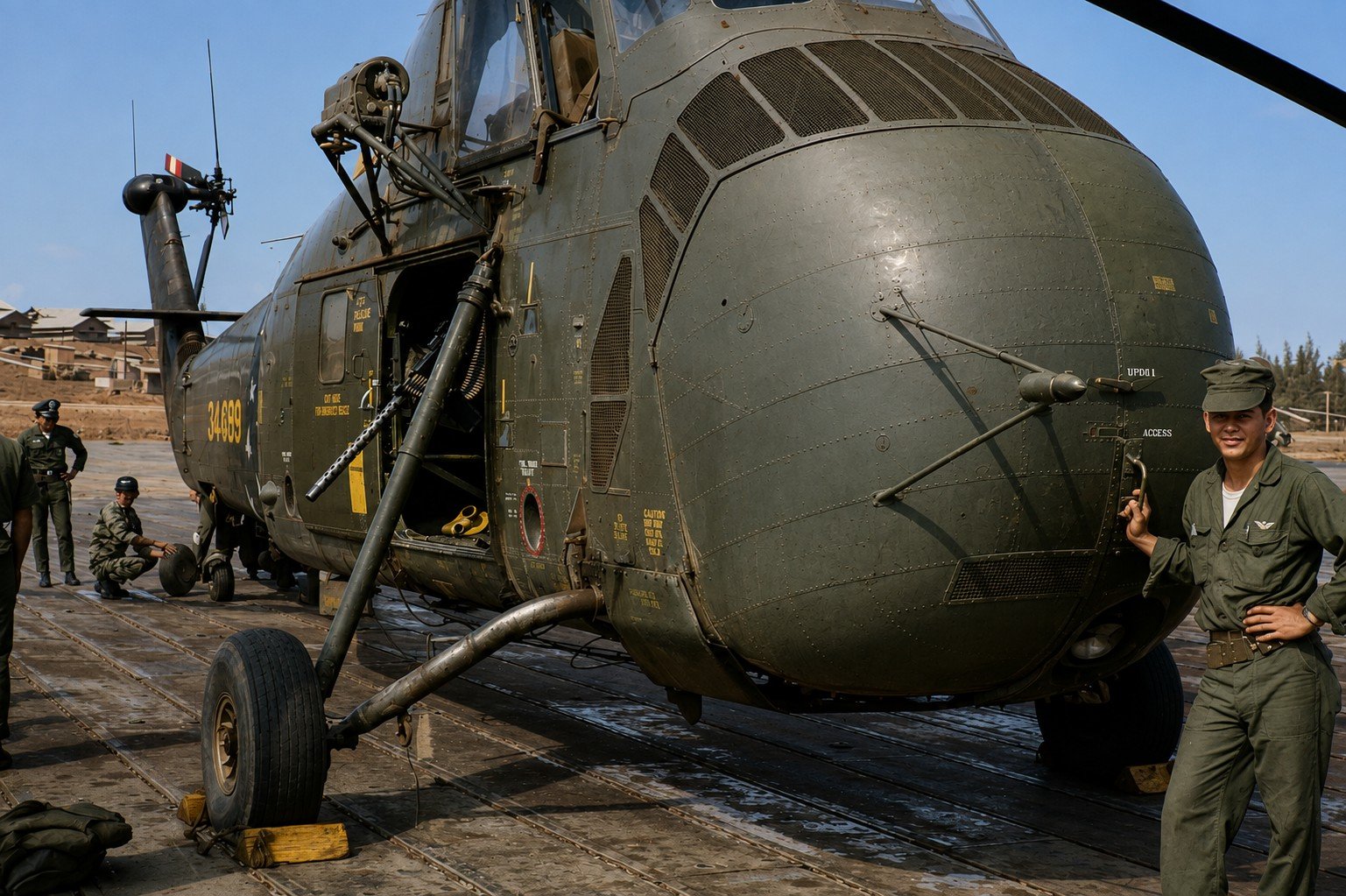
Castellano's photographs preserve that environment without needing to recreate it. Aircraft are dirty because helicopters operating from Vietnamese airfields became dirty. Panels are open because machines required constant maintenance. Marines appear tired, informal, and surrounded by equipment because a combat squadron was not a ceremonial flight line. The photographs show the machinery, but more importantly they show the people required to keep that machinery flying.
And in 1968, there was rarely a shortage of work.
One of HMM-362's most important assignments came during the opening days of the siege of Khe Sanh.
On January 22, Khe Sanh Combat Base was under increasing North Vietnamese pressure. Twenty Air Force C-123 transports delivered roughly 130 tons of ammunition during an intense resupply effort. After unloading, the empty transports joined helicopters of HMM-362 in evacuating wounded Marines and civilian refugees from the embattled base.
The environment was anything but secure. North Vietnamese artillery, rockets, mortars, and small-arms fire struck the combat base and surrounding hill positions throughout the day. One CH-46 was hit while departing the airstrip and crashed within the perimeter. HMM-362 continued operating as part of the enormous aviation effort required to keep Khe Sanh supplied, reinforced, and connected with the outside world.
The significance of helicopter operations around Khe Sanh is difficult to exaggerate. The combat base was surrounded by mountainous terrain, while Marine positions on isolated hills depended heavily upon aircraft. Weather frequently restricted operations. Enemy antiaircraft weapons covered approaches. Artillery and mortar fire could strike landing areas. Even when a helicopter reached its destination, crews were often most vulnerable during the few seconds when forward speed disappeared and the aircraft settled into the landing zone.
The helicopter crews nevertheless kept going.
For HMM-362, Khe Sanh was another stage in a progression that had begun in the rice paddies of the Delta. The squadron that once experimented with airborne reserves against scattered Viet Cong formations was now operating inside one of the largest battles of the Vietnam War.
Later in 1968, HMM-362 was involved in another major operation, this time southwest of Da Nang.
Operation Maui Peak was launched to relieve the Special Forces camp at Thuong Duc, which North Vietnamese forces had threatened in late September. The terrain was brutal, with steep mountains, dense jungle, narrow valleys, and limited landing areas. Helicopters were essential for inserting troops and supplying Marine units moving through country where overland movement could be painfully slow.
On October 11, tragedy came without enemy fire.
An HMM-265 resupply helicopter carrying replacements and supplies collided in flight with an HMM-362 UH-34D that had just taken off. Lieutenant Colonel James W. Stemple, commanding 2d Battalion, 5th Marines, witnessed the accident. Both aircraft fell near the Song Vu Gia. There were no survivors.
It was a reminder of another reality visible throughout the history of Marine aviation in Vietnam. The danger did not begin only when enemy tracers appeared.
Helicopters flew heavily loaded, at low altitude, in poor weather, through dust, rain, darkness, mountains, jungle, and crowded airspace. Mechanical failures, obstacles, visibility, rotor wash, collisions, and the simple absence of room for error could be as deadly as hostile fire.
For the Marines who flew every day, those distinctions probably mattered less than they do to historians. A man lost was still a Marine who did not come home.
 The Last Leatherneck UH-34s
HMM-362 entered 1969 with the UH-34 still at the center of its mission.
At the beginning of that year, HMM-362 formed the helicopter component of Special Landing Force Alpha alongside Battalion Landing Team 2/26. Marine records list the squadron with 24 UH-34Ds. On January 5, after completing Operation Valiant Hunt on Barrier Island south of Hoi An, the SLF reembarked aboard USS Okinawa. Within days, the force was preparing for Operation Bold Mariner on the Batangan Peninsula, an operation described in the official Marine history as the largest amphibious operation undertaken since the Korean War.
The organization illustrates just how far Marine vertical assault had progressed since HMM-362's first mission in 1962. The Special Landing Force was designed as a balanced, mobile fighting force. Its infantry battalion, supporting arms, ships, and helicopter squadron could remain offshore, move rapidly to a threatened area, and place combat power ashore by air and sea.
HMM-362 and the UH-34 were now integral parts of a mature system whose earliest combat lessons the same squadron had helped discover.
But the UH-34's time was running out.
The CH-46 had entered Marine service in Vietnam in 1966, while the CH-53 provided capabilities impossible for the older Sikorsky. The piston-engined UH-34 had nevertheless continued flying long after newer helicopters began replacing it.
There was a certain appropriateness in HMM-362 being the squadron that carried the aircraft to the end.
HMM-362 remained committed to Special Landing Force duties into 1969 before being replaced by HMM-265 in late May. The Ugly Angels then continued operations ashore as their Vietnam service drew to a close.
On August 18, 1969, HMM-362 flew the final Marine combat missions of the UH-34 in Vietnam. The aircraft type that had carried Archie's Angels ashore in April 1962 was retiring from the war with the same squadron.
A Marine Corps photograph from the period captures HMM-362 crewmen standing beside a UH-34D after its rotor blades had been folded, saluting as the aircraft was retired. It is difficult to imagine a more fitting image for the end of the era.
Three days later, on August 21, the squadron was redesignated Marine Heavy Helicopter Squadron 362, HMH-362, at Marine Corps Air Station New River, North Carolina, and began transitioning to the CH-53 Sea Stallion. The Ugly Angels would continue to serve for decades, eventually flying the CH-53 in later conflicts and ultimately returning to the active force as VMM-362 with the MV-22 Osprey.
But Vietnam permanently defined the squadron's identity.
HMM-362 had been there at the beginning.
It had arrived when a few dozen helicopters supporting South Vietnamese troops represented a major American commitment. Its Marines had learned how rapidly supposedly firm Delta soil could swallow a helicopter's wheels. They improvised boarding steps, refined recovery procedures for damaged aircraft, experimented with deception and quick-reaction missions, developed the Eagle Flight concept, and pushed helicopter operations into darkness.
They watched enemy tactics change and changed their own tactics in response.
They returned in 1965 to a full-scale American war and carried Marines into operations that stretched from the rice paddies of the south to the mountains below the Demilitarized Zone. They flew from primitive fields and large air bases, from Phu Bai and Marble Mountain, and from the decks of amphibious assault ships. They moved infantry, ammunition, food, equipment, casualties, and refugees. They flew at Khe Sanh and during the major campaigns of 1968. And finally, they flew the Marine Corps' last UH-34 combat missions in Vietnam.
The price was substantial.
The Marine Corps' official history of the squadron records that 33 Ugly Angels lost their lives while the squadron supported combat operations in Vietnam. Behind that number were pilots, aircrewmen, maintainers, and Marines whose individual stories formed the human cost of keeping the squadron in the air.
That is also why Richard Castellano Jr.'s photographs matter.
Official histories can tell us when HMM-362 arrived, how many aircraft it operated, which campaigns it supported, and when its last UH-34 left the war. They can document sorties, aircraft losses, commanders, and operations.
A Marine's camera records something different.
It records what the helicopter looked like when the mission was over. It records the crewman standing beside the aircraft, the gun in the doorway, the mechanic working where no official photographer was likely to be standing, the machinery waiting for another mission, and the young Marines for whom the events now called "history" were simply another day.
Richard Castellano Jr. was one of those Marines.
Through his photographs, the Ugly Angels are no longer only a squadron designation in an operational history. Their aircraft have faces around them. Their war has texture. The distance between a sentence such as "HMM-362 supported combat operations" and the reality of the men who actually climbed aboard those helicopters becomes a little smaller.
From the first Marine helicopters arriving at Sóc Trăng in April 1962 to the last UH-34 combat missions in August 1969, HMM-362 occupied an extraordinary place in the history of Marine aviation.
They entered Vietnam as Archie's Angels.
They left it as the Ugly Angels.
And thanks to Marines such as Corporal Richard Castellano Jr., part of what they saw along the way remains with us. A special thanks to his son for saving his photographs and allowing us to share them with you all.