The Thompson Submachine Gun From Gangland America to the Battlefields of the World
It was heavy, expensive, complicated, and chambered for a pistol cartridge that limited its effective range. Yet in the places where it was meant to fight, none of those shortcomings necessarily mattered.
August 13, 2026

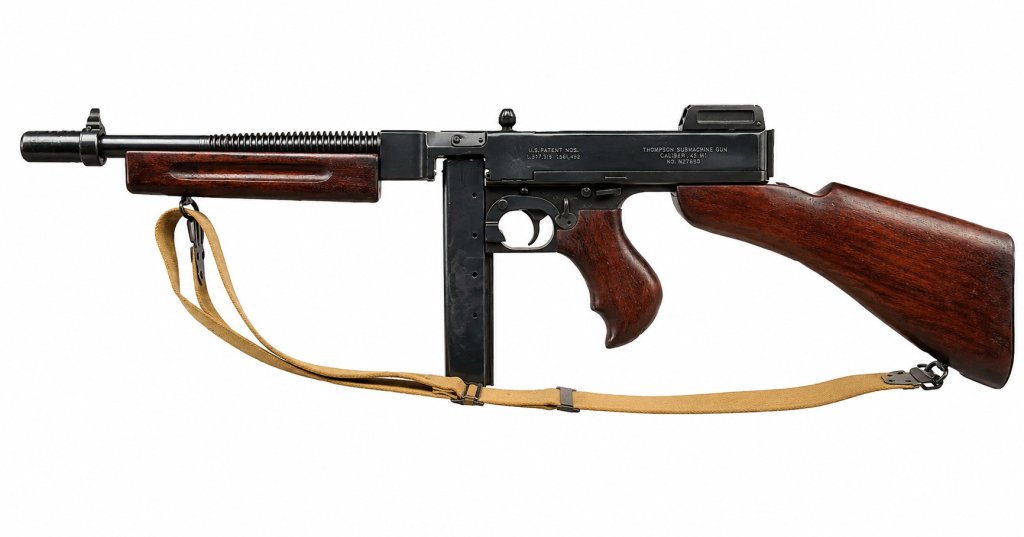
Few firearms have ever possessed two identities as powerful or as contradictory as the Thompson submachine gun. To Americans who grew up with gangster movies, it is the "Tommy Gun," the heavy wooden-stocked weapon with a circular drum magazine barking from the running board of a sedan while men in overcoats exchange fire in a city street. To generations of soldiers and Marines, however, the Thompson belonged somewhere very different. It was carried through the jungles of Nicaragua, clutched by British Commandos preparing to raid occupied Europe, jumped into Normandy with American paratroopers, dragged through Pacific mud by Marine Raiders, fired into Japanese bunkers, carried by tank crews pushing toward Germany, used by OSS teams operating behind enemy lines, and taken into another desperate war in Korea. Decades after it should have disappeared, old Thompsons could still turn up in Vietnam.
It was heavy, expensive, complicated by the standards of later submachine guns, and chambered for a pistol cartridge that limited its effective range. Yet in the places where it was meant to fight, none of those shortcomings necessarily mattered. At fifty yards inside a village, twenty yards along a jungle trail, across the room of a fortified building, or at the mouth of an enemy bunker, the Thompson could deliver a succession of heavy .45-caliber bullets faster than a rifleman could hope to match. That ability made it one of the defining close-combat weapons of the twentieth century.
The Thompson also survived long enough to witness enormous changes in warfare. It was conceived when armies were still thinking about breaking into the trenches of World War I, first saw military combat during America's interwar "small wars," gained infamy during Prohibition, became a mass-produced weapon of global war, fought again in Korea, and lingered into the era of the M16. The weapon that began as an answer to trench warfare eventually became an artifact of a world that had almost completely changed around it.
 A Weapon for the War That Ended Too Soon
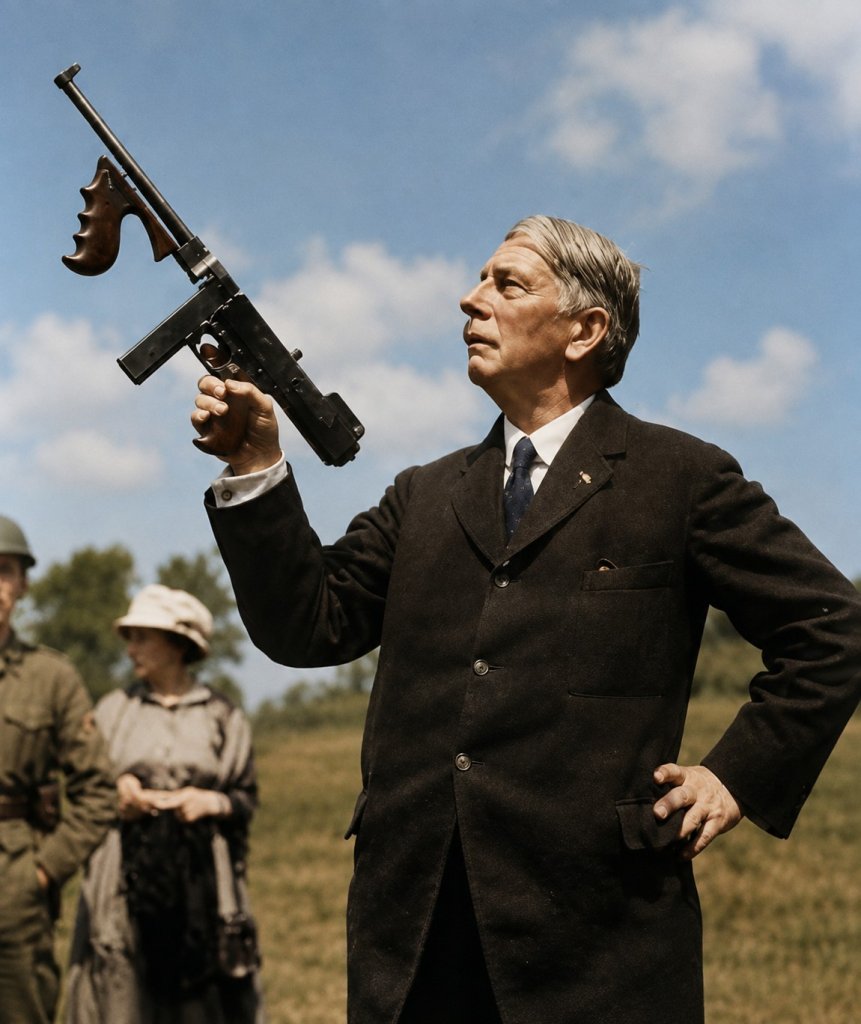
The Thompson story begins with Brigadier General John Taliaferro Thompson, a career U.S. Army ordnance officer with extensive experience in small-arms development. During World War I, Thompson became convinced that American troops needed a compact automatic weapon capable of producing overwhelming fire during assaults against enemy trenches. The rifle was powerful and accurate but comparatively slow in the confined violence of a trench system. Heavy machine guns could dominate ground but were cumbersome. Thompson envisioned something an individual soldier could carry while delivering automatic fire at close range. The Smithsonian describes his work as an effort to develop a weapon specifically suited to the brutal close fighting of the First World War.
The mechanical problem was considerable. A conventional rifle cartridge generated enormous chamber pressure, and Thompson wanted an automatic system that did not depend upon the complicated locking mechanisms common to many full-power automatic weapons. His project became associated with an invention patented by former naval officer John Bell Blish. Blish believed that certain dissimilar metals resisted sliding against one another more strongly under high pressure than under low pressure. Thompson's engineers attempted to exploit that principle in an automatic firearm by placing a bronze locking piece between the bolt and receiver. Under the theory, the lock would resist movement while chamber pressure was high and permit the action to open as the pressure declined. Springfield Armory's National Historic Site describes the principle as friction between inclined metallic surfaces intended to hold the action closed under high pressure and release it afterward.
The original dream was considerably more ambitious than a pistol-caliber submachine gun. Thompson wanted a lightweight automatic rifle, and experimental weapons were developed around rifle cartridges. The Blish system proved disappointing in that role. A Thompson automatic rifle tested against John Garand's designs at Springfield Armory in 1921 performed poorly, and the dream of using the system as the basis for a successful full-power infantry rifle faded. The design team instead concentrated on the much lower-powered .45 ACP cartridge already used by the M1911 pistol. What had failed to become an automatic rifle could become something entirely different.
The timing was almost comically unfortunate. Thompson's concept had been inspired by the trenches, but the Armistice of November 1918 arrived before the weapon could reach the troops fighting in them. The great war for which it had been imagined was over. Instead of abandoning the project, Thompson and the Auto-Ordnance Corporation continued development, transforming the weapon into a compact shoulder-fired automatic arm that Auto-Ordnance would market as a "submachine gun." The term neatly described its position below the full-sized machine gun in power and size while still offering fully automatic fire.
The basic concept that emerged was remarkably enduring. The Thompson fired the same .45 ACP cartridge as the standard American service pistol, operated from an open bolt in automatic fire, and placed a substantial mass of steel and wood behind a relatively slow but heavy bullet. The weapon was not a miniature rifle. It belonged to an entirely different tactical niche, one in which close-range controllability and a high volume of fire mattered more than long-range ballistics.
The Blish Lock and the Strange Heart of the Early Thompson
Early Thompson models are mechanically fascinating because of the bronze H-shaped component generally called the Blish lock. When the weapon fired, pressure on the cartridge case pushed against the bolt. The lock rode in angled tracks in the receiver and was intended to delay the bolt's rearward movement until pressure had fallen. Thompson's patents described systems for restraining the breech closure immediately after firing and then releasing it as pressure declined.
Whether the famous "Blish principle" actually contributed as much as its designers believed has been debated ever since. What became obvious later was that a .45 ACP Thompson did not truly need such an elaborate delay system. When wartime engineers simplified the gun into the M1 and M1A1, they eliminated the Blish lock entirely and operated the weapon by straightforward blowback. The simplified guns worked perfectly well, which was a rather impolite verdict on one of the mechanical ideas around which the original weapon had been designed.
Yet the Blish lock helps explain why early Thompsons were so beautifully machined and consequently so expensive. The receiver required substantial precision work. Internal parts were carefully fitted. The gun used large pieces of machined steel rather than the stampings and welded components that would characterize cheaper wartime submachine guns. The Thompson came from an era when firearms designers were still accustomed to solving manufacturing problems by machining more steel rather than asking how little steel they could get away with.
That philosophy produced an extraordinarily substantial weapon. Depending upon configuration, a Thompson weighed roughly ten to eleven pounds before a loaded magazine was installed. That placed it in the same neighborhood as many military rifles even though it fired a pistol cartridge. The barrel was only about ten and a half inches long, but the receiver, wooden buttstock, pistol grip, forearm, and large internal components gave the weapon considerable mass. The weight was unpleasant when carrying it all day, but the same weight helped tame the recoil and muzzle movement of automatic .45-caliber fire.
The Model 1921 and a Gun Looking for a Customer
By 1921, Auto-Ordnance had a commercial weapon ready to sell. Colt manufactured the first major production run for Auto-Ordnance at its famous Hartford works. Congressional records from the period refer to approximately 15,000 of those early Thompsons having been manufactured, an enormous inventory considering how limited the market initially proved to be. Colt's involvement also gave the new weapon a level of manufacturing quality that would become part of the mystique surrounding early Thompsons.
The Model 1921 looked much like the Thompson that popular culture remembers today. It had deeply blued steel, finely finished walnut furniture, a vertical front grip on many examples, a detachable buttstock, cooling fins around the barrel, and the ability to use both straight magazines and large drum magazines. The Cutts compensator, recognizable as the slotted muzzle device on many surviving examples, was later incorporated onto versions intended to reduce muzzle climb during automatic fire. The complete package looked less like a disposable military tool and more like an expensive commercial firearm that happened to fire hundreds of rounds per minute.
Early cyclic rates could approach roughly 800 rounds per minute or more, depending upon the specific model and ammunition. That made the Thompson spectacular at close range but also capable of emptying a magazine with alarming enthusiasm. A twenty-round box magazine could disappear in little more than a second and a half if the trigger remained depressed. Experienced shooters therefore learned to fire short bursts rather than simply leaning on the trigger until the weapon ran dry.
The famous drum magazines added enormous visual presence and ammunition capacity. Fifty-round drums became the version most closely associated with the gun, while even larger 100-round drums existed commercially. Yet the drum brought disadvantages that soldiers would eventually know very well. It was bulky, heavy, noisy when partially loaded, slower to manipulate, and more complicated than a simple box magazine. The elegant gangster image of a Thompson with a drum made excellent advertising and cinema. A soldier trying to crawl through jungle or climb through a hatch might come to considerably different conclusions.
Auto-Ordnance initially faced a problem that has killed many weapons projects: the weapon worked, but the customer for it was not obvious. The First World War had ended, the American military was shrinking, and neither the Army nor Marine Corps needed tens of thousands of expensive new submachine guns. Auto-Ordnance therefore marketed the Thompson internationally and to police departments, prisons, banks, private security organizations, and anyone else legally able to buy an automatic weapon.
That decision gave the Thompson its second identity.
The Gun That Gangsters Made Famous
The Thompson was never designed for gangsters. John Thompson had imagined American soldiers carrying it into enemy trenches. Yet the same characteristics that made it attractive for close combat also appealed to criminals during the violent years of Prohibition. It was compact compared with a rifle, could be concealed inside a vehicle or coat more easily than a full-sized machine gun, and could place an enormous number of .45-caliber bullets into a target at short range.
Criminal use gave the Thompson publicity Auto-Ordnance could never have purchased. Photographs of seized guns appeared in newspapers. Police departments acquired Thompsons partly because criminals might have them. The weapon became associated with bootlegging, bank robbery, organized crime, and the increasingly mechanized violence of criminals who could cross jurisdictional boundaries in fast automobiles.
The FBI's history of John Dillinger provides a wonderfully concrete example. When Dillinger and members of his gang were captured in Tucson in January 1934, authorities seized three Thompson submachine guns along with rifles, body armor, ammunition, and more than $25,000 in cash. The gang had previously raided police arsenals to steal automatic weapons. The gun created to arm soldiers had entered American criminal folklore.
That notoriety also helped shape federal firearms law. The National Firearms Act of 1934 imposed registration requirements and an enormous $200 tax on making or transferring regulated firearms including machine guns. ATF's own historical explanation states that Congress was reacting in significant part to the gangland violence of the era. Congressional testimony later noted that the $200 tax was approximately equal to the cost of a new Thompson at the time, making the tax deliberately punitive rather than incidental.
The irony is difficult to miss. Civilian notoriety made the Thompson famous at exactly the moment when the military remained lukewarm about it. The public came to recognize its distinctive silhouette before the gun had fought the war that would ultimately define its military reputation.
The Marines Discover What the Thompson Was Actually Good At
While newspaper readers were learning to associate Thompsons with gangsters, the United States Marine Corps was discovering that the weapon could be remarkably useful in the kind of fighting for which it had originally been conceived. During American interventions in Central America and the Caribbean, Marines often operated in mountains, jungle, villages, and other terrain where engagements could occur suddenly at close range. The Thompson's short length and automatic fire were valuable even though its pistol cartridge lacked the range and penetration of the BAR or Springfield rifle.
The Marine Corps' 1940 Small Wars Manual, based heavily upon actual interwar experience, is remarkably candid about the weapon. The manual said the Thompson had been used extensively in small wars partly because its short overall length and relative portability made it easier to carry through wooded and mountainous terrain. At the same time, Marine officers listed its limitations without romanticism. Its effective range was only about 150 to 200 yards, it was not particularly accurate at longer distances, its .45 ammunition was shared only with pistols inside the rifle company, and its magazines could become a logistical nuisance.
Even more interestingly, the Marines had already reached a conclusion that Hollywood apparently never received. The Small Wars Manual specifically preferred the twenty-round box magazine over the fifty-round drum because the box was quieter, easier to carry and handle, and less prone to malfunctions. The drum that would become inseparable from the visual mythology of the Tommy Gun was already being judged less practical by men who actually had to take one into the field.
One of the earliest human stories associated with the military Thompson came from Nicaragua in 1928. During the Battle of La Flor, Corporal Williamson was killed while carrying a Thompson. Captain Robert S. Hunter realized that his patrol desperately needed the weapon, ran back to retrieve it, and began firing. Hunter was then struck in the neck and shoulder but continued fighting despite wounds that would eventually kill him. A Navy corpsman treating him later remembered Hunter struggling to speak and saying, "Can't go back go ahead." Hunter received the Navy Cross posthumously.
That episode tells us more about the Thompson's battlefield value than a specification sheet. Williamson's death did not make the weapon irrelevant. Hunter risked himself to recover it because the patrol still needed its automatic fire. The Marines had rifles, but the Thompson could place an immediate volume of fire onto an enemy at close range in a way a bolt-action Springfield could not.
The Corps still did not view the Thompson as the ideal standard infantry arm. The Small Wars Manual actually argued that improved semiautomatic rifles such as the M1 Garand should replace it in the ordinary rifle squad. The Thompson was recommended instead for specialized personnel, messengers, vehicle crews, machine-gun crews, aviation personnel, military police, and others who needed compact close-range protection. That was a remarkably accurate prediction of many of the roles the weapon would perform during World War II.
The Navy Model 1928 and the Army Slowly Comes Around
The U.S. Navy formally accepted a modified Thompson in 1928. The resulting Model 1928 incorporated changes intended in part to reduce the extremely high rate of fire of the earlier Model 1921. A heavier actuator slowed the action, making the weapon somewhat easier to control and reducing its appetite for ammunition. The Model 1928 retained the Blish lock, detachable stock, barrel fins, Cutts compensator on many guns, and ability to accept drums.
The Army moved more slowly. Official Army ordnance history records that the Thompson was accepted by the Navy in 1928, adopted by the Army as a limited procurement item in 1932, and finally standardized in 1938 as international conditions began making another major war increasingly difficult to ignore.
By then the Thompson was almost an old design. The basic weapon had been commercially available for more than fifteen years. Yet the very thing that had made it difficult to sell during peacetime suddenly became an advantage. When nations began desperately demanding automatic weapons in 1939 and 1940, the Thompson already existed. It did not have to be invented. Tooling, drawings, manufacturing knowledge, ammunition, and field experience already existed.
Europe was about to turn an expensive American curiosity into a desperately needed weapon.
 Britain Needs Guns Now
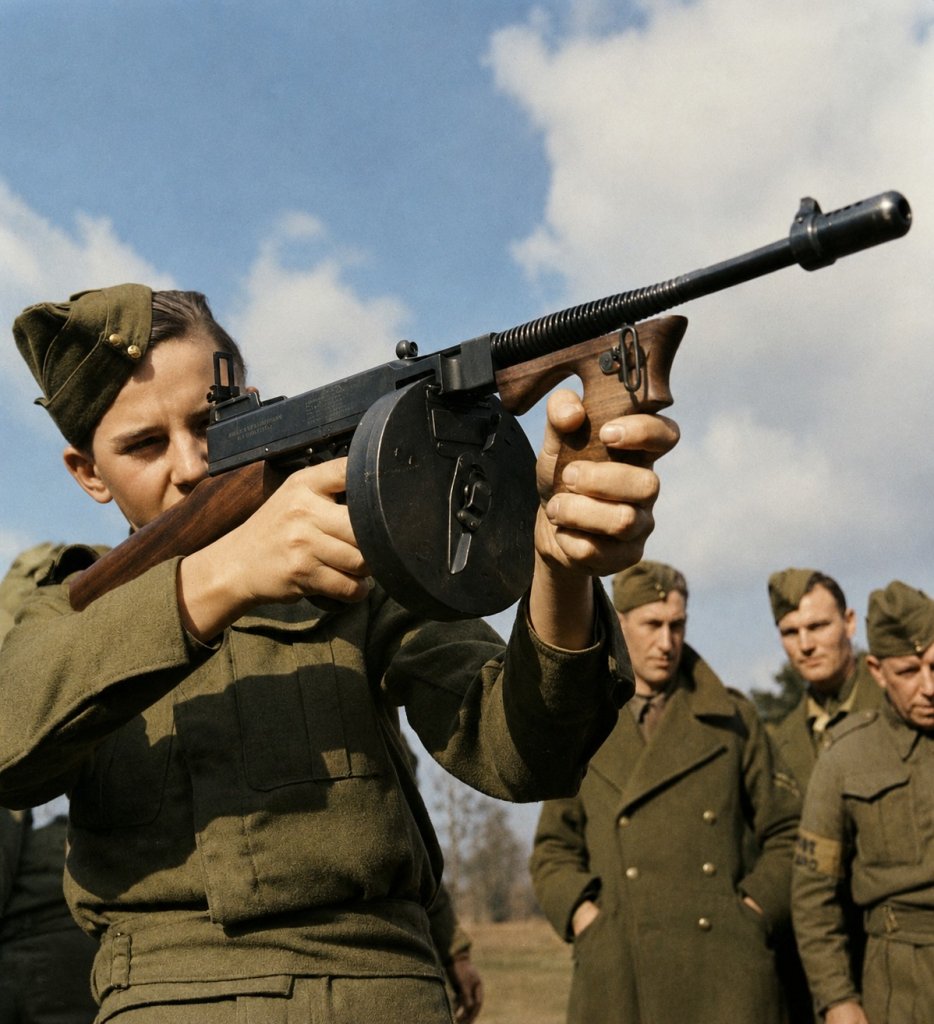
The fall of France in 1940 changed the value of the Thompson almost overnight. Britain faced the possibility of German invasion while rebuilding equipment stocks lost on the Continent. Submachine guns had become particularly attractive for raiding forces, reconnaissance troops, armored crews, Home Guard units, and the newly formed Commandos who expected to fight at extremely close range.
British forces adopted the Thompson in substantial numbers. Imperial War Museums photographs and wartime films show British soldiers and Commandos training with and carrying the M1928, often with the unmistakable Cutts compensator and vertical foregrip. The weapon appeared in Commando operations and training from Britain to Burma.
The British use of the Thompson helped turn it from an American oddity into an Allied weapon. Soldiers from Britain and the Commonwealth carried Thompsons through North Africa, the Mediterranean, Burma, and other theaters. The gun's short-range limitations mattered much less to Commandos clearing buildings, raiding coastal installations, or fighting through jungle than they would have mattered to riflemen exchanging fire across hundreds of yards of open country.
The Thompson's weight was still substantial. A fully equipped soldier carrying the gun plus magazines quickly learned that "submachine gun" did not necessarily mean light weapon. British troops would eventually receive the much cheaper and vastly simpler Sten, a gun that looked like a collection of plumbing parts compared with the finely machined Thompson but could be produced quickly and in enormous numbers. The Sten represented wartime economics stripped to their essentials. The Thompson represented the older philosophy that a gun ought to look like someone cared while making it.
Both could kill a man at thirty yards. One simply required far more machining to accomplish the task.
 The M1928A1 Goes to War
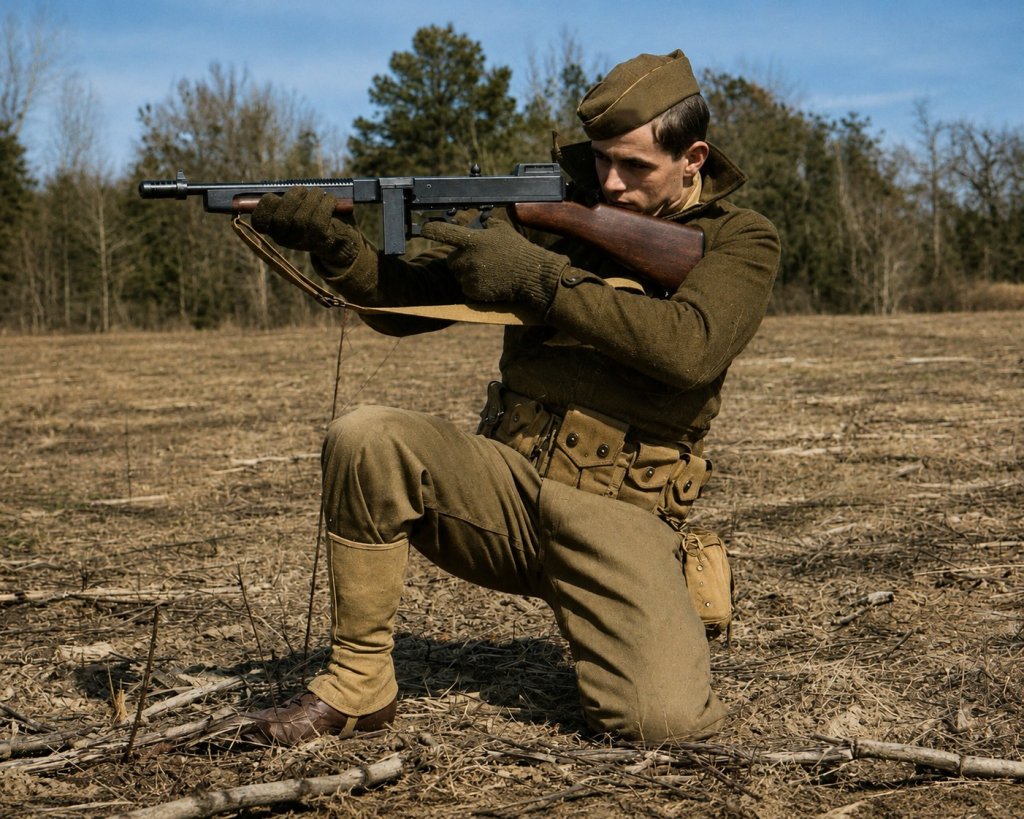
For American forces entering World War II, the principal early military version became the M1928A1. It retained many of the features that made the older commercial Thompsons visually distinctive, including the finned barrel, top-mounted charging handle, Blish lock, and compatibility with the fifty-round drum. Military examples commonly used a horizontal forearm rather than the classic vertical grip, making them easier to handle with normal field equipment.
The weapon fired from an open bolt. When cocked, the bolt remained at the rear. Pulling the trigger released the bolt, allowing it to move forward, strip a cartridge from the magazine, chamber and fire it, after which recoil forced the action rearward to repeat the cycle. Firing from an open bolt helped with cooling and reduced the danger of a cartridge remaining inside an extremely hot chamber during prolonged automatic fire, although it made precise first-shot accuracy more difficult than a closed-bolt weapon.
The controls were distinctive. Early Thompsons had separate selector and safety controls. The charging handle rode on top of the receiver, where its movement was readily visible. The detachable buttstock could be removed for storage or certain specialized uses. The rear sight on early guns was an elaborate adjustable design, another example of a weapon engineered with considerably more sophistication than a short-range submachine gun actually required.
The standard cartridge was the .45 ACP, typically launching a 230-grain projectile at a velocity in the neighborhood of 900 feet per second from the Thompson's barrel. Compared with the .30-06 cartridge of the M1 Garand, the ballistic performance was modest. The Thompson bullet traveled slower, dropped rapidly as distance increased, and possessed far less ability to defeat intermediate barriers or penetrate helmets and equipment at long range. The Marine Corps' prewar assessment of roughly 150 to 200 yards as the practical outer edge of usefulness was realistic.
Inside that distance, and particularly inside fifty yards, the equation changed dramatically. The .45 projectile was large and heavy, recoil was controllable because of the gun's mass, and the Thompson could deliver multiple rounds faster than any manually operated rifle. A good shooter using short bursts could move fire rapidly between targets without the weapon climbing uncontrollably.
That made it exactly the sort of gun specialized assault troops wanted.
Marine Raiders and the Thompson
Few American units embraced the Thompson more completely than the Marine Raiders. The Raiders were intended for aggressive light-infantry operations, reconnaissance, raids, and other missions where mobility and concentrated firepower mattered. They experimented with weapons, organization, equipment, camouflage, knives, packs, and tactics in ways ordinary units often could not.
Lieutenant Colonel Evans Carlson's 2d Raider Battalion reorganized its rifle squad into three three-man fire teams plus a squad leader. Each fire team contained a man with a Thompson, a BAR gunner, and a rifleman carrying the new M1 Garand. That was an extraordinary concentration of automatic and semiautomatic firepower for a ten-man unit at a time when many American infantry formations were still transitioning from bolt-action rifles.
The Marine Corps' official Raider history is equally blunt about weapon preference. The Raiders experimented with the Reising submachine gun, but the history calls the Reising "reviled" and specifically identifies the Thompson as the more dependable weapon. The 2d Raiders favored it so heavily that every fire team included one.
That tells us something about how soldiers judge weapons. The Thompson was heavier and far more expensive than the Reising. On paper, those disadvantages mattered. In the field, reliability mattered more. A gun that weighed less was not actually lighter if the man carrying it did not trust it and wished he had brought something else.
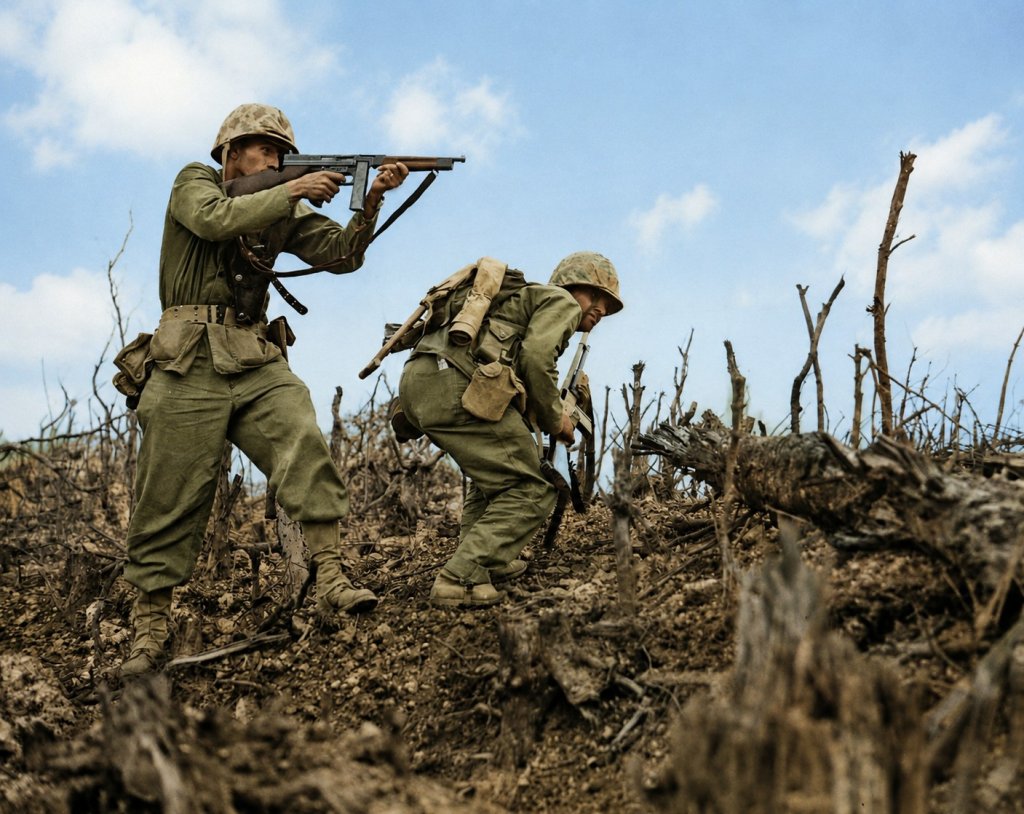
The same characteristics that had appealed to Marines in Nicaragua now mattered across Pacific islands. Dense vegetation compressed engagement distances. Japanese defensive positions were frequently concealed. Fighting around bunkers, caves, trenches, and jungle trails could become extremely close. A Thompson could be carried forward with the assault element and immediately pour fire through an opening before defenders had time to react.
 Into the Pacific
The Thompson became especially valuable in the Pacific because so much fighting occurred at short range. Jungle restricted visibility, Japanese defensive systems pushed combat into bunkers and caves, and night attacks could place opposing soldiers within yards of one another before either side fully understood what was happening.
Official Marine histories repeatedly show Thompsons in these environments. Marines used them while clearing pillboxes and fighting through fortified terrain. One wartime image preserved in Marine history shows a Marine firing a Thompson directly into a Japanese pillbox before approaching the opening. That is almost the ideal tactical environment for the weapon: close enough that the .45 ACP's limited range does not matter, dangerous enough that rapid automatic fire matters enormously.
At Bougainville, Marine Sergeant Robert A. Owens carried the concept to an almost unimaginable extreme. During an assault on a heavily defended Japanese 75mm gun bunker, Owens rushed the position, entered through the firing aperture while shooting his Thompson, and killed the gun crew. He emerged from the position but was mortally wounded during the action. He received the Medal of Honor posthumously.
The Thompson could not destroy a bunker in the way a flamethrower, demolition charge, or tank cannon could. What it could do was provide the assaulting Marine enough immediate fire to exploit an opening. Once a man reached the embrasure, the problem was no longer penetration through concrete. It was how rapidly he could incapacitate the people inside before they killed him.
Army troops in New Guinea developed their own attachment to the gun. Official Army ordnance history notes that infantrymen of the 32d Infantry Division demonstrated a preference for the Tommy Gun over the BAR in some circumstances, a striking endorsement considering the BAR fired the vastly more powerful .30-06 cartridge. The reason was not that the Thompson was universally superior. It was that jungle combat had changed what "superior" meant. A lighter, shorter weapon delivering controllable automatic fire at close range could be more useful than a longer, heavier automatic rifle firing much farther than the vegetation allowed the soldier to see.
The Drum Quietly Disappears
One of the most noticeable changes in wartime Thompson use was the gradual disappearance of the drum magazine. The famous fifty-round drum offered impressive capacity, but it was poorly suited to an army trying to supply millions of soldiers. It was large, complicated, expensive, and awkward to carry in quantity.
The twenty-round box magazine was much simpler. Later, the thirty-round magazine increased capacity without bringing back the drum's bulk and complexity. Soldiers could carry multiple stick magazines in pouches, replace them rapidly, and distribute loaded magazines easily. The Marine Corps had already concluded before the war that the twenty-round box was quieter, easier to handle, and generally less troublesome than the fifty-round drum. Wartime experience merely reinforced the conclusion.
The later M1 and M1A1 Thompson eliminated drum-magazine compatibility entirely. This is one reason photographs can help identify Thompson variants. If a gun is carrying a drum, it belongs to the earlier receiver family. The simplified M1/M1A1 magazine well accepted box magazines only.
The disappearance of the drum also illustrates the difference between what makes a gun famous and what makes it useful. Nearly a century later, put a drum on a Thompson and everyone recognizes it instantly. Ask men to carry six or eight reloads across twenty miles of jungle and enthusiasm for that beautiful drum arrangement tends to undergo rapid doctrinal revision.
America Simplifies the Thompson
The United States entered World War II needing weapons by the hundreds of thousands rather than the thousands. The M1928A1 worked, but it required too many machining operations, too much labor, too much material, and too much money. Wartime production forced engineers to examine every component and ask whether it actually needed to exist.
The answer for a surprising number of Thompson parts was no.
The result was the M1 Thompson. The Blish lock disappeared. The gun became simple blowback. The charging handle moved from the top of the receiver to the right side. The elaborate barrel fins and Cutts compensator disappeared. Drum-magazine compatibility was eliminated. The rear sight became simpler and was eventually protected by metal ears. The detachable buttstock arrangement was replaced by a fixed stock. Machining was reduced wherever possible.
The M1A1 simplified the mechanism still further by incorporating a fixed firing pin on the face of the bolt rather than the separate hammer and firing-pin arrangement of the M1. The operating concept had traveled a remarkable distance from John Thompson's elaborate Blish-locked weapon. It was now essentially a heavy steel bolt moving backward and forward inside a receiver under spring pressure, exactly the type of mechanical simplicity the original designers had been trying to avoid.
The resulting gun was less elegant but much better suited to a global industrial war. It still looked unmistakably like a Thompson because the basic receiver, pistol grip, stock, magazine location, and barrel arrangement remained, but much of the expensive refinement had been stripped away. The M1A1 was the Thompson after someone had gone through the design with a red pencil and a production deadline.
The scale of manufacturing is staggering. Official Army procurement statistics record 1,387,134 Thompson M1928A1, M1, and M1A1 submachine guns delivered through Army Ordnance channels between July 1940 and August 1945. More than 600,000 were delivered during 1942 alone and more than half a million in 1943. Thompson procurement essentially stopped during 1944 as production shifted toward the cheaper M3 family.
That number does not simply represent manufacturing capacity. Every one of those weapons required steel, wood, machine time, inspection, magazines, spare parts, shipping space, ammunition, manuals, and trained soldiers. The Thompson had gone from a commercial gun Auto-Ordnance struggled to sell into a weapon being produced on an industrial scale John Thompson could scarcely have imagined in 1921.
The M3 Arrives to Kill the Thompson
The Thompson's greatest enemy was not a German MP40, Japanese machine gun, or criminal armed with another Tommy Gun. It was American manufacturing efficiency.
The M3 submachine gun was designed from the beginning to do essentially the same close-range job using far fewer expensive machining operations. Its stamped sheet-metal construction, telescoping wire stock, simple blowback action, and utilitarian appearance earned it the nickname "Grease Gun." Beside a beautifully machined Thompson, the M3 looked like something built in a maintenance shop during lunch.
That was exactly the point.
Official Army ordnance history records that the easier-to-mass-produce M3 ultimately supplanted the Thompson as a production item in 1944. Army procurement records show the transition clearly. M3/M3A1 production surged as Thompson deliveries collapsed, eventually reaching more than 621,000 during the wartime procurement period recorded by Ordnance.
The M3 was lighter, cheaper, and mechanically simpler. It fired the same .45 ACP cartridge and fed from a thirty-round magazine. A man shot with one had little reason to complain that the gun producing the bullets lacked walnut furniture and a polished receiver.
Yet replacing a weapon in production is not the same as removing it from combat. Millions of magazines, parts, and cartridges already existed for the Thompson, and enormous numbers were already distributed throughout the Allied armies. Thompsons would continue fighting long after American factories stopped making them.
 Paratroopers and the Image of the Thompson
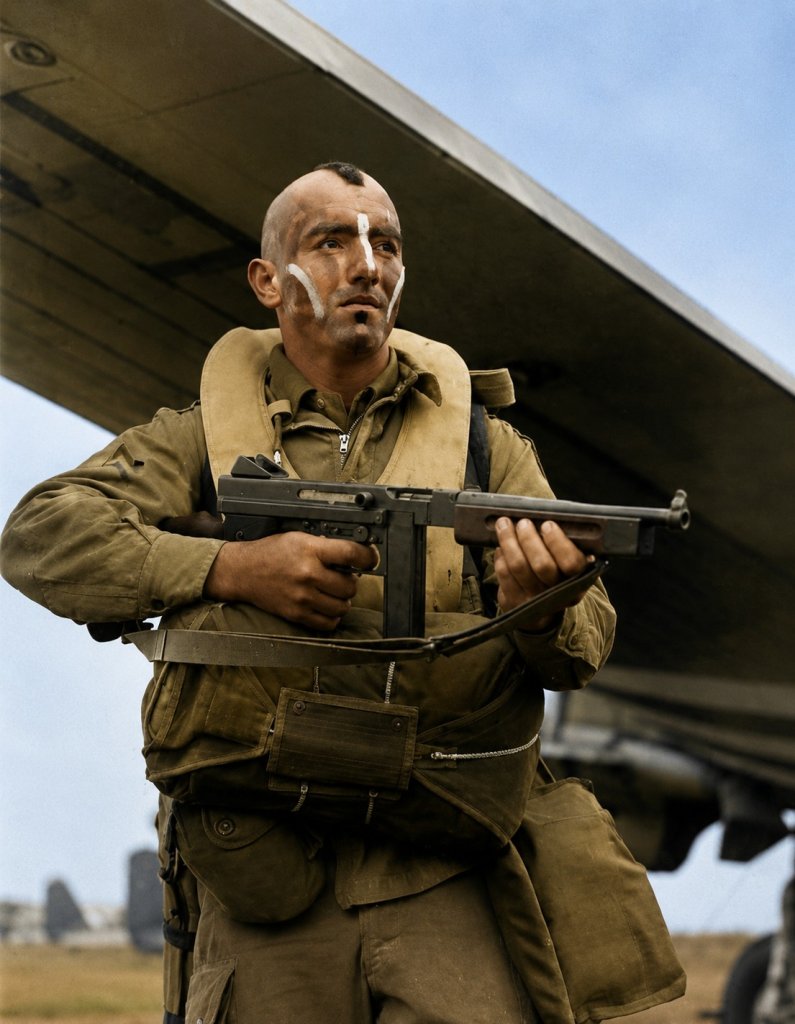
The Thompson became particularly associated with American airborne troops. Paratroopers needed weapons compact enough to be carried during a jump yet capable of producing immediate fire once men landed scattered across enemy territory. Submachine guns were especially useful for officers, NCOs, scouts, radio operators, and others who might find themselves fighting at close range immediately after landing.
The association became so strong that it entered Army recruiting imagery. Future 508th Parachute Infantry Regiment veteran Kenneth "Rock" Merritt remembered seeing a poster of a paratrooper descending beneath his canopy with a Thompson attached to his reserve parachute. Merritt later joked that the image and the additional "$50 a month in jump pay" were enough to convince him to volunteer.
The Thompson was hardly the only weapon carried by paratroopers on D-Day. M1 Garands, M1 carbines, BARs, machine guns, pistols, bazookas, grenades, and demolition equipment went into Normandy as well. Yet the Thompson became one of the visual symbols of the airborne soldier, particularly when carried with a sling across the chest.
Philip A. Russell of the 1st Battalion, 506th Parachute Infantry Regiment, 101st Airborne Division, later remembered one violent encounter in wonderfully plain language: "I was crossing a field with my Thompson gun." Enemy small-arms fire caught him in the open. Russell recalled that the shooters led him too much, with rounds striking ahead of him rather than cutting him down.
There is no cinematic poetry in that recollection, which is why it works. The Thompson was not a prop. Russell was moving through a European field carrying one while people were trying to kill him. The weapon's history is filled with moments like that, most of which were never photographed and never became famous.
 The Thompson in Europe
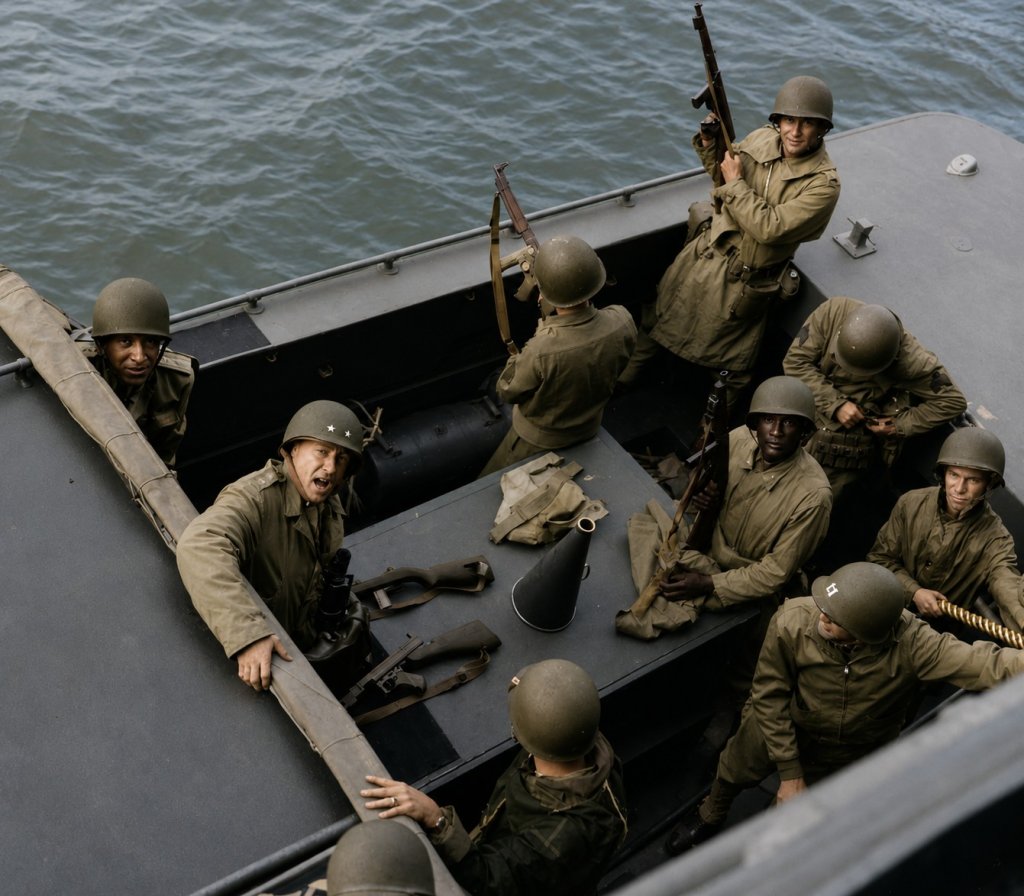
In the European Theater, the Thompson was particularly useful in villages, forests, hedgerows, ruined buildings, and other terrain where engagement distances collapsed. Tank commanders and armored crews valued compact automatic weapons because a Garand was awkward inside a turret. Officers and platoon leaders could carry Thompsons while moving among their men. Scouts and assault elements used them during house clearing and close fighting.
Combat photographs show the gun everywhere from North Africa and Italy through France, Belgium, and Germany. One official Army photographic history describes a Thompson-armed soldier covering companions as they hunted snipers in the Mediterranean theater. The gun was not intended to duel a German rifleman across a kilometer of open ground. It was intended for the moment when somebody might appear from the next doorway.
The Battle of the Bulge produced especially brutal examples. American units fighting through forests and villages encountered German troops at ranges where the Thompson remained highly effective. Official Army histories repeatedly use the phrase "tommy gun" almost casually because by 1944 it had become part of the ordinary vocabulary of the battlefield.
One of the most celebrated infantrymen to carry a Thompson was Garlin Murl Conner of the 3d Infantry Division. Fellow soldiers remembered Conner repeatedly using his Thompson aggressively in combat. His eventual Medal of Honor recognized an extraordinary January 1945 action in which he deliberately exposed himself while directing artillery against a massive German attack, rather than a particular Thompson engagement, but the gun had been one of the weapons associated with his combat service. When asked later about his wartime heroism, Conner reduced the entire matter to: "I'd done what I had to do."
That sentence could probably stand for thousands of men who carried the weapon.
The OSS Takes the Thompson Behind Enemy Lines
The Office of Strategic Services found the Thompson almost tailor-made for unconventional warfare. OSS personnel trained with pistols, rifles, knives, explosives, and "Tommy guns" because their missions might involve ambushes, sabotage, raids, resistance operations, and fighting in confined terrain far from conventional American formations. National Park Service histories of OSS training specifically identify the Thompson among the weapons taught to agents and operational groups.
One extraordinary Thompson narrative comes from an OSS operation in China in August 1945. During an attack on a Japanese position, Lieutenant Larry Drew and Sergeants Roy Gallant and James Gardner were tasked with eliminating a concrete pillbox that was stopping the advance. Gallant and Gardner crawled forward with Chinese commandos while enemy fire swept the area. Drew's assessment was simple: "That pillbox has to go."
Gallant carried his Thompson as he moved around the position, discovered additional Japanese troops in foxholes, and then worked close enough to attack the pillbox with grenades. A Japanese soldier appeared in the firing slit and was shot before he could kill Gardner. Gallant then managed to get grenades through the opening, destroying the position, but remained exposed too long and was shot by a sniper. The account survived because Gallant, Gardner, and Drew later reconstructed what happened for medic Al Johnson.
Again, the Thompson did not magically defeat the bunker. Grenades did the actual destruction. The gun allowed Gallant to move into a close fight with substantial immediate firepower while performing the sort of mission for which Thompson's original trench weapon had been imagined nearly thirty years earlier.
Ammunition: The Heavy Price of .45-Caliber Firepower
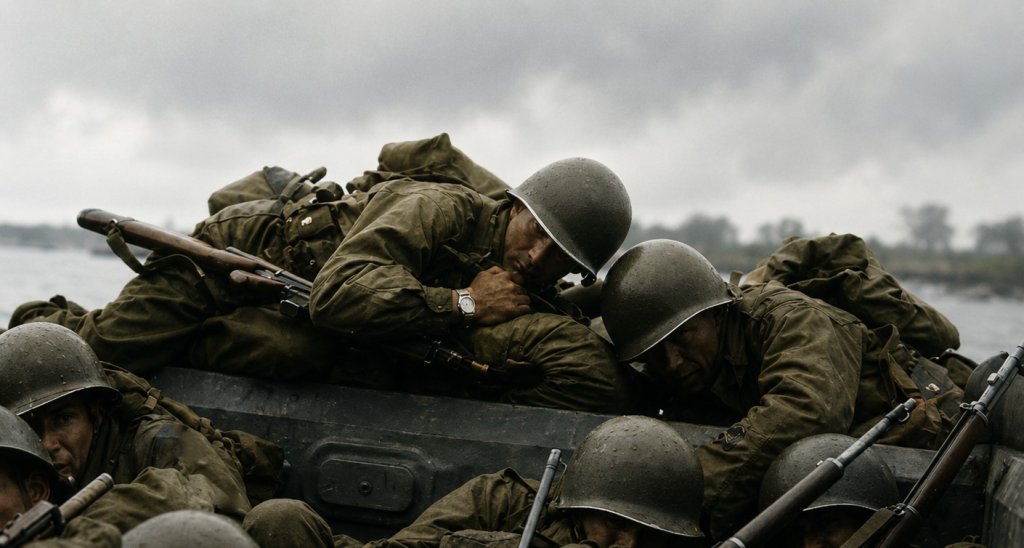
A Thompson's weight was only the beginning of what a soldier had to carry. Ammunition was heavy. The .45 ACP cartridge contains a large bullet and substantial brass case, and multiple loaded magazines quickly added pounds to a man's field load.
A twenty-round magazine could disappear extremely quickly under automatic fire. Thirty-round magazines improved capacity, but even they lasted only a few seconds if a frightened or inexperienced gunner held down the trigger. Fire discipline therefore mattered. The effective Thompson user fired short bursts, often two to five rounds, and allowed the weapon's weight to help keep those bursts concentrated.
The .45 ACP round had advantages at short range. It produced moderate recoil, operated at relatively low pressure, and delivered a heavy projectile. It also made ammunition commonality possible with the M1911 pistol. The Marine Corps had correctly identified the limitation before World War II, however: the pistol was the only other normal rifle-company weapon consuming the cartridge. A rifleman could not hand the Thompson gunner a clip of Garand ammunition and solve his problem.
The cartridge also lacked the flat trajectory and velocity of rifle ammunition. At longer distances, bullet drop became substantial and target movement harder to judge. Against thick cover, helmets at unfavorable angles, or other barriers, the rifle had an enormous advantage. The Thompson was therefore not a replacement for the Garand. It was a specialized weapon operating inside the rifle's tactical world.
What It Felt Like to Fire One
The Thompson's reputation for controllability was helped enormously by its weight. Newton, irritatingly, remains present even in famous guns. A ten-pound weapon firing .45 ACP moves considerably less violently than a five-pound weapon firing the same cartridge.
The straight-line recoil impulse and substantial receiver mass made short bursts relatively manageable. The muzzle could still climb, especially with the faster-firing early guns, but an experienced shooter could walk bursts across a target or keep several shots within a comparatively small area at close range.
The weapon's wooden stock also gave the shooter a conventional shoulder-fired stance. Unlike some later submachine guns built around folding wire stocks or compact metal tubes, the Thompson felt like a traditional long gun. The pistol grip gave the firing hand excellent leverage, while the forearm gave the support hand control over muzzle movement.
There were drawbacks. The drop of the stock and position of the barrel relative to the shoulder encouraged some muzzle rise. The weapon became front-heavy with certain configurations and dramatically heavier with a loaded drum. The sights were more elaborate than the practical accuracy of an open-bolt pistol-caliber automatic weapon really justified. None of those things stopped soldiers from using it effectively.
The sound was distinctive as well. The .45 ACP operated at subsonic or near-subsonic velocity with normal military ball ammunition, avoiding the sharp ballistic crack of supersonic rifle bullets while producing a deep report from the muzzle. Combined with the mechanical clatter of a heavy bolt moving rapidly inside a steel receiver, the Thompson possessed a rhythm difficult to confuse with a Garand or carbine.
Reliability, Dirt, and a Gun Made of Steel
The Thompson developed a generally strong reputation for reliability, particularly compared with some other early American submachine guns. Marine Raiders explicitly preferred it over the Reising for that reason.
That should not be converted into mythology. Any automatic weapon can malfunction. Magazines can be damaged. Dirt can enter the receiver. Ammunition can fail. Parts can break. The early drum magazine had its own complications. The Thompson's tolerances and numerous components required maintenance, and Pacific mud could defeat almost anything if given sufficient opportunity.
The simplified M1 and M1A1 eliminated some of the mechanical complexity of the earlier guns. Blowback operation required fewer specialized moving parts, the fixed stock reduced detachable hardware, and the removal of the Cutts compensator and barrel fins simplified the exterior. The M1A1's fixed firing pin reduced internal components still further.
The gun remained extremely durable physically. There was a lot of steel in a Thompson, which is a problem when carrying one and a virtue when abusing one. Stocks could crack and sights could be damaged, but the basic receiver and action were substantial.
That durability would become important after World War II because many Thompsons simply refused to disappear.
The Thompson Goes to Korea
When the Korean War erupted in 1950, American forces went into combat with enormous amounts of World War II equipment. Official Army histories note that .45-caliber Thompson and M3 submachine guns remained in service alongside M1 Garands, carbines, BARs, and Browning machine guns.
The Thompson's close-range firepower remained useful in Korean terrain, especially during night attacks and fights over trenches and hill positions. Chinese and North Korean troops also captured American weapons and sometimes turned them against their former owners. One official Army combat history records an American battalion commander and sergeant major being struck by fire from an American-made Thompson being used by the enemy.
Another episode from the Chosin Reservoir is almost painfully vivid. During the desperate fighting, Lieutenant Wilson assembled twenty to twenty-five men for a counterattack. Ammunition was nearly exhausted, and Wilson carried a recaptured Tommy Gun as he led the group forward. He was hit in the arm and continued advancing. Another bullet struck him in the chest or arm, prompting only the comment "That one bit." Seconds later, another bullet struck him in the head and killed him. His men continued the attack and eventually drove the Chinese from the position.
By Korea, the Thompson was no longer the newest American submachine gun. The M3 was lighter and cheaper, and the M1 carbine gave many soldiers a light shoulder arm with considerably better reach than a pistol cartridge. Yet the Thompson remained present because there were thousands of them in the inventory and because nothing about close-range combat had suddenly rendered .45-caliber automatic fire useless.
Why Soldiers Loved It and Hated Carrying It
The Thompson's reputation among veterans is complicated because the characteristics that made it pleasant to shoot made it miserable to carry. Weight absorbed recoil. Weight also remained weight after ten miles.
A soldier armed with an M1 Garand carried a rifle weighing roughly nine and a half pounds but possessed a weapon effective at several hundred yards. A Thompson gunner might carry a weapon as heavy or heavier while accepting a practical effective range measured in a fraction of that distance. He then had to add a significant ammunition load to exploit the reason he had been given the gun in the first place.
The Thompson made sense when a man's job brought him into close combat. Paratroopers, scouts, tankers, Rangers, Raiders, patrol leaders, and assault troops could reasonably trade range for rapid fire. A rifleman crossing open terrain might view the bargain differently.
That is why wartime photographs sometimes create a misleading impression. The Thompson looks glamorous. A man standing in a studio or climbing from a landing craft with one can look considerably more dangerous than the soldier beside him carrying a Garand. After hours of marching, the Garand owner may have been considerably less envious.
Men could nevertheless develop intense loyalty to the weapons they trusted. The Thompson had enough power, mechanical reliability, and combat history to create exactly that relationship.
The Tommy Gun in the Hands of Medics, Sailors, Tankers, and Specialists
The Thompson was never confined to infantry squads. Its compact size made it particularly attractive to people whose primary job made a full-length rifle inconvenient. Tank crewmen operated inside cramped armored vehicles. Drivers needed weapons that would not fill the entire cab. Artillery crews and headquarters personnel required something for local defense. Naval personnel could use it aboard ships and small craft.
Even medical personnel occasionally acquired Thompsons in combat circumstances, though medics and Navy corpsmen were protected personnel under the laws of war when properly identified and functioning in their medical role. Combat rarely remained neat enough for every individual weapon carried during emergencies to fit an organizational chart.
The gun's compact dimensions also made it attractive for guarding prisoners, installations, headquarters, and convoys. The Marine Corps had predicted these roles in 1940 when it specifically suggested Thompson issue for messengers, tank personnel, transport troops, aviation personnel, military police, and others requiring close defense.
Its usefulness to armored crews deserves special emphasis. If a tank was knocked out and the crew had to evacuate, they suddenly became infantrymen whether they had planned on it or not. A Thompson gave them considerably greater immediate firepower than a pistol without requiring them to wrestle a full-size rifle through a hatch.
The same logic would keep submachine guns in armored vehicles long after the Thompson itself faded from service.
From 850 Rounds a Minute to Wartime Restraint
The various Thompson models did not all fire at the same cyclic rate. Early Model 1921 guns could run extraordinarily fast, commonly around 800 rounds per minute or higher depending upon ammunition and condition. The Navy Model 1928 deliberately slowed the action, and wartime guns generally operated in the neighborhood of roughly 600 to 700 rounds per minute.
That may still sound furious, but the difference is significant. At 850 rounds per minute, a twenty-round magazine contains less than a second and a half of continuous firing. At 600 rounds per minute, it lasts about two seconds. Either way, the man who treated full-auto as an on/off switch was soon holding an extremely expensive club.
The selector allowed semiautomatic fire as well as full automatic. A disciplined shooter could use single shots when time and distance permitted, preserving ammunition and making better use of the sights. In the kind of close combat that justified carrying a Thompson, however, short automatic bursts were its great advantage.
The weapon therefore demanded judgment. Automatic fire is easy mechanically. Effective automatic fire is not. The soldier had to decide when the target justified a burst, how long to fire, when to reload, and how much ammunition he needed to preserve for whatever came next.
The movies generally skipped that part because a two-second burst is less cinematic than thirty seconds of ammunition generated by supernatural forces.
The Thompson and the Psychology of Close Combat
Weapons affect behavior as well as bodies. A man carrying a Thompson knew he possessed enormous short-range firepower. A man facing one knew the same thing.
In a room, trench, bunker, or jungle trail, automatic fire could create immediate shock. Several .45-caliber bullets striking walls, vegetation, or a defensive position in rapid succession forced opponents to react while the gunner or his companions moved.
The weapon also allowed one man to produce suppressive fire that otherwise might require several riflemen. That did not make the Thompson a light machine gun. Its ammunition supply, barrel, cartridge, and range prevented it from performing sustained-fire missions like a BAR or belt-fed machine gun. But for several violent seconds, it could dominate a small piece of ground.
That distinction helps explain why the Thompson repeatedly appears in assault units. It was a weapon for the moment of collision. The rifle might win the approach. The machine gun might dominate the battlefield. The Thompson was particularly comfortable when the distance had collapsed and somebody had to go through the door.
John Thompson had imagined something remarkably similar during World War I. The battlefield changed. The basic requirement did not.
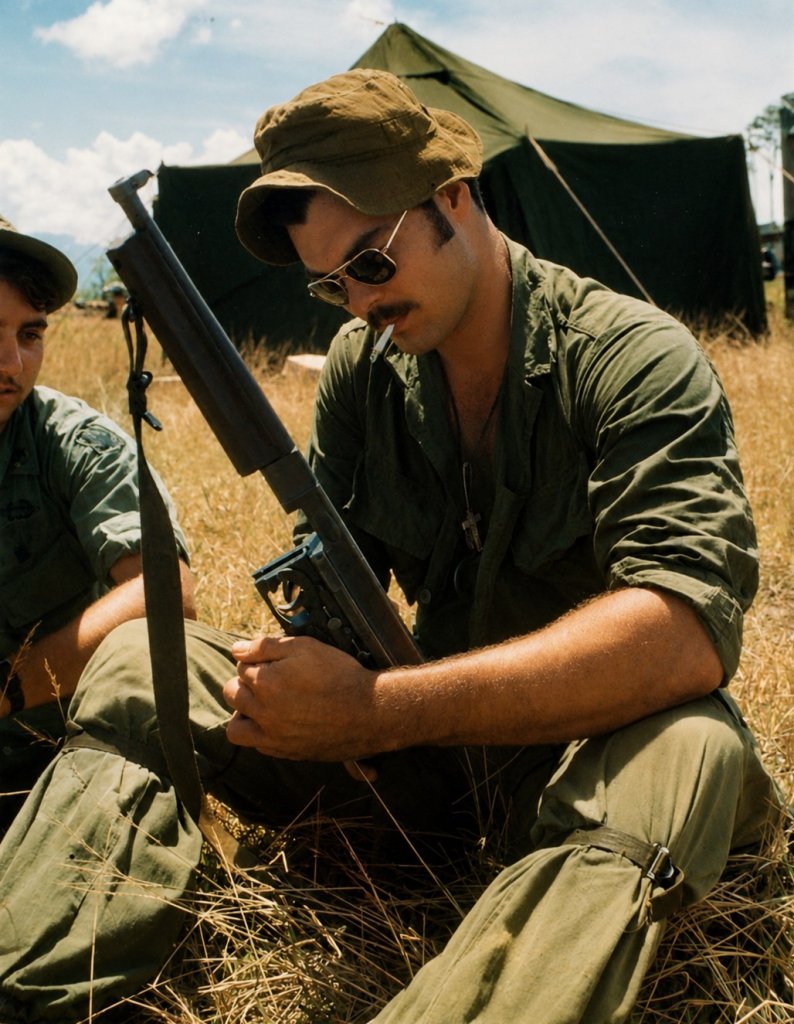 The Thompson in Vietnam
By the time large numbers of American troops entered Vietnam, the Thompson was thoroughly obsolete as a standard U.S. weapon. The M14, M16, M60, M79, and modern carbines and submachine guns had transformed the small-arms inventory. Yet Southeast Asia had a habit of making old weapons reappear.
American military histories of long-range reconnaissance units document Thompsons among the remarkable assortment of nonstandard weapons that could turn up in Vietnam. Reconnaissance troops sometimes experimented with foreign, captured, suppressed, or older American weapons because their mission requirements were different from those of ordinary infantry. Official Army research records Thompson .45-caliber submachine guns among weapons encountered or carried in units including the 1st Infantry Division and Americal Division reconnaissance community.
The Tropic Lightning Museum preserves another wonderful recollection. Vietnam veteran Allen "KC" Allcock remembered finding an old Thompson while at Tay Ninh and considering carrying it. He tried to make the weapon operational but ultimately could not get it functioning properly, a small story that perfectly illustrates the Thompson's late-war status. It was still there, still desirable enough to attract a soldier's attention, but it belonged to another generation and another supply system.
South Vietnamese and other allied forces also inherited enormous quantities of older American weapons during the postwar period, which helped keep Thompsons circulating long after regular American units had stopped issuing them. A gun manufactured during World War II could therefore find itself present in a conflict fought beside helicopters, jet aircraft, M16 rifles, and electronic sensors its designers could never have imagined.
The Thompson had become a survivor.