Greyhounds, Mad Dogs, and Kennel Keepers: The 240th Assault Helicopter Company in Vietnam
The Greyhounds, the Mad Dogs, and the Men Who Flew Into the Worst of It. Every once in a while, a unit developed a reputation that spread beyond its own flight line. The 240th Assault Helicopter Company was one of those units.
August 22, 2026

 There were hundreds of American helicopter units that served in Vietnam, and courage was hardly in short supply among any of them. But every once in a while, a unit developed a reputation that spread beyond its own flight line. The 240th Assault Helicopter Company was one of those units. Its troop-carrying Hueys were the Greyhounds. Its gunships were the Mad Dogs. Its maintenance men became the Kennel Keepers. And somewhere along the way, the men of the 240th acquired another, considerably less official name.
They were called the “Suicide Company.”
It was not because the men of the 240th had some death wish. The nickname grew from a simpler and considerably more dangerous habit: the company seemed to have a talent for finding the worst trouble available and then flying directly into it. Their missions put Hueys into hostile landing zones, alongside long-range reconnaissance teams, into rescue attempts already driven back by enemy fire, and over battlefields where the difference between getting home and disappearing into the jungle might come down to a few seconds of suppressive fire from a minigun.
The 240th had been organized in the United States under the command of Major Glenn Hoffman and deployed from Fort Hood, Texas, to Vietnam in May 1967, establishing itself at Bear Cat in III Corps. The company operated as part of the vast Army aviation network that had transformed the way American ground forces moved and fought. Its primary work included supporting the 9th Infantry Division, Royal Thai forces, South Vietnamese units, and other American formations that needed troops, ammunition, supplies or firepower delivered somewhere quickly. The company remained in Vietnam into 1971.
 Like other assault helicopter companies, the 240th divided much of its flying work between troop-carrying Hueys and armed gunships. The Greyhounds were the slicks, the aircraft that carried infantrymen, reconnaissance teams, supplies and casualties. The Mad Dogs were the gunships, carrying combinations of rockets, miniguns and other weapons and using that firepower to suppress enemy positions while the slicks entered or escaped landing zones. Behind both of them were the Kennel Keepers, the maintenance crews who repaired aircraft that had been shot through, overstressed, battered by hard flying or simply worn down by the relentless operating tempo of helicopter warfare. Contemporary material from Vietnam specifically described the 240th's mechanics repairing both troop-carrying slicks and Huey gunships at Bear Cat. The pilots got much of the glory. The aircraft flew because somebody else stayed awake long enough to make them fly again.
It did not take long for the 240th to discover how unforgiving that work could be. On December 14, 1967, one of its Greyhound UH-1Hs, tail number 66-16211, went down in the Bao Loc Pass while supporting an operation in South Vietnam. The aircraft suffered a transmission failure, crashed and burned. All four crewmen were killed: 1st Lt. Haron L. Brown II, WO1 William K. Clawson, SP5 Matthew P. Amaral III, and SP4 Ronny K. Kindred. Ghosts of the Battlefield has already told the story of that aircraft, remembered as “The Portuguese Man of War,” and the circumstances surrounding its loss. It is one of those stories that strips away the mythology surrounding the Huey and reminds us that danger did not always arrive in the form of an enemy machine gun. Sometimes a crew could do everything right and still never come home.
By the spring of 1968, however, part of the 240th had moved into an even darker corner of the war. Aircraft and crews were supporting Detachment B-56, 5th Special Forces Group, associated with Project SIGMA and highly sensitive reconnaissance work along the Cambodian border. Small teams went into territory dominated by the North Vietnamese Army to determine what was moving through sanctuaries beyond South Vietnam. The missions depended heavily upon helicopters. The same aircraft that inserted a reconnaissance team might later be asked to return for it after surprise had been lost and hundreds of enemy soldiers were converging on the landing zone.
On the morning of May 2, 1968, the 240th inserted a twelve-man Special Forces reconnaissance team into dense jungle west of Loc Ninh, in an area later accounts identify as across the border in Cambodia. The team almost immediately discovered that it had entered an area occupied by a major North Vietnamese force. Surrounded and taking casualties, the men called for an emergency extraction. Three helicopters attempted to reach them but were driven away by intense small-arms and antiaircraft fire. When the damaged 240th aircraft returned to the forward operating base carrying wounded crewmen, Staff Sergeant Roy Benavidez heard what was happening over the radio. He was not scheduled to go. He grabbed medical supplies, climbed aboard one of the helicopters heading back toward the trapped team, and volunteered himself into what would become one of the most extraordinary battles of the Vietnam War.
The helicopter carrying Benavidez could not land beside the team. He jumped from the hovering aircraft and ran through enemy fire toward the surrounded men, being wounded in the leg, face and head before he even reached them. He reorganized the survivors, distributed ammunition, treated the wounded, called in air support and helped move the casualties toward extraction helicopters. He was wounded repeatedly but kept fighting and moving men. When one extraction aircraft was hit and crashed, Benavidez continued the effort around the wreck, recovering wounded men and classified material while enemy soldiers closed in. By the end of the battle he had been shot, struck by fragments, clubbed and bayoneted, yet he continued fighting until the surviving members of the team were finally aboard a helicopter and leaving the battlefield. His Medal of Honor citation credited his actions with saving at least eight lives.
 Benavidez's story became famous. What is sometimes lost in the telling is that the helicopters fighting to reach him and the reconnaissance team belonged to the 240th Assault Helicopter Company. The Greyhounds and Mad Dogs had been in the fight from the beginning, repeatedly putting aircraft back toward a landing zone that had already demonstrated exactly what it could do to helicopters. The price was terrible. A 240th UH-1H, 66-00699, was lost to enemy fire during the May 2 action. WO1 Larry Sims McKibben, crew chief SP4 Michael Dennis Craig, and gunner SP4 Nelson Edward Fournier were killed. Their names belong beside Benavidez's when the story is told because the rescue was not the work of one extraordinary man alone. It was an entire collection of soldiers on the ground and in the air repeatedly refusing to abandon one another.
That was only May.
By August 1968, the 240th was supporting long-range reconnaissance patrols, including teams operating around Duc Hoa and surrounding areas. The Greyhounds inserted the small patrols, often late in the day. The men on the ground established ambushes, gathered intelligence and sometimes attempted to capture enemy personnel. The Mad Dogs waited for the inevitable radio call when concealment failed and a handful of reconnaissance soldiers suddenly discovered that the jungle around them was full of armed men who wanted them dead.
One of the Mad Dog pilots during this period was WO1 Terry Morris. Morris was not new to dangerous work. Before becoming an Army aviator he had served in the airborne forces and Special Forces. During two Vietnam tours he would eventually be shot down seven times and receive decorations including the Silver Star, Bronze Star with Valor device, four Distinguished Flying Crosses, numerous Air Medals and four Purple Hearts. In 1968 he was flying the UH-1C gunships of the 240th, and for part of that August he repeatedly flew one particular helicopter: 66-15156, better known by the final three numbers of its serial as 156.
On August 18, 1968, Morris and the other Mad Dogs were covering the extraction of a reconnaissance patrol when the Greyhound slicks entering the pickup zone were hammered by automatic weapons and rocket-propelled grenade fire. The aircraft were hit heavily. Men were killed and wounded. As the helicopters fought their way out, there was a report that one member of the patrol had fallen from an aircraft and remained inside the pickup zone.
Another Greyhound, flying a separate mission nearby, heard the radio traffic and offered to go after him.
The crew was warned that the pickup zone was extremely hot.
They came anyway.
As the Greyhound touched down, enemy fire immediately tore into the aircraft. Morris had just completed a gun run in Mad Dog 156 when he saw an enemy soldier rush close to the Huey and fire directly into its cockpit. The aircraft somehow lifted away from the landing zone, climbed, turned toward a dirt road and came down again. What Morris did not yet know was that the pilot had been killed almost instantly. The wounded copilot had regained enough control to get the crippled helicopter onto the ground.
Morris followed the damaged Greyhound down and landed 156 behind it. The crew had been torn apart. The pilot was dead, the copilot had been wounded, and other members of the crew had also been hit. Another Greyhound arrived to collect the survivors while Morris went to the cockpit, released the pilot's seat, unstrapped the dead aviator and carried his body back to Mad Dog 156. He placed the pilot in the rear of the gunship and flew him to the hospital at Cu Chi. During the fighting, one of 156's miniguns had itself been shot away. The 240th lost three men killed and seven wounded on August 18. The company's ugly nickname, the Suicide Company, needed very little help surviving after days like that.
Morris kept flying 156.
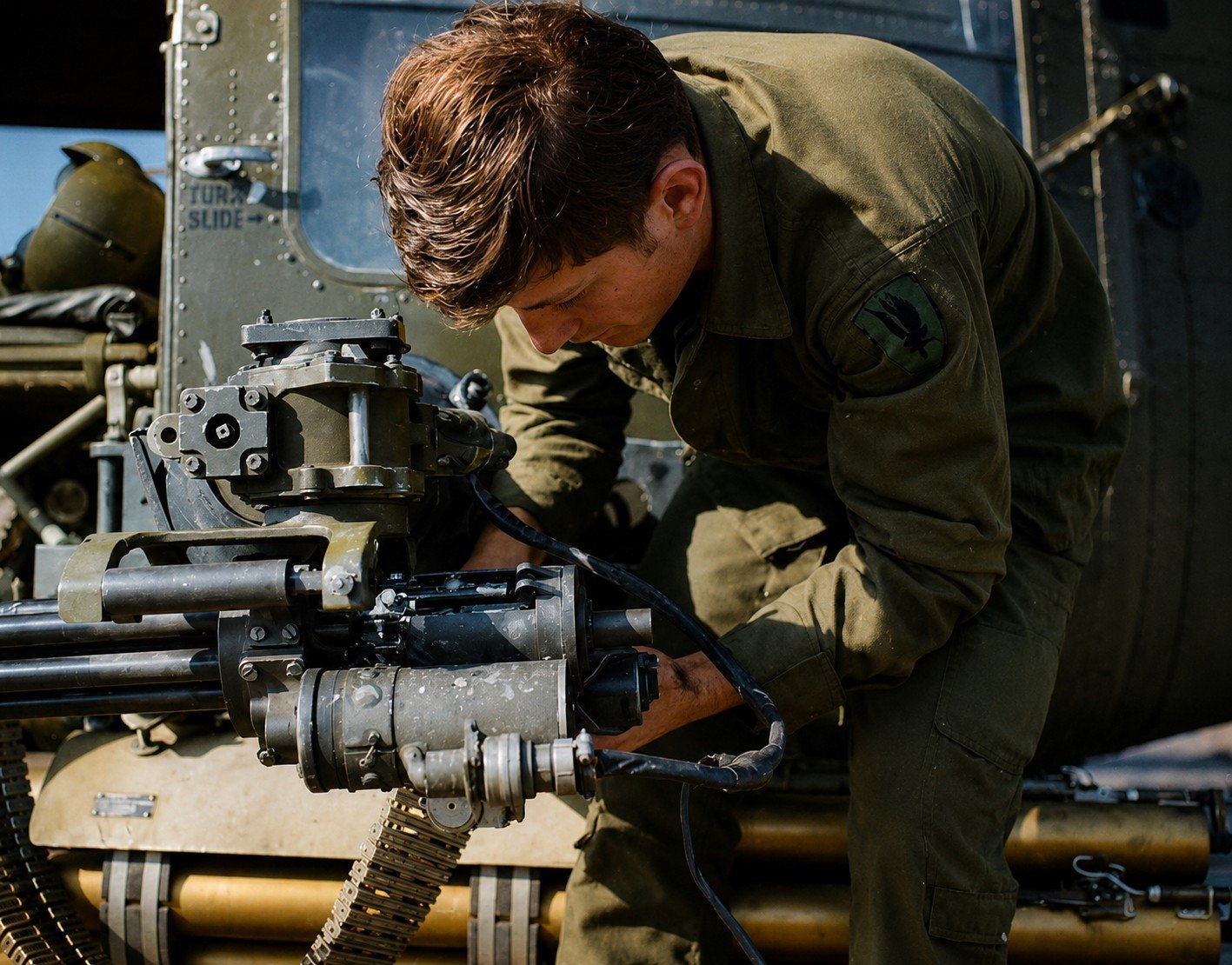
Between August 18 and August 29, an eleven-day stretch of operations, Mad Dog 156 expended 138 2.75-inch rockets and approximately 24,000 rounds of 7.62mm minigun ammunition, in addition to thousands of rounds fired by its door gunners. Think about that for a moment. Not during an entire tour. Not during a year. Eleven days. That amount of ammunition gives some idea of what “supporting reconnaissance teams” could actually mean once the jungle erupted around them. The slicks had to enter landing zones that wanted to kill them, and the Mad Dogs tried to make those landing zones temporarily survivable by putting a wall of fire between the Greyhounds and the enemy.
Mad Dog 156 survived Vietnam, and that survival has given the 240th something remarkably tangible. The helicopter eventually entered the collection of the U.S. Army Aviation Museum. When museum staff examined the old Huey, they found numerous small sheet-metal repairs scattered across the aircraft. They were scars left by its service. Research connected the helicopter to Morris's logbook and his combat missions with the 240th, allowing the museum to reconstruct part of the story behind those patches of repaired aluminum. It is easy to walk past an old military aircraft and see nothing more than another Huey. Once you know that a dead Greyhound pilot was carried in the back of that particular aircraft after the August 18 fight, the machine becomes something else entirely.
That is one of the reasons the 240th fits the Ghosts of the Battlefield story so well. The history is not confined to famous names or spectacular gun-camera moments. It survives in battered aircraft, logbooks, maintenance records, old photographs and the memories of crewmen who remember which holes appeared after which mission. The Huey became one of the great symbols of Vietnam because thousands of them filled the sky, but every individual helicopter had its own history. Some carried infantry into battle. Some brought them back. Some returned with blood on the floor and holes through the skin. Some did not return at all.
 The Greyhounds were especially exposed to that reality. A slick entering a landing zone did not have the luxury of remaining high above the battle. It had to descend into it. The aircraft slowed, settled toward the ground and became an enormous target while soldiers jumped out or climbed aboard. Crew chiefs and door gunners leaned into open doorways firing M60s while also watching for obstacles, enemy movement and men trying to reach the aircraft. The pilots were often landing into dust, smoke, trees or elephant grass with only seconds to decide whether the aircraft could stay or had to leave. The Mad Dogs existed to buy those seconds.
And the Mad Dogs developed their own personality. Their UH-1 gunships carried miniguns and rockets and often operated at very low altitude. Surviving photographs show exactly what the name implied: these were not sterile machines flying neat formations over a distant battlefield. They were armed Hueys flown by young men who expected to go looking for whoever was shooting at the slicks. One surviving 240th photograph shows a crewman servicing a minigun. Another shows an M60 gunner at his position. Perhaps the strangest surviving image shows the Mad Dogs using gunfire to ignite JP-4 fuel poured onto jungle vegetation, an improvised method used to burn openings through thick growth. Vietnam helicopter warfare was nothing if not inventive, occasionally to a degree that makes modern risk-management officers spontaneously develop chest pains.
But the company was far more than the Mad Dogs. Its identity depended equally upon the men who kept the aircraft operating. The Kennel Keepers worked in a climate that attacked machines almost as relentlessly as the enemy did. Heat, humidity, dust, rain, constant vibration and high flight hours punished engines, transmissions, rotor systems and airframes. Add bullet holes and combat damage to the equation, and maintenance stopped being a support function somewhere behind the war. It became part of the battle itself. Every Greyhound or Mad Dog returned to service because mechanics inspected it, repaired it and decided that someone could trust his life to it again.
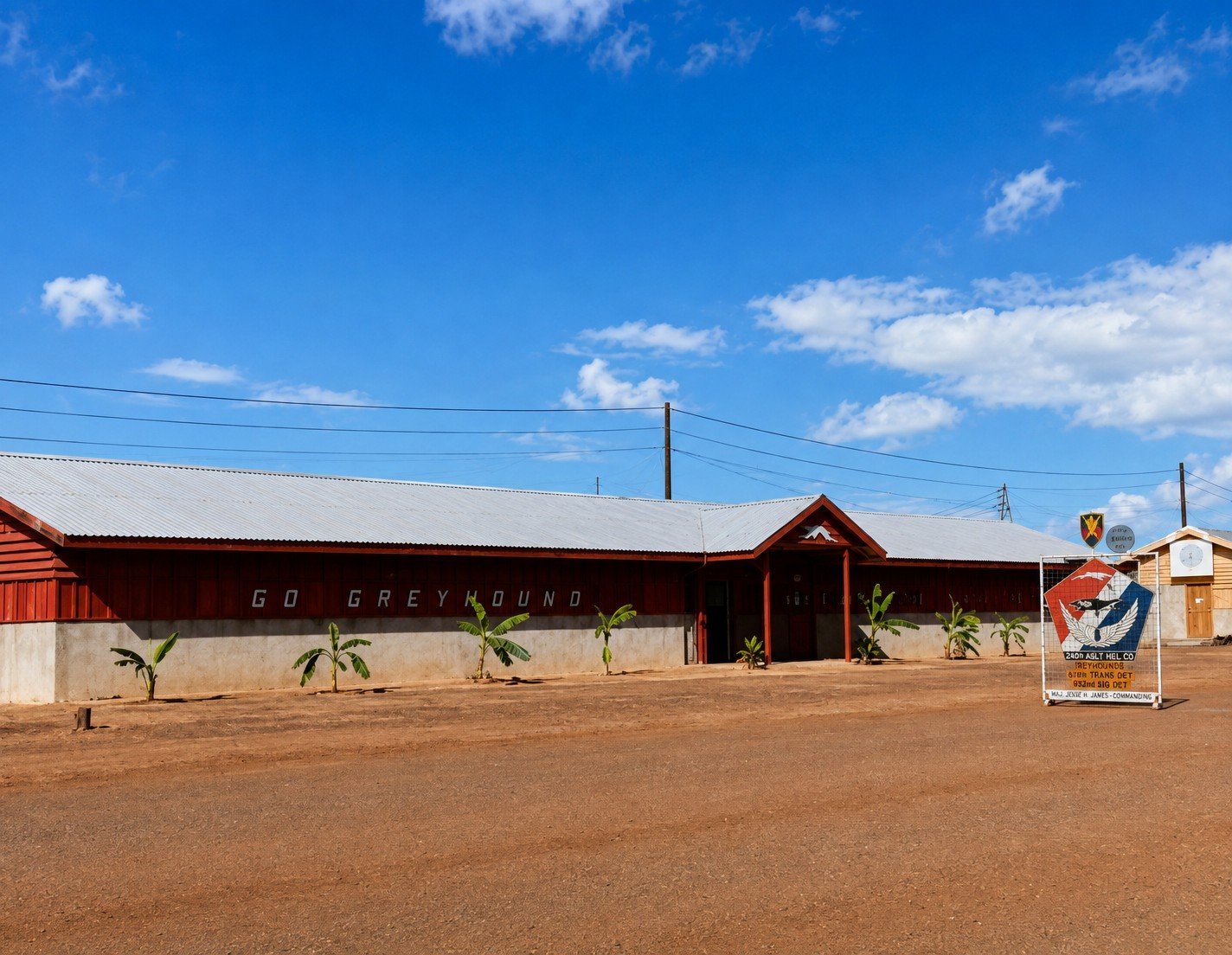
 The 240th also spent substantial time supporting Royal Thai forces operating from the Bear Cat area. By the later years of the company's Vietnam service, its Hueys could be found carrying Thai soldiers, delivering supplies and supporting operations far removed from the covert reconnaissance missions that had made 1968 so brutal. Veteran photographs from 1970 and 1971 show the company still at work: Greyhounds on the flight line, Hueys supporting Thai troops, crew chiefs beside their aircraft, and men living in the collection of huts, revetments and improvised buildings that made up an aviation company's home. The photographs are important because they show the other side of combat aviation. Between the desperate extractions were meals, maintenance, waiting, joking, sleeping and wondering when the next mission would come.
And then the radio would crackle again.
That may be the best way to understand the 240th Assault Helicopter Company. Its history is not really about an unofficial nickname, no matter how unforgettable “Suicide Company” might be. It is about what happened after somebody on the ground called for help. A reconnaissance patrol was surrounded. A helicopter had gone down. A landing zone was taking fire. Men were wounded. Somebody had to go in.
On May 2, 1968, the 240th went back into a battlefield that had already damaged helicopters and wounded their crews. Three of its men died helping bring Roy Benavidez and the survivors out. On August 18, Greyhound crews entered a pickup zone after being warned how dangerous it was, while Mad Dogs attacked the enemy around them. Terry Morris followed a wounded aircraft down, carried its dead pilot into Mad Dog 156 and then went back to flying combat missions the next day and the day after that. The Kennel Keepers repaired whatever could be repaired so the aircraft could do it again.
The nickname made them sound reckless.
The reality was more complicated.
They kept going into terrible places because somebody else was already there.
That is why the Greyhounds and Mad Dogs of the 240th Assault Helicopter Company earned their reputation. Not because they wanted to die. Not because they thought they were invincible. And not because the Huey somehow made the men inside it immune to fear.
They knew exactly what those landing zones could do to a helicopter.
They went in anyway.
Sources
U.S. Army Aviation Museum
“156 and the Tale of Mad Dog.” History of UH-1C 66-15156, Terry Morris, the 240th Assault Helicopter Company, August 1968 combat operations, ammunition expenditures, battle damage, and the unit’s “Suicide Company” reputation.
https://www.armyaviationmuseum.org/heritage/spotlight-in-history/156-and-the-tale-of-mad-dog/
Vietnam Helicopter Pilots Association
240th Assault Helicopter Company personnel and aircraft records, including unit history, casualty records, and aircraft losses.
https://www.vhpa.org/
Vietnam Helicopter Pilots Association
Casualty record for the crew of UH-1H 66-16211, lost December 14, 1967.
https://www.vhpa.org/KIA/K10388.HTM
Vietnam Helicopter Pilots Association
Casualty and aircraft records connected to the May 2, 1968 Special Forces extraction and the loss of UH-1H 66-00699.
https://www.vhpa.org/
U.S. Army Center of Military History
Medal of Honor information and historical material concerning Master Sergeant Roy P. Benavidez and his actions on May 2, 1968.
https://history.army.mil/
Army University Press / NCO Journal
Historical account of Roy Benavidez and the May 2, 1968 reconnaissance-team rescue.
https://www.armyupress.army.mil/Journals/NCO-Journal/
Vietnam Center and Sam Johnson Vietnam Archive, Texas Tech University
Contemporary and historical documentation relating to the 240th Assault Helicopter Company, its aircraft, maintenance personnel, and operations in Vietnam.
https://www.vietnam.ttu.edu/
Vietnam Helicopter Pilots Association Museum
240th Assault Helicopter Company photographic archive and veteran-contributed historical material relating to the Greyhounds, Mad Dogs, Bear Cat, Royal Thai forces, and later operations.
https://museum.vhpa.org/companies/240ahc/240ahc.shtml
Modern Forces
Biographical material concerning WO1 Terry Morris and his service with the 240th Assault Helicopter Company.
https://modernforces.com/