"The Scooter" The Tiny A-4 Skyhawk, The Little Attack Aircraft That Carried a Giant War
The A-4 earned nicknames including “Scooter,” “Tinker Toy” and “Heinemann’s Hot Rod,” affectionate names for an aircraft whose modest dimensions concealed an extraordinary ability to carry weapons into combat.
August 10, 2026

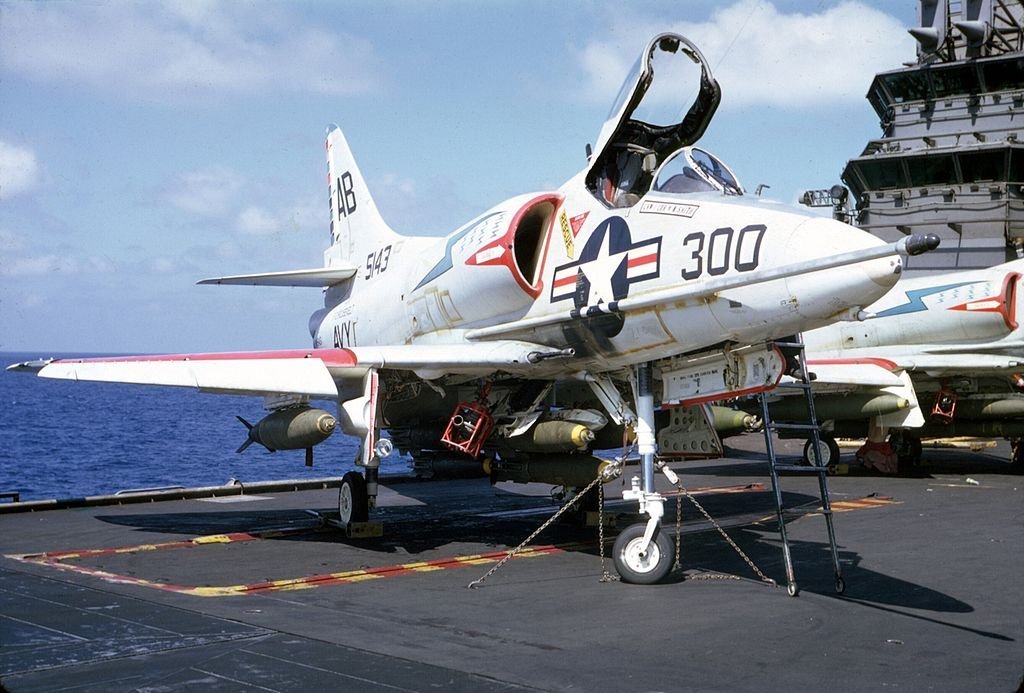
Few military aircraft have ever demonstrated the value of simplicity as convincingly as the Douglas A-4 Skyhawk. Small, light, inexpensive, easy to maintain and capable of carrying a weapons load completely out of proportion to its size, the Skyhawk became one of the most successful attack aircraft of the postwar era. It flew from American aircraft carriers, supported Marines fighting on the ground, attacked some of the most heavily defended targets in North Vietnam, served as a nuclear strike aircraft, trained generations of fighter pilots, flew with the Blue Angels and went to war in the hands of several foreign air forces. It fought over Southeast Asia, the Middle East and the South Atlantic, and remained useful long after newer and far more sophisticated aircraft had entered service. The A-4 earned nicknames including “Scooter,” “Tinker Toy” and “Heinemann’s Hot Rod,” affectionate names for an aircraft whose modest dimensions concealed an extraordinary ability to carry weapons into combat.
The Skyhawk emerged during a period when American combat aircraft were generally becoming larger, heavier and more complicated. Douglas Aircraft Company engineer Edward H. Heinemann took a different approach. The United States Navy needed a new carrier-based attack aircraft to replace the aging Douglas AD Skyraider in the nuclear strike role. The requirement could easily have produced another large and increasingly complex airplane, but Heinemann and his design team attacked the problem through aggressive weight reduction and simplicity. Rather than simply meeting the Navy’s maximum allowable weight, they produced an aircraft significantly lighter than expected. Every component was examined with weight, reliability and maintenance in mind. The result was an airplane that seemed almost startlingly small beside contemporary naval aircraft.
The prototype, initially designated the XA4D-1, first flew on June 22, 1954. The Skyhawk was a compact single-seat jet with a conventional low-mounted delta-like swept wing, a single turbojet engine and relatively simple systems. Its short wingspan was one of its most important characteristics. Unlike many carrier aircraft, the Skyhawk did not require folding wings to fit aboard an aircraft carrier. Eliminating the folding mechanism saved weight, reduced complexity and removed another system that could fail or require maintenance. This philosophy ran through the entire design. Heinemann’s team did not make the aircraft simple because they lacked ambition. They made it simple because every pound and every unnecessary mechanism reduced the airplane’s ability to perform its real mission.
 That mission was attack. The Skyhawk was built to carry weapons from an aircraft carrier to a target and return. It did not need to be a supersonic interceptor or a technological showcase. It needed to be dependable, maneuverable and capable of carrying a substantial load. The A-4 eventually proved capable of carrying several thousand pounds of external ordnance on multiple weapons stations, including conventional bombs, rockets, missiles, fuel tanks and nuclear weapons. Later models received additional pylons, giving the small aircraft even greater flexibility. Its ability to carry an impressive weapons load led to one of the enduring observations about the airplane: under some configurations, a fully loaded Skyhawk could carry a weapons load approaching or exceeding its own empty weight.
Early production versions entered Navy service during the second half of the 1950s. The original A4D designation was changed to A-4 under the standardized Department of Defense aircraft designation system introduced in 1962. Successive versions improved the airplane without fundamentally changing the concept. The A-4A was followed by improved A-4B and A-4C models, while later versions incorporated more powerful engines, greater fuel capacity, improved avionics and additional weapons stations. The A-4E became particularly important during the Vietnam War, while the later A-4F incorporated further improvements, including the distinctive dorsal avionics hump that appeared on many aircraft. Two-seat TA-4 trainers extended the usefulness of the design even further.
The Skyhawk entered service during the Cold War, and one of its original responsibilities was nuclear strike. Navy attack squadrons trained to carry tactical nuclear weapons from aircraft carriers against targets that might include enemy airfields, ports and military installations. A small aircraft such as the Skyhawk could therefore be assigned a mission with strategic consequences vastly larger than the airplane itself. Pilots trained for low-level penetration and special weapons delivery techniques intended to give them some possibility of escaping the effects of their own weapon. Among the methods developed for tactical nuclear delivery was loft bombing, in which an aircraft approached at low altitude, pulled sharply upward and released the weapon so that it followed a ballistic arc toward the target while the aircraft turned away. Whether the pilot could actually escape a nuclear detonation under wartime conditions was another matter entirely, but nuclear delivery remained a genuine part of the Skyhawk’s early career.
The aircraft’s defining American war would be Vietnam. When major United States combat operations intensified during the 1960s, Navy and Marine Corps A-4s became some of the most heavily used attack aircraft of the conflict. Skyhawks flew from carriers in the Gulf of Tonkin and from land bases in South Vietnam. Their missions ranged from strikes against targets in North Vietnam to close air support for troops fighting far to the south. The little aircraft that had been created partly as a nuclear delivery platform became a conventional attack workhorse.
Navy A-4 squadrons participated heavily in Operation Rolling Thunder, the prolonged air campaign against North Vietnam that began in 1965. Skyhawk pilots attacked bridges, roads, rail lines, storage areas, military installations, coastal targets and other components of North Vietnam’s transportation and military infrastructure. Many of those targets were protected by increasingly dense anti-aircraft defenses. Machine guns, automatic cannon, heavy anti-aircraft artillery and eventually surface-to-air missiles created overlapping threat zones around important locations. A Skyhawk pilot often had to descend into the very environment where those weapons were most dangerous in order to deliver bombs accurately.
The Skyhawk’s small size and excellent handling were advantages in combat, but they could not make the aircraft invulnerable. Attack pilots entered their bombing runs knowing that enemy gunners were waiting. Tracer fire could rise toward the formation as the aircraft descended. Anti-aircraft shells burst around them. Surface-to-air missile warnings added another layer to the threat. The pilot had to monitor the target, aircraft attitude, speed, altitude, weapons delivery, formation position and enemy fire while making decisions in seconds. At the bottom of the attack, the Skyhawk’s survival often depended upon speed, maneuvering and the inability of enemy gunners to predict precisely where the aircraft would be next.
Unlike the two-seat F-4 Phantom, most combat Skyhawks placed all responsibility on one man. The pilot flew the airplane, navigated, communicated, operated the weapons and watched for threats. There was no Radar Intercept Officer or Weapon Systems Officer in another cockpit to divide the workload. This simplicity was part of the aircraft’s design, but in combat it meant the pilot carried the entire mental burden of the mission. The cockpit was small, the work demanding and the margin between a successful attack and disaster could be extremely thin.
 The Marine Corps used the Skyhawk somewhat differently. Marine aviation has traditionally emphasized direct support of Marines on the ground, and A-4 squadrons became heavily involved in close air support. Skyhawk pilots attacked enemy troops, bunkers, defensive positions and other targets threatening friendly forces. These missions could require operating close to American and South Vietnamese troops, where bombing accuracy was not merely desirable but essential. Forward air controllers and ground units helped direct aircraft onto targets, and the Skyhawk’s maneuverability and ability to carry a useful assortment of ordnance made it well suited to the mission.
The aircraft could carry conventional iron bombs, rockets, napalm and other weapons used in the air war over Southeast Asia. Later in the war, precision-guided weapons increasingly changed attack aviation, but much of the Skyhawk’s combat career belonged to the era of visually aimed conventional ordnance. Bombing accuracy depended heavily upon training, experience, attack geometry and the pilot’s ability to fly precisely while people on the ground were actively trying to kill him.
 One of the most famous men associated with the Skyhawk was future United States Senator John McCain. On October 26, 1967, Lieutenant Commander McCain launched from USS Oriskany in an A-4E Skyhawk as part of a strike against the Hanoi area. During his attack, his aircraft was struck by a surface-to-air missile. McCain ejected and descended into Trúc Bạch Lake in Hanoi, suffering serious injuries. He was captured and would spend more than five years as a prisoner of war. His experience became one of the best-known personal stories associated with the A-4, but McCain was only one among many Skyhawk pilots who were shot down, killed, captured or rescued during the conflict.
Another important Skyhawk pilot was Lieutenant Commander Everett Alvarez Jr. On August 5, 1964, during Operation Pierce Arrow, Alvarez was flying an A-4 from USS Constellation when his aircraft was shot down over North Vietnam. He became one of the first American naval aviators captured during the Vietnam conflict and remained a prisoner for more than eight years. His captivity illustrates how early the Skyhawk became involved in the air war and how long the human consequences of a few seconds over a target could last.
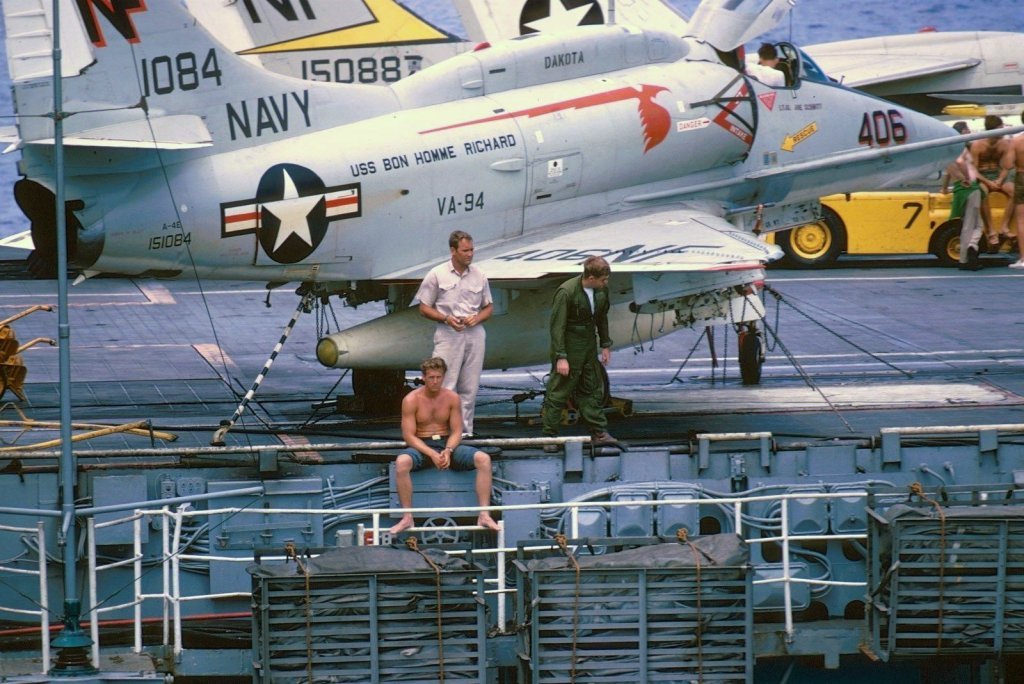
The A-4 was also involved in one of the Vietnam War’s most unusual air-to-air engagements. Although designed as an attack aircraft rather than a fighter, Skyhawks could carry AIM-9 Sidewinder missiles for self-defense. In May 1967, Lieutenant Commander Theodore Swartz of VA-76, flying an A-4C from USS Bon Homme Richard, shot down a North Vietnamese MiG-17 with a Zuni rocket during combat. The event remains one of the strangest air-to-air victories of the jet age. A weapon intended primarily for attacking ground targets became the means by which a small attack aircraft destroyed an enemy fighter.
Combat also demonstrated the Skyhawk’s ability to absorb punishment. Pilots sometimes returned to carriers or bases with damaged wings, control surfaces or systems after being struck by ground fire. The airplane’s relatively straightforward construction and reliable systems could make the difference between returning home and ejecting over enemy territory. Yet there were limits. Many A-4s were lost during Vietnam, and attack missions against defended targets remained among the most dangerous assignments in naval aviation.
Aircraft carrier operations added their own hazards before a Skyhawk ever reached enemy airspace. The flight deck was an environment of moving aircraft, jet exhaust, live weapons, fuel and machinery. A Skyhawk had to be positioned, armed, fueled and prepared by teams of sailors working rapidly in confined spaces. Catapult launches accelerated the aircraft from the deck into flying speed within seconds. Returning pilots had to find a moving carrier, enter the landing pattern and place the airplane precisely onto a deck that suddenly seemed much smaller than it had during launch.
Here the Skyhawk’s handling qualities helped make it beloved by many naval aviators. The aircraft was responsive and maneuverable, earning a reputation as a pilot’s airplane. It was not burdened by excessive size or complicated automation. Pilots flew it directly. Those characteristics eventually made the Skyhawk valuable for a mission that its designers had never seriously envisioned: teaching fighter pilots how to fight other fighters.
As Vietnam exposed shortcomings in American air-combat training, the Navy established the Fighter Weapons School, better known as TOPGUN, in 1969. Instructors needed aircraft capable of representing smaller and more agile enemy fighters such as the MiG-17. The A-4 proved ideal for the role. Its small size, excellent maneuverability and relatively low operating costs allowed instructor pilots to use Skyhawks as adversary aircraft against fleet fighters including the F-4 Phantom II.
This produced one of the great ironies in the history of the airplane. An aircraft designed to drop bombs became one of the tools used to teach American fighter pilots how to survive dogfights. In the hands of highly skilled adversary instructors, the Skyhawk could be an infuriating opponent. Its small visual signature made it difficult to see at distance, while its maneuverability allowed experienced pilots to exploit mistakes made by crews flying larger and more powerful fighters.
The Skyhawk remained deeply connected with adversary training for decades. Navy and Marine Corps units used A-4 variants to simulate enemy aircraft, and civilian contractors eventually continued using versions of the airplane in similar roles. The qualities that had made the Skyhawk effective in the 1950s remained useful long after the aircraft had ceased to be a primary American attack platform.
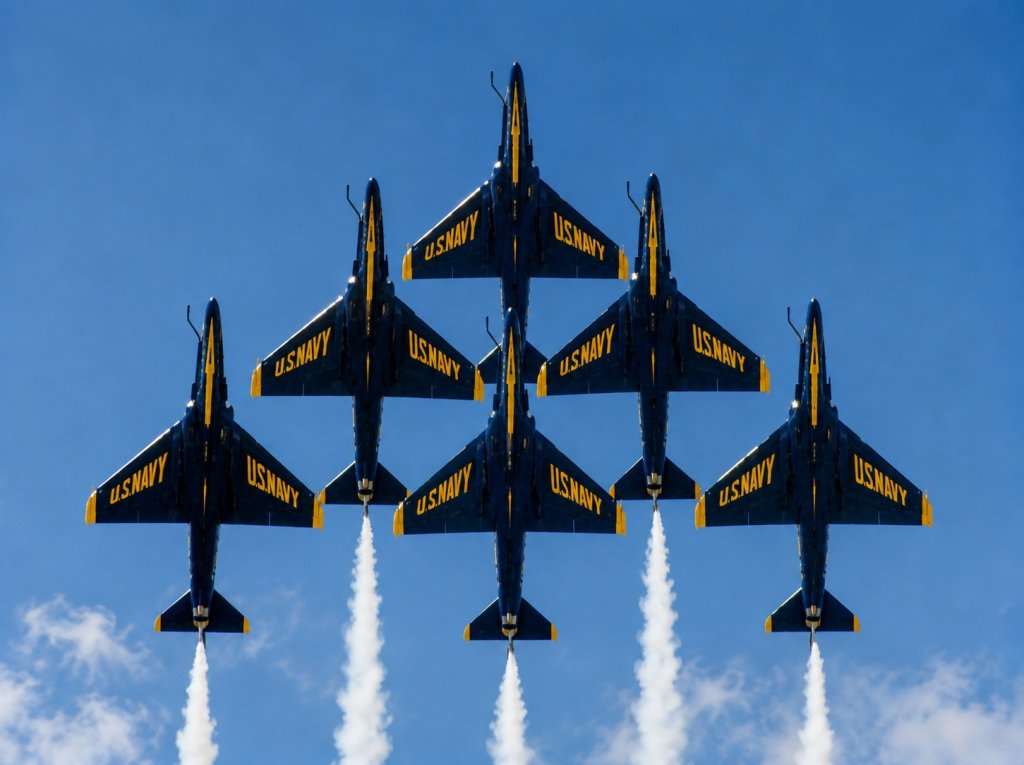
Perhaps the most visible noncombat Skyhawks were those flown by the United States Navy Blue Angels. The demonstration team transitioned to the A-4F Skyhawk II in 1974 after years of operating larger F-4 Phantoms. The little Skyhawk was almost perfectly suited to precision aerobatic display. Its tight turning ability, responsiveness and compact size allowed the team to fly exceptionally close formations. The Blue Angels operated the A-4 through the 1970s and into the 1980s, introducing millions of spectators to an aircraft whose combat reputation had been forged in Vietnam.
The Skyhawk also became a major export success. Israel was among its most important foreign operators. Israeli A-4s, known as Ayits, became important attack aircraft beginning in the late 1960s. They flew during the War of Attrition and later fought extensively during the 1973 Yom Kippur War. Israeli pilots used Skyhawks for close air support and battlefield strike missions against Egyptian and Syrian forces. Like American pilots over Vietnam, they confronted dense anti-aircraft defenses and surface-to-air missiles.
The Yom Kippur War was particularly brutal for Israeli attack aviation. Soviet-designed SAM systems and anti-aircraft weapons inflicted serious losses on Israeli aircraft operating near the battlefield. A-4 pilots often flew missions directly into defended areas because troops on the ground urgently needed support. The Skyhawk’s ruggedness and maneuverability were valuable, but neither could completely overcome modern missile defenses. Israeli losses reinforced the growing realization that attacking a sophisticated integrated air-defense network required specialized tactics, electronic warfare and coordinated suppression.
Israel continued modifying and operating its Skyhawks for decades. The aircraft remained useful as trainers long after it had left frontline combat service, another demonstration of the adaptability that characterized the design throughout its life.
Argentina wrote another dramatic chapter in Skyhawk history during the 1982 Falklands War. Argentine Air Force and Naval Aviation A-4s attacked British ships around the Falkland Islands under extraordinarily difficult conditions. Pilots flew long distances over the South Atlantic, often operating near the limits of their fuel endurance. They approached British ships at extremely low altitude in an attempt to reduce warning time and avoid missile defenses.
The attacks demanded extraordinary nerve. Argentine pilots skimmed over the water, sometimes so low that sea spray and the surface itself became hazards. British ships defended themselves with missiles, anti-aircraft guns and small arms. Skyhawks were shot down, but others reached their targets and released bombs at close range. Problems with bomb fuzing meant that some weapons struck British ships without detonating, but other attacks caused severe damage and loss of life.
A-4s participated in attacks that damaged or contributed to the loss of several British vessels. Their performance during the Falklands demonstrated that a combat aircraft designed in the early 1950s could still pose a serious threat to modern warships nearly thirty years later when flown aggressively by determined pilots. It also demonstrated once again that the Skyhawk’s history could never be separated from the human beings willing to take a small aircraft directly into heavily defended targets.
Other nations also operated the Skyhawk, including Australia, New Zealand, Kuwait, Singapore, Indonesia and Brazil. Each adapted the aircraft to different requirements. Some used it primarily for attack, others for training or maritime operations, and several modernized their aircraft with new avionics and weapons. Brazil became particularly notable for operating carrier-capable Skyhawks into the twenty-first century, demonstrating just how much useful life remained in Heinemann’s supposedly simple little attack aircraft.
The Skyhawk’s success was partly the result of something military aviation does not always reward: restraint. Heinemann did not attempt to make the aircraft perform every possible mission. The original concept concentrated on doing one important job extremely well. Simplicity reduced weight. Lower weight improved performance and reduced structural demands. Fewer complicated systems could mean easier maintenance. Compact dimensions helped carrier operations. The aircraft could then be improved gradually without abandoning the qualities that had made the original design successful.
That does not mean the Skyhawk remained primitive. Later versions incorporated radar warning receivers, improved navigation and bombing systems, electronic countermeasures, advanced avionics and new weapons. Engines became more powerful. Additional pylons expanded the weapons load. The recognizable dorsal avionics hump of later A-4s provided space for equipment that had not existed when the original aircraft was designed. The Skyhawk evolved, but it did so without becoming something completely different.
Maintenance crews were just as important to the aircraft’s success as pilots. Carrier-based aircraft live difficult lives. Saltwater corrosion, repeated hard landings, catapult launches, hydraulic systems, engines and electronics all demanded constant attention. A squadron could possess excellent pilots, but without maintainers there were no sorties. Plane captains, mechanics, electricians, avionics technicians, ordnance crews and numerous other specialists worked around the clock to keep aircraft ready.
The Skyhawk’s comparatively simple design made their task easier than it might have been, but never easy. Combat operations required aircraft to fly repeatedly, often with little time between missions. A Skyhawk might return from a strike, be inspected, repaired, refueled and rearmed, and then be prepared to launch again. The glamorous portion of naval aviation lasted only as long as the flight. Behind every sortie were hours of maintenance performed by people whose names rarely appeared in histories of famous missions.
Ordnance crews transformed the little aircraft into whatever the next mission required. Bombs, rockets, missiles, gun ammunition and external fuel tanks had to be transported, inspected, loaded and connected correctly. A mistake made on the flight deck could follow an aircraft into combat. Loading weapons aboard a carrier was also inherently dangerous. Crews worked close to fueled aircraft and running engines while handling explosives on a ship moving through the ocean.
The A-4’s twin 20mm cannon provided an internal gun capability from the beginning, unlike early versions of the F-4 Phantom. The cannons could be used against ground targets and, under the right circumstances, in air combat. Although the Skyhawk was never intended primarily as a fighter, its gun armament, maneuverability and ability to carry Sidewinders gave it at least some capacity to defend itself.
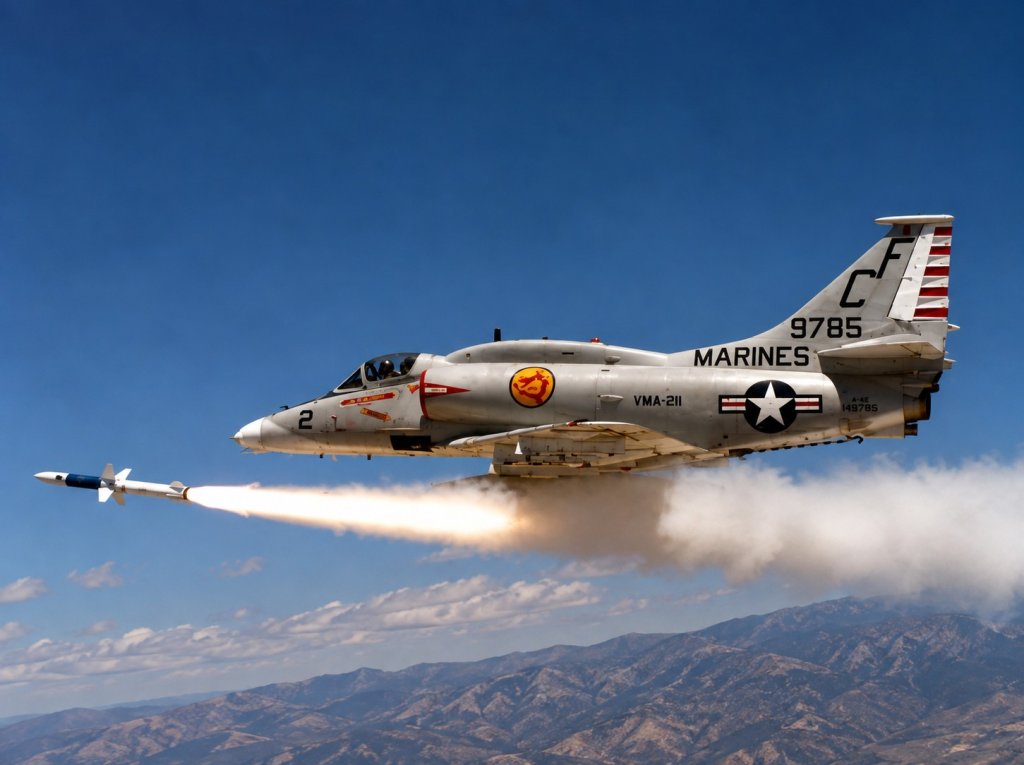
Its small physical size also became part of its combat personality. Enemy pilots could have difficulty visually acquiring a Skyhawk, while ground gunners were attempting to hit a relatively compact target traveling at high speed and maneuvering aggressively. These advantages were valuable but not magical. Attack aircraft still had to enter the engagement envelope of enemy defenses, and the Skyhawk’s combat losses proved how dangerous that work remained.
The aircraft also possessed limitations. It was subsonic, lacked the sophisticated radar of larger fighters and had limited internal fuel compared with some contemporary aircraft. External fuel tanks were commonly necessary, consuming pylons that might otherwise carry weapons. A heavily loaded Skyhawk did not possess the same performance as a clean aircraft. Later combat environments increasingly demanded advanced sensors, electronic warfare systems and precision weapons that the original design had never anticipated.
Yet the Skyhawk survived because its limitations mattered less in some missions than its strengths. A training aircraft did not need Mach 2 performance. An adversary aircraft did not need to carry thousands of pounds of bombs. A light attack aircraft did not require the radar system of a fleet interceptor. Nations operating under constrained budgets could obtain useful capability without buying the largest or most expensive fighter available.
The Skyhawk also emerged from an era when individual aircraft designers could have enormous influence over a program. Edward Heinemann became inseparable from the aircraft’s history because the Skyhawk reflected his engineering philosophy so clearly. His team treated weight as an enemy and unnecessary complexity as something to be challenged rather than accepted. The airplane became a physical argument that clever engineering could sometimes accomplish more by removing things than by adding them.
That approach made the Skyhawk strikingly different from many aircraft that followed. Later combat airplanes became increasingly dependent upon sophisticated radar, computers, data links, precision navigation, advanced sensors and complex electronic systems. Those developments brought enormous capability, but also weight, expense and maintenance demands. The Skyhawk belongs to another philosophy of military aviation: give a pilot enough airplane to perform the mission, make it reliable and keep unnecessary machinery out of the way.
Its longevity vindicated that philosophy. From its first flight in 1954, the A-4 remained relevant through radically different periods of military aviation. It entered service when many naval aircraft still carried straight from the traditions of World War II. It fought during the height of the Vietnam War. It trained pilots during the era of the F-14 Tomcat and F/A-18 Hornet. Foreign Skyhawks continued operating after stealth aircraft had entered service.
The Skyhawk’s American frontline career gradually ended as newer aircraft took over the attack mission. The A-7 Corsair II provided greater range and payload for many Navy missions, while the Marine Corps eventually transitioned through newer types. The F/A-18 Hornet ultimately combined fighter and attack roles in a single aircraft and replaced several older types, including the Skyhawk in many assignments.
But the A-4 did not disappear. Training units kept it alive. Adversary squadrons found it useful. Test organizations continued flying specialized versions. Foreign operators modernized it. Civilian companies eventually acquired Skyhawks for contracted military training. Instead of one clean retirement date, the aircraft slowly migrated from one job to another.
That may be the best measure of a military aircraft’s success. The Skyhawk survived not because anyone was sentimental about it but because people kept finding useful things for it to do.
The A-4 Skyhawk never possessed the raw speed of the F-4 Phantom, the futuristic appearance of later fighters or the enormous size and payload of heavy attack aircraft. It did not need any of those things. Its greatness came from the fact that it delivered exactly what its users repeatedly needed: a small, reliable aircraft capable of carrying meaningful firepower into difficult places.
It also carried men into some of the most dangerous skies of the Cold War. Skyhawk pilots flew toward Hanoi through missiles and anti-aircraft fire. Marine pilots rolled in on targets close to friendly troops. Israeli pilots attacked through dense Arab air defenses. Argentine pilots flew at wave-top height toward British warships. Some returned with damaged aircraft. Others ejected and were rescued or captured. Many never came home.
Those stories matter more than the specifications.
Aircraft become famous because of performance figures, photographs and combat records, but machines do not choose to enter defended airspace. People do. Every Skyhawk that left a carrier deck or combat airfield carried one person into danger, usually alone in a small cockpit, responsible for flying the aircraft, finding the target, delivering the weapons and somehow bringing the machine home again.
That may be why the A-4 inspired such affection among the people who flew it. It was an honest airplane. It did not hide behind enormous size or excessive complexity. It responded directly to the pilot, carried far more than appearances suggested and performed an astonishing range of jobs despite having been designed around deliberate simplicity.
Edward Heinemann and his team created the Skyhawk because they believed the best solution to the Navy’s problem was not necessarily a larger airplane. They removed weight, eliminated unnecessary mechanisms and produced one of the smallest carrier attack aircraft of its era. What followed was more than half a century of military usefulness.
From the decks of American aircraft carriers to the skies over Vietnam, from Israeli battlefields to the freezing waters of the South Atlantic, the A-4 repeatedly went where it was needed and carried whatever the mission demanded. It bombed, strafed, trained, demonstrated, simulated enemy fighters and served nations its original designers could never have imagined operating it.
The Skyhawk proved that size and complexity were not the same things as capability. Sometimes the aircraft that leaves the deepest mark on history is not the biggest, fastest or most technologically ambitious machine.
Sometimes it is simply the one that works.