The Rifle Between Eras: The M14 and America’s Search for the Perfect Infantry Rifle
The roots of the M14 reach much farther back than the 1950s competition normally associated with it. By the middle of World War II, the Army was already studying ways to improve the M1 Garand.
August 14, 2026

 The M14 occupies one of the strangest places in American small-arms history. It was supposed to be the rifle that simplified everything. The U.S. Army wanted one modern 7.62mm weapon that could replace the M1 Garand, the M2 carbine, the M3A1 submachine gun and, in an automatic-rifle configuration, much of the role performed by the Browning Automatic Rifle. It would use the new NATO-standard rifle cartridge, feed from a detachable 20-round magazine, fire either semiautomatically or automatically when appropriately equipped, retain the excellent sights and familiar handling of the Garand, and provide American infantry with one common rifle for the nuclear-age battlefield. The Army formally approved the design in 1957 and began issuing it in 1960. Within only a few years, however, the United States was buying the radically different 5.56mm AR-15/M16 for combat in Southeast Asia, and by 1967 the M14 was disappearing rapidly from American infantry units in Vietnam.
Calling the M14 a failure because of that short career misses much of the story. The rifle was accurate, powerful, mechanically mature and descended from one of the most successful American military rifles ever built. It was also nearly 45 inches long, fired a full-power cartridge, carried relatively heavy ammunition and was difficult for most soldiers to control during automatic fire. The Army had spent years perfecting a rifle for the kind of combat it expected to fight in Europe just as research into smaller-caliber, high-velocity ammunition was challenging many of the assumptions behind it. The M14 therefore became a bridge between two eras. One end belonged to John Garand, walnut stocks, machined-steel receivers and long-range rifle marksmanship. The other led toward Eugene Stoner, aluminum receivers, synthetic furniture, lightweight ammunition and the modern assault rifle.
The M14 began during World War II
The roots of the M14 reach much farther back than the 1950s competition normally associated with it. By the middle of World War II, the Army was already studying ways to improve the M1 Garand. The Garand had transformed American infantry firepower by giving the ordinary rifleman a reliable semiautomatic .30-06 rifle, but combat experience revealed obvious limitations. Its internal magazine held eight rounds in an en-bloc clip, it could not provide controlled automatic fire, and reducing the size and weight of the basic rifle while increasing ammunition capacity was increasingly attractive. Springfield Armory began experimenting with improved M1 designs as early as December 1942.
John C. Garand completed the T20 in October 1944. The rifle retained much of the M1's fundamental mechanical architecture but used a detachable 20-round magazine based on the BAR magazine concept and offered selective fire. Further T20E1 and T20E2 versions followed, and in 1945 the Army actually ordered 100,000 T20E2 rifles as preparations continued for the final stages of the Pacific War. Japan surrendered before that procurement occurred. The rifle intended for the invasion that never happened consequently became another experimental branch in Springfield's enormous postwar effort to determine what should follow the Garand.
That connection is important because the M14 was not simply an M1 Garand to which somebody attached a box magazine in 1957. More than a decade of experimentation separated them. Remington developed its own T22 and T27 designs. Springfield worked on Garand's unusual T31. The Army investigated alternate gas systems, shortened rifles, select-fire mechanisms, different magazines and eventually a completely new cartridge. Many prototypes failed, but their individual features fed into later rifles. Even the magazine developed for Garand's T31 eventually contributed to the T44 program that produced the M14.
The cartridge changed first
The .30-06 cartridge had served the United States through two world wars, but ammunition development after 1945 made it possible to produce similar military performance from a shorter case. American work on what became the T65 cartridge eventually resulted in the 7.62x51mm round that NATO adopted as a standard rifle and machine-gun cartridge in 1954. That was strategically attractive because rifles and machine guns fielded by multiple NATO armies could theoretically share common ammunition during a war against the Warsaw Pact.
The shorter cartridge also allowed designers to reduce the length of a rifle's receiver and operating components without sacrificing the external ballistics then considered necessary for a military rifle. Springfield converted experimental Garand-derived designs to the T65 cartridge, producing the T36 and T37 series, and those experiments led into the T44. The family resemblance remained obvious because the T44 retained the Garand-type rotating bolt and operating rod arrangement while incorporating a detachable magazine and numerous changes intended to reduce weight and improve manufacture.
The cartridge ultimately standardized as 7.62x51mm NATO gave the M14 much of its personality. Standard M80 ball ammunition drove a 147-grain projectile at roughly 2,750 to 2,800 feet per second, depending upon measurement method and barrel. This was a genuine full-power rifle cartridge capable of useful fire at distances far beyond most infantry engagements. It was also the reason a 20-round M14 magazine represented considerably more weight and recoil than a later 20-round M16 magazine.
T44 versus the FAL
The M14 almost did not happen. By the early 1950s, one of its strongest competitors was the Belgian Fabrique Nationale rifle that became internationally famous as the FN FAL. American test versions were designated T48. The competition between the T44 and T48 has accumulated enough mythology that it is sometimes portrayed as a predetermined American effort to keep a foreign rifle out of U.S. service, but the actual testing history was considerably messier. At several points the T44 was in serious danger of cancellation.
Trials at Fort Benning in 1952 eliminated another competitor, the T47, leaving the FN and T44 as principal contenders. Testing during the summer of 1953 exposed enough problems with the T44's magazine and receiver that dropping the entire project was recommended. Springfield Armory's Colonel Roy Rayle and his engineers were essentially given one final opportunity to improve the rifles before Arctic trials near Fairbanks, Alaska, beginning in December 1953. Unexpected difficulties with the FN during those trials kept the T44 alive. Even then, adoption of the FN appeared quite possible, and the Army ordered an American-production study of the design. High Standard converted metric drawings to American dimensions, and Harrington & Richardson was eventually contracted to manufacture 500 T48 rifles.
Springfield simultaneously produced 500 redesigned T44E4 rifles. Subsequent testing found that the T44E4 performed at least as well as the T48, and on May 1, 1957, the Secretary of the Army approved it for adoption as the U.S. Rifle, 7.62mm, M14. The decision disappointed several NATO allies that had favored the FN design, but from the Army's perspective the M14 offered a weapon rooted in an established American manufacturing and maintenance tradition. Actual production, however, did not begin until 1959.
The timing was brutal. While the Army was completing one of the longest and most elaborate service-rifle competitions in American history, another line of research was already asking whether the entire requirement had been based on the wrong assumptions.
Project Salvo and the argument happening in the background
Beginning in 1952, Project Salvo examined battlefield casualty data and questioned the traditional emphasis on long-range, individually aimed rifle fire. Studies suggested that many battlefield casualties resulted from relatively random bullets or fragments rather than deliberate marksmanship at extreme distance. Researchers consequently explored whether soldiers could produce more useful battlefield effects by firing larger numbers of small, high-velocity projectiles. Some experiments were genuinely bizarre, including multi-projectile cartridges and multi-barreled weapons, but the underlying question was profound: was a powerful .30-caliber rifle really the best individual weapon for the average infantryman?
Eugene Stoner's AR-10 arrived too late and insufficiently developed to defeat the T44 and T48. One prototype suffered a catastrophic barrel failure during the 1956 trials and the design was withdrawn, although it impressed senior Army officers. Stoner subsequently scaled the concept down around a .223-caliber cartridge, creating the AR-15. That rifle would eventually become the M16. The extraordinary part is that the future M16 was already being developed as the M14 was entering production.
The M14 was therefore born with its replacement visible on the horizon. Nobody necessarily knew in 1957 that the AR-15 would win, but the intellectual foundation for the smaller-caliber rifle revolution was already in place. The M14 represented the culmination of one philosophy of infantry rifle design at almost exactly the moment another philosophy was beginning to challenge it.
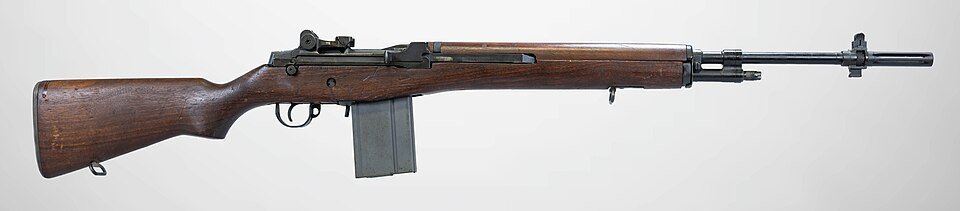
What the M14 actually was
The Army described the M14 as an air-cooled, gas-operated, magazine-fed shoulder weapon designed primarily for semiautomatic fire. That last phrase is important because the M14's selector capability has created a modern assumption that every rifleman routinely carried a fully automatic weapon. The mechanism was capable of automatic operation when the appropriate selector components were installed, but Army doctrine regarded the standard M14 principally as a semiautomatic rifle.
Mechanically, anyone familiar with an M1 Garand immediately recognizes the ancestry. When a round fires, gas is tapped from the barrel into the gas system beneath it. The gas acts on the piston, which drives the operating rod rearward. The operating rod cams the bolt roller, rotating the bolt out of its locking recesses. The bolt then travels rearward, extracting and ejecting the empty case while cocking the hammer. The recoil spring reverses the process, sending the operating components forward, stripping another cartridge from the magazine, chambering it and rotating the bolt back into lock. The Army broke this cycle into eight familiar stages: feeding, chambering, locking, firing, unlocking, extracting, ejecting and cocking.
The operating system was robust and relatively easy for troops familiar with the Garand to understand. Field stripping separated the rifle into three main assemblies: the firing mechanism, the barrel-and-receiver group and the stock. The trigger guard itself locked the trigger housing and receiver into the stock, another recognizable Garand-family feature. Soldiers were warned not to disassemble the rifle unnecessarily because repeated removal and reassembly could cause wear and degrade accuracy.
The rifle was approximately 44¼ inches long with its flash suppressor installed and weighed roughly nine pounds unloaded, depending upon configuration. The Army listed a cyclic automatic rate of approximately 700 to 750 rounds per minute and a nominal muzzle velocity around 2,800 feet per second. The standard rear sight was adjustable for both elevation and windage and continued the excellent Garand-style sight picture American riflemen already knew well.
Twenty rounds instead of eight
One of the most obvious improvements over the Garand was the detachable 20-round magazine. The M1 required the rifleman to insert an eight-round en-bloc clip from the top. The M14 allowed a loaded magazine to be inserted from below, dramatically increasing ammunition immediately available in the weapon. The magazine locked into place by engaging its front first and then rocking the rear upward, a motion that became familiar to generations of M14 users.
There was another feature that often surprises people familiar only with modern detachable-magazine rifles. The M14 could also be replenished from above while the magazine remained installed. A cartridge clip guide was built into the receiver, allowing five-round stripper clips to be pressed into the magazine through the open action. Five-round clips could also be used with a separate magazine filler to load magazines outside the rifle.
That made logistical sense because M14 magazines were comparatively substantial pieces of equipment rather than disposable containers. Ammunition could be issued on stripper clips in bandoleers while soldiers retained and repeatedly replenished their magazines. The concept occupied another interesting middle ground between the Garand's clip-fed arrangement and the later American expectation that riflemen would carry multiple ready-loaded lightweight magazines.
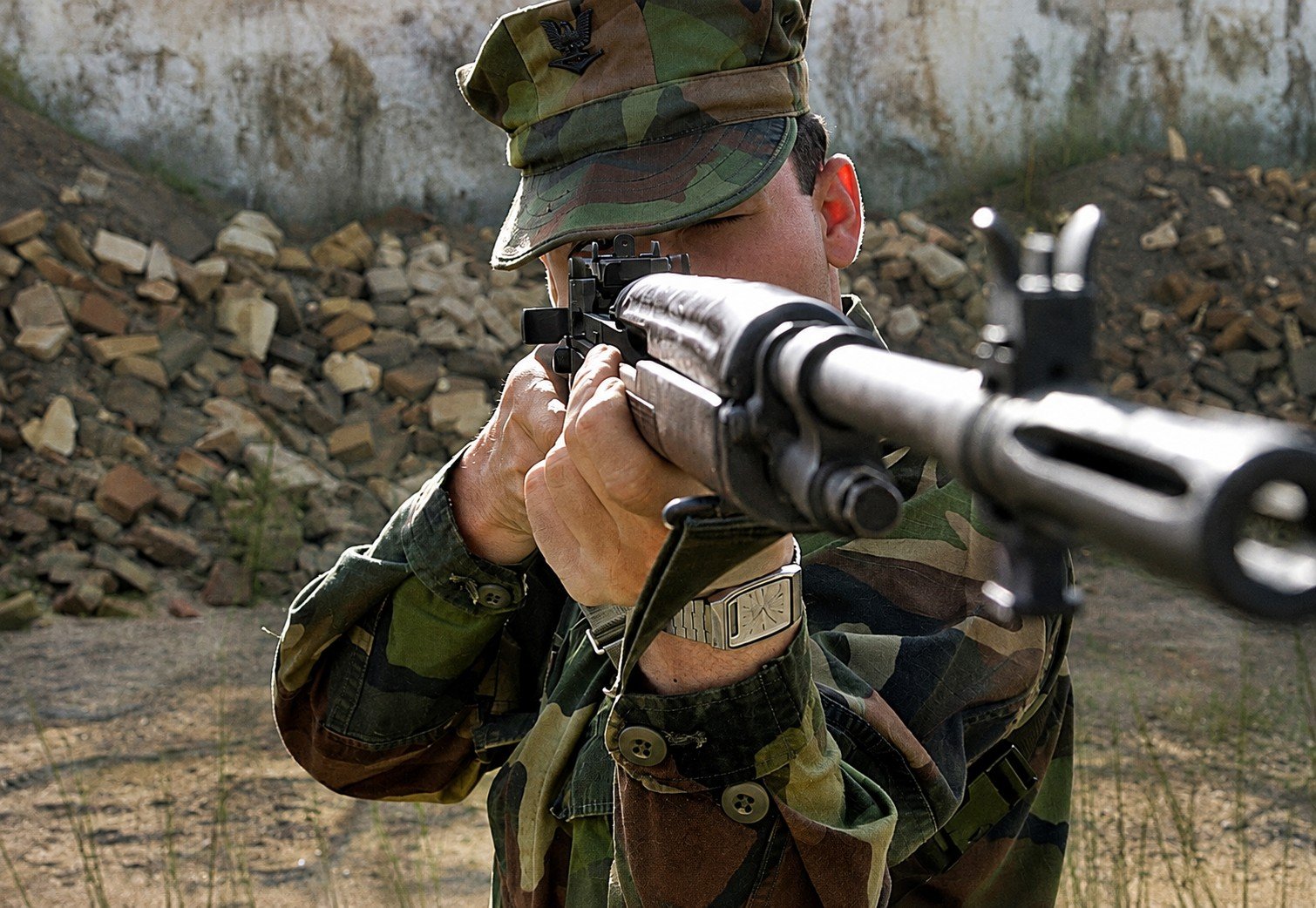 The flash suppressor did more than hide flash
The long slotted flash suppressor became one of the M14's defining visual features, but its solid lower portion also helped reduce muzzle climb and limit the amount of dust kicked up by muzzle blast when firing close to the ground. That mattered for a rifle producing the pressure and blast of 7.62mm NATO, particularly from the prone position. The flash suppressor also incorporated the mounting point for the M6 bayonet and supported other accessories.
The rifle retained a gas-system spindle valve specifically for rifle-grenade use. Rotating the valve shut off normal gas operation so that firing a grenade cartridge would not drive the operating system violently enough to damage the weapon. The same rifle could therefore accept the M76 grenade launcher and M15 grenade-launcher sight, giving it a capability inherited from an era when rifle grenades remained part of infantry doctrine.
That feature also demonstrates how much the M14 was designed as a universal infantry tool. Bayonet, rifle grenade, semiautomatic rifle, automatic rifle and precision rifle were all expected to grow from the same basic weapon. Trying to make one rifle satisfy so many missions contributed to some of its compromises.
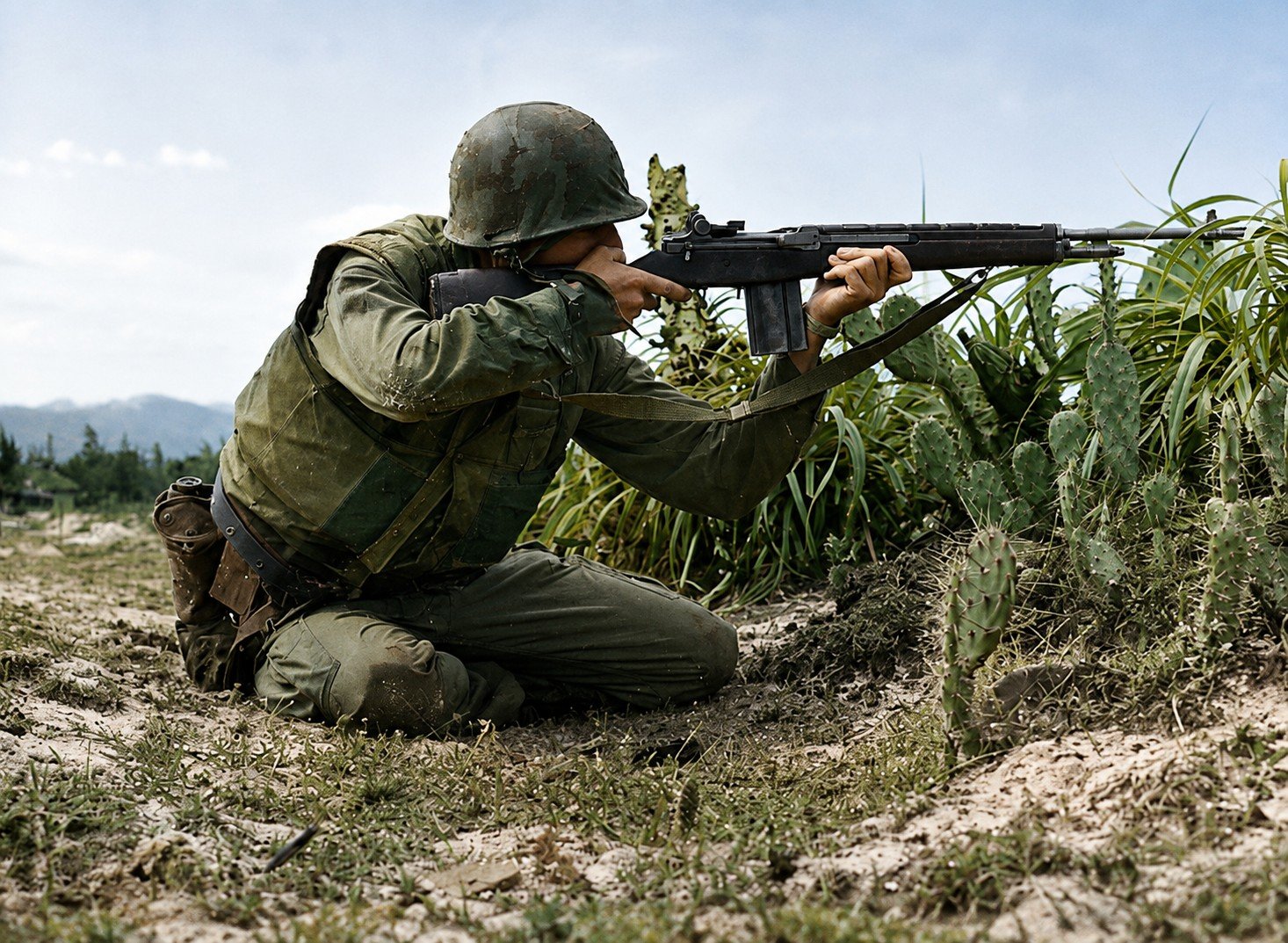
The full-auto problem
The M14 could fire automatically, but physics was unimpressed by the procurement requirement. A roughly nine-pound shoulder rifle firing 7.62x51mm ammunition at somewhere around 700 rounds per minute generates substantial recoil and muzzle movement. The first round can be well aimed. Keeping rounds two through twenty on anything resembling the same point while firing from an unsupported position is a different proposition. The Army itself described the basic M14 as being intended primarily for semiautomatic fire and used additional equipment when it was deliberately employed as an automatic rifle.
The problem became especially important because the Army initially hoped the M14 family could help replace the BAR. The BAR was heavier, but that additional mass made full-power automatic fire more manageable, particularly when firing from a supported position. The planned M15 automatic rifle represented a heavier-barreled, bipod-equipped derivative intended for the automatic-rifle role. Eventually, however, development concentrated on modifying the M14 itself.
The M14E2 was the most serious attempt to turn the design into a genuine squad automatic rifle. Its changes were extensive. The E2 used a straighter stock, fixed rear pistol grip, folding adjustable front handgrip, modified bipod, rubber recoil pad, hinged shoulder rest and a muzzle stabilizer fitted over the flash suppressor. It was primarily intended for automatic rather than semiautomatic fire. Fully loaded it weighed about 14½ pounds, which helped control the same recoil that made the lighter rifle so difficult to handle in bursts.
The Army even developed techniques in which the automatic rifleman pulled against the front grip and sling arrangement to increase downward pressure on the bipod and reduce dispersion. It was a mechanically clever solution, but it also illustrated the underlying problem. By the time enough weight, grips, stabilizers and supports had been added to make the M14 genuinely useful as a sustained automatic weapon, much of the original advantage of having one light universal rifle had disappeared.
A rifle built for marksmanship
Where the M14 excelled was controlled semiautomatic fire. The Army listed a maximum effective range of roughly 460 meters for the standard rifle in ordinary semiautomatic use, with longer effective distances possible from supported positions and against suitable targets. The maximum ballistic range extended several thousand meters, although that obviously had little relationship to the distance at which an ordinary rifleman could identify and deliberately hit a battlefield target.
The sights were among the rifle's strongest features. The protected rear aperture offered precise windage and elevation adjustment, and Marines in particular continued to build their rifle culture around deliberate marksmanship. For a trained shooter firing prone, sitting or kneeling, an M14 could be an exceptionally effective rifle. The full-power cartridge remained useful at distances where intermediate-caliber weapons surrendered velocity and energy, and the 22-inch barrel allowed the 7.62mm cartridge to perform near its intended ballistic potential.
This is part of the reason opinions about the M14 vary so dramatically. Ask whether it was an excellent rifle on a qualification range and one answer emerges. Ask whether it was the ideal rifle to carry through humid jungle while also hauling water, grenades, ammunition and field equipment, and the argument changes considerably. A rifle can be superb at what it was designed to do while still being poorly matched to a battlefield that changed beneath it.
The promise of one rifle runs into production
The Army's ambitions for the M14 were enormous. It hoped that M14s and M60 machine guns sharing 7.62mm NATO ammunition could simplify a small-arms inventory previously containing multiple weapons and cartridges. The Army began issuing the M14 in 1960, but production was slower and more troublesome than planners wanted. Rather than instantly replacing every Garand and carbine in the force, the new rifle entered service gradually as the Kennedy administration simultaneously expanded conventional forces and accelerated American involvement in Southeast Asia.
Springfield Armory itself was no longer intended to function as the sole gigantic production center it had been during World War II. Postwar procurement increasingly shifted actual volume production to private contractors, while Springfield concentrated more heavily on research, engineering, pilot production, technical data and quality control. Winchester, Harrington & Richardson and Thompson-Ramo-Wooldridge became major M14 producers along with Springfield Armory.
The M14 became the last standard American service rifle closely associated with Springfield Armory's long government small-arms tradition. The federal armory ultimately closed in 1968 as Defense Department policy increasingly favored private contract production.
There is a little historical symmetry there. Springfield had spent generations refining the American military rifle, beginning with muzzle-loading weapons and eventually producing millions of Garands. Its final standard rifle represented an exquisitely refined version of that manufacturing tradition, with substantial machined-steel construction. The M14 was not merely competing against another rifle when the M16 arrived. It was competing against an entirely different way of designing and manufacturing rifles.
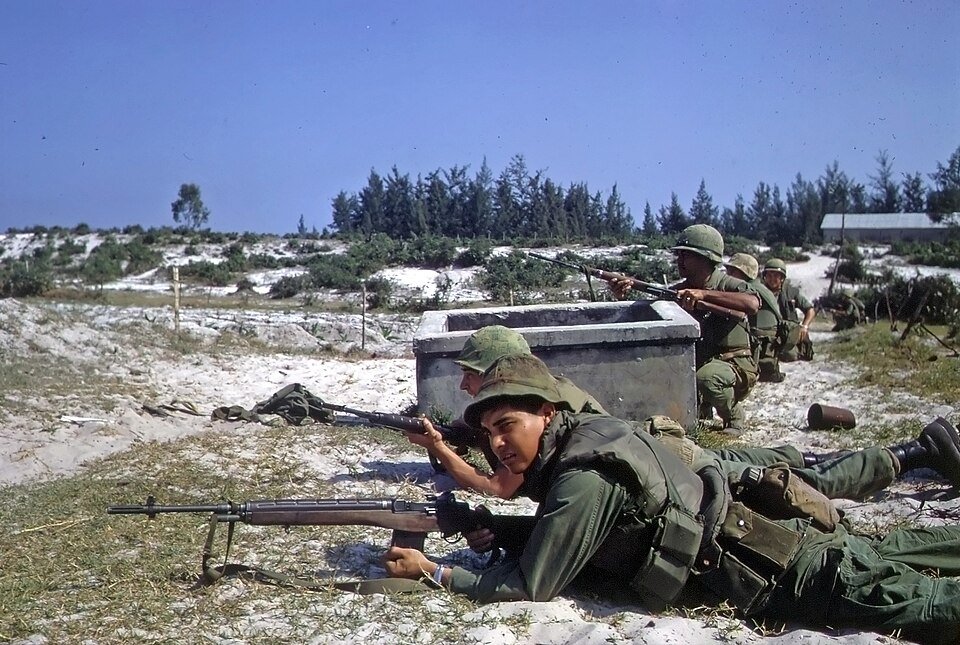
The Marines receive their new rifles
For the men receiving the weapon, none of those procurement arguments necessarily mattered. Marine veteran Ben Palermo remembered being on Okinawa in 1965 when his unit learned it was heading toward what had been described as a relatively small conflict. New equipment began appearing, including factory-fresh M14s. Palermo remembered the excitement of receiving a rifle nobody else had used and feeling almost like a kid with something new. Around him, other Marines understood what the new equipment issue meant. They were going to war.
That recollection captures something easy to lose when discussing the M14 only as a procurement controversy. In 1965 it did not look obsolete to the young Marine being handed one from the factory. It was his new service rifle, firing a powerful cartridge, built from steel and wood and carrying the accumulated prestige of the Garand behind it. Marines had been trained to shoot at distance and to consider the rifle an extension of the individual Marine. The M14 fit naturally into that culture.
Palermo arrived in Vietnam in May 1965. The excitement surrounding the new rifle was quickly displaced by what the weapon was actually for. He remembered attacks from Viet Cong moving through rice paddies, a sergeant being shot and stabbed during close fighting and the realization that what had been described before deployment was now a war in which another human being was deliberately trying to kill him. The M14 had crossed the same line with him, from clean newly issued equipment to something carried on patrol because it might have to be fired in the next several seconds.
Operation Starlite and the M14 in the first big Marine battle
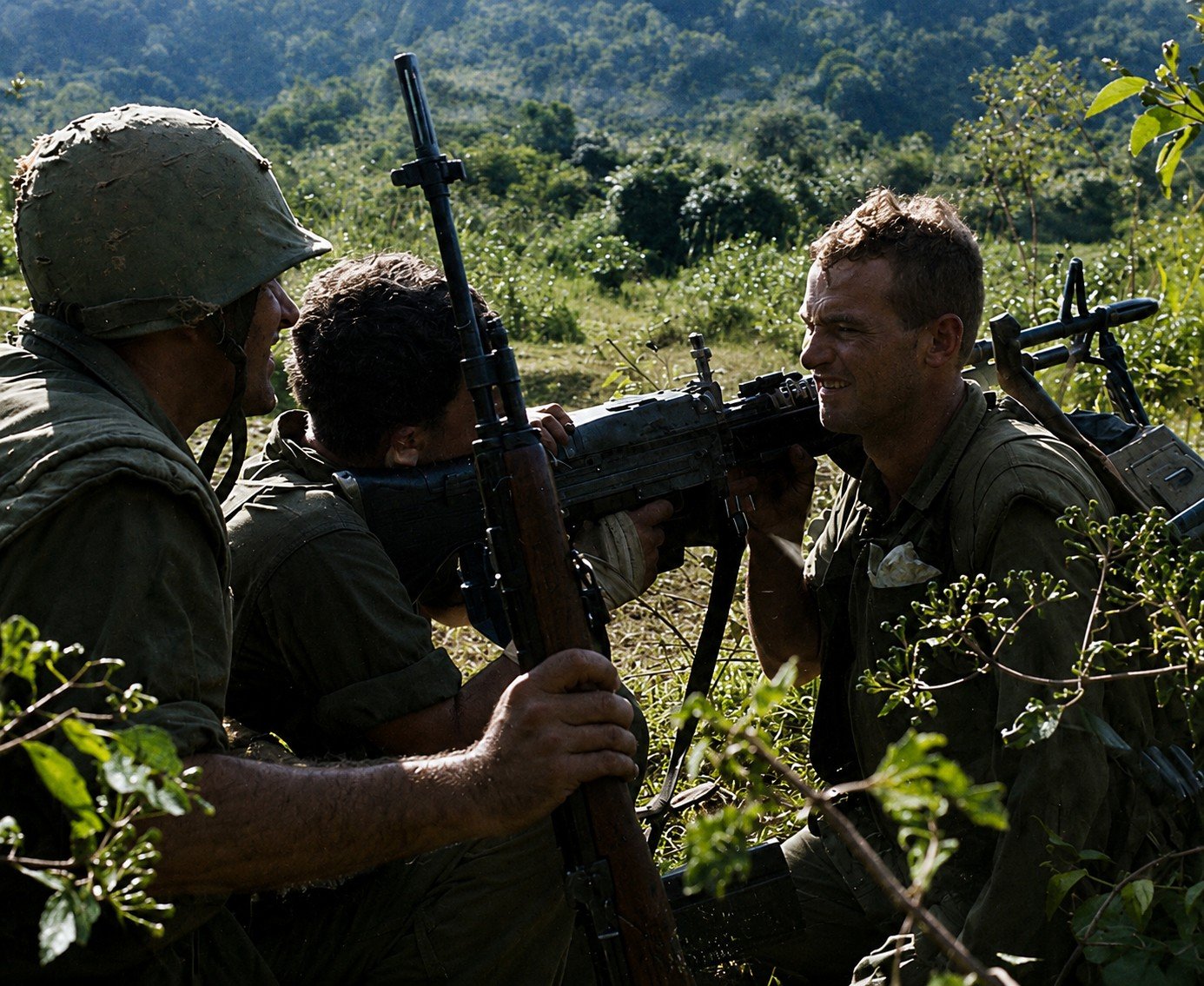
The M14 became one of the characteristic weapons of the early American ground war in Vietnam. Marines carried it during Operation Starlite in August 1965, the first major offensive conducted by a large American force against a major Viet Cong formation. Photographs from the period show the long rifles alongside M60 machine guns, M79 grenade launchers and the other equipment that defined the first phase of the Marine buildup.
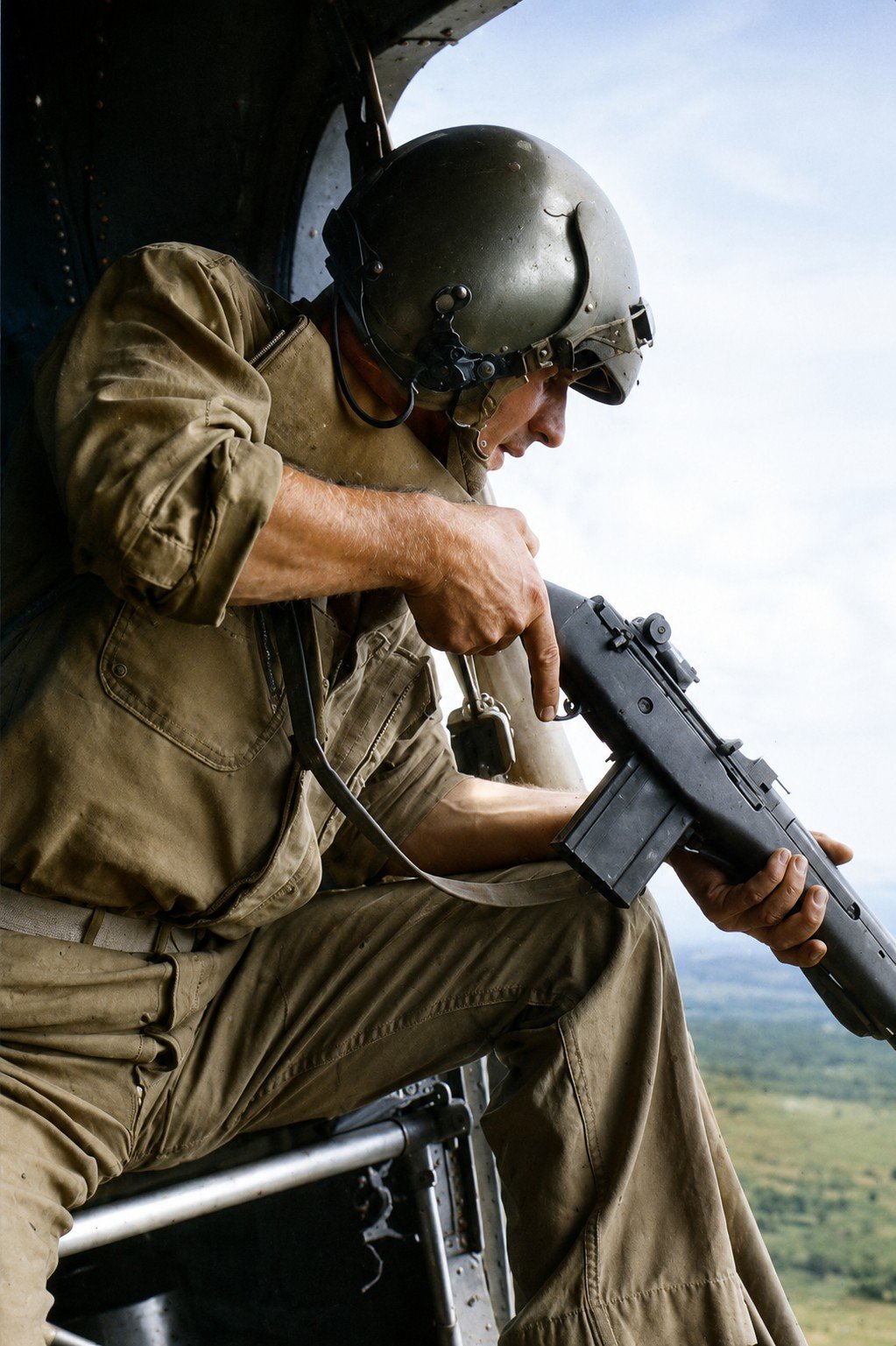
The weapon's strengths were real. A 7.62mm bullet could penetrate vegetation and light cover effectively, and the rifle was capable of excellent aimed fire across open areas, rice paddies and hills. Its shortcomings were equally physical. The rifle was long inside helicopters and thick vegetation, ammunition was heavy, and the recoil that felt entirely manageable in deliberate semiautomatic fire became something else when a frightened man wanted immediate automatic fire at close distance.
Marine veteran Gregory Lake later remembered an encounter that strips away virtually everything technical about the rifle. During a patrol he came around a path and suddenly found another armed man only fifteen or twenty feet away. Lake stood there with his M14 while the other man held a rifle. Rather than immediately firing, both men stared at one another and backed away. Lake later described the moment as changing his understanding of the war. The story tells us little about muzzle velocity or magazine capacity, but it tells us exactly what an infantry rifle ultimately represents: sometimes the distance between carrying a weapon and using it collapses to a few yards and a fraction of a second.
Vietnam was changing the requirement
The M14 had been shaped heavily by expectations of a major conventional war, particularly one fought in Europe. The Army valued range, power and ammunition standardization with NATO. Vietnam repeatedly forced different questions. Soldiers were moving by helicopter, carrying every round on their bodies, fighting in jungle and villages, and often engaging enemies at relatively close distances. The ability to carry substantially more ammunition for the same weight became extremely attractive.
By 1963, the Defense Department had selected the M16 for use in jungle warfare, where the expectation was that volume of fire and ammunition capacity could matter more than long-range power. When major American infantry formations deployed to Vietnam in 1965, many still carried M14s because M16 production had not yet caught up. By 1967, however, the transition had accelerated dramatically, and the M16 eventually became the standard American infantry rifle throughout the force.
The arithmetic was difficult for the M14 to defeat. Its ammunition was powerful, but power weighs something. A soldier could carry substantially more 5.56mm ammunition for the same burden. The M16 was also shorter and lighter, especially important when infantrymen were climbing aboard helicopters, pushing through dense vegetation and carrying extraordinary quantities of other equipment. The M14 could defeat the M16 in some individual characteristics without defeating the entire logistical and tactical argument behind the smaller weapon.
The transition was anything but clean
It is tempting to write the transition as though commanders simply collected the M14 one day and passed out a superior M16 the next. Vietnam was considerably less cooperative. Early M16 rifles suffered serious reliability problems resulting from a combination of ammunition changes, inadequate cleaning equipment and training, procurement decisions and other factors. The controversy became severe enough to trigger congressional investigation, and some troops encountered malfunctions serious enough to damage confidence in the new weapon.
Those problems delayed conversion in some Marine units and forced modifications to rifles already in theater. As a result, M14s continued appearing in Marine service after the formal replacement process had begun. A Marine photographed during 1967 or even 1968 could still plausibly be carrying an M14 while another unit was already equipped with M16s.
This is an important correction to both varieties of rifle mythology. Early M16 problems do not prove that replacing the M14 was inherently foolish, and the eventual success of the M16 does not mean every early complaint was imaginary. The military was moving from a mature rifle based on decades of Garand development to an entirely different weapon system while fighting a rapidly expanding war. Predictably, the transition was considerably less tidy than the procurement documents suggested.
Veterans consequently remembered the change differently. Some trained entirely with M14s and first encountered M16s only shortly before deployment or after arriving in Vietnam. For them, the old rifle had become familiar enough that replacing it immediately before combat could feel less like modernization and more like having somebody exchange a trusted tool just before the job began.
The M14 did not simply vanish
The disappearance of the M14 from ordinary rifle squads did not end its military usefulness. In fact, one of the qualities that made it less suitable as the universal infantry rifle, the powerful 7.62mm cartridge, made it extremely attractive for more specialized applications.
Long-range reconnaissance units continued using M14s in some configurations, particularly before M16s became universal. Small patrols operating beyond normal infantry lines had their own preferences and sometimes retained or experimented with weapons that ordinary line units were abandoning. The rifle's power and accuracy remained valuable where ammunition weight and overall length could be accepted.
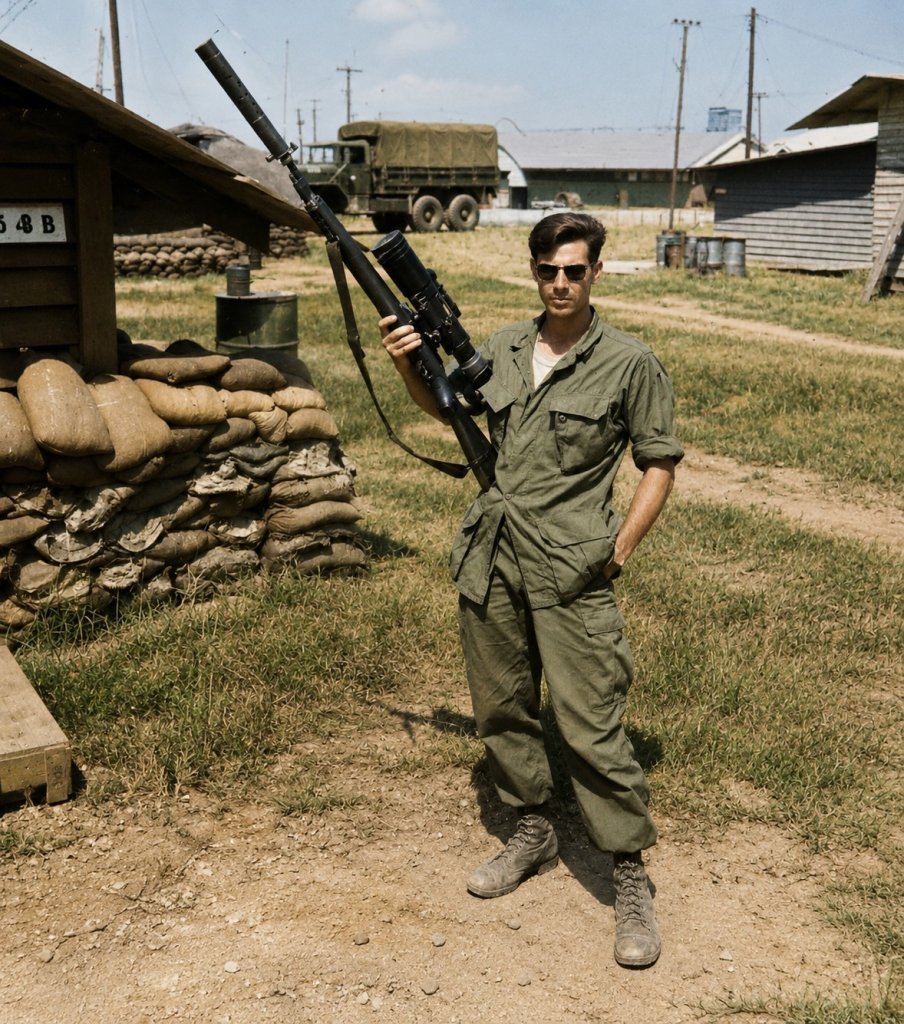
The most important transformation was the sniper role. Vietnam helped stimulate the return of formal American sniper programs, and Army work with accurized M14 rifles eventually produced the M21 sniper system. Match-conditioned rifles, optical sights and specially selected ammunition took a weapon originally intended for every rifleman and turned it into a precision system capable of exploiting the accuracy and retained energy of the 7.62mm cartridge.
That development should not be surprising. Removing the requirement that the M14 be lightweight enough for every infantryman and controllable enough for automatic rifle fire allowed armorers to emphasize what the basic action already did well: fire powerful ammunition accurately and quickly from a semiautomatic rifle.
 The M21 and the sniper rifle hiding inside the M14
The M21 deserves special attention because it represents one of the most successful second careers of any American service rifle. Early Army sniper rifles in Vietnam were often specially selected and accurized M14s fitted with telescopic sights. Improvements eventually produced the standardized M21 system.
The transformation involved much more than simply attaching a scope to a rack-grade rifle. National Match-type modifications tightened tolerances and improved consistency. Stocks could be bedded to the action, trigger mechanisms tuned, barrels selected for accuracy and ammunition carefully controlled. The ART telescopic sight system added another important capability by helping the sniper estimate range and compensate for bullet drop.
In this role, the characteristics that had burdened the ordinary infantryman became virtues. The 7.62mm ammunition retained energy at longer distances. The rifle's weight steadied it. Semiautomatic operation allowed an immediate second shot without cycling a bolt, and the excellent basic mechanical design provided a strong foundation for accurizing.
The Army kept the M21 in service until the bolt-action M24 Sniper Weapon System began replacing it during the late 1980s. The standard M14's reign as America's general-service rifle had been remarkably short, yet its precision derivative served for roughly two decades afterward.
A rifle returns from storage
Decades after Vietnam, the M14 family received another unexpected lease on life. Operations in Iraq and especially Afghanistan created renewed demand for semiautomatic 7.62mm rifles capable of reaching beyond the practical envelope of standard 5.56mm carbines. The military discovered that large numbers of old M14 receivers still existed and could be converted for modern designated-marksman roles.
The resulting Enhanced Battle Rifles bore little visual resemblance to the walnut-stocked rifles carried through Vietnam. Modern chassis systems added adjustable stocks, pistol grips, accessory rails, bipods and optical sights while retaining the M14 receiver and operating system. These weapons were used to give infantry squads greater range and precision without requiring a dedicated bolt-action sniper rifle for every situation.
The Marine Corps followed similar paths with M14-based designated marksman and enhanced marksman rifles. Specialized M14s also survived in naval service for duties such as line throwing, while ceremonial units continued using the rifle because its traditional proportions and substantial construction made it exceptionally well suited to drill and honor-guard work.
A rifle designed in the 1950s to confront Soviet troops in Europe consequently found itself fighting in Afghanistan more than half a century later. Military procurement rarely produces irony intentionally, but it remains remarkably efficient at creating it.
The M14 in ceremony and memory
The M14 also survived because it looks and handles like what generations of Americans imagined a military rifle should be. Its walnut stock, exposed steel operating components and traditional rifle proportions visually connect it to the M1 Garand and earlier American service rifles. That appearance made it particularly attractive for honor guards, drill teams and ceremonial units even after newer rifles dominated combat formations.
There is a deeper reason veterans and collectors remain attached to it. The M14 feels like the end of a particular American rifle tradition. Its lineage can be traced directly through the M1 Garand and the experimental rifles of World War II to an era when Springfield Armory was not merely manufacturing weapons but developing the machines, gauges and production methods used to make them. The M14 was born inside an institution whose rifle history stretched back generations, and it became the final standard service rifle associated with that system before Springfield Armory closed in 1968.
That heritage can sometimes distort evaluation of the rifle. Nostalgia turns the M14 into an indestructible long-range masterpiece betrayed by politicians, while enthusiasts of the M16 can reduce it to an overweight relic that deserved immediate retirement. Neither caricature survives much contact with the evidence. The M14 was a mature, powerful and accurate service rifle. It was also an expensive solution to a requirement that was changing almost as soon as the weapon entered production.
Why the M16 won
The fundamental argument was never simply that a 5.56mm bullet was somehow individually more powerful than a 7.62mm bullet. It obviously was not. The argument concerned the entire infantry system. A lighter rifle meant less burden. Smaller ammunition meant more cartridges could be carried. Reduced recoil made rapid fire easier to control and simplified training for soldiers of widely varying size and shooting experience. A shorter weapon was easier to handle inside helicopters, vehicles, buildings and vegetation. If most actual infantry engagements took place well inside the range where 7.62mm possessed its greatest ballistic advantage, carrying the extra weight and recoil of the larger cartridge became harder to justify for every soldier.
The M14's own automatic-fire characteristics illustrated the problem. The rifle could cycle at roughly 700 to 750 rounds per minute, but the mechanism's ability to fire that quickly said little about whether the shooter could control it or whether the barrel and ammunition supply could sustain it. Full automatic fire from the basic rifle consumed ammunition rapidly while producing substantial muzzle movement.
When the Army wanted serious automatic fire from the weapon, it added a bipod, specialized stock, handgrips, recoil pad and muzzle stabilizer until the M14E2 weighed roughly 14½ pounds loaded. At that point the effort to create one universal rifle had essentially recreated a separate automatic-rifle configuration. Meanwhile, the M60 already provided belt-fed 7.62mm fire.
The supposed simplicity of replacing several weapons with one was disappearing in actual use.
The M16 therefore won not because the M14 suddenly became incapable of killing anyone or hitting distant targets, but because the newer rifle fit the developing concept of the individual infantry weapon better. The fact that 7.62mm rifles later returned as designated-marksman weapons actually reinforces the point. The larger cartridge still had enormous value, but not every rifleman needed to carry it.
 What the M14 got right
The M14 deserves more credit than its extraordinarily short reign as America's standard rifle might suggest. Its sights were excellent. Its semiautomatic accuracy could be very good. The 7.62mm cartridge offered substantial reach and authority. The basic Garand-derived action was proven and understandable. The detachable magazine corrected one of the M1's largest limitations while preserving the ability to replenish magazines with stripper clips. The rifle could accept a bayonet, grenade launcher, bipod and other accessories, and its basic action was accurate enough to become the foundation of a successful sniper system.
It was also a rifle that rewarded traditional marksmanship. A trained shooter who understood sight adjustment, position, sling use and trigger control could exploit the weapon at distances far beyond the close engagements for which later carbines became optimized. This quality helped keep the M14 alive in match shooting and precision roles after its standard-service career ended.
Its greatest weakness may therefore have been not that it was poorly designed, but that it was designed exceptionally well around assumptions that were losing influence. The Army had asked Springfield to create a better Garand capable of filling several additional roles. Springfield essentially did that. The battlefield then asked whether the infantryman needed a better Garand at all.
The rifle in a Marine's hands
The technical history eventually comes back to people such as Ben Palermo. Before Vietnam, he could look at a factory-new M14 and feel the excitement of receiving something new and powerful. Shortly afterward, the same rifle accompanied him through patrols where men were being killed within sight of one another. Gregory Lake could walk around a bend carrying his M14 and suddenly find himself staring at another armed human being fifteen or twenty feet away. Those moments matter because they separate the artifact from the specifications stamped beside it in a museum case.
For many Americans who entered the military during that brief early-1960s window, the M14 was the rifle through which the military taught them what a rifleman was supposed to be. They learned its sights, recoil, safety, operating rod and magazine. They carried it through recruit training and qualification. Some carried it to Vietnam. Others trained with it and were handed an M16 before entering combat. The M14's short period as the standard rifle therefore overlapped one of the most dramatic transformations the American military ever experienced, from a largely Cold War force organized around confrontation in Europe to an enormous helicopter-borne war fought in Southeast Asia.
The rifle changed with that history rather than simply disappearing from it. The ordinary M14 became the M14E2 automatic rifle, the accurized M14 became the M21 sniper system, surviving rifles became ceremonial weapons and line throwers, and decades later modern chassis systems turned old receivers into designated-marksman rifles carried in Afghanistan. Very few standard rifles have had such a short period at the center of American infantry doctrine and such an extraordinarily long afterlife around its edges.
 The last rifle from Springfield
There is an appropriate irony in the M14 being remembered as both old-fashioned and remarkably durable. It was essentially the final military expression of a rifle-development tradition that had begun at Springfield Armory generations before anyone had heard of Vietnam. It combined the Garand's rotating-bolt operating architecture with a detachable 20-round magazine, NATO ammunition and selective-fire capability, then carried those ideas about as far as a conventional full-power wooden-stocked service rifle reasonably could.
Its replacement did not make the rifle meaningless. The M16 represented a different answer to a different understanding of infantry combat, and eventually that answer proved more adaptable as the general service rifle. The M14 retreated into the places where its own strengths still mattered: precision shooting, longer-range semiautomatic fire, specialized naval work, competition and ceremony. The Army that had expected one M14 to replace several different weapons ultimately discovered something militaries repeatedly relearn at considerable expense: specialized jobs have an irritating habit of requiring specialized tools.
The result is that the M14 never really received the clean retirement its short frontline career seemed to promise. It entered standard service just before Vietnam, was pushed aside during Vietnam, returned as a sniper rifle because of Vietnam, survived for decades afterward and then appeared once again on twenty-first-century battlefields after American troops rediscovered a need for semiautomatic 7.62mm fire at longer ranges.
The M14 was not America's great failed rifle, nor was it the perfect weapon foolishly discarded for the M16. It was an excellent final development of the Garand tradition that arrived at precisely the moment the United States was beginning to leave that tradition behind.