The Real Story of the Jeep
The Willys MB and the Ford GPW, both formally called the U.S. Army Truck, 1/4 ton, 4×4, Command Reconnaissance, commonly known as the Willys Jeep, or just Jeep, and sometimes referred to by its Standard Army Supply number G-503.
October 17, 2023

 Few military vehicles are as instantly recognizable as the World War II Jeep. Small, square, uncomplicated, and seemingly incapable of understanding the word “impossible,” it became one of the most useful pieces of equipment fielded by the United States during the war. Officially, the Willys MB and Ford GPW were designated as quarter-ton, four-wheel-drive command reconnaissance trucks and belonged to the Army’s G-503 family of vehicles. To the soldiers who drove them, rode in them, overloaded them, repaired them, cursed them, and occasionally slept beside them, they were simply Jeeps.
More than 600,000 standardized quarter-ton Jeeps were produced during World War II, primarily by Willys-Overland and Ford. They served American forces and Allied armies in virtually every theater of the war, carrying officers, infantrymen, ammunition, radios, medical supplies, machine guns, stretchers, food, mail, and almost anything else that could be strapped onto them. The Jeep was never glamorous, and that was part of its genius. It was light enough to go places larger trucks could not, simple enough to be repaired under primitive conditions, and rugged enough to endure punishment that would have reduced many civilian automobiles to scrap. Jeeps crossed deserts in North Africa, bounced along muddy roads in Italy, squeezed through French villages, climbed mountain trails, churned across Pacific islands, and operated in conditions their designers could scarcely have imagined.
The vehicle was born from urgency. In 1940, with war already consuming Europe and American involvement increasingly possible, the U.S. Army wanted a lightweight four-wheel-drive vehicle that could perform reconnaissance and general utility duties. The requirements were demanding. It had to be small, relatively light, durable, capable of carrying soldiers and equipment, and able to operate over rough terrain. American Bantam produced one of the earliest prototypes, followed by designs from Willys-Overland and Ford. The Army eventually standardized a design that incorporated features developed during this competitive process. Willys became the principal manufacturer with the MB, while Ford produced the nearly identical GPW. Standardization mattered enormously. A Ford-built Jeep and a Willys-built Jeep could share many components, making maintenance and replacement parts far easier for an army operating thousands of miles from American factories.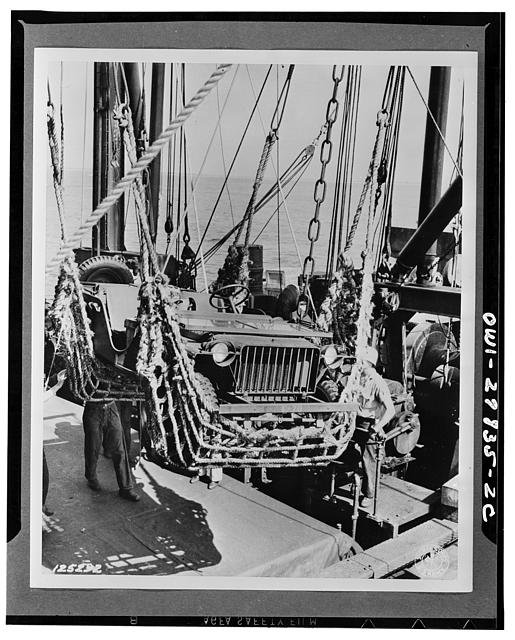
Once the Jeep reached the troops, its role quickly expanded beyond reconnaissance. Soldiers found uses for it that its designers had never anticipated. It transported officers and messengers between headquarters, carried radio teams and communications equipment, hauled trailers loaded with ammunition or supplies, and sometimes carried machine guns. Engineers used them. Military police used them. Chaplains used them. Mechanics used them. Airfield crews used them. Medical units converted Jeeps into improvised ambulances capable of reaching places larger vehicles could not. Photographs from the war show Jeeps carrying astonishing loads of equipment, fuel cans, duffel bags, weapons, ammunition, and soldiers, often with barely an inch of unused space remaining. Windshields were folded down, shovels and axes were strapped to the body, and extra fuel cans went wherever crews could secure them. Over time, each vehicle became less like a factory product and more like the particular Jeep of the men using it.
 Even the name “Jeep” has a history as complicated as the vehicle itself. The word existed before the famous quarter-ton truck entered service. American military personnel had already used “jeep” as slang for inexperienced recruits, new equipment, experimental machinery, and assorted mechanical contraptions. Another possible influence came from popular culture. In 1936, cartoonist E. C. Segar introduced Eugene the Jeep into the Popeye comic strip. Eugene was a strange little creature able to go almost anywhere and overcome seemingly impossible obstacles. The comparison to a tiny four-wheel-drive vehicle that seemed capable of climbing, crawling, and bouncing through nearly any terrain was easy to make, and the cartoon character may have helped popularize the term.
Military terminology in the early 1940s was anything but tidy. Soldiers did not always use “Jeep” specifically for the quarter-ton vehicle. Other light military vehicles were also called Jeeps, peeps, bantams, puddle-jumpers, and assorted other nicknames. The often-repeated explanation that the word “Jeep” simply came from pronouncing the initials “GP” is probably too simple. The term was already circulating before Ford’s GPW became famous, and Ford’s designation itself had a specific manufacturing meaning. Like much military slang, the name appears to have developed gradually rather than being invented at one identifiable moment. Eventually, however, the little quarter-ton truck claimed the word for itself. When soldiers said “Jeep,” everyone knew what they meant.
 Its importance came largely from mobility. Armies consume staggering quantities of material, and all of it has to move. Ammunition, food, water, fuel, replacement parts, medical supplies, radio batteries, messages, and people constantly travel between depots, headquarters, field positions, and the front. Large trucks could carry enormous amounts, but they could not always reach the last mile. The Jeep often could. It could move down narrow roads, cross rough fields, follow trails, and travel close to combat units. Need to move a radio team? Take the Jeep. Need ammunition delivered to a gun position? Take the Jeep. Need to retrieve wounded soldiers? Take the Jeep. Need to get an officer across ten miles of terrible road before headquarters starts wondering where he went? Once again, take the Jeep. Not every machine that helps win a war fires a projectile. Some simply make sure everything else gets where it needs to go.
One of the Jeep’s most important roles was also one of its least glamorous: medical evacuation. Battlefields rarely provided convenient roads between wounded soldiers and medical facilities. Jeeps could travel into areas inaccessible to ambulances and larger trucks, and stretcher racks could be fitted to carry casualties. In other situations, wounded men were simply placed wherever space could be found. For many injured soldiers, the sight or sound of an approaching Jeep meant movement away from the fighting and toward medical care. Some men rode into battle in Jeeps. Others rode out of it in them. That makes the Jeep part of more than the story of military transportation. It is also part of the story of survival.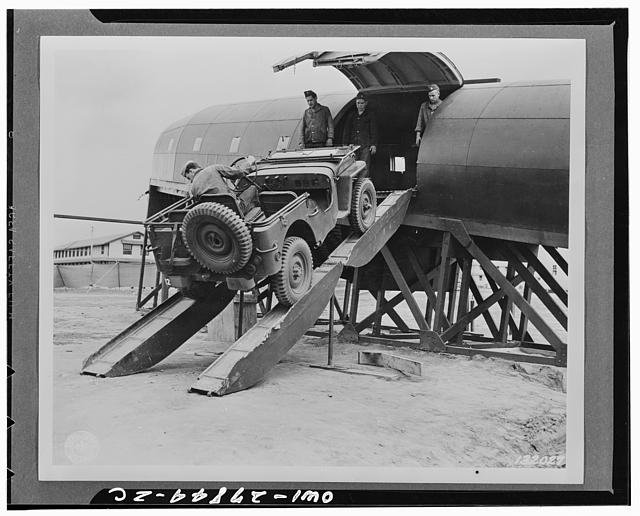
When World War II ended, the Jeep’s usefulness did not. Thousands remained in military service while others entered civilian life. Farmers, construction crews, hunters, utility companies, and private owners quickly discovered that a vehicle designed to survive wartime service was remarkably useful in peacetime. Military Jeep development continued with vehicles such as the M38 and M38A1, while civilian Jeep models helped establish an entirely new market for practical four-wheel-drive vehicles. The original MB and GPW, however, belong to a very specific moment in history. They were built because the United States suddenly needed enormous numbers of dependable machines capable of operating almost anywhere, and millions of servicemen came to know them as part of everyday life.
At Ghosts of the Battlefield, that human connection is the part of the story that matters most. A restored Jeep sitting silently in a museum or at a show can easily become just another old military vehicle. During the war, it was anything but silent. Imagine one sitting beside a muddy road somewhere in Europe with its engine running, equipment rattling against the body, a radio operator trying to hear through static, soldiers squeezed into every available space, and artillery rumbling somewhere in the distance. Perhaps that Jeep carried ammunition forward. Perhaps it carried mail that a soldier had been waiting weeks to receive. Perhaps a chaplain rode in it. Perhaps a lieutenant used it to reach his platoon. Perhaps wounded men were strapped to its stretchers and carried toward a field hospital.
 Those moments rarely appear in technical manuals or production statistics, yet they are what gave the Jeep its meaning. History naturally remembers the enormous machines of war: battleships, bombers, tanks, and artillery pieces. Wars, however, are often held together by smaller things. A helmet. A radio. A canteen. A letter from home. And a little four-wheel-drive truck that seemed capable of going wherever somebody needed it to go.
The Jeep was not simply transportation. For hundreds of thousands of servicemen, it was part of daily life at war. Somewhere behind nearly every surviving Jeep is a collection of stories belonging to people whose names may never appear in a history book. Those are the stories worth saving.
See the Jeep in Our Collection: Bringing a WWII Workhorse Back to Life