The Pig: The M60 Machine Gun and the Sound of the Vietnam War
There are weapons that become associated with a war because they were present, and there are others that become almost inseparable from the memory of it. The M60 machine gun belongs firmly in the second category.
August 12, 2026

There are weapons that become associated with a war because they were present, and there are others that become almost inseparable from the memory of it. The M60 machine gun belongs firmly in the second category. A photograph of an American infantry patrol moving through elephant grass, a helicopter banking over a landing zone, an armored personnel carrier pushing through a village, or a river patrol boat cutting across muddy water often contains the same familiar shape somewhere in the frame: a long 7.62mm machine gun with its distinctive forearm, folding bipod, flash suppressor, and belt of linked ammunition hanging from the feed tray. To the men who carried it, fed it, fired it, cleaned it, cursed its weight, and depended upon it when a firefight began, it became simply “the Pig.”
The nickname was not an official designation and probably never had one universally agreed explanation. The M60 was heavy compared with the rifles surrounding it, consumed ammunition voraciously, and required a considerable amount of additional equipment and ammunition to keep it useful. Yet the name was not necessarily an insult. Like many military nicknames, “the Pig” could contain irritation, affection, respect, and profanity simultaneously. The Army itself has since acknowledged that Vietnam troops referred to the M60 by that name, while generations of gunners continued using it long after the war. Whatever a soldier thought about carrying one through the heat, when the shooting began the M60 was often the weapon everyone wanted working.
The M60 entered American service at a moment when the Army was trying to solve a problem left over from the Second World War and Korea. American infantry had relied on an assortment of Browning automatic rifles and machine guns, particularly the M1918A2 BAR and members of the M1919 family. They were proven weapons, but they represented different approaches to automatic fire and required different employment. The Army wanted a modern general-purpose machine gun capable of being carried with infantry, fired from a bipod, mounted on a tripod for sustained fire, and adapted to vehicles and aircraft. By the late 1950s, the new 7.62mm M60 was beginning to replace several older Browning designs, while the Army also adopted the M14 rifle chambered for the same NATO cartridge. Army histories note that the M60 entered the force as part of this larger effort to modernize and standardize infantry firepower.
 An American Machine Gun with German Ancestors
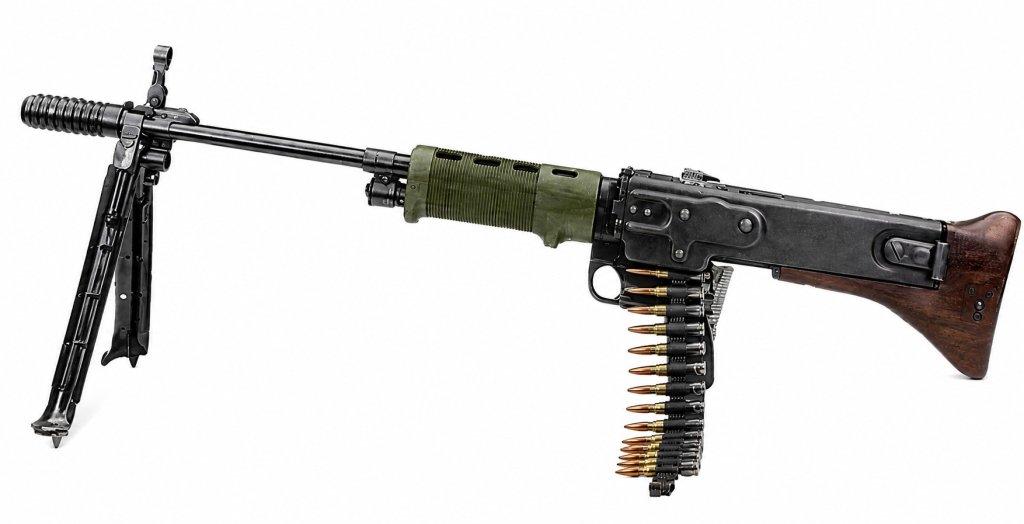
The M60 was unmistakably American in service, manufacture, and eventual reputation, but its mechanical ancestry crossed the Atlantic. The official U.S. Navy technical history The Machine Gun, written by retired Marine Colonel George M. Chinn, traces the M60 back to experimental work begun near the end of World War II. The early T44 prototype combined the belt-feed concept of the German MG42 with the operating system and rotating bolt of the German FG42 automatic rifle. Chinn even pointed out the historical irony that some features of the FG42 itself could be traced to the American-designed Lewis gun of the First World War. The T44 led to the T52 series, then to the T161 family, and the NATO-chambered T161E3 ultimately entered production as the M60.
 That lineage matters because the M60 represented a different philosophy from simply building another heavy machine gun and assigning men to drag it around. The German general-purpose machine-gun concept had demonstrated the value of a single belt-fed weapon adaptable to different tactical roles. A machine gun could accompany infantry on a bipod, become a more stable sustained-fire weapon when placed on a tripod, or be adapted to vehicles and other mounts. The American weapon that emerged from postwar development followed that broad concept while being chambered for the new 7.62x51mm NATO cartridge.
The Army formally adopted the M60 in the late 1950s, and by the early Vietnam era it had become a core part of American infantry firepower. The transition was not instantaneous. Weapons rarely disappear from inventories because somebody signs a piece of paper in Washington, despite the extraordinary faith bureaucracies place in paperwork. Older Brownings and BARs remained visible for a time, particularly in allied and advisory service, but the M60 increasingly became the standard American 7.62mm belt-fed weapon carried into the field.
What the M60 Actually Was
The standard M60 was a gas-operated, air-cooled, belt-fed automatic weapon firing from the open-bolt position. Its ammunition was the full-power 7.62x51mm NATO cartridge fed through disintegrating M13 metallic links. Instead of a cloth belt or a reusable solid belt, the links separated as the cartridges were stripped and fired, leaving empty brass and individual links scattered around the gunner. The weapon was fully automatic and relied upon a gas system to drive the operating components rearward after each shot, cycle the action, feed the next cartridge, and continue firing as long as ammunition remained and the trigger was held. Government technical histories describe the standard gun at roughly 23 to 24 pounds, about 43.5 inches long, with a muzzle velocity around 2,800 feet per second and a cyclic rate in the neighborhood of 550 rounds per minute.
Those figures only begin to explain the gun. The M60 fired from an open bolt, meaning the bolt remained to the rear between bursts rather than leaving a cartridge sitting inside a hot chamber. That was important for an automatic weapon expected to produce sustained fire because it allowed more air circulation through the chamber and reduced the risk that heat alone could ignite a chambered cartridge. It also used a quick-change barrel system because no air-cooled rifle-caliber machine gun can simply fire indefinitely without heat becoming a serious problem.
Marine Corps tactical references later listed the M60E3 at a rapid rate of approximately 200 rounds per minute and a sustained rate of 100 rounds per minute, typically fired in controlled bursts rather than simply holding the trigger until the belt disappeared. The same Marine reference listed a maximum effective range of approximately 1,000 meters and grazing fire out to about 600 meters. Exact doctrinal range figures varied somewhat by version, target type, and whether the weapon was fired from a bipod or stable mount, but the important distinction is that the M60 was capable of useful fire far beyond ordinary close-range jungle engagements.
The cyclic rate of roughly 500 to 600 rounds per minute was actually one of the M60's useful characteristics. It was dramatically slower than the German MG42 that had influenced its feed mechanism and slower than high-rate weapons such as the M134 Minigun. That made the M60 comparatively controllable and reduced ammunition consumption and heat compared with a weapon firing well over a thousand rounds per minute. The gun still ate belts at an impressive rate when frightened humans were pulling the trigger, but a trained crew could place short bursts where they mattered instead of converting every ammunition can in the province into noise.
 The Gun Was Only Half the Weapon System
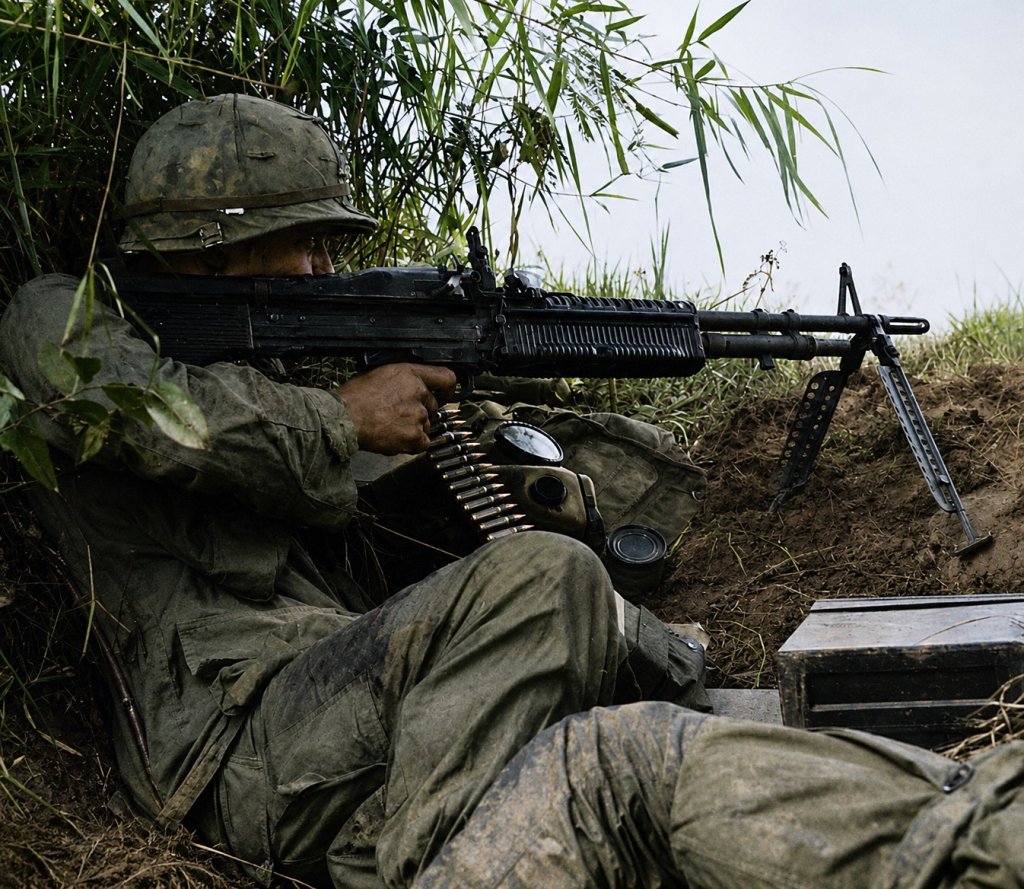
A machine gun is not merely the object in the gunner's hands. It is a gun, ammunition, spare barrel, supporting equipment, and the people required to keep all of it moving. The M60 was normally treated as a crew-served weapon. A gunner carried the weapon, while an assistant gunner and other members of the squad could carry ammunition, the spare barrel, and additional equipment. In actual Vietnam units, how that burden was distributed varied according to mission, unit practice, personnel strength, terrain, and the eternally persuasive argument of who was still capable of carrying another belt.
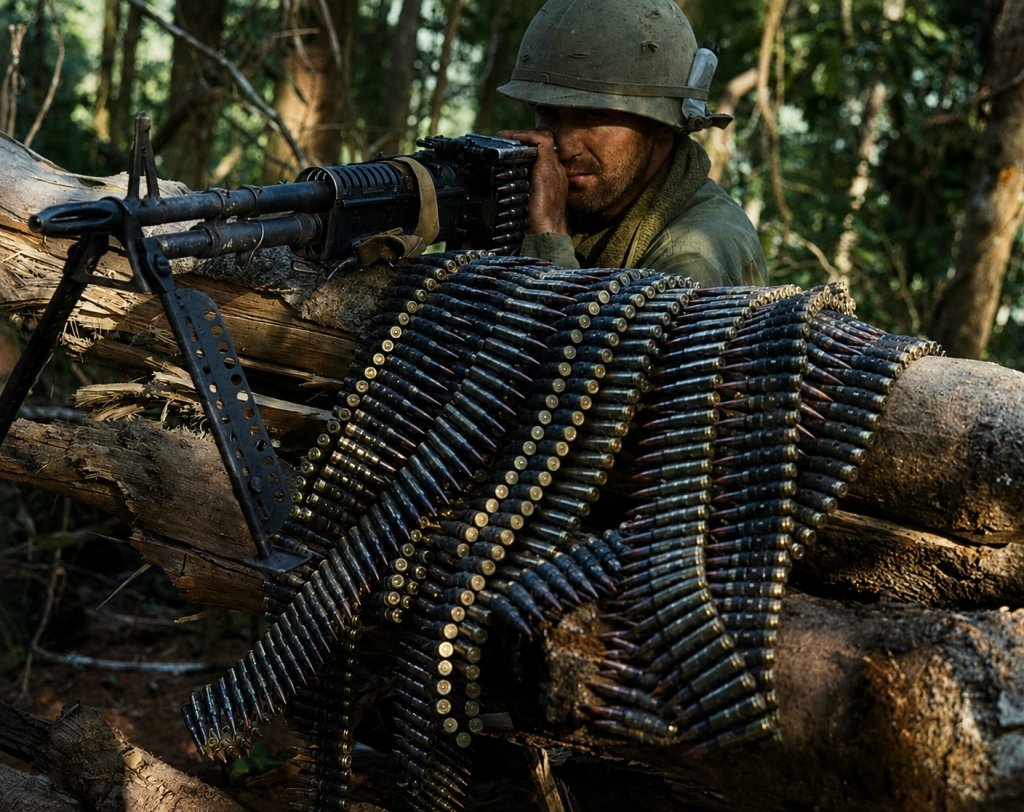
This is where the reputation of “the Pig” becomes easier to understand. Twenty-three pounds does not sound extraordinary until it is added to water, helmet, body armor when worn, grenades, personal weapon equipment, rations, poncho, radio batteries, and everything else required to live in the field. Then came the ammunition. A 100-round belt of 7.62mm NATO ammunition was not a theoretical number in a manual; it was several pounds that somebody had to carry through mud, rice paddies, jungle, hills, and heat.
Army combat studies show just how seriously units treated the machine gun's ammunition supply. In one documented patrol, each M60 crew carried at least four boxes of ball ammunition before moving out. Other Vietnam reconnaissance accounts show ammunition levels becoming low enough that commanders changed what patrols were allowed to do. If a team no longer possessed enough M60 ammunition to dominate a sudden engagement, its tactical options changed immediately. Firepower was only useful as long as somebody had carried the ammunition far enough to feed it.
That burden was frequently shared. Men who did not carry the M60 often carried belts for the man who did. It created an important relationship inside an infantry element because the machine gunner's firepower depended upon the rest of the group, while the rest of the group might soon depend upon that machine gunner. The weapon therefore encouraged exactly what a crew-served weapon is supposed to create: collective responsibility for firepower.
Why the M60 Mattered in a Firefight
The M16 eventually gave the American infantryman a lightweight rifle and a large personal ammunition load, while the M79 grenade launcher provided explosive fire beyond hand-grenade distance. Neither replaced what the M60 could do. The M60 fired a full-power 7.62mm cartridge from a belt, allowing the gunner to produce sustained, controlled automatic fire capable of suppressing enemy positions, sweeping likely avenues of approach, protecting flanks, breaking ambushes, and covering friendly movement.
The word “suppression” can sound bloodless when written in a field manual. In combat it means making the other man sufficiently concerned about being hit that he cannot effectively aim, move, fire, or organize against you. A machine gun does not have to strike every enemy soldier to change what an enemy unit can do. Bullets passing inches overhead, striking trees, cutting vegetation, throwing dirt, and hammering a position can destroy the ability of men to expose themselves long enough to return accurate fire.
An official Army interview collection from Vietnam describes one engagement in which enemy supporting fire was met immediately by M60 machine guns and M79 grenade launchers. The resulting heavy volume of grazing fire prevented enemy RPG gunners from delivering accurately aimed rockets. That is the M60's purpose in one small battlefield example. It was not simply attempting to kill an individual target. It was denying the enemy the freedom to use his own weapons effectively.
Defensively, machine guns could be positioned to provide interlocking fields of fire and predetermined final protective lines. In the worst case, when an enemy force was close to penetrating a perimeter, machine gunners could fire along those lines to create overlapping bands of bullets just above the ground. Marine doctrine described final protective fire as essentially a last resort against imminent penetration, the moment before a defensive position could collapse into close combat. In that situation, the machine gun was not merely another rifle. It was the structural backbone of the defense.
 Carrying the Pig
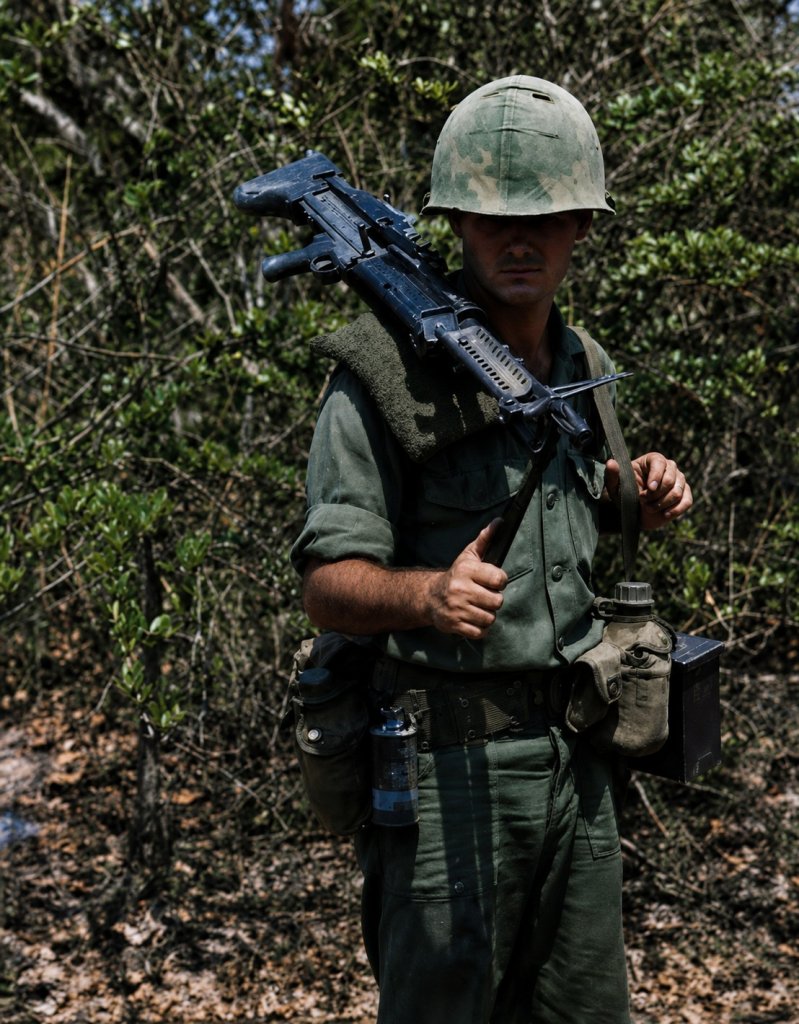
Photographs make carrying an M60 look considerably easier than it was. A gunner photographed for a fraction of a second may appear almost cinematic, belt draped over his shoulder and weapon held across his chest. The photograph does not show the tenth mile, the soaked uniform, the mud trying to remove his boots, the ammunition pressing into his shoulders, the barrel and receiver becoming hot enough to demand care, or the constant awareness that when contact began everyone would expect him to get the gun firing immediately.
Official Marine histories preserved images of M60 gunners literally plodding across slick rice-paddy dikes with the weapon. The gun was light by the standards of many earlier medium machine guns but still heavy enough that carrying it for hours in Vietnam could become punishment. The nickname “Pig” therefore makes perfect sense without requiring a single tidy origin story. The thing was heavy, hungry, dirty, and immensely valuable.
There was also a psychological dimension to being the gunner. The man carrying the M60 was carrying one of the most important weapons in the squad, which could make him both valuable and conspicuous. During an ambush or meeting engagement, an experienced enemy understood what that belt-fed weapon could do. Eliminating the machine gunner could sharply reduce an American unit's immediate firepower. Conversely, American soldiers knew that getting the M60 into action quickly could change the character of the fight before the enemy gained control of it.
A recent Army account of Vietnam veteran Raymond Steven Williams illustrates that burden in human terms. Williams deployed as a nineteen-year-old paratrooper with Company B, 4th Battalion, 503rd Infantry, 173rd Airborne Brigade, and became his unit's M60 gunner. During combat north of An Khe on December 31, 1968, he was hit first in the arm and then the shoulder while trying to continue fighting. Looking back more than half a century later, Williams summarized his response without theatrics: “I did the best I could.” He was evacuated with severe wounds and medically retired in 1969.
That is perhaps a more useful M60 gunner quote than any dramatic description of how powerful the weapon sounded. The gunner was expected to keep the weapon working because other men were relying on him. The burden was physical, but it was also responsibility.
Heat, Barrels, and Controlled Fire
Every machine gun has to manage heat. Each cartridge converts chemical energy into pressure and velocity, and a significant amount of that energy remains in the barrel and mechanism. Fire enough rounds quickly and the barrel temperature rises dramatically. Accuracy deteriorates, parts suffer greater stress, and eventually the weapon can become unsafe or incapable of sustained operation.
The M60 addressed this with an interchangeable barrel. The crew could replace an overheated barrel with a cooler spare and continue firing while the first cooled. In theory this allowed the gun to maintain a much greater volume of fire than any ordinary rifle. In practice the original M60's barrel arrangement contained one of the design's most criticized peculiarities: several components associated with the front of the gun went with the barrel assembly. Early development itself recognized the desirability of simplifying barrel changes, and Chinn recorded that the proposed M60E1 was specifically intended in part to simplify the process and reduce the number of parts involved.
This is also why the difference between cyclic rate and practical rate matters. A gun capable of cycling at roughly 550 rounds per minute was not intended to fire 550 rounds every minute for hour after hour. Doctrine relied on controlled bursts and deliberate barrel management. Marine tactical references later called for six- to eight-round bursts with the 7.62mm M60E3 and differentiated between rapid and sustained rates of fire. The gun was not a garden hose filled with ammunition, despite what certain movies have done to generations of human expectations.
Ammunition: Ball, Tracer, and the Belt
The standard M60 fired 7.62x51mm NATO ammunition from M13 disintegrating links. Ball ammunition provided the bulk of the belt, while tracer rounds could be mixed into the ammunition to help the gunner observe the beaten path of fire and assist in directing bursts. Later Marine references describe typical machine-gun belts using ball and tracer in a four-to-one arrangement, though ammunition mixes and available types varied over the weapon's long service life.
Tracer was particularly useful because a machine gun was often being fired at targets that were difficult to see clearly. A gunner might be shooting toward a tree line, bunker aperture, trail crossing, muzzle flash, or suspected position rather than at an enemy soldier conveniently standing against a contrasting background. Seeing the tracer path gave both gunner and team leader immediate information about where the burst was going and allowed corrections.
The M60 could also use specialized 7.62mm ammunition appropriate to military missions, including armor-piercing ammunition. Chinn's official technical history described multiple authorized cartridge types and emphasized that the gun's ammunition family extended beyond basic ball. This adaptability helped make the M60 useful against personnel, light cover, certain materiel targets, and in mounted roles.
Mud, Rain, Carbon, and the Reality of Vietnam
The M60's mechanical system was expected to function in an environment almost professionally designed to abuse machinery. Vietnam combined heat, humidity, monsoon rain, red dust, mud, vegetation, water crossings, and long field operations. A machine gun might be fired, dragged through brush, carried through rain, placed into wet dirt, loaded into a helicopter, and fired again before anyone had the luxury of performing the kind of maintenance a range weapon receives at the end of the day.
The gun could be effective and reliable when properly maintained, but it was not immune to wear or neglect. Hard use exposed weaknesses that became increasingly evident as M60s accumulated large round counts. Receivers and other components wore, feed components could become troublesome, and aging guns were not always representative of what a fresh weapon had been capable of. Later redesigns of the M60 family addressed many of these issues, which is one reason it is misleading to speak about every M60 variant as though nothing changed between 1957 and the modern M60E6.
Maintenance therefore became part of the gunner's life. The weapon had to be cleaned, inspected, lubricated appropriately, and understood by the men using it. A soldier who knew the gun could often recognize when something was beginning to feel wrong before a complete failure occurred. In 2011, an Army public-affairs story about American soldiers training Kuwaiti troops on M60 maintenance made the same point decades after Vietnam: knowing how to fire the weapon was not enough if the user did not understand the maintenance required to keep it functioning.
The weapon's later replacement also tells us something about the shortcomings the Army wanted to eliminate. Army procurement documents explicitly described the M240B as a replacement for the M60 series in light infantry, mechanized infantry, armor, Rangers, Special Forces, and selected engineer units, with the goal of providing a more reliable and accurate 7.62mm machine gun. That does not mean the M60 was useless or universally unreliable. It means that by the time the Army had decades of experience, accumulated wear, and a proven alternative available, it judged the M240 family better suited for the conventional medium-machine-gun role.
The M60 in the Infantry Squad
The M60 arrived during a period of substantial change in American infantry organization. After Korea, the Army continued seeking enough automatic firepower at squad level, and official Army histories note that the M60 replaced additional BAR firepower beginning in the late 1950s. During Vietnam, infantry squads combined rifles, grenade launchers, and machine guns in formations intended to give small units the ability to maneuver while supporting themselves with automatic fire.
The M60 could serve as the base of fire while riflemen maneuvered. One element could keep enemy heads down while another moved around a flank, withdrew wounded men, crossed an exposed area, or broke contact. This sounds elementary when drawn as arrows on a tactical diagram. Under fire, it depended upon the gunner maintaining enough composure to identify where his fire was needed, the assistant keeping the ammunition feeding, and the rest of the squad ensuring the machine gun did not run dry.
The gun could also be placed at critical points in an ambush. Vietnam interview records describe M60s positioned at corners or key portions of an ambush formation, where they could immediately cover selected sectors and prevent the enemy from escaping or counterattacking. In other cases the M60 protected a patrol's rear or provided the violent initial fire needed to break an enemy ambush.
Long-range reconnaissance teams also carried M60s when mission requirements justified the weight. That choice involved a harsh calculation. A small reconnaissance team valued stealth and mobility, and every pound mattered. Taking an M60 and enough ammunition to make it worthwhile reduced what else could be carried, but if the team was compromised far from conventional support, the machine gun could provide enough firepower to help disengage from a larger enemy force. Army studies of long-range reconnaissance specifically mention the M60 among the weapons used by these teams and even record experimentation with shortened guns, although such modifications did not perform as well as standard weapons.
Men Behind the Gun
One of the dangers of writing about the M60 is allowing the weapon to become more important than the people using it. The gun acquired a personality in popular memory because so many men had intimate relationships with it. They carried it until their shoulders hurt, slept beside it, cleaned carbon from it, counted belts before patrols, changed barrels, and sometimes trusted it with their lives. But every surviving M60 photograph ultimately contains a human story.
Specialist Four Donald P. Sloat was one of those men. The Army identifies Sloat as an M60 machine gunner with Delta Company, 2nd Battalion, 1st Infantry Regiment, 196th Light Infantry Brigade, Americal Division. On January 17, 1970, his squad encountered an enemy grenade booby trap in the Que Son Valley. Sloat initially attempted to throw the grenade away, realized that there was no time and that nearby soldiers would be caught in the blast, and pulled it beneath his body instead. He was killed instantly and saved the men around him. Former PFC DeWayne Lewis, who was only a few feet away, later remembered, “His act saved my life.” Sloat received the Medal of Honor posthumously in 2014.

Sloat's death was not an M60 firefight story, and that is precisely why it belongs here. The term “M60 gunner” can become an action-movie character type if we allow it to. In reality it described young Americans such as Sloat who happened to be entrusted with the squad's belt-fed weapon and whose lives contained far more than the machine gun they carried.
Read About Donald Sloat's Action Here
 Specialist Four Leslie H. Sabo Jr. carried the M60 machine gun in Vietnam with Company B, 3rd Battalion, 506th Infantry, 101st Airborne Division. On May 10, 1970, near Se San, Cambodia, his unit was surrounded and ambushed by a much larger enemy force. Sabo repeatedly attacked enemy positions and drew fire away from his fellow soldiers. When an enemy grenade landed near a wounded comrade, Sabo threw it away and shielded the man with his own body, taking the force of the explosion. Badly wounded, he continued fighting, eventually crawling toward an enemy bunker and destroying it with a grenade before succumbing to his wounds. His actions saved the lives of fellow soldiers and earned him the Medal of Honor, awarded posthumously in 2012.
Read About Leslie Sabo's Action Here!
The M60 Goes Airborne
For millions of people, the M60 is almost as closely associated with the UH-1 Huey as it is with the infantry. Helicopter warfare created an entirely new environment for the gun. The M60D became a flexible mounted version intended for aircraft, vehicles, and boats. Rather than the standard infantry stock and pistol grip, the M60D used spade-style grips and a mount appropriate for firing from a helicopter doorway or other flexible position.
 In Vietnam, the M23 armament subsystem mounted an M60D on each side of UH-1D and UH-1H Hueys. Door gunners and crew chiefs used them to cover landing zones, suppress enemy fire during insertions and extractions, and protect the helicopter during the moments when it was slow, low, and most vulnerable. The gun was particularly well suited to this role because it was relatively light for a full-power belt-fed machine gun and could deliver controlled 7.62mm fire from a moving aircraft. Modern Army historical material specifically identifies the M23 arrangement as two M60D machine guns, one on each side of the Huey.
The experience of Huey crew chief Dennis Stack gives a sense of what that meant. Stack served in Vietnam from 1969 to 1970, maintained his aircraft on the ground, and manned the M60 behind the pilot when airborne. Recalling the pace of assault-helicopter operations decades later, he said, “There were times we were flying into a hot LZ, 4 or 5 times a day.” The M60 beside him was not decorative defensive armament. It was what he had between the men inside his aircraft and enemy fire coming from the ground.
Aircraft presented additional problems that ground gunners did not face. Empty cartridge cases and metal links flying around inside or outside a helicopter could become dangerous debris. M60D installations could therefore use catch bags to collect links and casings rather than allowing them to scatter into aircraft systems. Modern M60D documentation still describes casing-and-link catchers for precisely that reason.
The M60 family also appeared in fixed aircraft installations. The M60C replaced the normal manual firing arrangement with electrical control for use in armament subsystems. Chinn's official history describes an experimental OH-6 scout-helicopter system using two inverted M60C machine guns with remote electrical firing and a large linked-ammunition supply. The scout program ultimately moved toward the M134 Minigun, but the experiment demonstrates how quickly the M60 was being adapted to the new world of helicopter warfare.
On Tracks, Trucks, and River Boats
Vietnam did not confine the M60 to men on foot and helicopters. Its general-purpose nature allowed it to appear almost anywhere American forces needed a relatively light belt-fed 7.62mm weapon. Armored cavalry units mounted M60s on vehicles, including armored personnel carriers, where the gun supplemented heavier weapons and gave crews additional firepower against infantry threats. Army combat histories repeatedly describe M60s firing from armored vehicles during engagements in which machine-gun fire and mounted maneuver worked together.
Convoy units used M60s on gun jeeps and other improvised or purpose-built security vehicles. American supply routes in Vietnam became battlefields in their own right, and transportation units learned that trucks carrying ammunition, fuel, and supplies could not depend upon someone else always being present when an ambush began. Machine guns mounted on escort vehicles gave convoys immediate suppressive fire while heavier gun trucks developed into increasingly formidable fighting vehicles.
The weapon also went to war on the rivers. Patrol boats and other riverine craft carried combinations of heavy and medium machine guns, and the M60 gave crews a flexible weapon that could be mounted or handled in spaces where a .50-caliber Browning was impractical. Chinn's technical history includes M60 adaptations specifically intended for riverine craft, another example of how broadly the basic weapon could be configured.
This versatility was the whole point of a general-purpose machine gun. One basic family could travel with infantry, sit on an armored vehicle, hang from a helicopter doorway, or defend a boat. The mounting hardware, grips, sights, barrels, and controls might change, but much of the mechanical heart remained familiar.
The M60D, M60C, and M60E2
The standard infantry M60 is the version most associated with Vietnam, but the family grew rapidly. The M60D was designed for flexible mounted use and became particularly famous as the Huey door gun. Modern production versions retain the essential architecture of a gas-operated, open-bolt, disintegrating-link belt-fed weapon with spade grips, a flexible mount, and a quick-change barrel.
The M60C was intended for fixed aircraft installations and therefore dispensed with much of what an infantry gunner needed. It could be fired electrically from an aircraft armament system rather than by a man holding a conventional trigger group. This allowed designers to place the gun in pods or other fixed positions where the pilot or another crew member controlled it remotely.
The M60E2 represented an attempt to adapt the family to enclosed vehicle and tank installations. One of the problems with firing a machine gun inside an enclosed armored vehicle is gas. The E2 therefore incorporated systems intended to carry muzzle and operating gases forward and outside the crew compartment. Chinn described the M60E2 as mechanically close enough to the basic M60 that many components remained interchangeable, reducing the burden of training and spare parts.
That commonality was one of the strongest arguments for the M60 family. A military with huge numbers of men already trained on the basic gun could adapt related versions to specialized roles without creating an entirely unrelated maintenance and logistics system for every platform.
 What Was Wrong with the Original M60?
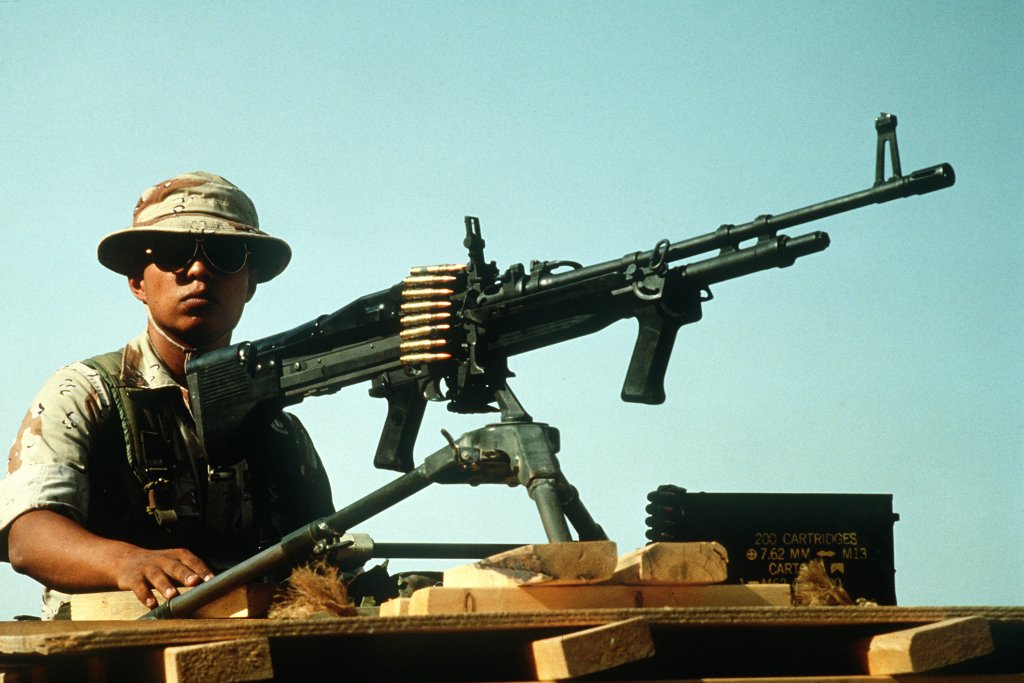
No serious history of the M60 should turn into either worship or abuse. The weapon was neither the flawless super-gun sometimes remembered by veterans who loved it nor the useless pile of loose sheet metal described by people who encountered worn-out examples decades later. It was an ambitious lightweight general-purpose machine gun developed in the 1950s, used extraordinarily hard in Vietnam, and left in service long enough for its weaknesses to become well understood.
The standard M60 used a stamped and riveted receiver construction that helped keep weight down. Over long service and high round counts, wear in the receiver and related parts could eventually affect reliability and alignment. Feed components and other operating parts also wore. Army and industry work over subsequent decades repeatedly strengthened or redesigned parts of the weapon, which by itself tells us that the original design had room for improvement.
The original barrel system also created unnecessary complexity. The front sight and other associated components were part of the barrel arrangement, and the early gun's bipod was associated with the barrel assembly. That meant a spare barrel was more than a simple steel tube and made changing barrels less elegant than it could have been. Chinn recorded that development of the M60E1 specifically sought to simplify barrel changing and reduce parts, showing that this was recognized while the weapon was still comparatively young.
Another criticism involved the accumulated condition of the fleet. A new M60 built to specification and maintained properly could be a very different weapon from one that had survived years of training, high round counts, worn parts, questionable rebuilds, and indifferent maintenance. By the 1980s and 1990s, some American troops were forming their opinions of the M60 from guns that were older than they were. It is hardly surprising that their experiences varied enormously.
The eventual Army decision to replace the M60 with the M240B was based on more than fashion. Procurement documents described the desired replacement as a more reliable, accurate, and lethal 7.62mm medium machine gun. The M240 was heavier than the M60, which was no small disadvantage to the men carrying it, but it possessed an exceptional reputation for durability and reliability. The Army accepted additional weight because it judged the overall weapon system superior.
The M60E3: Trying to Fix the Pig Without Killing It
The Marine Corps became an important user of the M60E3, a lighter and improved version intended to address weaknesses and make the gun easier to handle. The E3 incorporated changes to the barrel, bipod arrangement, foregrip, handling features, and other components. It was noticeably lighter and more comfortable for a mobile gunner, but reducing weight from a machine gun is never free. Less steel generally means less material available to absorb heat, and a lighter barrel becomes hot faster during sustained fire.
That tradeoff is the eternal problem of the infantry machine gun. The gunner wants a weapon weighing fifteen pounds while the fire-support problem would prefer a thirty-pound gun with a massive barrel. Engineers are then asked to violate physics politely. The M60E3 moved toward mobility and handling while maintaining the 7.62mm firepower that made the family valuable.
Marine tactical publications continued listing the M60E3 into the late 1990s, with an effective range around 1,000 meters, rapid rate of approximately 200 rounds per minute, sustained rate of about 100, and six- to eight-round bursts as the normal doctrinal firing pattern. The weapon remained recognizably an M60 while incorporating years of lessons from its predecessors.
M60E4 and the Mk43
The M60 family did not simply die when the conventional Army selected the M240. Special operations and other users still valued the combination of 7.62mm firepower and comparatively low weapon weight. Development therefore continued into the M60E4, also associated with the Mk43 designation in U.S. special-operations service.
The E4/Mk43 incorporated substantial improvements to parts that had caused trouble in earlier models, including the feed system, bipod, gas system, charging arrangement, sights, furniture, and other structural or ergonomic components. A defense small-arms presentation later described the M60E4/Mk43 as having addressed the previous M60 technical issues while retaining a lighter weight than the standard M240B. It was used by special-operations forces beginning in the 1990s.
This later history is important because it demolishes the lazy statement that “the M60 was bad, so everyone dumped it.” What actually happened was more complicated. Conventional American forces selected the extremely durable M240 for most medium-machine-gun roles, while improved M60 variants continued to appeal to users who placed a premium on lighter weight and mobility. Different missions produced different answers.
The M60E6: The Pig Refuses to Die
More than sixty years after the original M60 entered production, the design family is still being manufactured in substantially improved form. U.S. Ordnance currently produces the M60E6 and related M60 variants for approved government and military customers. The company describes more than twenty upgrades incorporated into the mature E6/Mk43 family and continues offering conversion systems capable of rebuilding earlier M60 receivers into modern configurations.
That is a remarkable lifespan for a weapon whose ancestors were being sketched when American soldiers were still examining captured German machine guns after World War II. The modern E6 is not the same M60 carried through a Vietnamese rice paddy in 1968 any more than a modernized military aircraft is identical to its first production model. Materials, machining, barrels, rails, furniture, feed components, gas-system details, and ergonomics have evolved substantially.
Modern M60D versions likewise remain commercially available for government and military users. U.S. Ordnance lists a cyclic rate of approximately 500 to 600 rounds per minute, maximum effective range around 1,100 meters, muzzle velocity of approximately 2,800 feet per second, and a weight a little over 24 pounds for its current M60D Enhanced. The basic numbers would be immediately recognizable to a Vietnam-era gunner even though the modern weapon incorporates rails, improved barrels, modern materials, and accessories that did not exist when Hueys were flying into the Central Highlands.
Few weapons illustrate continuity and evolution quite so neatly. The heart of the concept survived because a relatively light 7.62mm belt-fed machine gun remains useful. What changed were the details necessary to make that concept more durable, ergonomic, adaptable, and compatible with modern optics and accessories.
Why the M240 Won
The Belgian-designed FN MAG, adopted in American service through the M240 family, eventually displaced the M60 from most conventional U.S. military roles. The M240 had already proven itself as a vehicle-mounted weapon before the Army adopted the M240B for infantry use. Army procurement documents from the 1990s and 2000s are explicit that the M240B was intended to replace the M60 series across light and mechanized infantry, armor, combat engineers, Rangers, and other formations.
The M240's great advantage was durability and reliability. Its disadvantage was weight. The standard M240B was several pounds heavier than the old M60, and those pounds mattered immensely to infantrymen. Later Army programs therefore spent considerable effort creating lighter M240 variants, including the M240L. There is a certain mechanical irony in replacing a lighter gun with a heavier one because it is more durable and then spending years trying to remove weight from the replacement. Firearms development, like most human activity, occasionally completes a large circle while everyone involved produces paperwork explaining why it is progress.
The M60 nevertheless had already served through Vietnam, the Cold War, Grenada, Panama, and numerous other operations before replacement became widespread. It had spent decades doing exactly what had been demanded of it, even if another weapon eventually did the job better.
The Sound of the Gun
Veterans often remember weapons through senses that technical manuals cannot record. The weight of the gun against the shoulder, the smell of burned powder and lubricant, the heat coming from the barrel, the metallic movement of the belt, and the sound all become part of memory. The M60's relatively moderate cyclic rate produced a recognizable series of individual 7.62mm reports rather than the almost continuous ripping sound of an extremely high-rate gun.
In a firefight, that sound carried information. American troops could recognize when their machine gun was firing, where it was firing from, and sometimes whether the burst sounded healthy. If the M60 suddenly stopped during the wrong moment, men noticed. The gun was not merely creating noise. Its rhythm told soldiers that the base of fire was still functioning.
The enemy noticed it too. A burst from an M60 meant that an American position had considerably more automatic firepower than a rifle alone could provide. Multiple M60s firing across overlapping sectors could make movement extraordinarily dangerous. That psychological effect should not be confused with magic. Machine guns could be outflanked, suppressed, jam, run out of ammunition, or lose their crews like any other weapon. But when properly positioned and supplied, they controlled ground.
What Movies Got Right and Wrong
Popular culture turned the M60 into one of the visual symbols of Vietnam. Films frequently show a single soldier standing upright, holding the gun at waist or shoulder height, and firing enormous uninterrupted bursts while ammunition belts apparently reproduce when not observed. The M60 could indeed be fired from improvised positions and was sufficiently controllable that a strong gunner could fire it from the shoulder at close ranges. Photographs from Vietnam prove that men carried and sometimes used the weapon in ways no range instructor would choose as the ideal supported firing position.
What movies usually omit is everything that made the M60 effective over time. Somebody carried the ammunition. Somebody carried the spare barrel. Somebody watched the gunner's flank. Somebody helped identify targets. Someone had to clean the weapon afterward. Belts ended. Barrels became hot. Men became exhausted. The real M60 was far more dependent upon teamwork than the cinematic image of one indestructible gunner firing forever.
The M60 was therefore not the American equivalent of a magic wand. It was a crew-served machine gun whose effectiveness came from men understanding how to use it as part of a squad, platoon, aircraft crew, vehicle crew, or boat crew.
The Pig and the Human Cost of Firepower
There is an uncomfortable truth beneath all discussions of machine-gun performance. The M60 was designed to place large numbers of bullets into an area because doing so could kill people, suppress them, destroy equipment, or prevent them from fighting effectively. Its success as a weapon cannot be separated from the violence of the battlefield where it was used.
For the gunner, that could create its own burden. Unlike a rifleman who might fire only a handful of carefully aimed shots during an engagement, an M60 gunner could fire hundreds of rounds into a position. He might see the results closely, or he might never know exactly whom his fire had struck. Veterans remembered machine-gun fire differently depending upon the fight, the range, and what they witnessed afterward.
The weapon also placed the gunner near the center of violence. Enemy soldiers had every reason to identify and suppress the machine gun. Gunners were wounded and killed while trying to keep their weapons firing. Assistant gunners took over when they went down. Riflemen carried ammunition forward because a silent machine gun could endanger everyone.
This is why photographs of M60 gunners deserve more than admiration of the hardware. The gun may dominate the image because it is large and instantly recognizable, but the man carrying it was often nineteen, twenty, or twenty-one years old. The belt around his shoulders may have weighed almost as much as the weapon itself. He may have been carrying it into his first firefight or his fiftieth. The gun tells us something about the battle, but the face tells us whose battle it was.
 The M60's Place in Vietnam
The M60 became one of the defining American weapons of Vietnam because it appeared across almost every kind of battlefield. Infantry carried it through paddies and jungle. Rangers and reconnaissance teams carried it beyond conventional lines. Marines used it from hill positions and defensive perimeters. Armored cavalry mounted it on vehicles. Convoys placed it on escort trucks. Sailors and riverine forces carried it onto boats. Crew chiefs and door gunners fired M60Ds from Hueys. Experimental systems even adapted electrically fired versions for fixed helicopter armament.
Few American weapons touched so many different parts of the war.
It was imperfect. Its original design accumulated problems with age and hard use. Barrel changes were less elegant than they should have been. Parts wore. Maintenance mattered. Later variants were created precisely because there were things worth fixing, and the Army eventually chose the heavier but more durable M240 as its standard medium machine gun.
Yet none of those facts erase what the M60 accomplished. A weapon does not have to be mechanically perfect to become historically important. It has to be available, useful, and present when men need it. For hundreds of thousands of American servicemen, the M60 was all three.
Its reputation also cannot be understood purely through specifications. Twenty-three pounds, 7.62mm NATO, 550 rounds per minute, and a thousand-meter effective range are numbers. They do not explain why a rifleman carried another belt for the gunner even when his own load was already miserable. They do not explain why a Huey crew chief leaned out into the wind behind an M60 while his aircraft descended into a hot landing zone. They do not explain why a patrol suddenly felt considerably more exposed when the machine gun stopped firing.
Those things explain the weapon better than the data sheet does.
The M60 was called the Pig because men had to live with it. They carried it, fed it, fought with it, and occasionally fought with the gun itself when something went wrong. It was heavy enough to hate during a long movement and powerful enough to love when the first rounds came out of the tree line. That contradiction is probably the closest thing the nickname ever needed to an official definition.
Today, original M60s have become museum pieces, collector firearms, veterans' memories, and instantly recognizable artifacts of the Vietnam era. Improved descendants remain in production more than six decades after the first guns entered American service. The M240 may have replaced it in the conventional U.S. force, but it has never replaced the M60 in the visual and human memory of Vietnam.
The helicopter may have been the sound most associated with the war from above, and the M16 may have been the rifle carried by the greatest number of American infantrymen, but on the ground there was another sound that meant something very specific.
When the Pig started talking, everybody listened.