The M35 Deuce-and-a-Half: The Truck That Carried America’s Wars
It was never designed to be glamorous. For more than four decades, the M35 hauled troops, ammunition, food and fuel wherever the American military went. In Vietnam, some of its drivers discovered that simply delivering the war could mean fighting one.
August 26, 2026


Few military vehicles have worked harder while attracting less attention than the M35 2½-ton 6x6 cargo truck. Soldiers knew it simply as the “deuce-and-a-half,” a nickname inherited from the 2½-ton trucks that had hauled the American military through World War II. The M35 was not a tank, artillery piece or armored personnel carrier. It was a truck, which meant that almost everything those more celebrated machines needed eventually found its way onto the back of one.
From the Korean War through Vietnam, the Cold War and into the final years of the twentieth century, the M35 family carried troops, ammunition, food, water, fuel, communications equipment and almost every other imaginable military load. It could tow trailers, serve as a mobile workshop, become a tanker or dump truck, and, when circumstances became particularly unfriendly, be transformed into an improvised armored fighting vehicle. Its longevity came not from technological sophistication but from something armies value just as much: it was rugged, adaptable, relatively simple to maintain and capable of performing an extraordinary number of jobs.
Replacing the Trucks That Won World War II
The M35 belonged to a lineage that stretched back well before the Second World War. The U.S. Army had spent decades developing standardized cargo trucks capable of moving men and supplies away from established roads. By World War II, the 2½-ton 6x6 had become one of the logistical foundations of the American war effort, most famously represented by the GMC CCKW. Tens of thousands of those trucks carried supplies from ports and depots toward the fighting fronts, including along the famous Red Ball Express after the Normandy landings.
When the war ended, the Army possessed an enormous truck fleet, but much of it was based on designs created for an emergency that had begun years earlier. The service wanted a new generation of tactical vehicles incorporating lessons learned during the war while retaining the basic virtues that had made the 2½-ton truck so valuable.
In 1949, the REO Motor Car Company developed what became the new Army 2½-ton truck family. The first cargo configuration was designated the M34, which used single rear tires. It was soon followed by the M35, which used dual tires on both rear axles. That ten-wheel arrangement offered better load distribution and became the familiar configuration most people now associate with the postwar deuce-and-a-half. The U.S. Air Force's Museum of Aviation identifies the M35 as originating from REO's 1949 design and notes that the M34 was quickly superseded by the ten-wheel M35.
The M35 was part of the broader M44-series family rather than a single vehicle standing by itself. The basic chassis could be adapted for cargo carrying, fuel and water transport, maintenance work, dumping, tractor duties and other specialized missions. That commonality was one of the design's great advantages: a military that needed thousands of trucks could support numerous specialized vehicles without maintaining completely unrelated mechanical systems for every job.
Why “Deuce-and-a-Half”?
The nickname came directly from the truck's rated cross-country payload. The standard M35 cargo truck was designed to carry approximately 5,000 pounds, or 2½ tons, off road. On improved roads it could carry roughly twice that amount, approximately 10,000 pounds or five tons, although soldiers throughout its service life were not particularly famous for treating published payload ratings as sacred scripture.
The M35 used three driven axles, giving it its familiar 6x6 designation. Power was transmitted through a manual transmission and two-speed transfer case, allowing the truck to operate over unimproved roads and terrain that would stop ordinary commercial vehicles. Large ground clearance, robust suspension and military tires made it useful almost anywhere the Army could physically get a truck.
The cargo bed could carry supplies or be fitted with troop seats along its sides, allowing the same truck to move soldiers. Bows and a canvas cover could protect personnel or cargo from the weather. A front-mounted winch was available on many examples, giving crews another means of recovering vehicles when mud, snow or poor judgment overcame traction.
It was fundamentally a machine designed around utility rather than comfort. Drivers sat in a simple cab surrounded by little that could be described as luxurious, and early trucks offered the sort of ride quality that encouraged young soldiers to develop an intimate understanding of every pothole maintained by the United States government.
 From Gasoline to Multifuel
 From Gasoline to Multifuel
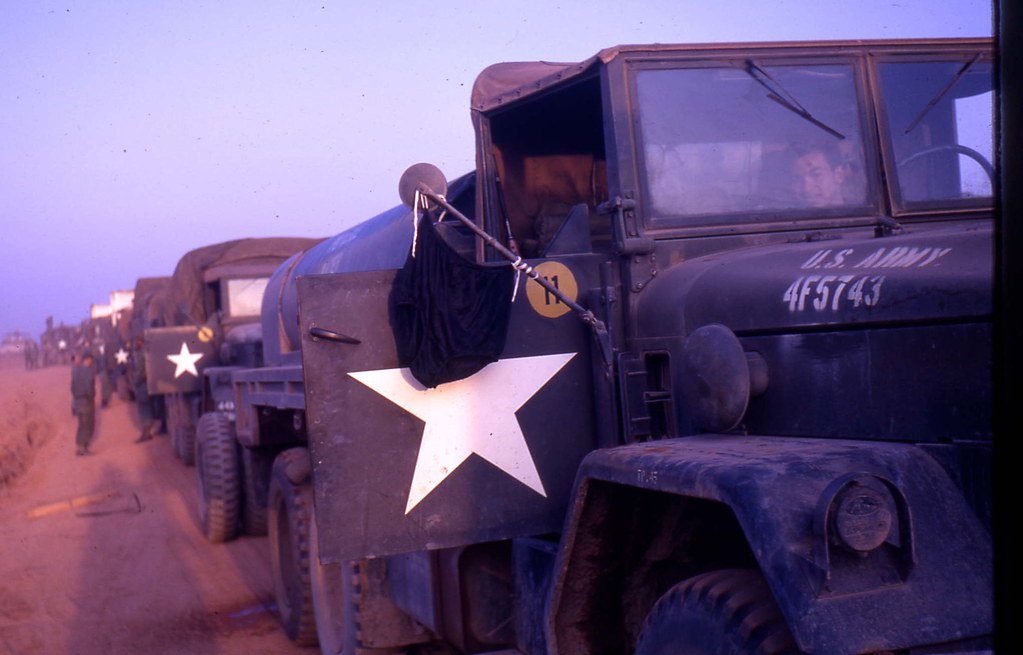
The earliest M35s were gasoline powered. Original trucks used six-cylinder engines such as the REO or Continental OA-331, but as the military moved toward diesel-type powerplants and greater fuel standardization, the truck changed with it.
The M35A1 represented an important transitional step. It used the Continental LDS-427 multifuel engine, part of an Army effort to field tactical vehicles capable of operating on several types of fuel when normal diesel supplies were unavailable. The concept offered obvious advantages to an army operating an enormous global logistics system, although early multifuel engines brought their own mechanical difficulties.
The version most closely associated with Vietnam and the later Cold War was the M35A2. The A2-series trucks used engines from the LD/LDT-465 family, six-cylinder, water-cooled multifuel engines of approximately 478 cubic inches. Later versions were turbocharged, although the turbocharger was used substantially to improve combustion and reduce exhaust smoke rather than turn the deuce into something likely to frighten a sports car.
The “multifuel” name has also produced decades of mythology. The engines were intended primarily to operate on diesel fuel but were designed with enough flexibility to use other approved fuels under appropriate conditions. That capability was valuable in wartime, but the popular notion that an M35 could routinely be filled with virtually any liquid that happened to burn and driven indefinitely is rather more folklore than maintenance doctrine.
With its distinctive engine sound, manual gearbox and enormous steering wheel, the M35A2 became one of the most recognizable American military trucks of the Vietnam era.
A Family of Trucks
Although “M35” is often used casually to describe almost any postwar American deuce-and-a-half with the familiar cab, the M44 family included numerous distinct vehicles. The M35A2 was the standard cargo truck, while the M35A2C incorporated drop sides that made loading and unloading easier. The M36A2 used an extra-long wheelbase and longer cargo body for increased capacity.
Other members of the family performed jobs far removed from ordinary cargo hauling. The M49 series carried fuel, while M50 variants served as water tankers. M109 and M185 trucks carried enclosed shop and repair bodies, effectively turning the chassis into mobile maintenance facilities. The M275 was a tractor designed to pull semitrailers, while the M342 was configured as a dump truck. Still other specialized versions supported pipeline work, engineering operations and communications.
This enormous variety explains why the basic truck appeared virtually everywhere in the American military. An infantry soldier might ride in one, an artillery unit might receive ammunition from another, engineers might work from a specialized version, and mechanics might repair equipment inside a shop van built on essentially the same family of chassis.
The M35 and its relatives were also produced over many years by different companies. REO originated the design, while Studebaker became an important producer. Kaiser-Jeep later took over military vehicle production connected with Studebaker's South Bend operations, and those operations ultimately became part of AM General. That complicated corporate lineage explains why surviving deuces bearing different manufacturers' data plates can nevertheless appear almost identical.
The Deuce Goes to Vietnam
The Vietnam War gave the M35 one of the largest and most demanding chapters of its service life. As American ground forces expanded dramatically beginning in 1965, the Transportation Corps had to create an enormous logistics system almost from scratch. Ports were expanded or constructed, depots appeared throughout the country, and truck units began moving vast quantities of supplies from coastal facilities and major bases toward American units scattered across South Vietnam.
The M35A2 was one of the basic tools used to accomplish that mission. For example, when the 87th Transportation Company deployed to Vietnam in 1966, Army Transportation Corps records note that it arrived with 66 brand-new multifuel M35A2 trucks. Across the country, similar light truck companies relied on the deuce to move cargo between ports, depots and combat bases.
Those routes could be punishing even without an enemy. Tropical heat, monsoon rain, dust and mud wore on vehicles while convoys often operated day after day. Trucks that returned from one mission could require maintenance overnight simply so they could leave again the next morning.
Then there was the problem of people trying to destroy them.
The Convoy War
Destroying supply trucks was an obvious way for North Vietnamese and Viet Cong forces to hurt American combat units without attacking heavily defended bases. Roads frequently passed through jungle, mountain passes, villages and rubber plantations that offered excellent concealment for ambush forces. Mines could halt a convoy, while automatic weapons and rocket-propelled grenades could then attack the trapped vehicles.
Truck drivers therefore occupied an uncomfortable position in the Vietnam War. They belonged to logistics units, but their daily work could carry them directly through territory where contact with the enemy was entirely possible. A driver's primary job might have been moving cargo, yet a rifle was never very far away.
The danger became impossible to ignore as enemy units began mounting increasingly large attacks against American convoys. In September 1967, a major ambush in the Qui Nhon area destroyed 27 trucks and killed or wounded many of their drivers. Transportation commanders recognized that relying entirely on infantry, armored units or helicopters for protection was no longer enough.
The truck companies began developing their own answer.
 When the M35 Became a Gun Truck
 When the M35 Became a Gun Truck
Some of the earliest convoy protection vehicles were M35 2½-ton trucks carrying M45 Quad .50 mounts, originally developed as antiaircraft weapons. Four synchronized .50-caliber machine guns could produce a tremendous volume of fire and were extremely effective against enemy troops attempting to close on a convoy.
The Quad .50 arrangement also had disadvantages. The system required a comparatively large crew, occupied substantial space and could not always engage targets at the angles needed during a road ambush. Transportation soldiers therefore began experimenting with more flexible homemade gun trucks.
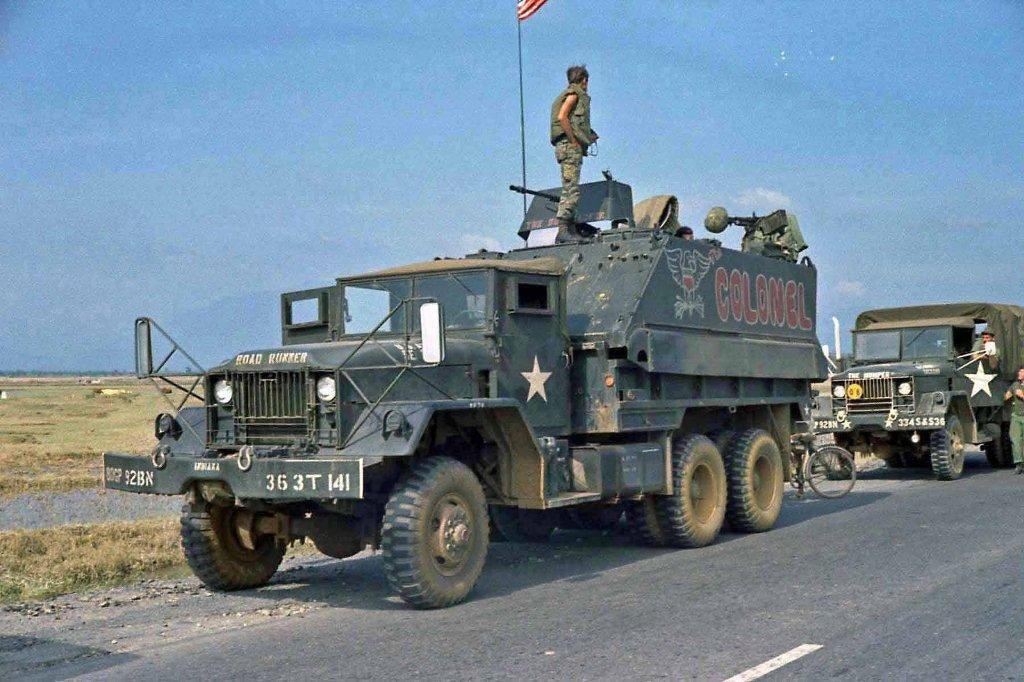
M35s were among the vehicles adapted for the role. Crews added steel armor plate or other protective material around the cargo bed and mounted M60 machine guns, .50-caliber machine guns and combinations of other weapons. The earliest examples often remained olive drab and looked relatively crude, because they were not produced according to some elegant Army master plan. They were built by soldiers solving an immediate problem with whatever could be obtained.
As the concept matured, the larger 5-ton trucks became preferred gun-truck platforms because they could carry heavier armor and armament. Some later vehicles even incorporated complete M113 armored personnel carrier hulls in their cargo beds. Nevertheless, 2½-ton M35s remained an important part of the gun-truck story, particularly during its early development.
The gun trucks also developed identities of their own. Crews painted names and elaborate artwork on their vehicles, including Brutus, Misfits, The Boss, Snoopy, Little Respect, Ball of Confusion, VC Undertaker, Big Kahuna and the most famous survivor of them all, Eve of Destruction. Many were eventually painted black, making them stand apart dramatically from the olive-drab cargo trucks they protected.
They were Transportation Corps vehicles that increasingly looked like something Mad Max might have designed after receiving a government procurement card.
Ap Nhi and the Men Behind the Trucks
The reason for those modifications becomes painfully obvious when looking at battles such as the August 25, 1968 ambush at Ap Nhi. An 81-truck American logistics convoy traveling along Route 22 toward Tay Ninh entered a carefully prepared ambush beside the Ben Cui Rubber Plantation. Fuel and ammunition trucks were struck, leaving much of the convoy trapped while enemy troops attacked from the rubber trees.
Many of the stranded Americans were transportation soldiers. With their vehicles immobilized, the drivers climbed down, took cover around their trucks and fought back with their personal weapons while waiting for reinforcements.
Among them was William Wayne Seay, a 19-year-old driver with the 62nd Transportation Company. Seay fought beside a trailer carrying high explosives, twice picked up enemy grenades and threw them back, continued firing after his right wrist was shattered and killed several enemy soldiers who had penetrated the American position. He was mortally wounded during the battle and posthumously awarded the Medal of Honor.
The Transportation Corps notes that two of its Medal of Honor recipients from Vietnam, William Seay and Larry Dahl, earned the decoration while fighting as truck soldiers. Their stories reveal something often missed when the Vietnam War is reduced to infantry patrols and helicopter assaults: getting supplies to the battlefield could itself become combat.
Hardening the Convoys
By 1968, the hardened-convoy concept was becoming increasingly sophisticated. Gun trucks were deliberately distributed throughout columns rather than always being placed at the front, making it more difficult for enemy ambush forces to identify and eliminate them during the opening moments of an attack. Ordinary cargo trucks also received improvised protection where possible.
Tactics evolved alongside the vehicles. Drivers learned to increase spacing, accelerate through kill zones when possible, return fire and avoid simply stopping when shooting began. Gun-truck crews trained specifically to race toward the heaviest fighting and bring concentrated machine-gun fire against enemy positions.
The results were significant. Army Transportation Corps histories record that after gun trucks and other hardened-convoy methods became widespread, large-scale ambushes became less successful and eventually less frequent along several important routes. A vehicle originally intended simply to move cargo had helped produce an entirely new form of convoy defense.
One gun truck was deliberately saved. In 1971, Captain Richard Voightritter arranged for Eve of Destruction to be shipped from Vietnam to the Transportation Museum at Fort Eustis. The heavily armored 5-ton truck had four .50-caliber machine guns and represented what crews considered one of the most advanced designs developed during the war. Its preservation meant that the improvised gun-truck story did not disappear when the last convoys left Vietnam.
 The M35 After Vietnam
 The M35 After Vietnam
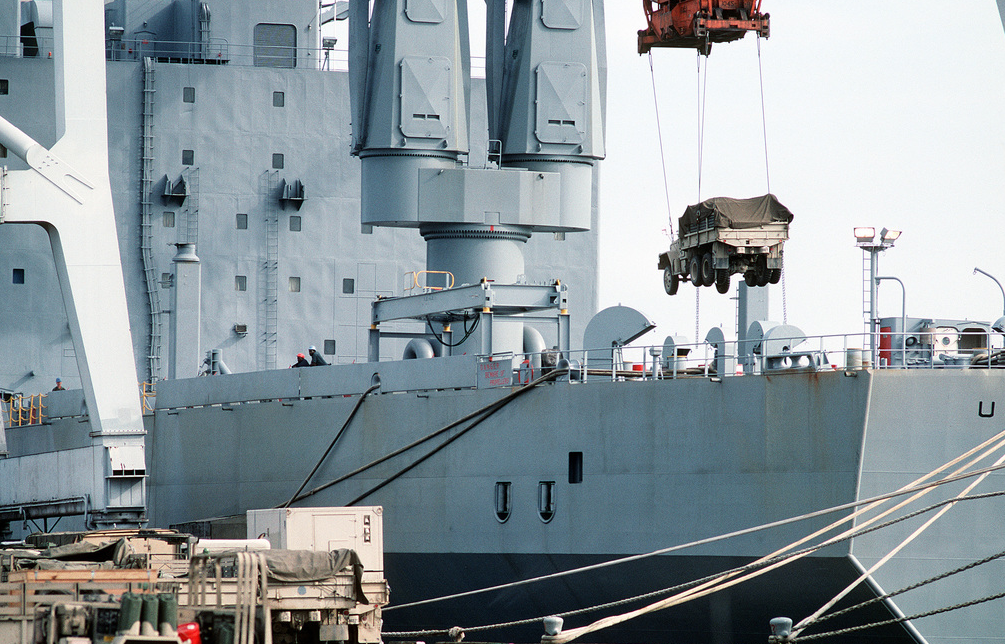
The end of American involvement in Vietnam did not end the M35's career. The trucks remained in service throughout the Cold War with the Army, Air Force, Marine Corps, National Guard and Reserve components. Thousands continued carrying personnel and equipment on American bases and during deployments around the world.
By then the basic design was undeniably old, but that was partly why it remained useful. The military had an enormous inventory of vehicles, spare parts and personnel familiar with maintaining them. For many routine missions, replacing every deuce simply because something newer existed would have been enormously expensive.
The Army therefore continued rebuilding and improving portions of the fleet even while developing replacements. The most extensive modernization produced the M35A3 during the 1990s. Rather than merely overhaul an old A2, the Extended Service Program substantially modernized the vehicle.
The M35A3 received a Caterpillar 3116 diesel engine, an Allison automatic transmission, power-assisted steering, improved brakes, radial “super single” tires and a central tire inflation system that allowed tire pressures to be adjusted for different terrain. Improved seating, heating, windshield equipment and other changes made the truck far easier to operate than the old manual-transmission A2.
The transformation demonstrated just how much service remained in the basic M35 architecture. A truck whose design origins reached back to 1949 could still be rebuilt into a useful tactical vehicle nearly half a century later.
The End of the Deuce
Eventually, however, there was only so much modernization that could reasonably be squeezed from a design created when Harry Truman was president.
In 1991, the Army awarded the first major production contract for the new Family of Medium Tactical Vehicles, or FMTV. The 2½-ton Light Medium Tactical Vehicle and larger 5-ton variants were intended to replace the aging M44-series deuces and older 5-ton truck fleets with vehicles offering improved mobility, reliability, maintainability and common components.
FMTVs entered large-scale Army service during the 1990s, and the M35 gradually disappeared from active units. The process took years because the American military possessed a huge number of legacy trucks spread throughout active, Guard and Reserve organizations. As late as 2010, Army planning documents were still calling for the complete divestiture of remaining M35 2½-ton trucks by the end of fiscal year 2011.
Even then, the deuce did not disappear. Thousands entered civilian hands through military surplus programs, while others went to fire departments, emergency agencies, foreign militaries, collectors and museums. Their simplicity and off-road ability made them particularly attractive for jobs where comfort and fuel economy ranked somewhere below “please start and get through that mud.”
More Than a Truck
The M35 lasted because it performed one of warfare's least glamorous and most important jobs. Armies consume astonishing quantities of material, and almost none of it matters if it cannot reach the men who need it. Trucks are the final link between the enormous logistical machinery behind an army and the soldiers at the front.
For decades, the deuce-and-a-half filled that role. It carried soldiers to training ranges and ammunition toward battlefields. It hauled food, water and fuel. It became a tanker, shop, dump truck, tractor and communications vehicle. In Vietnam, transportation soldiers bolted armor and machine guns onto it when the enemy began attacking the supply lines, turning an ordinary cargo truck into part of a uniquely American family of improvised fighting vehicles.
The M35 was never supposed to be the star of America's military vehicle fleet, and perhaps that is the point. It was designed to arrive, carry the load and do it again tomorrow.
For more than forty years, that was exactly what it did.
Sources
U.S. Air Force, Museum of Aviation / Robins Air Force Base, “What the Deuce? Museum of Aviation Procures M-35 Truck for New Display,” for the M35's REO origins, M34-to-M35 development and rated payload.
U.S. Army Transportation Museum, historical material on the development of the Army's 2½-ton truck and the role of the standard truck fleet in twentieth-century Army transportation.
U.S. Army Technical Manual TM 9-2320-361-10 and related M44-series technical documentation, for M35A2 family designations, roles and multifuel vehicle configurations.
U.S. Army Transportation Corps history of the 6th Transportation Battalion, documenting the 87th Transportation Company's deployment to Vietnam with 66 new multifuel M35A2 trucks.
U.S. Army Transportation Corps histories of the 27th, 36th and 39th Transportation Battalions, for convoy ambushes, development of gun trucks, M35 gun-truck configurations and the preservation of Eve of Destruction.
U.S. Army Transportation Corps historical overview and Transportation Museum Vietnam exhibit, for convoy operations, gun-truck development and Medal of Honor recipients William Seay and Larry Dahl.
U.S. Army Acquisition material on the Medium Truck Extended Service Program, for the rebuilt 2½-ton truck's Caterpillar 3116 engine, Allison automatic transmission, central tire inflation, steering, braking and other M35A3 improvements.
U.S. Army acquisition history of the Family of Medium Tactical Vehicles, for the 1991 production program and replacement of the M44-series 2½-ton fleet.
U.S. Army tactical wheeled vehicle fleet planning, for the planned final divestiture of remaining M35 vehicles by the end of FY2011.