The Last Torpedo: USS Pennsylvania and the Attack That Nearly Sank Her at the End of World War II
Three days before the fighting effectively ended, USS Pennsylvania was struck by a Japanese aerial torpedo at Buckner Bay, suffering catastrophic stern flooding, damaged propeller shafts, lost steering, and 20 dead.
August 13, 2026

By the evening of August 12, 1945, USS Pennsylvania had survived almost everything the Pacific War could throw at an old battleship. She had been under attack at Pearl Harbor on the first morning of the war, had fought through the Aleutians, the Marshalls, the Marianas, Peleliu, Leyte, Lingayen Gulf, and had stood in the battle line at Surigao Strait. She had fired thousands of shells in support of American troops advancing across the Pacific. Now the war appeared to be ending. Hiroshima had been struck on August 6, Nagasaki on August 9, and Japan was moving toward accepting the Allied surrender terms. Yet no cease-fire had been ordered. Japanese aircraft were still flying, American ships were still at general quarters when warnings came, and one Japanese torpedo bomber was about to give the old battleship perhaps the most dangerous wound of her entire career.
The timing made the attack particularly cruel. Pennsylvania had not arrived at Okinawa as an exhausted hulk limping toward retirement. She had just undergone one of the most extensive overhauls of her wartime career. Her main and secondary batteries had been regunned, additional close-range antiaircraft weapons installed, and her radar and fire-control equipment improved. After trials and refresher training, she left San Francisco on July 12, 1945, crossed the Pacific, bombarded Wake Island on August 1, replenished ammunition at Saipan, and continued toward Okinawa. She arrived at Buckner Bay on August 12 and became Vice Admiral Jesse B. Oldendorf's flagship for Task Force 95. She was twenty-nine years old, but she had effectively just come out of the shop ready for what planners still expected might become the invasion of Japan.
That makes what happened a few hours later all the more remarkable. The Navy had just spent months giving Pennsylvania new teeth. One torpedo was about to end her combat career.
The Old Battleship
USS Pennsylvania, BB-38, was the lead ship of a two-ship class, her sister being USS Arizona. Laid down at Newport News in October 1913 and commissioned on June 12, 1916, Pennsylvania belonged to the generation of American "Standard Type" battleships designed before the United States entered World War I. As completed she displaced roughly 31,400 tons, measured 608 feet long, and carried twelve 14-inch guns arranged in four triple turrets. Her designed speed was about 21 knots. In the battleship world of 1916, she was an enormously powerful capital ship. By 1945, carriers and fast battleships had transformed naval warfare, but twelve 14-inch rifles could still deliver an unpleasant amount of persuasion to anyone occupying a beach the Marines wanted.
Her wartime role increasingly became shore bombardment. That was not glamorous compared with carrier strikes or fast-battleship operations, but it was brutally useful. Old battleships could remain offshore and throw heavy shells into fortifications, troop concentrations, artillery positions, caves and transportation networks before and during amphibious assaults. The punishment wore out gun barrels, and by early 1945 Pennsylvania's batteries needed serious attention. She departed the combat zone and reached San Francisco in March, where Hunters Point undertook the major overhaul that regunned her primary and secondary batteries and updated her combat systems.
She therefore reached Buckner Bay in unusually good material condition for a ship nearing her thirtieth birthday. The irony is difficult to miss. Had the Japanese aircraft arrived several months earlier, it would have struck a battleship whose guns were worn from years of bombardment. Instead, it hit a ship freshly prepared for another campaign.
Buckner Bay, August 12, 1945
Buckner Bay, the Allied name for Nakagusuku Bay on Okinawa's southeastern coast, was crowded with American shipping. The island had only recently been secured after one of the bloodiest campaigns of the Pacific War, and the anchorage had become an enormous forward naval base. Yet proximity to Japan meant the danger of air attack had not disappeared. During the first half of August, Japanese aircraft continued attempting to reach American ships around Okinawa.
As dusk approached on August 12, intelligence indicated that an air attack might be coming. Ships began using chemical smoke generators to conceal themselves. Pennsylvania, however, lacked her own smoke-generating capability, so smaller craft maneuvered around her attempting to cover the battleship. The wind was uncooperative and repeatedly blew the smoke away. When the attacker finally arrived, according to the Naval History and Heritage Command's later account, the enormous gray battleship remained conspicuously exposed while much of the surrounding anchorage was obscured.
At approximately 2045, under a clear night sky, a Japanese aircraft came in extremely low. The official Commander in Chief, Pacific Fleet monthly report described the plane simply as an enemy aircraft that approached so low that it remained undetected until it was essentially upon the anchorage. The attack developed so rapidly that Pennsylvania's guns apparently never effectively engaged the attacker. The aircraft released a torpedo, and the weapon passed through the anchorage toward the battleship.
Contemporary American records generally describe the attacker only as a Japanese torpedo plane. Later research drawing on Japanese records has identified the aircraft as probably a Nakajima B6N2 Tenzan, Allied code name "Jill," associated with the 931st Naval Air Group. That identification is plausible and appears in specialist studies, but because the immediate American reports did not positively identify the aircraft, it is better treated as the probable identification rather than carved into stone as absolute fact.
The torpedo's aim was excellent.
It struck Pennsylvania well aft and deep below the waterline, beneath the area protected by the antitorpedo bulges that had been added during modernization. The explosion tore an opening reported by the Navy as approximately 30 feet in diameter near the propeller shafting. Unlike a hit amidships against the main torpedo-defense system, this was an attack on one of a battleship's most awkward and vulnerable areas: the stern, where multiple propeller shafts had to penetrate the hull and where steering machinery, shaft alleys and numerous compartments were packed into a narrowing structure.
In a few seconds the ship went from being a fully functioning battleship at anchor to fighting for survival.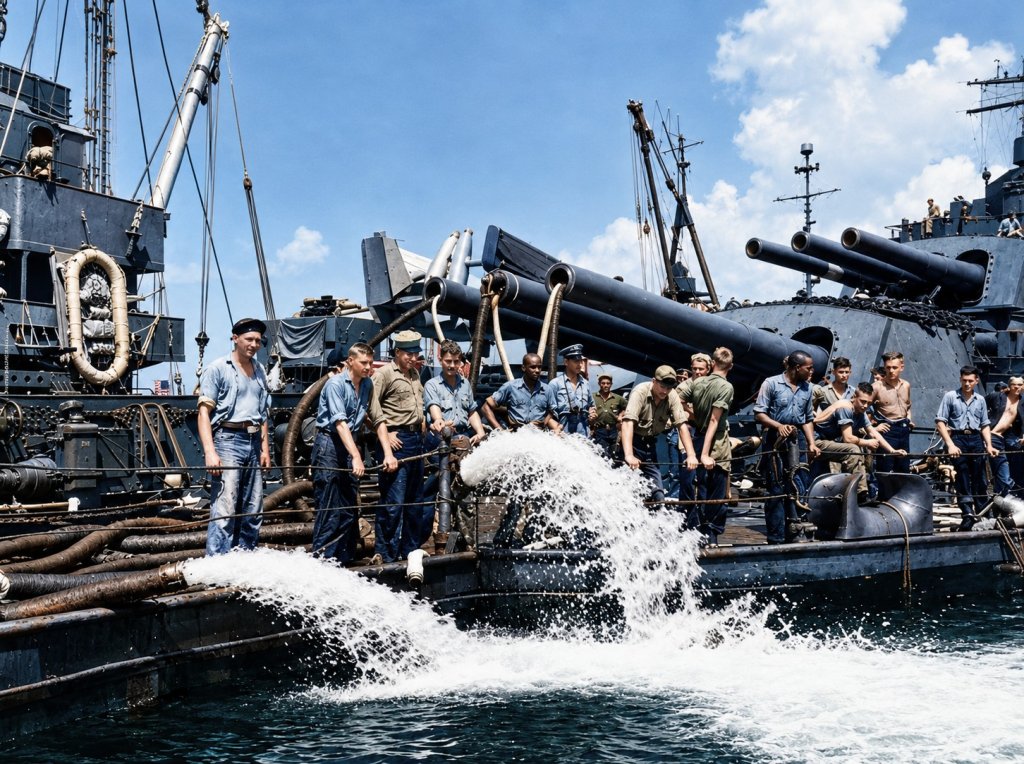
What the Torpedo Actually Did
The explosive damage to the hull was serious, but the truly dangerous part was what happened next. A later U.S. Navy war-damage analysis found that three propeller shafts were bent, steering was lost, and every compartment aft of frame 127 below the third deck flooded immediately. Frame 127 was around the after portion of the ship, meaning a huge volume of the hull behind the aft main-battery turret suddenly became open to the sea.
The hit also demonstrated why watertight discipline mattered so much aboard a warship. The torpedo had opened the hull, but water did not politely remain inside the spaces directly damaged by the explosion. It moved forward through open watertight doors and hatches. The Bureau of Ships analysis later specifically cited Pennsylvania as an example of flooding becoming much more dangerous because watertight integrity had been compromised. The ship began settling sharply by the stern.
This was not merely an inconvenient list or several flooded storerooms. The Navy's later technical analysis of battleship torpedo damage specifically noted that Pennsylvania's low freeboard aft and severe trim by the stern very nearly proved fatal. As the stern sank deeper, openings that had originally been safely above the waterline moved closer to the surface. Increasing trim also placed additional pressure on damaged boundaries and made controlling progressive flooding more difficult. A ship can survive an enormous hole if flooding remains localized. Once water begins migrating through the hull faster than pumps can remove it, survival becomes a race measured in minutes and feet.
The torpedo also crippled the very machinery that might have allowed Pennsylvania to maneuver out of danger. Steering was gone and her shafting had been badly distorted. Even if the battleship had been at sea rather than anchored, her ability to make useful speed would have been drastically reduced. The war-damage assessment later described her as having come frighteningly close to being lost.
Twenty men were ultimately killed and ten injured. Vice Admiral Oldendorf, aboard because Pennsylvania had just become his flagship, suffered several broken ribs. He had already survived an extraordinary series of wartime accidents and attacks, including kamikaze action and a March 1945 barge collision that had broken his collarbone. Apparently the Pacific had decided he had enjoyed sufficient skeletal integrity.
A diary aboard nearby USS Colorado captured how uncertain the first reports were. The entry recorded, "At about 2100 tonight the Pennsy was hit by an aerial torpedo," followed by a preliminary casualty estimate much lower than the final count. Like so many combat reports written while events were still unfolding, the numbers changed as flooded compartments were entered, wounded men were located, and missing sailors were accounted for.
 Fighting to Keep the Stern Above Water
The crew's immediate problem was straightforward to describe and exceptionally difficult to solve: stop enough water entering the ship to keep her afloat.
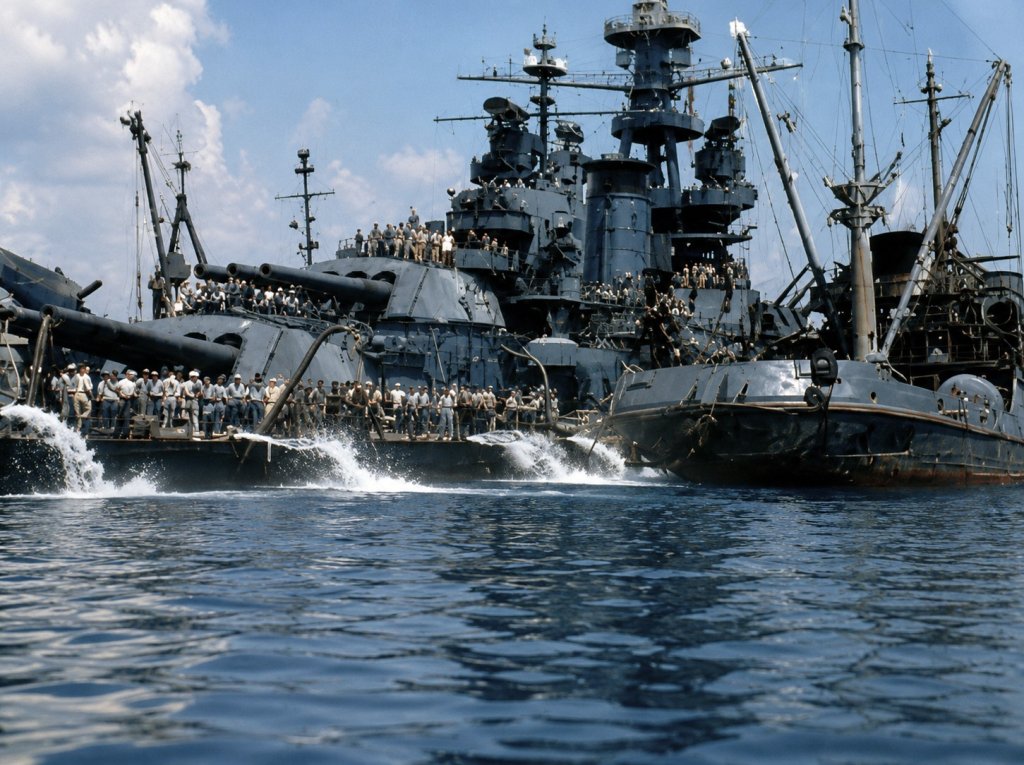
Pennsylvania's repair parties isolated spaces, closed boundaries, shored damaged structures and began pumping. Outside help arrived quickly. Salvage vessels and tugs moved alongside, adding pumps and manpower to the battle against the flooding. Official Navy history credited both the battleship's own repair parties and the prompt assistance of salvage tugs with bringing the flooding under control.
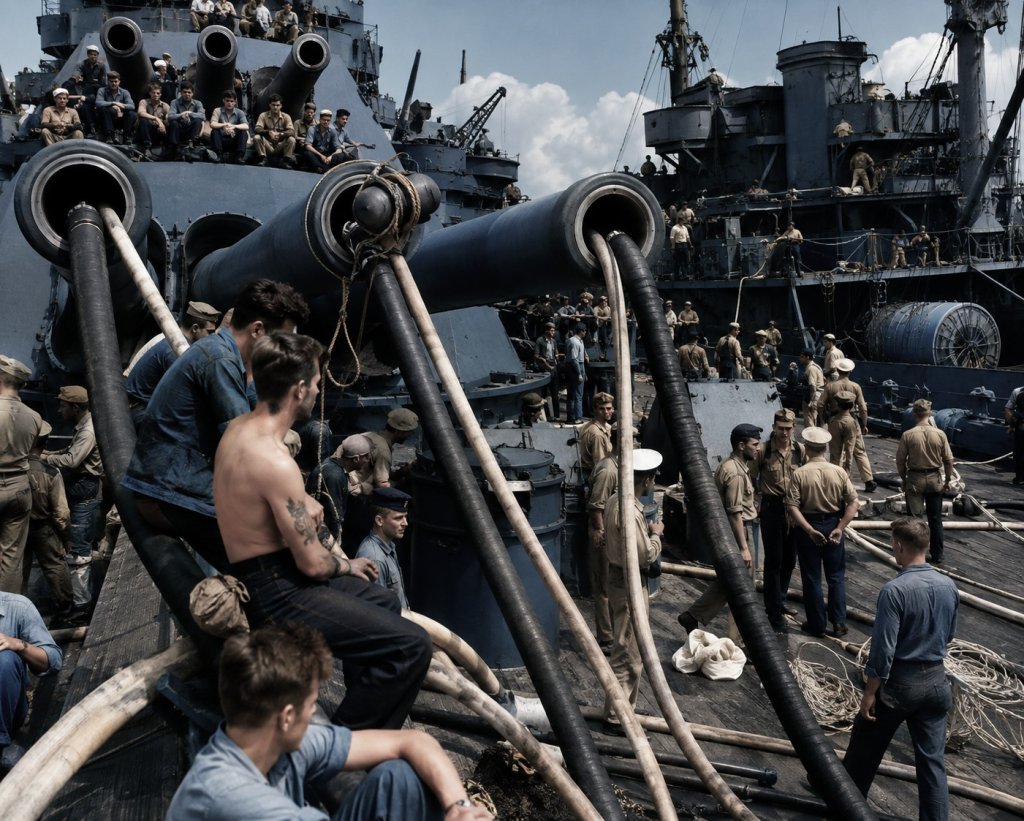
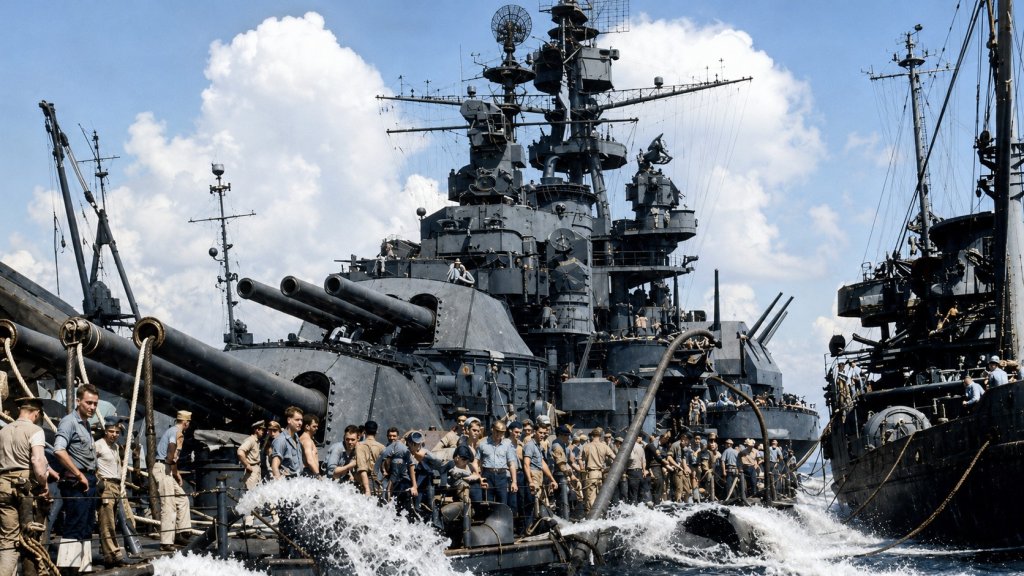
The photographs taken afterward tell the story better than almost any written description. Pennsylvania sits visibly down by the stern while water pours from hoses laid across her decks. Some pumping hoses were actually led out through the barrels of the after 14-inch turret, turning guns built to throw 1,400-pound projectiles miles inland into convenient conduits for water being pumped from inside the wounded ship. Salvage ships clustered around her stern while crews worked continuously.
By the morning of August 13, the immediate emergency had eased enough for the battleship to be moved into shallower water, where salvage work could continue with less risk that an unexpected failure would send her into deep water. Naval History and Heritage Command's assessment is unusually direct: had Pennsylvania not been moved into shallow water, she might very well have sunk.
The distinction matters. Sometimes the survival of a battleship is attributed vaguely to massive armor or legendary construction. Armor did not save Pennsylvania's stern. Damage control did. Pumps, compartment boundaries, repair parties, salvage crews and the availability of shallow water kept the ship from becoming the only U.S. battleship sunk by enemy action after Pearl Harbor.
And the war still was not technically over.
The following evening, August 13, Japanese kamikazes struck the attack transport USS La Grange in the same anchorage, killing 21 men and wounding 89. Japan did not accept the Potsdam terms until August 14, with the cease-fire following. The torpedoing of Pennsylvania was therefore not some bizarre postwar accident. Men were still dying because World War II was still in progress.
 How Badly Was Pennsylvania Hurt?
The answer is: badly enough that her combat career was over, but not badly enough that the hull was beyond saving.
Structurally, the torpedo did not break the battleship's back or destroy her main armored citadel. The main battery remained aboard, magazines did not explode, and the machinery spaces forward of the hit were not obliterated. The critical damage was concentrated in the stern and shafting. Three shafts had been affected, steering was lost, and the afterbody had suffered massive flooding. The problem was less that the entire ship had been destroyed than that a relatively localized explosion had disabled several systems essential to keeping a 600-foot battleship mobile and controllable.
That distinction explains why she could ultimately be moved and repaired enough to travel, while simultaneously explaining why the Navy never returned her to fighting condition. Repairing a battleship stern properly would have meant much more than putting a plate over the hole. Damaged shell plating would need replacement, internal structure rebuilt, shaft alignment restored with extraordinary precision, stern tubes and bearings repaired or replaced, steering machinery inspected and reconstructed, damaged piping and electrical runs renewed, and watertight integrity thoroughly restored.
By August 1945 there was no longer any military reason to invest that level of labor into a battleship commissioned in 1916.
 The Long Tow to Guam
On August 18, six days after the attack, Pennsylvania left Buckner Bay under tow. She could not simply start her engines and sail away. The damaged battleship required ocean tugs to drag her across the western Pacific to a facility capable of putting the entire hull out of the water. She did not reach Apra Harbor, Guam, until September 6.
That nearly three-week tow is an important part of the story because it illustrates the difference between "saved" and "repaired." She was afloat, but she was still a casualty. Her stern had been patched and stabilized enough to survive ocean movement under tow, not restored to normal service.
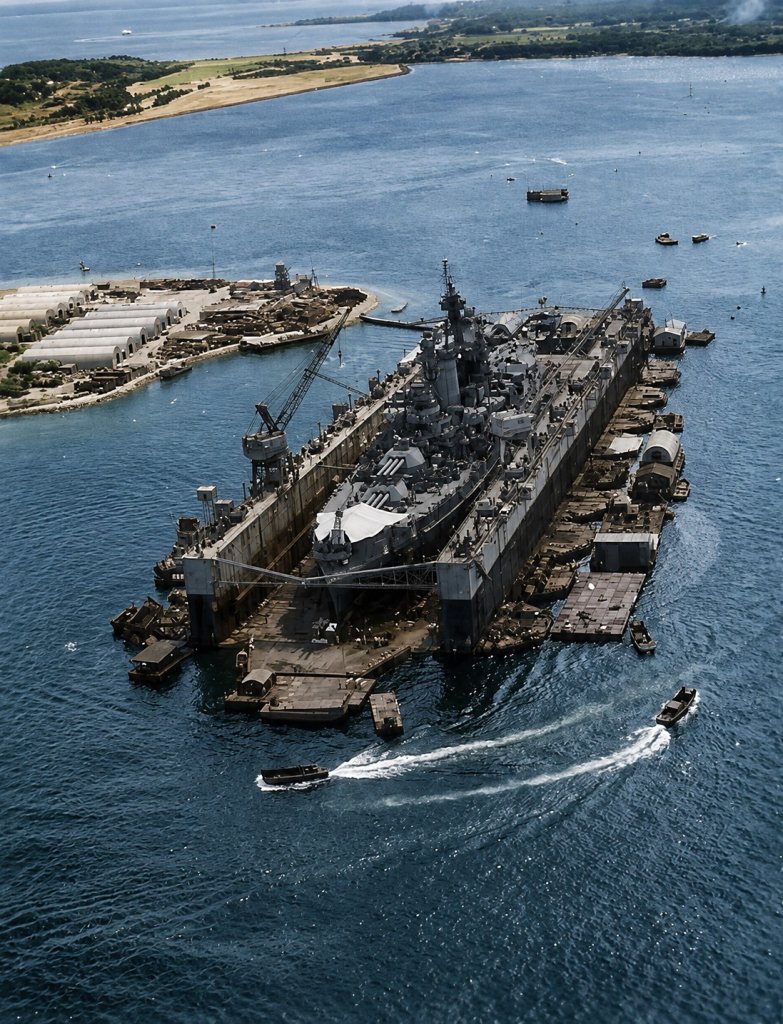
At Guam she entered a large Advanced Base Sectional Dock, one of the extraordinary floating drydock systems the Navy had moved into forward areas. Once the water was pumped out and the damaged area exposed, workers could finally reach the enormous wound properly.
What they did was deliberately limited.
Official Navy history states that workers welded a large sheet-steel patch over the torpedo hole and completed repairs intended to allow the battleship to return to the continental United States under her own power. That wording is important. Guam did not rebuild her stern to full combat specification. It made her seaworthy enough to go home.
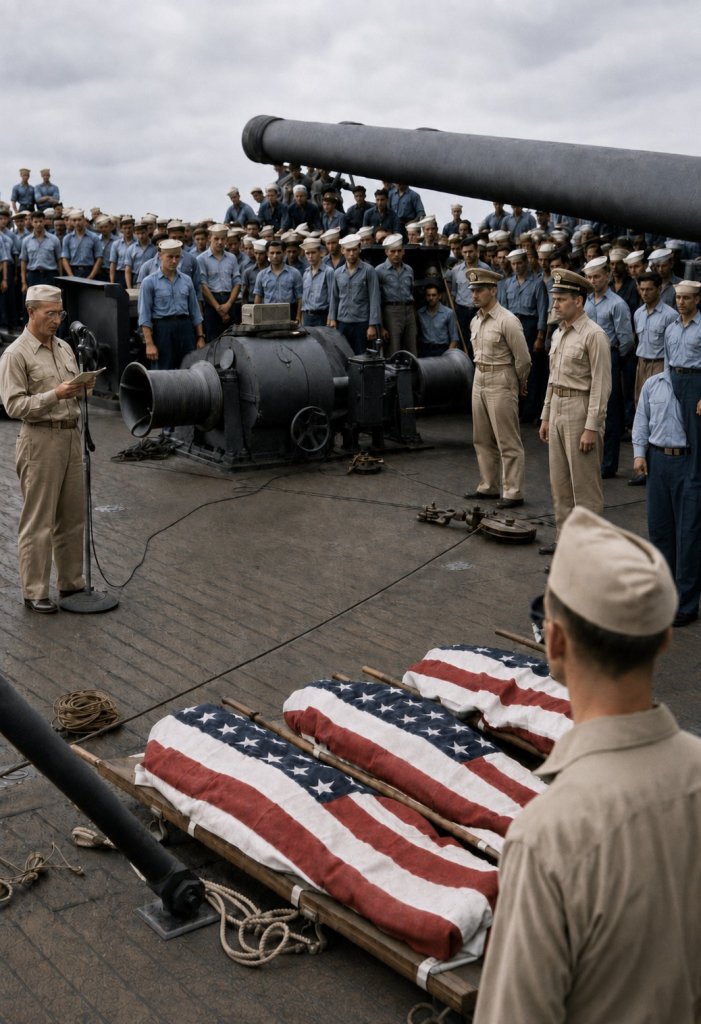
Photographs of Pennsylvania in the floating drydock show the scale of the operation. One particularly somber image also shows coffins containing men killed in the August 12 attack on a nearby barge while the damaged battleship sat in dock. Behind every engineering discussion of shafts, plates and flooding were twenty men who were not making the voyage home.
 The Patch Was Not a Repair in the Normal Sense
On October 4, Pennsylvania departed Guam for the Puget Sound Navy Yard, accompanied by USS Walke and USS Atlanta. She was once again moving under her own power, which at first glance might suggest that the repairs had restored her reasonably well.
Thirteen days later, the Pacific demonstrated otherwise.
On October 17, the battleship's No. 3 shaft failed inside the stern tube and began sliding aft. This was an enormously serious mechanical casualty. A battleship propeller shaft was not a convenient little rod that somebody could pull out with a wrench. It ran through carefully aligned bearings and stern-tube structures and terminated in a massive propeller outside the hull. A damaged shaft moving where it should not could tear open seals and create another flooding path directly through the stern.
Divers went over the side.
The decision was made to cut the damaged shaft and let the outer section and its propeller fall into the Pacific. Once it had been sacrificed, Pennsylvania was left taking water and able to turn only one screw. She nevertheless continued toward the United States, finally reaching Puget Sound Navy Yard on October 24.
That episode tells us more about the true condition of the battleship after Guam than simply calling the work "temporary repairs." The patch kept the Pacific Ocean outside the hull well enough for her to travel. It did not undo the torpedo's distortion of the stern and propulsion system.
What Puget Sound Actually Repaired
This is where the story is often oversimplified. Some accounts say Pennsylvania went home "for repairs," which can create the impression that the Navy rebuilt her and then decided to retire her afterward.
That is not what happened.
By the time she reached Puget Sound, Japan had surrendered and the Navy possessed newer, faster and more capable battleships in abundance. Restoring a nearly thirty-year-old ship with a severely damaged stern to full fighting condition made little sense. Instead, Pennsylvania was selected for Operation Crossroads, the 1946 atomic bomb tests at Bikini Atoll. Repairs were therefore limited to making her sufficiently sound to reach the test site and survive as an instrumented target.
The Bureau of Ships' own internal history is unusually revealing. It described the torpedo repair as a "crude repair" and stated that the damaged area remained a weak spot in the strength of the hull. Puget Sound Naval Shipyard was instructed to examine the area, reinforce it where necessary, and tighten the watertight boundaries around the torpedo-damaged section. That is about as definitive an answer as we can get regarding how thoroughly Pennsylvania was repaired. She was not restored to her August 11, 1945 condition. She was stabilized.
That also means photographs of her at Bikini can be deceptive. From a distance she still looked like an imposing battleship: twelve 14-inch guns, towering superstructure, massive hull and the unmistakable silhouette of a veteran American battlewagon. Underneath the paint, however, the afterbody still carried a structurally compromised region from the Japanese torpedo. The Navy knew it and specifically accounted for it when preparing the ship for the atomic tests.
From Japanese Torpedo to Atomic Bomb
In July 1946, Pennsylvania joined the extraordinary collection of American, Japanese and German vessels assembled at Bikini Atoll for Operation Crossroads. Among the target fleet were battleships USS Nevada, USS New York, USS Arkansas, the captured Japanese battleship Nagato, the German cruiser Prinz Eugen, carriers, cruisers, destroyers, submarines, landing ships and transports. Pennsylvania was there because the Navy had no intention of returning her to normal service.
She survived both nuclear detonations.
The first, Test Able, was an airburst on July 1, 1946. The second, Test Baker, detonated underwater on July 25 and created an entirely different problem. Although Pennsylvania survived structurally, radioactive contamination from the underwater explosion made many target ships exceedingly difficult to handle safely. Naval History and Heritage Command records that Pennsylvania suffered comparatively little direct fire damage but became heavily contaminated.
She was subsequently taken to Kwajalein, where the Navy used her for radiological and structural studies. She was formally decommissioned on August 29, 1946. The battleship that had survived a bomb at Pearl Harbor, a torpedo at Okinawa and two atomic-bomb tests was still refusing to sink on anyone's preferred schedule.
Finally, on February 10, 1948, she was towed into deep water off Kwajalein and deliberately sunk. She was removed from the Navy list nine days later.
The First Day and Almost the Last
There is an extraordinary symmetry to Pennsylvania's World War II history. On December 7, 1941, she was in Dry Dock No. 1 at Pearl Harbor when Japanese aircraft attacked. Her sister Arizona, only a short distance away, was destroyed with catastrophic loss of life. Pennsylvania was hit by a bomb and damaged but survived largely because she sat inside a drydock where torpedoes could not reach her.
Three years, eight months and five days later, a Japanese torpedo finally found her.
This time there was no drydock beneath the hull and no concrete wall between the battleship and an incoming weapon. The torpedo struck almost exactly where a battleship least wanted to be hit, deep in the stern around the shafting, below much of the protective system that had been added during modernization. It blew open a thirty-foot wound, disabled steering, damaged three shafts and flooded virtually everything below the third deck aft of frame 127. Water then moved forward through open boundaries while the stern sank lower and lower. The Bureau of Ships later used Pennsylvania as an example of how dangerous excessive stern trim could become.
Yet she stayed afloat.
She stayed afloat because sailors below decks fought flooding they could not see the source of, because repair parties closed boundaries and shored bulkheads, because pumps ran continuously, because salvage crews came alongside, and because tugs could move her toward water shallow enough to give everyone another margin of survival. The huge armor belt and fourteen-inch guns are what people usually notice in photographs of a battleship. On the night of August 12, none of that mattered as much as pumps, valves, hatches, hoses and men who understood the ship beneath their feet.
The Japanese attack did not technically destroy USS Pennsylvania. It did something almost as consequential: it ended her career as a fighting battleship. Guam covered the wound and restored enough machinery for her to travel. When one of those damaged shafts failed on the way home, divers cut it loose and threw a propeller and shaft section into the Pacific so the ship could keep moving. Puget Sound did not rebuild her. The Navy's own Bureau of Ships characterized the surviving torpedo repair as crude and the stern as a structural weak point. From that moment forward, she was being kept alive not to fight again but to become a test subject.
There is something fitting, if rather merciless, about the final years of the old ship. Pennsylvania had been designed before World War I, commissioned in 1916, attacked on the first morning of America's war against Japan, modernized repeatedly, and used to batter enemy positions across the Pacific. Three days before the fighting stopped, a lone aircraft nearly sent her to the bottom. The Navy patched her together, she crossed the ocean wounded, lost another shaft along the way, survived two atomic explosions, endured years of radiological study and still had to be deliberately sunk.
For a ship that had spent almost thirty-two years refusing to go quietly, that seems about right.