The Flight Back to Vietnam: The 1965 KC-130F Crash at Kai Tak That Killed 59
They had been given a few days away from the war. On August 24, 1965, 71 American servicemen boarded a Marine Corps KC-130F in Hong Kong for the flight back to South Vietnam. Fifty-nine of them would never arrive.
August 24, 2026

For the Marines and sailors fighting in Vietnam in 1965, rest and recuperation meant a brief escape from a war that was rapidly growing around them. A few precious days might be spent in Hong Kong, Bangkok, the Philippines, or another destination outside the combat zone before military transportation carried them back to their units. For the men gathering at Hong Kong's Kai Tak Airport on the morning of August 24, their leave was over. Vietnam was waiting.
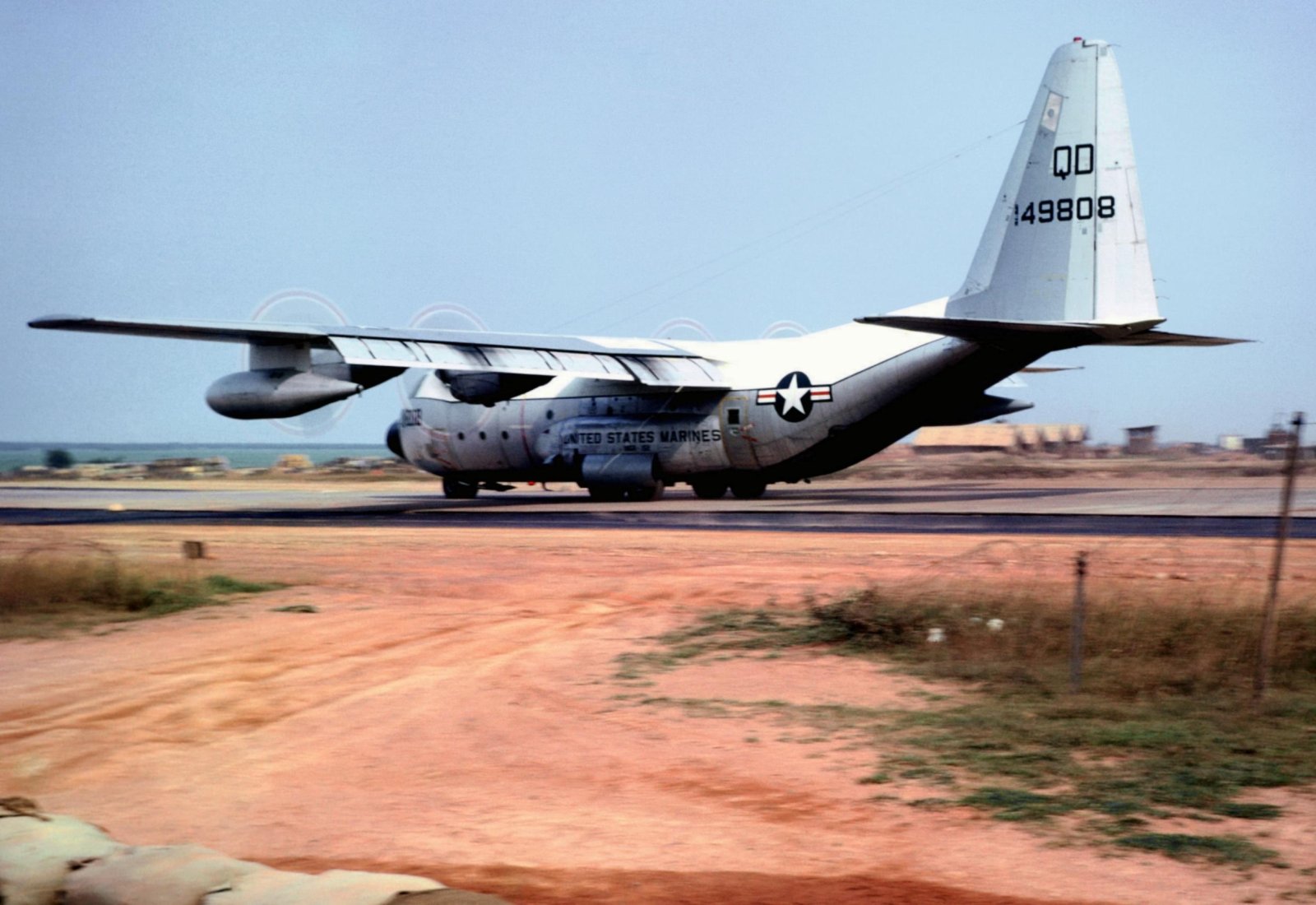
Their aircraft was Lockheed KC-130F Hercules Bureau Number 149802, assigned to Marine Aerial Refueler Transport Squadron 152, VMGR-152. Although the KC-130 was best known as an aerial refueler and transport, that morning its job was painfully ordinary: carry American servicemen from Hong Kong back to the war. The planned route would take the Hercules first to Da Nang and then onward to Saigon. Six crewmen and 65 passengers were aboard, 71 men in all.
Most of the passengers were Marines. Several were Navy personnel serving alongside them. Some were experienced career servicemen. Many were barely out of high school. They had survived Vietnam long enough to earn a few days away from it and were now doing something thousands of other servicemen did during the war: going back.
They never made it.
Trouble During the Takeoff
At approximately 10:10 a.m., KC-130F 149802 began its takeoff from Runway 13 at Kai Tak. The old Hong Kong airport would later become famous for its demanding approaches, squeezed between mountains, crowded neighborhoods and water. In 1965, the end of the runway also left little room for a heavily loaded Hercules suffering a serious problem at the moment when speed and engine power mattered most.
According to a reconstruction preserved by the Bureau of Aircraft Accidents Archives, during the takeoff roll the flight engineer reported a loss of pressure associated with the No. 1 engine and called for the takeoff to be abandoned. The copilot, seated in the left seat, began reducing power while the aircraft commander in the right seat continued the rotation for takeoff. Whatever happened during those few seconds in the cockpit, the result was disastrous. The Hercules became airborne with inadequate and uneven thrust.
Later accounts describe the No. 1 engine and propeller as producing only limited useful power, with some summaries stating that the propeller had reversed. The exact technical sequence is less certain than some modern retellings make it sound. The accident summary itself notes that the precise cause of the No. 1 engine problem could not be established. What is consistent across the surviving accounts is that 149802 was attempting to climb with a serious power problem on its left side and with the crew no longer acting in concert at the most critical moment of the flight.
The aircraft struggled upward to roughly 100 feet.
Then it began rolling left.
The Wing Hit the Seawall
There was almost no altitude available for recovery.
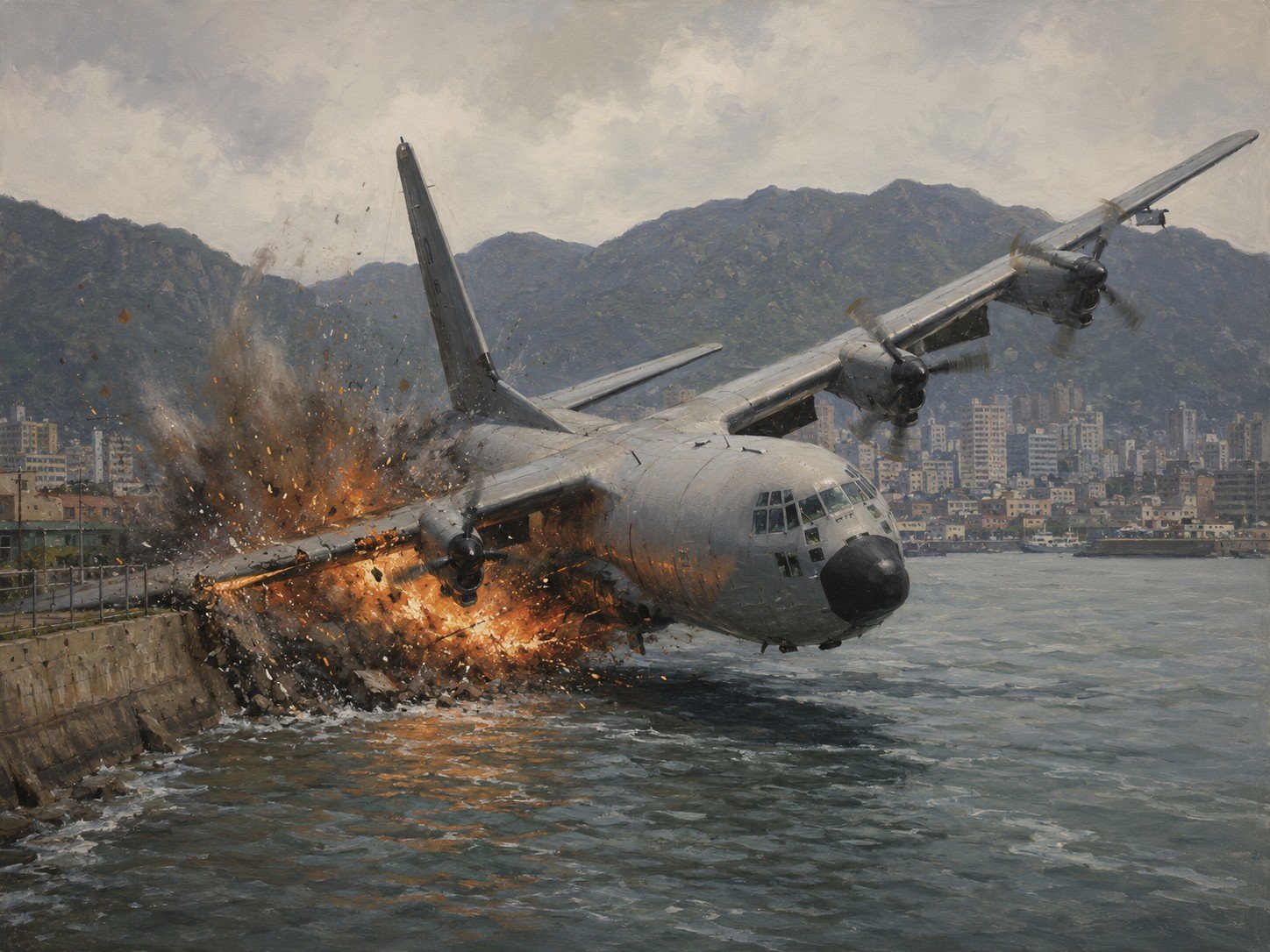
The lumbering Hercules continued left toward the edge of the airport. Its port wingtip struck a seawall approximately two meters high. Later accounts describe fire erupting as the wing tore into the barrier. The aircraft continued for only a short distance, roughly 250 meters according to one accident reconstruction, before plunging into Kowloon Bay.
The impact shattered the aircraft.
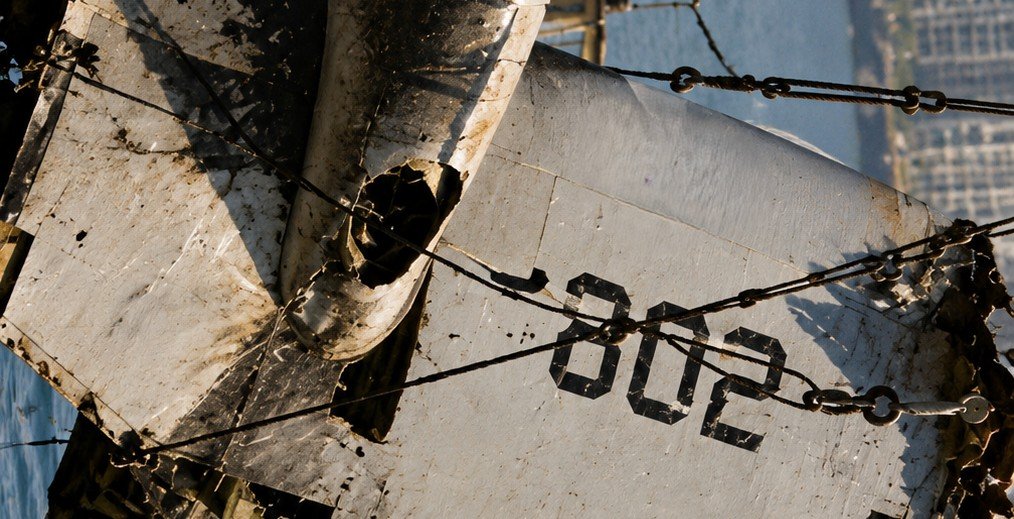
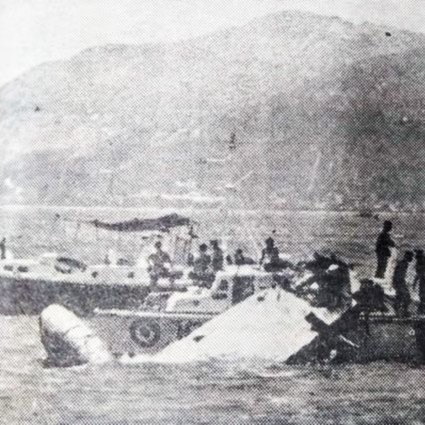
Photographs taken afterward show sections of the Hercules scattered in the water and being recovered from the bay. In one of the most haunting images, a large piece of the vertical tail is lifted from the water. The last four digits of the aircraft's Bureau Number, 9802, remain plainly visible.
The men aboard had left Hong Kong expecting that, within hours, they would again be in South Vietnam.
Instead, rescuers were suddenly searching the waters beside Kai Tak.
Thirteen Men Were Still Alive
Remarkably, there were survivors.
Marine records identify four surviving members of the flight crew: Capt. C. F. Simerly, 1stLt. P. C. Cranston, SSgt. C. J. McQueen and SSgt. Ernie Howe. The same record specifically notes that Howe rescued McQueen from the wrecked aircraft. Only two members of the six-man crew were ultimately lost: Sgt. Gordon H. Blexrude and Cpl. Jerry L. Gerry. In all, 13 men initially survived the disaster. That number would not hold. One of the injured passengers, PFC George A. Bell Jr., remained alive for six more days. Department of Defense casualty records give his date of death as August 30, 1965. Bell was only 18 years old. His death raised the final toll to 59 dead and 12 survivors. That detail helps explain why accounts of the disaster can appear confusing. Contemporary casualty reporting began with 13 survivors. The final historical count is 12. The Work After the Crash For the Marine Corps, the catastrophe did not end when the wreckage stopped burning. The August 1965 command chronology records a grim process of recovery and identification. The 1st Marine Aircraft Wing personnel officer traveled to Hong Kong that same afternoon to help handle the casualties. By approximately 2:20 on the morning of August 25, only seven bodies had been positively identified. Identification of the others proved difficult enough that remains were transferred from Hong Kong to Clark Air Base in the Philippines. Thirty-three were moved to Clark on August 26, another 23 on August 27, and the final two recovered remains on August 31. Bell, who had died on August 30 after initially surviving the crash, was also transferred to Clark on August 31. The first of the remains began the journey home to the United States on September 2. Behind those sterile numbers were families receiving notifications from the military, hometowns learning that sons and husbands would not be returning, and units in Vietnam discovering that men expected back from leave were never coming through the door. There had been no enemy fire. No ambush. No artillery barrage. No battle at all. They were simply returning to one. What Caused the Crash? The broad outline is clear, although surviving sources do not agree on every technical detail. The No. 1 engine or propeller system was not developing normal forward power during the takeoff. One accident reconstruction states that the engine itself had been changed approximately two weeks before the crash, although its propeller had not. It attributes the loss primarily to a partial loss of No. 1 engine power combined with a breakdown in crew coordination, with the copilot's limited experience and decisions by the aircraft commander contributing to the accident. Other later histories go further, describing the No. 1 propeller as reversed and stating that the aircraft commander disregarded standard operating procedure by continuing the takeoff. Because the surviving summaries differ in their wording and level of certainty, it is safer not to pretend that every second inside the cockpit can now be reconstructed perfectly. What cannot be disputed is the outcome: an already compromised Hercules left the ground with asymmetric power, rolled left, struck the seawall and crashed into Kowloon Bay. The loss of 149802 was also a milestone nobody in Marine aviation wanted. It is recorded as the first Hercules hull loss in Marine Corps service. The Men Behind the Number History has a habit of compressing disasters. 71 aboard. 12 survived. 59 dead. Three numbers can replace an airplane full of people remarkably quickly. But the casualty records tell a different story when their birth dates are placed beside their names. Six of the men who died were 18 years old. Ten were 19. Fifteen were 20. Eleven were 21. Forty-two of the 59 had not yet reached their 22nd birthday, and 51 were 23 or younger. The average age of the men lost was only a little over 21. PFC Terry A. Chase was 18. His nineteenth birthday would have been the next day. The oldest man aboard to lose his life was SSgt. Kelly K. Heinze, 37. The statistics suddenly become considerably less abstract. The names below were checked against the Vietnam Veterans Memorial Fund casualty roll and Department of Defense casualty information preserved by the National Archives. Ages were calculated from the recorded dates of birth and casualty. Where secondary indexes disagree, the National Archives' Defense Casualty Analysis System records were given precedence. That matters in cases such as James B. O'Kane, Robert M. Lathrope, Richard Smith and Ronald L. Wafford, for whom errors or conflicting information appear in some online memorial indexes. On August 24, 1965, these men were not supposed to become a casualty list. They were supposed to land in Vietnam, shoulder their gear and return to their units. Their war ended on the way back. The 59 Lost Aboard KC-130F BuNo 149802 Aircrew Sgt. Gordon H. Blexrude — 26 Cpl. Jerry L. Gerry — 21 Passengers LCpl. Major Arnold Jr. — 22 PFC Dennis D. Backen — 18 PFC George A. Bell Jr. — 18 (initially survived the crash; died August 30, 1965) LCpl. Narciso Bertomen Jr. — 20 LCpl. Harold J. Brazen — 21 LCpl. Joseph E. Brunelle — 21 LCpl. Cecil W. Burton — 19 PFC Terry A. Chase — 18 LCpl. Joseph A. Clancy — 20 PFC Thomas M. Crow — 19 LCpl. Ronald L. Davis — 21 LCpl. Harold V. Dayringer Jr. — 22 LCpl. Maarten DeGroot — 19 HN Robert T. Efaw, U.S. Navy — 19 LCpl. Carroll E. Fankhauser — 22 LCpl. Joseph A. Ford III — 21 Cpl. James A. Gilford — 25 PFC Frank A. Given — 20 Gary W. Grimes, U.S. Navy — 23 PFC Barry N. Hambleton — 20 LCpl. Donald D. Hansen — 19 LCpl. Lonnie D. Hartsock — 20 SSgt. Kelly K. Heinze — 37 Sgt. Gerald V. Johnson — 29 LCpl. Richard L. Jossendal — 20 LCpl. Robert J. Kuzmanko — 20 Sgt. Dahl J. La Porte — 25 Cpl. John W. Lake — 20 Robert M. Lathrope, U.S. Navy — 21 PFC Jack B. Leaf — 19 LCpl. Dennis R. Martin — 19 Sgt. James Massey — 31 LCpl. Harry C. McCartney — 18 Pvt. Ricardo Mesa — 19 PFC John S. Michel — 18 LCpl. Edward J. Monahan Jr. — 18 Cpl. Grat G. Myers — 20 LCpl. David C. Ney — 20 LCpl. James B. O'Kane — 20 PFC Warren W. Pfefferle — 21 Cpl. John T. Povey — 24 LCpl. Ronald L. Powell — 21 LCpl. Felix Rodriquez — 20 LCpl. John P. Roland — 21 1stLt. Paul E. Rudeen Jr. — 26 LCpl. Ronald L. Runkel — 21 Thomas A. Sagen, U.S. Navy — 22 LCpl. Jerry J. Sanders — 22 LCpl. William K. Shoup — 23 Cpl. Richard Smith — 20 Cpl. Otha T. Thompson — 23 John H. Van Wyk, U.S. Navy — 19 LCpl. James J. Votava Jr. — 22 LCpl. Ronald L. Wafford — 20 LCpl. Richard F. Wallace — 19 LCpl. Donald R. Wiest — 21 LCpl. Richard A. Willis — 20
Marine records identify four surviving members of the flight crew: Capt. C. F. Simerly, 1stLt. P. C. Cranston, SSgt. C. J. McQueen and SSgt. Ernie Howe. The same record specifically notes that Howe rescued McQueen from the wrecked aircraft. Only two members of the six-man crew were ultimately lost: Sgt. Gordon H. Blexrude and Cpl. Jerry L. Gerry.
In all, 13 men initially survived the disaster.
That number would not hold.
One of the injured passengers, PFC George A. Bell Jr., remained alive for six more days. Department of Defense casualty records give his date of death as August 30, 1965. Bell was only 18 years old. His death raised the final toll to 59 dead and 12 survivors.
That detail helps explain why accounts of the disaster can appear confusing. Contemporary casualty reporting began with 13 survivors. The final historical count is 12.
 The Work After the Crash
For the Marine Corps, the catastrophe did not end when the wreckage stopped burning.
The August 1965 command chronology records a grim process of recovery and identification. The 1st Marine Aircraft Wing personnel officer traveled to Hong Kong that same afternoon to help handle the casualties. By approximately 2:20 on the morning of August 25, only seven bodies had been positively identified.
Identification of the others proved difficult enough that remains were transferred from Hong Kong to Clark Air Base in the Philippines. Thirty-three were moved to Clark on August 26, another 23 on August 27, and the final two recovered remains on August 31. Bell, who had died on August 30 after initially surviving the crash, was also transferred to Clark on August 31. The first of the remains began the journey home to the United States on September 2.
Behind those sterile numbers were families receiving notifications from the military, hometowns learning that sons and husbands would not be returning, and units in Vietnam discovering that men expected back from leave were never coming through the door.
There had been no enemy fire.
No ambush.
No artillery barrage.
No battle at all.
They were simply returning to one.
What Caused the Crash?
The broad outline is clear, although surviving sources do not agree on every technical detail.
The No. 1 engine or propeller system was not developing normal forward power during the takeoff. One accident reconstruction states that the engine itself had been changed approximately two weeks before the crash, although its propeller had not. It attributes the loss primarily to a partial loss of No. 1 engine power combined with a breakdown in crew coordination, with the copilot's limited experience and decisions by the aircraft commander contributing to the accident.
Other later histories go further, describing the No. 1 propeller as reversed and stating that the aircraft commander disregarded standard operating procedure by continuing the takeoff. Because the surviving summaries differ in their wording and level of certainty, it is safer not to pretend that every second inside the cockpit can now be reconstructed perfectly. What cannot be disputed is the outcome: an already compromised Hercules left the ground with asymmetric power, rolled left, struck the seawall and crashed into Kowloon Bay.
The loss of 149802 was also a milestone nobody in Marine aviation wanted. It is recorded as the first Hercules hull loss in Marine Corps service.
The Men Behind the Number
History has a habit of compressing disasters.
71 aboard. 12 survived. 59 dead.
Three numbers can replace an airplane full of people remarkably quickly.
But the casualty records tell a different story when their birth dates are placed beside their names. Six of the men who died were 18 years old. Ten were 19. Fifteen were 20. Eleven were 21. Forty-two of the 59 had not yet reached their 22nd birthday, and 51 were 23 or younger. The average age of the men lost was only a little over 21.
PFC Terry A. Chase was 18.
His nineteenth birthday would have been the next day.
The oldest man aboard to lose his life was SSgt. Kelly K. Heinze, 37.
The statistics suddenly become considerably less abstract.
The names below were checked against the Vietnam Veterans Memorial Fund casualty roll and Department of Defense casualty information preserved by the National Archives. Ages were calculated from the recorded dates of birth and casualty. Where secondary indexes disagree, the National Archives' Defense Casualty Analysis System records were given precedence. That matters in cases such as James B. O'Kane, Robert M. Lathrope, Richard Smith and Ronald L. Wafford, for whom errors or conflicting information appear in some online memorial indexes.
On August 24, 1965, these men were not supposed to become a casualty list. They were supposed to land in Vietnam, shoulder their gear and return to their units.
Their war ended on the way back.
The 59 Lost Aboard KC-130F BuNo 149802
Aircrew
- Sgt. Gordon H. Blexrude — 26
- Cpl. Jerry L. Gerry — 21
Passengers
- LCpl. Major Arnold Jr. — 22
- PFC Dennis D. Backen — 18
- PFC George A. Bell Jr. — 18 (initially survived the crash; died August 30, 1965)
- LCpl. Narciso Bertomen Jr. — 20
- LCpl. Harold J. Brazen — 21
- LCpl. Joseph E. Brunelle — 21
- LCpl. Cecil W. Burton — 19
- PFC Terry A. Chase — 18
- LCpl. Joseph A. Clancy — 20
- PFC Thomas M. Crow — 19
- LCpl. Ronald L. Davis — 21
- LCpl. Harold V. Dayringer Jr. — 22
- LCpl. Maarten DeGroot — 19
- HN Robert T. Efaw, U.S. Navy — 19
- LCpl. Carroll E. Fankhauser — 22
- LCpl. Joseph A. Ford III — 21
- Cpl. James A. Gilford — 25
- PFC Frank A. Given — 20
- Gary W. Grimes, U.S. Navy — 23
- PFC Barry N. Hambleton — 20
- LCpl. Donald D. Hansen — 19
- LCpl. Lonnie D. Hartsock — 20
- SSgt. Kelly K. Heinze — 37
- Sgt. Gerald V. Johnson — 29
- LCpl. Richard L. Jossendal — 20
- LCpl. Robert J. Kuzmanko — 20
- Sgt. Dahl J. La Porte — 25
- Cpl. John W. Lake — 20
- Robert M. Lathrope, U.S. Navy — 21
- PFC Jack B. Leaf — 19
- LCpl. Dennis R. Martin — 19
- Sgt. James Massey — 31
- LCpl. Harry C. McCartney — 18
- Pvt. Ricardo Mesa — 19
- PFC John S. Michel — 18
- LCpl. Edward J. Monahan Jr. — 18
- Cpl. Grat G. Myers — 20
- LCpl. David C. Ney — 20
- LCpl. James B. O'Kane — 20
- PFC Warren W. Pfefferle — 21
- Cpl. John T. Povey — 24
- LCpl. Ronald L. Powell — 21
- LCpl. Felix Rodriquez — 20
- LCpl. John P. Roland — 21
- 1stLt. Paul E. Rudeen Jr. — 26
- LCpl. Ronald L. Runkel — 21
- Thomas A. Sagen, U.S. Navy — 22
- LCpl. Jerry J. Sanders — 22
- LCpl. William K. Shoup — 23
- Cpl. Richard Smith — 20
- Cpl. Otha T. Thompson — 23
- John H. Van Wyk, U.S. Navy — 19
- LCpl. James J. Votava Jr. — 22
- LCpl. Ronald L. Wafford — 20
- LCpl. Richard F. Wallace — 19
- LCpl. Donald R. Wiest — 21
- LCpl. Richard A. Willis — 20