The Deck Where the War Ended: September 2, 1945
On the morning of September 2, 1945, USS Missouri sat at anchor in Tokyo Bay surrounded by one of the greatest concentrations of naval power ever assembled.
September 2, 2026

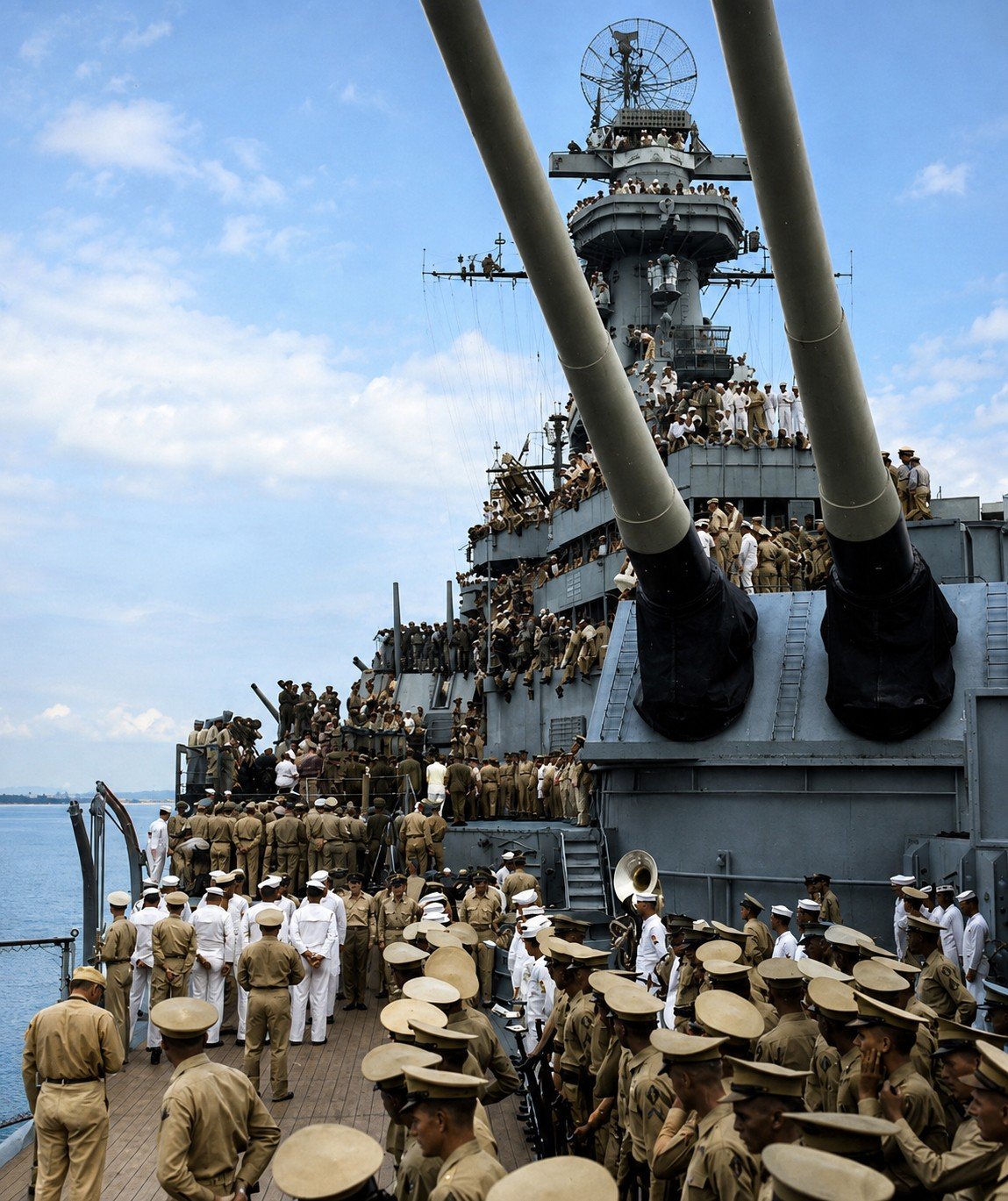
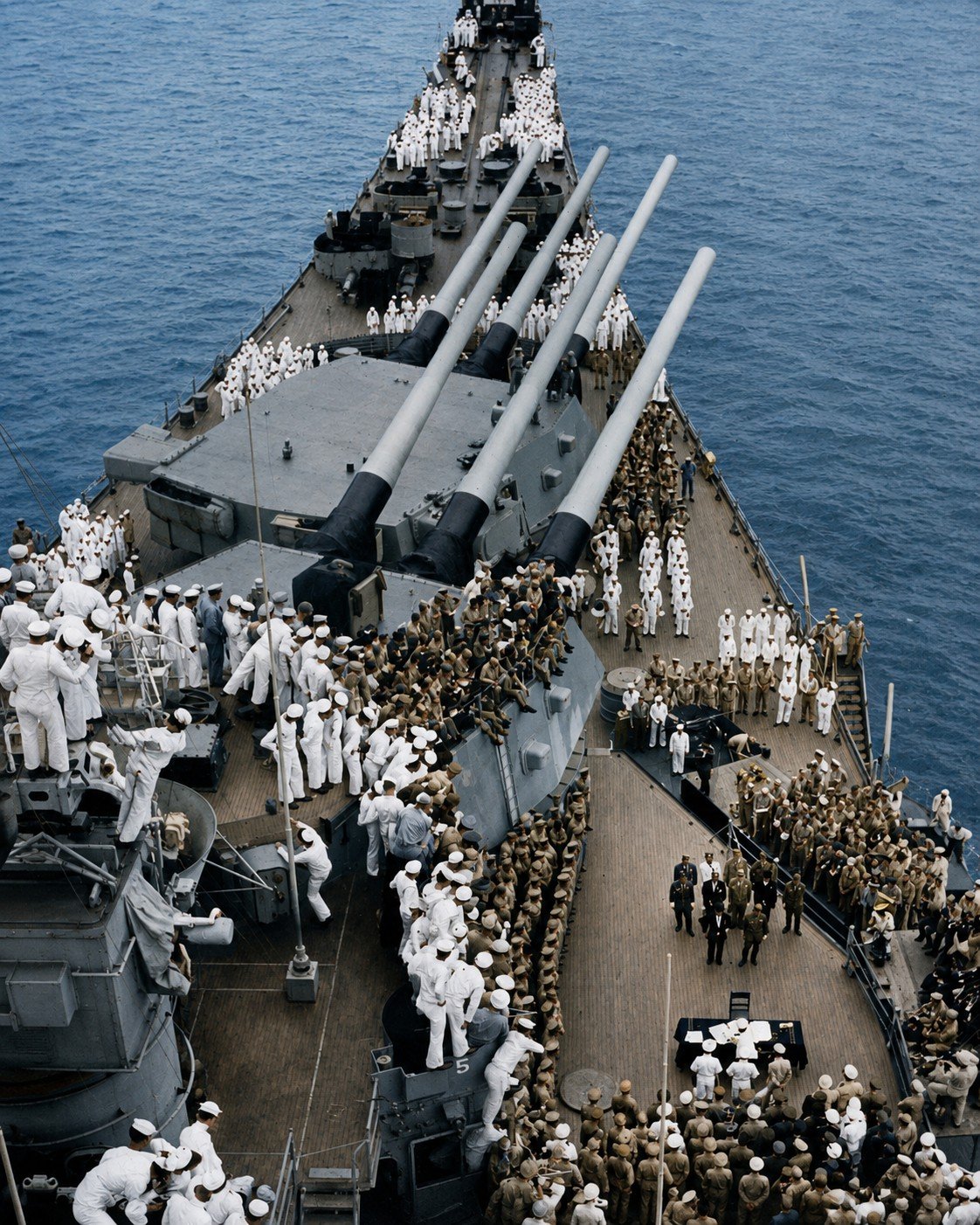
On the morning of September 2, 1945, USS Missouri sat at anchor in Tokyo Bay surrounded by one of the greatest concentrations of naval power ever assembled. More than 250 Allied ships and craft crowded the waters around Japan. Battleships, cruisers, destroyers, carriers, transports and smaller vessels had come from fleets that had spent years fighting their way across the Pacific. Above them waited hundreds of aircraft. On Missouri herself, sailors climbed onto turrets, superstructure, gun mounts and nearly every other place from which they might glimpse what was about to happen.
The ceremony they were preparing to witness would last only about 23 minutes.
That almost seems inadequate.
World War II had lasted six years and one day from Germany’s invasion of Poland to the formal surrender of Japan. It had consumed continents, destroyed cities and killed tens of millions of people. American servicemen had carried the war from Pearl Harbor to North Africa, Normandy, Italy, New Guinea, Guadalcanal, Tarawa, the Philippines, Iwo Jima and Okinawa. Families had spent years waiting for telegrams they prayed would never arrive. Prisoners of war had disappeared behind enemy lines. Entire communities had watched sons, husbands, fathers and brothers leave without knowing whether they would ever see them again.
Yet on September 2, all of that history was about to be compressed onto a small section of teak deck aboard an American battleship.
That is what makes the surrender aboard Missouri so powerful. The men signing the document mattered, but they represented far more people than could ever fit around that table. In a very real sense, the deck was crowded with ghosts.
Why Missouri?
USS Missouri was an extraordinarily young ship to become the setting for the end of the largest war in history. She had been commissioned only on June 11, 1944 and did not reach the Pacific combat zone until early 1945. In the months that followed, however, she supported the invasion of Iwo Jima, bombarded Okinawa, screened carrier strikes against the Japanese home islands and participated in direct naval bombardments of Japan. In May 1945 she became Admiral William F. Halsey’s Third Fleet flagship.
 Missouri had also experienced the war at frighteningly close range. On April 11, 1945, a Japanese kamikaze struck the battleship’s starboard side. The aircraft caused only superficial damage and no American casualties, but part of the pilot’s body landed aboard the ship. Captain William M. Callaghan ordered that the Japanese airman receive a military burial at sea the following day.
Four months later, representatives of the government that pilot had died defending would come aboard the same ship to surrender.
Missouri was selected partly because she was Halsey’s flagship and partly because her name connected the ceremony to President Harry S. Truman’s home state. She was also an unmistakable symbol of American industrial and naval power. At approximately 45,000 tons standard displacement, armed with nine 16-inch guns and bristling with antiaircraft weapons, an Iowa-class battleship was not a subtle backdrop for a defeated nation’s representatives.
But the ship’s symbolism went deeper than size.
Two Flags and Nearly a Century of History
Near the surrender area hung an old American flag that had crossed the Pacific long before anyone aboard Missouri was born.
It was the 31-star flag associated with Commodore Matthew C. Perry’s expedition to Japan in 1853–54. Perry had sailed into Japanese waters with American warships and forced the isolated Tokugawa government to open relations with the United States. Ninety-two years later, that same flag was displayed aboard Missouri as Japan formally surrendered to the Allied powers.
The connection was impossible to miss. American naval power had helped open Japan to the outside world in the nineteenth century, and American naval power now sat in Tokyo Bay at the end of a catastrophic war between the two nations.
Another flag flown that morning developed an even more famous story. Contemporary press accounts said Missouri raised an American flag that had flown over the United States Capitol on December 7, 1941, the day Japan attacked Pearl Harbor, and which subsequently flew over Casablanca, Rome and Berlin as those cities fell to Allied forces. Naval History and Heritage Command notes an important complication, however: Missouri’s commanding officer, Captain Stuart S. Murray, later dismissed the story and called it simply a normal government-issue flag.
That distinction is worth preserving because history does not become less powerful when one of its favorite legends turns out to be uncertain.
There was already enough symbolism aboard Missouri without inventing any.
Before the Japanese Arrived
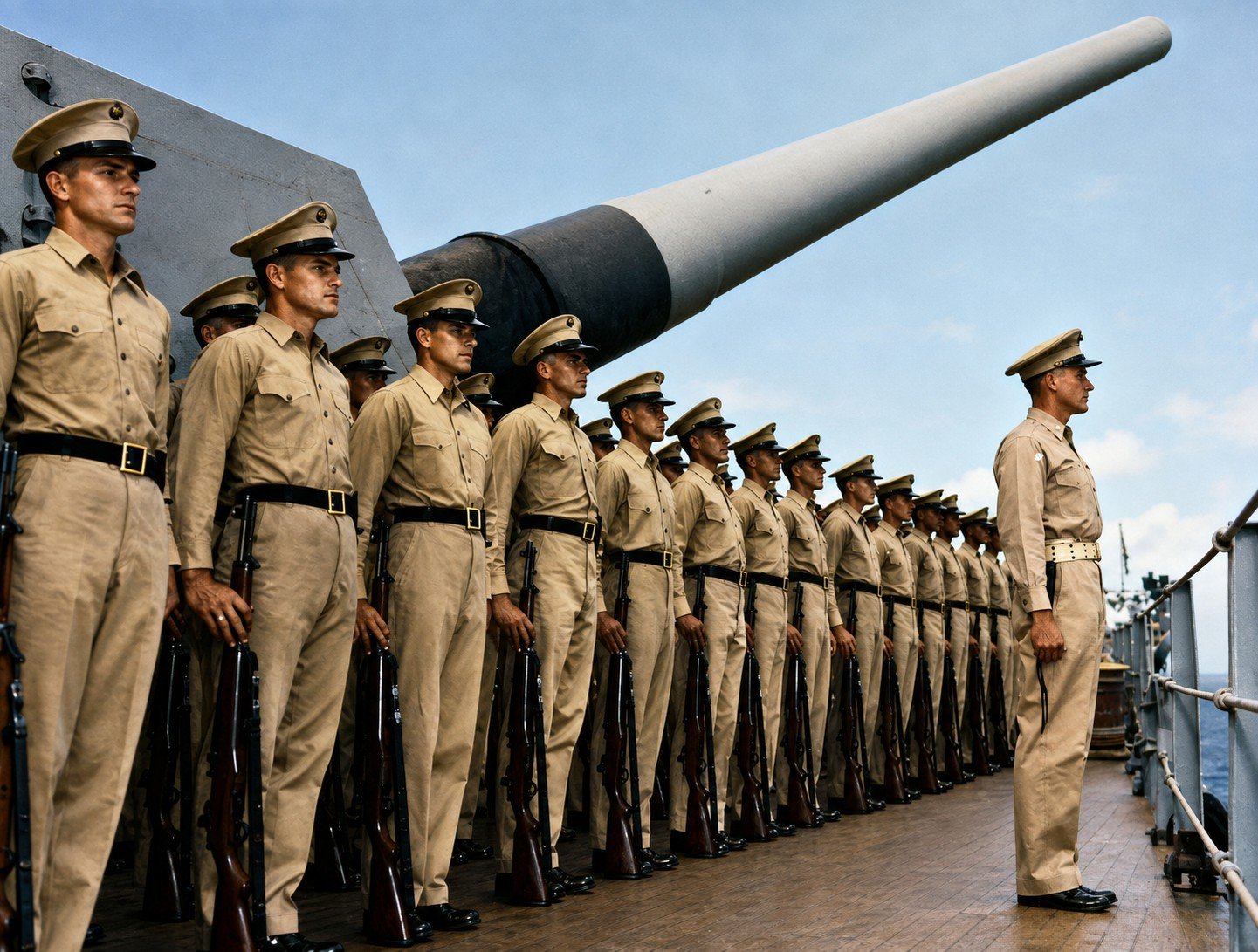
Sunday morning began with extraordinary precision. Missouri held morning colors at 0800. Allied representatives began arriving shortly afterward, followed by Fleet Admiral Chester W. Nimitz and then General of the Army Douglas MacArthur. MacArthur and Nimitz represented two enormous American commands that had advanced toward Japan along different paths through the Pacific. Even the question of where their five-star flags would fly aboard Missouri required diplomacy: Nimitz’s blue flag and MacArthur’s red flag were displayed at exactly the same height.
Their uniforms had also been discussed. MacArthur and Nimitz ultimately agreed that because they had fought the war without neckties, they would conduct the surrender ceremony without them. It was a small decision, but somehow fitting. The event was historic enough without dressing the people involved like they were attending a state dinner.
By then nearly every vantage point aboard Missouri was occupied. Nimitz later sketched the surrender deck and wrote that turret tops and every available position were crowded with officers, sailors, cameramen and correspondents. When his own turn came to sign, he admitted experiencing “nervous excitement.”
That is one of the details that brings the event back to human scale.
Chester Nimitz had commanded the Pacific Fleet through nearly four years of war. He had watched the disaster at Pearl Harbor become Midway, Guadalcanal, the Central Pacific drive, the Marianas, Iwo Jima and Okinawa. Now, standing only a few feet from the representatives of defeated Japan, he was nervous about signing his name in the correct place.
History rarely feels historic to the people inside it until afterward.
 The Men Who Had Been Prisoners
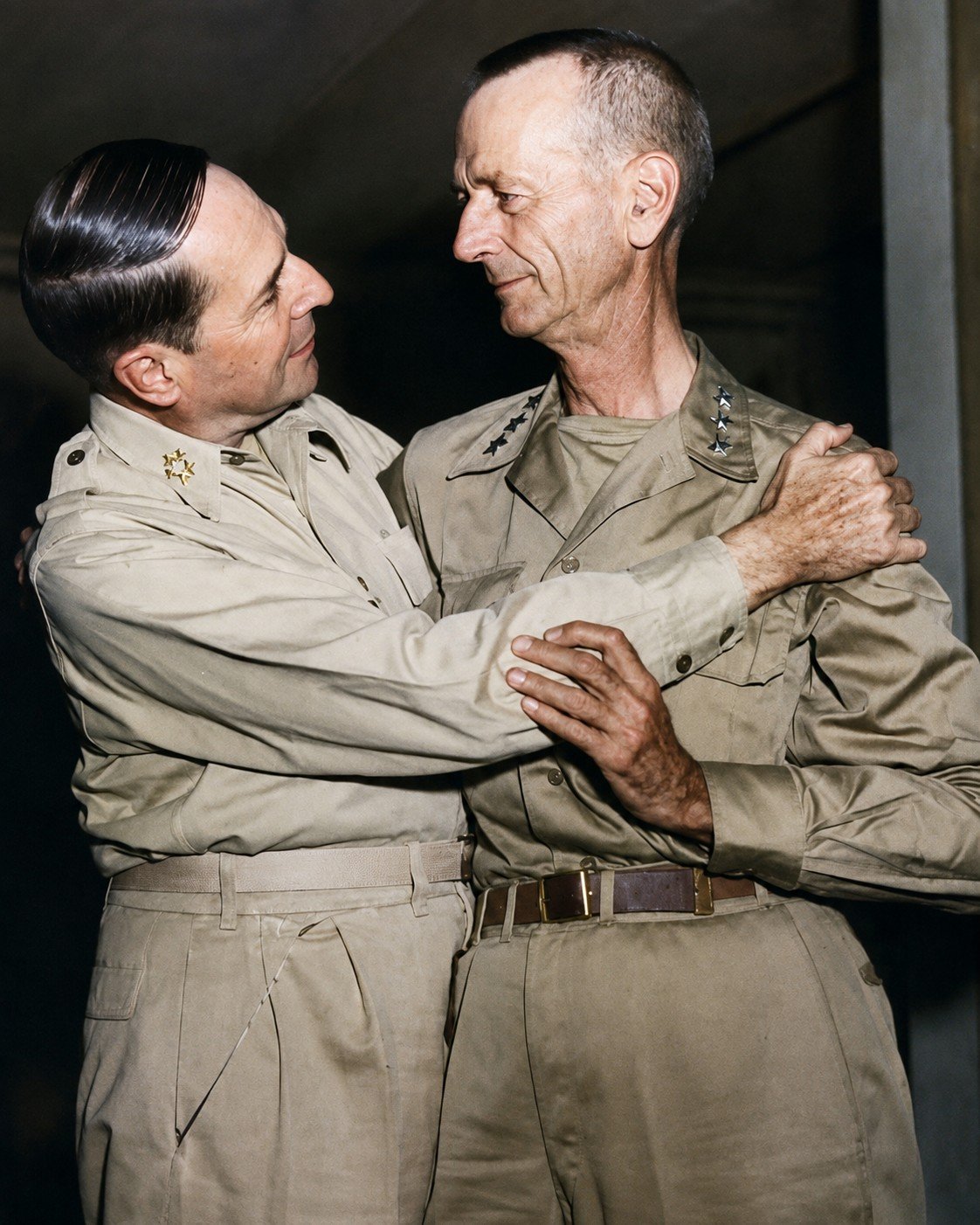
MacArthur deliberately invited two recently liberated prisoners of war to stand behind him during the ceremony: Lieutenant General Jonathan Wainwright and British Lieutenant General Arthur Percival.
Their presence may have been one of the most powerful details aboard Missouri.
Wainwright had commanded American and Filipino forces in the Philippines after MacArthur departed for Australia in 1942. He endured the final collapse of resistance on Corregidor and was forced to surrender. He then spent more than three years as a Japanese prisoner. Percival had commanded British forces during the disastrous defense of Singapore and had likewise spent years in captivity.
Only weeks before the surrender ceremony, both men remained prisoners of Japan.
Now they stood behind MacArthur while Japan surrendered.
MacArthur used several pens while signing the surrender documents and gave pens to Wainwright and Percival. It was not difficult to understand what those objects represented. Men once compelled to surrender Allied armies were now present for the surrender of the empire that had imprisoned them.
The reversal was complete.
At 8:56, the Japanese Came Aboard
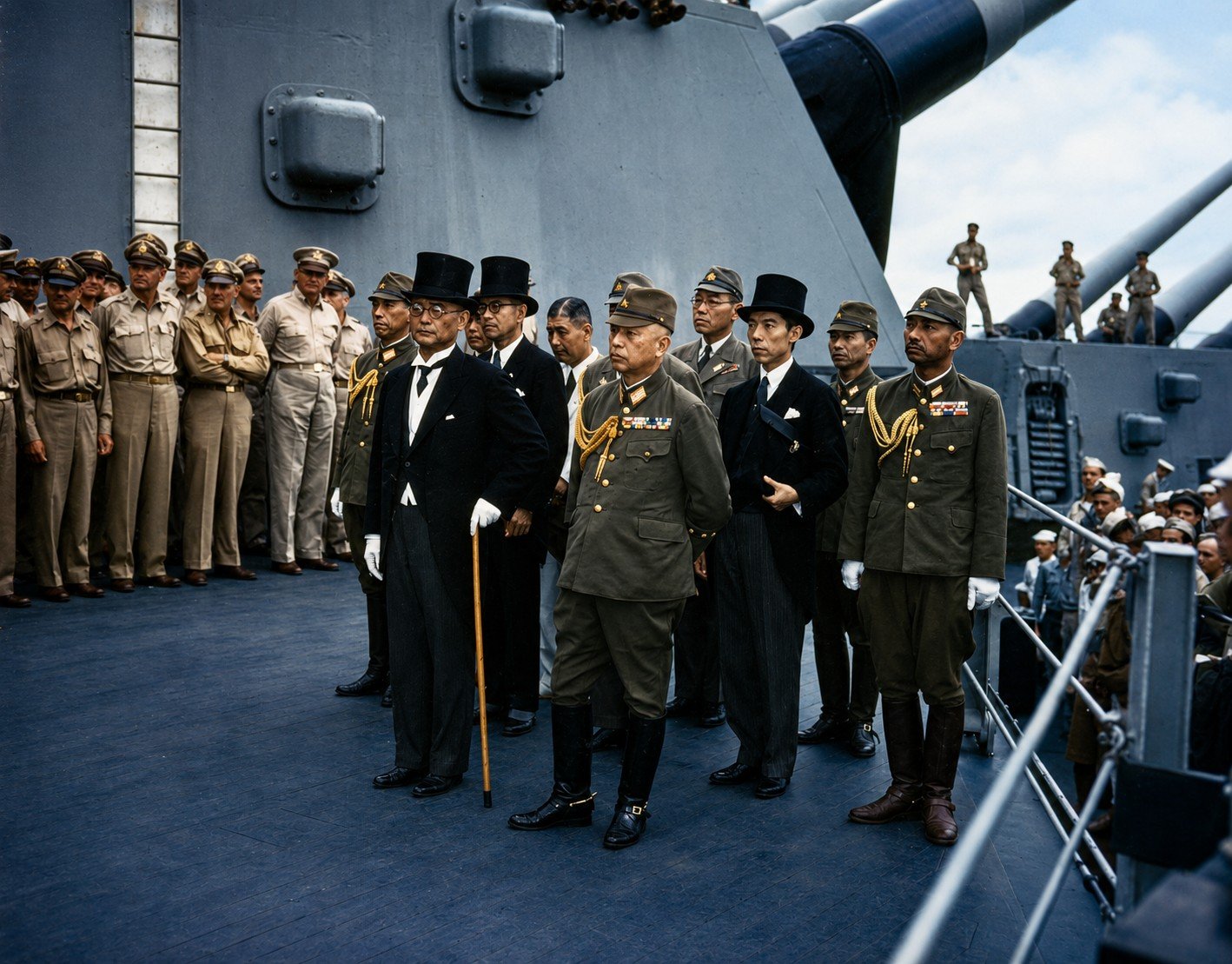
The Japanese delegation traveled across Tokyo Bay aboard the destroyer USS Lansdowne and reached Missouri at 0856. Eleven representatives climbed the starboard accommodation ladder and stepped onto a ship packed with the military leadership of the nations they had spent years fighting.
At their head was Foreign Minister Mamoru Shigemitsu, representing Emperor Hirohito and the Japanese government. Shigemitsu walked with difficulty using a cane and an artificial leg, the result of injuries suffered during an assassination attempt years earlier. Beside him was General Yoshijiro Umezu, Chief of the Army General Staff, representing Imperial General Headquarters.
An American eyewitness later remembered that the atmosphere aboard Missouri had been almost festive before their arrival. Sailors crowded vantage points, bands played and men talked excitedly. When the Japanese delegation appeared, he recalled, the mood changed instantly. The deck became so quiet that the contrast itself remained vivid in his memory decades later.
Nobody needed an announcement explaining what these eleven men represented.
The people watching them had spent years trying to survive the forces operating under their government.
The War Reduced to Eight Paragraphs
The Instrument of Surrender was surprisingly short.
The document contained only eight paragraphs. In them, Japan accepted the Potsdam Declaration, proclaimed the unconditional surrender of Imperial General Headquarters and all Japanese armed forces, ordered Japanese forces everywhere to cease hostilities, directed commanders to surrender, required government and military officials to obey Allied directives, and ordered the liberation and protection of Allied prisoners of war and civilian internees.
That last provision mattered enormously.
Across Asia and the Pacific, prisoners were still waiting. Some were desperately ill. Some had survived years of starvation, forced labor, disease and abuse without knowing whether surrender negotiations might collapse or whether their guards might kill them before Allied troops arrived.
The signatures aboard Missouri were therefore not merely symbolic.
They were orders intended to reach men still holding weapons throughout an empire stretching across thousands of miles.
MacArthur stepped to the microphones shortly after 0900. His remarks were strikingly restrained considering what had brought everyone there. He said the issues of the war had already been determined on the battlefields and that this was not the moment for “distrust, malice or hatred.” He expressed the hope that something better might emerge from the destruction that had preceded the ceremony.
Then he invited the Japanese representatives forward.
Shigemitsu Signs
Mamoru Shigemitsu signed first on behalf of the Emperor and the Japanese government.
The photographs show the scene better than almost any description could. Shigemitsu bends over the small table while Umezu and the other delegates stand behind him. Across from them are MacArthur and the Allied representatives. American sailors cover the superstructure behind the ceremony, watching from every available opening.
The man signing represented a government whose forces had attacked Pearl Harbor, conquered much of Southeast Asia and the western Pacific, and fought some of the most brutal campaigns of the twentieth century.
Yet there was no dramatic declaration.
There was the scratch of a pen on paper.
Then Shigemitsu stepped away and General Umezu came forward.
Umezu had resisted personally signing the surrender and reportedly required direct instruction from Emperor Hirohito before agreeing to do so. Now he signed on behalf of Imperial General Headquarters. With that signature, Japan’s military leadership formally accepted surrender.
Two signatures accomplished what years of fighting had been intended to achieve.
MacArthur and the Allies
MacArthur signed next as Supreme Commander for the Allied Powers. Behind him stood Wainwright and Percival, living reminders of how dramatically the war had changed since 1942.
 Nimitz followed as the representative of the United States. Representatives of China, the United Kingdom, the Soviet Union, Australia, Canada, France, the Netherlands and New Zealand then added their signatures.
The ceremony was international because the war had been international. China had been fighting Japan since 1937. British and Commonwealth forces had fought from Burma to Singapore and the Pacific. Australians had battled through New Guinea and the islands. Dutch territories had been overrun. Soviet forces had entered the war against Japan in August 1945.
The deck of Missouri therefore represented far more than an American victory.
It represented a coalition finally reaching the end of a war fought across much of the planet.
There was even a small bureaucratic stumble. Canadian representative Colonel Lawrence Moore Cosgrave accidentally signed on the wrong line of the Japanese copy, causing later signatures to be shifted one line downward. American and Japanese officials corrected the problem by hand afterward.
Apparently even the formal conclusion of World War II could not escape paperwork.
“The Big Moment Is Over”
Nimitz returned to USS South Dakota shortly afterward and wrote to his wife.“The big moment is over,” he began.
Those five words may capture the morning better than most grand speeches.
For Nimitz, the war had consumed nearly four years of his life. Every major Pacific operation had crossed his desk in some form. He had sent men into battles knowing that many would not return. He had absorbed casualty reports from ships lost, aircraft missing, Marines and soldiers killed on beaches, submarines overdue from patrol and sailors buried at sea.
Now the big moment was over.
But not everyone who had carried the war to that deck was there to see it.
That absence is the part of the surrender photographs we sometimes fail to notice.
The Men Missing From the Deck
Nobody from USS Arizona climbed onto Missouri’s turrets to watch Japan surrender.
Neither did the five Sullivan brothers from USS Juneau.
The Marines killed at Tarawa were not there. Neither were the men who disappeared beneath the sea aboard submarines that never returned, the soldiers buried overseas, the aircrews lost over Japan, the men killed during the Bataan Death March, or those who died in Japanese prison camps.
Thousands of empty places existed behind every person standing on Missouri.
That is why the surrender cannot be reduced merely to victory.
For the surviving men watching the ceremony, relief and triumph existed alongside memories of people who should have been there.
The United States Navy alone lost 36,950 personnel to enemy action during World War II. The losses across all American services were vastly greater, while the worldwide human cost reached into the tens of millions.
Those numbers are too large to comprehend easily.
A photograph is sometimes better.
Look at the sailors crowding Missouri’s superstructure and imagine the men missing from beside them.
That is the cost hidden inside the celebration.
Then the Sky Filled With Airplanes
At approximately 0925, MacArthur closed the proceedings.
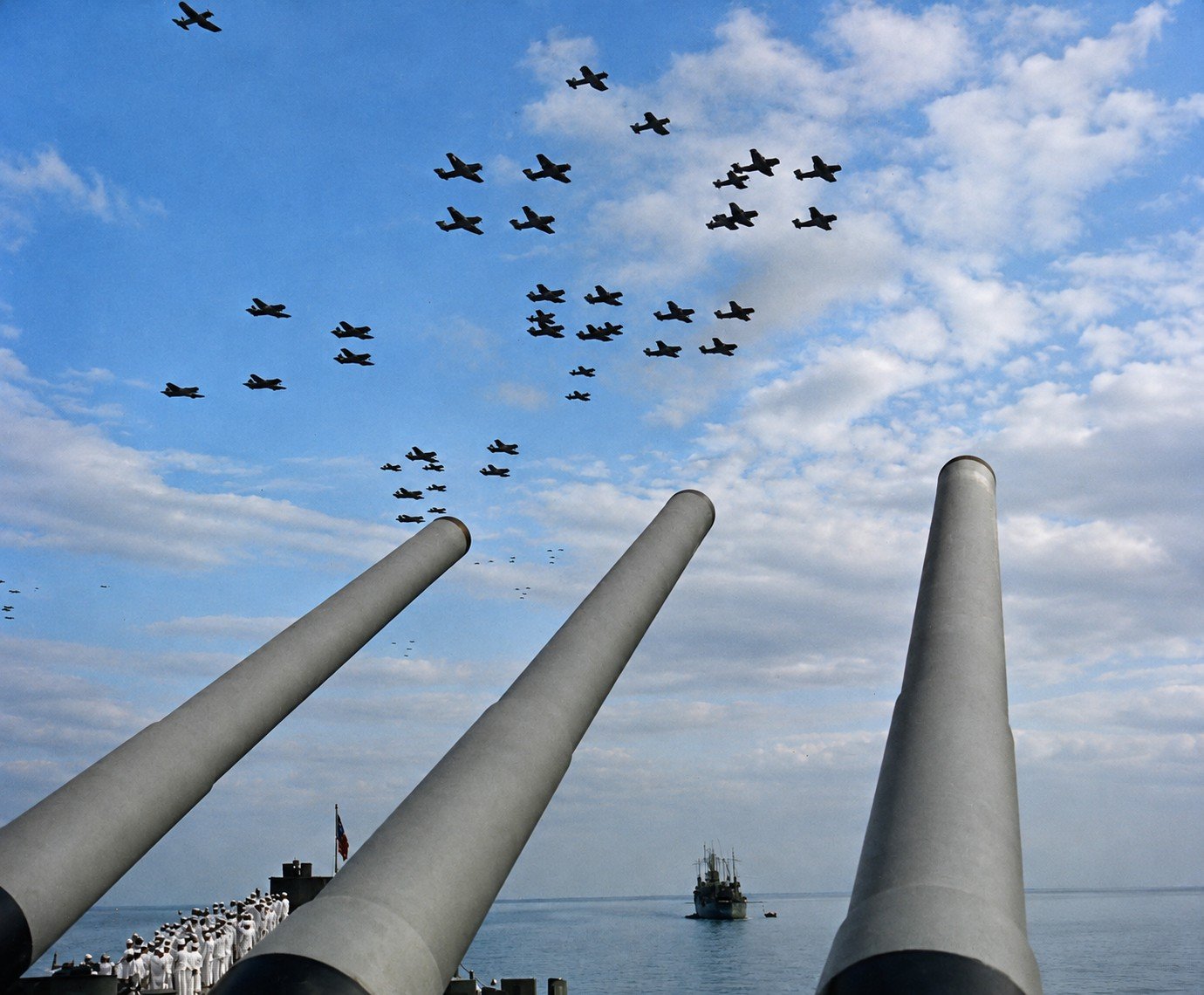
Almost immediately afterward came one of the most extraordinary displays of the morning. The clouds began breaking, and formations of American aircraft filled the sky above Tokyo Bay. Navy carrier aircraft passed over Missouri, followed by large formations of Army Air Forces aircraft. Official histories place the total at roughly 1,000 airplanes.
The symbolism could hardly have been more obvious.
These were the aircraft types that had carried the war toward Japan: fighters, dive bombers, torpedo aircraft and heavy bombers. Only weeks earlier, their appearance over Japanese territory meant bombs, gunfire and destruction.
Now they flew overhead while the guns remained silent.
The same machines that had helped end the war became part of the ceremony marking its end.
Photographs taken from Missouri’s forward turret show aircraft filling the sky above the battleship’s enormous 16-inch guns. It is one of the most powerful images of the surrender because nearly every instrument of modern war is present in the photograph, yet nobody is firing.
For once, the weapons are merely scenery.
The War Did Not End Everywhere at Once
MacArthur’s closing words did not instantly cause every weapon throughout Asia to fall silent.
Japanese forces remained scattered across China, Korea, Southeast Asia and numerous Pacific islands. Separate surrender ceremonies followed in the days and weeks after September 2 as local commanders formally surrendered their forces.
Allied prisoners still had to be located and liberated. Occupation forces had to enter Japan. Millions of servicemen had to be transported home, leading to the enormous Operation Magic Carpet movement that filled ships with men desperate to see the United States again.
The war had ended.
Getting everyone home from it was another operation entirely.
 Missouri’s Story Was Not Finished Either
There is another reason USS Missouri is such a fitting place to tell this story.
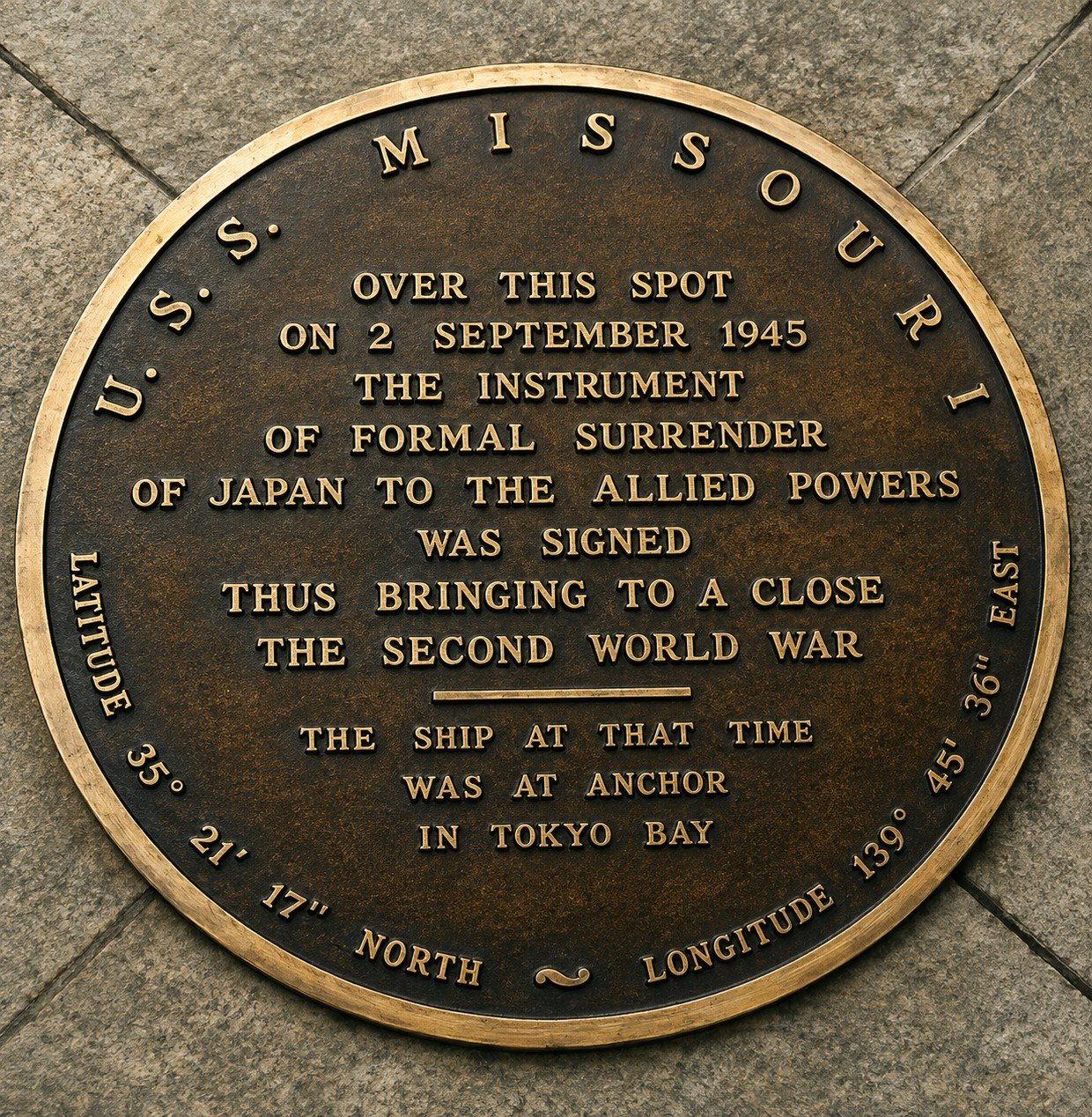
September 2, 1945 did not turn her into a museum piece.
Five years later, North Korean forces invaded South Korea, and Missouri returned to combat. She conducted two deployments during the Korean War, once again firing those enormous 16-inch guns against targets ashore. After decades in reserve she was modernized and recommissioned during the 1980s, then returned to war once again during Operation Desert Storm in 1991.
The battleship that hosted the surrender ending World War II remained capable of fighting another war almost half a century later.
Today Missouri rests at Pearl Harbor.
That location creates one of history’s remarkable circles.
The ship upon whose deck World War II formally ended is preserved only a short distance from USS Arizona, where more than 900 sailors and Marines remain entombed from the attack that brought the United States into the war.
Visitors can stand at Pearl Harbor and see both ends of America’s Pacific War.
One ship represents the morning it began.
The other carries the place where it ended.
What Happened to the Paper?
The original Instrument of Surrender did not remain aboard Missouri.
Colonel Bernard Thielen transported it back to Washington, where it was presented to President Truman on September 7. It then went on public display at the National Archives. General Jonathan Wainwright, who only weeks earlier had been liberated from Japanese captivity, participated in the ceremony opening that exhibit. The document was formally accessioned into the National Archives on October 1, 1945.
Today those pages still survive.
They are not elaborate. There is no gold illumination or monumental proclamation. They are typed sheets carrying signatures and a few corrections.
That simplicity somehow makes them more powerful.
Wars are fought with ships, tanks, aircraft, rifles and artillery. They require factories, armies, fleets, governments and millions of people.
This one ended on paper.
 Thirty Feet Away
One eyewitness to the ceremony later remembered standing only about thirty feet from the surrender table. He recalled Missouri looming over the destroyer that brought him to the ceremony and sailors packed everywhere trying to see. Before the Japanese delegation arrived, the atmosphere had been celebratory.
Then the deck fell quiet.
For several minutes, he remembered, people simply looked at the representatives of the nation they had fought.
That recollection gets closer to the human reality than most official photographs.
Imagine being a sailor aboard Missouri that morning.
Perhaps you had watched kamikazes attack at Okinawa. Maybe you had lost friends aboard another ship. Perhaps you had been away from home for years. You knew preparations had been underway for the invasion of Japan and that if the surrender had not come, the fighting might have continued for months.
Now the men representing Japan were standing only yards away.
Nobody was shooting at anybody.
That alone must have felt strange.
What September 2 Really Meant
History likes clear endings.
The armistice is signed. The flag is lowered. The last shot is fired. The war is over.
Human lives are messier.
For the men aboard Missouri, September 2 did not erase what had happened before it. A signature could not restore Guadalcanal’s dead, raise Arizona, rebuild Manila, return prisoners who had died in captivity or bring back the Marines buried on islands whose names their families had barely known before the war.
Victory did not undo the cost.
What the signatures did was stop adding to it.
That may be the most important way to understand the surrender.
Every hour after those documents took effect was an hour in which another American landing craft did not have to approach a defended Japanese beach. Another Japanese city did not have to be bombed. Another sailor did not have to watch the horizon for a kamikaze. Another family did not have to receive a telegram because somebody died taking the next island.
The paperwork aboard Missouri mattered because human beings finally stopped dying for the outcome it recorded.
That is why September 2 deserves more than the familiar photographs of famous men leaning over a table.
The real story is everything surrounding them.
Perry’s old flag hung nearby. Wainwright stood behind MacArthur after surviving captivity. Nimitz nervously signed his name. Sailors crowded gun turrets to watch. More than 250 Allied vessels filled Tokyo Bay, and roughly a thousand aircraft eventually crossed the sky overhead. Somewhere beyond those ships were millions of servicemen waiting to learn when they could finally go home.
And absent from all of it were the people who had carried the war that far but had not survived long enough to see its end.
For 23 minutes on the morning of September 2, 1945, those stories converged on the deck of USS Missouri.
Then the representatives finished signing.
The airplanes passed overhead.
The ships remained at anchor.
And for the first time in nearly six years, the world was no longer at war.
Sources
Naval History and Heritage Command, official history of USS Missouri and archival material concerning the September 2, 1945 surrender ceremony, including Missouri’s deck log, surrender photographs, Fleet Admiral Chester Nimitz’s annotated deck plan and correspondence, and the Navy’s reconstruction of the ceremony.
Naval History and Heritage Command, material on the formal surrender of Japan aboard USS Missouri, including the Japanese delegation, Allied representatives, aircraft flyover, Marine honor guard, and the display of Commodore Matthew Perry’s flag.
Naval History and Heritage Command, H-Gram material concerning V-J Day and the surrender ceremony, including Captain Stuart S. Murray’s recollections, the discussion of flags flown aboard Missouri, MacArthur and Nimitz’s preparations, and the Canadian signature error.
National Archives, Instrument of Surrender, September 2, 1945, including the original eight-paragraph document, signatures, and subsequent transfer of the document to Washington.
National Archives, Japanese surrender records and related instruments covering surrender ceremonies throughout Asia and the Pacific after September 2, 1945.
National Park Service oral-history material preserving an eyewitness account of the atmosphere aboard USS Missouri during the surrender ceremony.
Naval History and Heritage Command, surviving text of General Douglas MacArthur’s opening remarks at the surrender ceremony.
Naval History and Heritage Command, correspondence and notes of Fleet Admiral Chester W. Nimitz, including his September 2, 1945 letter describing the surrender ceremony and his remark that “the big moment is over.”
Naval History and Heritage Command, official USS Missouri history covering her commissioning, combat service at Iwo Jima and Okinawa, the April 1945 kamikaze strike, postwar service, Korean War operations, recommissioning, and service during Operation Desert Storm.
Naval History and Heritage Command, Operation Magic Carpet and postwar demobilization material documenting the enormous effort required to return American servicemen home after Japan’s surrender.
Battleship Missouri Memorial and Naval History and Heritage Command material concerning USS Missouri’s preservation at Pearl Harbor and her relationship to the nearby USS Arizona Memorial.