The Battle of Polei Duc: Into the Valley of Tears
The Plei Trap Valley, a rugged and unforgiving stretch of terrain in Vietnam's Central Highlands, was a battlefield where courage was tested and legends were forged.
March 22, 2025

The Battle of Polei Duc: Into the Valley of Tears

The men went into the jungle looking for Americans who were already missing, but by the end of the following day they would be fighting simply to keep from joining them. On March 22, 1967, soldiers of the 1st Battalion, 8th Infantry, 4th Infantry Division found themselves locked in a savage battle near the Cambodian border in Vietnam’s Central Highlands. Company A was caught in the main ambush, while Company B, separated from it by dense jungle and an enemy blocking force, spent much of the day fighting desperately to reach the trapped men. Before the two companies finally joined again, dozens of Americans had been killed or wounded, a company commander was dead, leadership had passed rapidly from one man to another, medics were working among casualties under fire, artillery was being brought dangerously close to friendly positions, and helicopters were attempting to reach men who badly needed to get out.
The location appears under several spellings in wartime and later records, including Plei Doc and Polei Doc, while the battle has also become widely remembered as Polei Duc. Whatever spelling is used, the place belonged to a larger stretch of country that American soldiers had already given a far more memorable name: the Valley of Tears.
Into the Valley of Tears
The Plei Trap and Plei Doc areas of western Pleiku Province lay close to Cambodia in some of the most difficult terrain encountered by American troops in the Central Highlands. Mountains, steep ridges, thick jungle and dense undergrowth sharply limited visibility and movement. The nearby Cambodian border presented another problem because North Vietnamese forces could move into South Vietnam, engage American units and then withdraw toward sanctuaries where U.S. ground troops were politically restricted from following them. The region was also strategically important because it contained routes through which Communist forces could move men and supplies toward populated areas farther east.
The 4th Infantry Division had moved into the western highlands with the mission of finding and disrupting those forces before they could establish themselves in strength. In February 1967, the division began Operation Sam Houston, sending infantry battalions into the Plei Trap Valley. What followed was not a campaign of easy sweeps through abandoned jungle. North Vietnamese units repeatedly used prepared positions, ambushes and the restrictive terrain to engage American companies and battalions on favorable terms, then break contact before U.S. firepower could completely trap them. By mid-February the fighting had already cost the division heavily, and combat continued through March.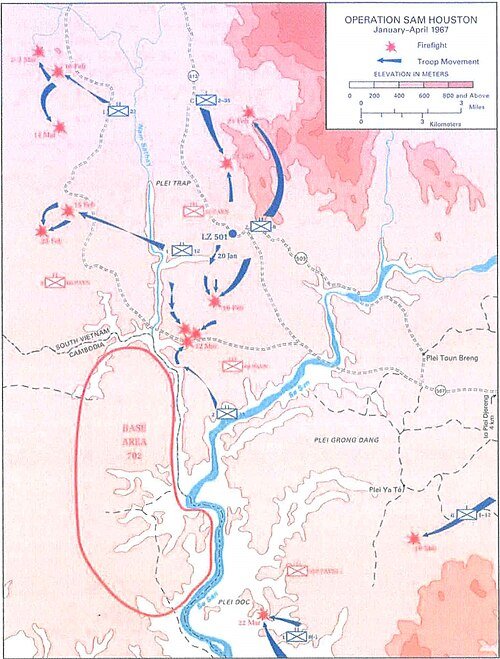
The geography shaped nearly everything. A company could be only a short distance from another friendly unit and still require hours to reach it. Vegetation restricted observation to remarkably short distances, while supporting aircraft could have difficulty identifying exactly where friendly troops ended and the enemy began. Artillery remained enormously powerful, but when opposing forces fought almost on top of one another, calling for fire meant accepting frighteningly small margins for error. It was in this environment that the men of the 1st Battalion, 8th Infantry moved toward Plei Doc.
A Patrol Goes Missing
On March 21, a long-range reconnaissance patrol operating near the Cambodian border lost radio contact with its headquarters. In country where a small patrol could disappear quickly and North Vietnamese forces were known to be operating in strength, silence on the radio was ominous. The 1st Battalion, 8th Infantry was tasked with finding the missing men, and Companies A and B became part of the effort. Enemy troops of the North Vietnamese 95B Regiment were operating in the area, and a battalion of that regiment had already struck the reconnaissance patrol before American infantry began moving toward its last known position.
Specialist Fourth Class John Nelson of Alpha Company later remembered being flown into the area and moving toward the suspected enemy position. His recollection reduced an entire day of fighting to a few stark sentences: “The battle started around 7:30 AM and the heaviest fighting ended around 4:30 PM. Lighter fighting continued while the choppers were getting the wounded out.”
Alpha Company moved through the jungle on the morning of March 22 with Captain William D. Sands in command. The four platoons were advancing along a ridgeline, with elements of the 1st and 2nd Platoons toward the front. They had traveled only a short distance when the jungle erupted around them. Enemy rifle and automatic-weapons fire tore into the leading elements from concealed positions, and the North Vietnamese had chosen their ground well. What had begun as a search for missing comrades had become an ambush.
The effect was immediate and devastating. Men at the front of the column were hit before many soldiers farther back completely understood where the firing was coming from. Dense vegetation made it difficult to identify targets or even comprehend the shape of the fight. North Vietnamese soldiers attempted to maneuver around the American flanks and divide the company, while the surviving Americans tried to pull themselves into positions from which they could defend one another.
 This is where casualty statistics begin to fail as a way of describing a battle. An official history can record that a unit suffered a certain number killed and wounded, but it cannot adequately convey what those numbers looked like inside a company. A friend who had been walking a few yards ahead might suddenly be lying on the ground. Someone would begin calling for a medic while a radio operator desperately tried to contact another unit and bullets cut through the vegetation around him. Platoon leaders and noncommissioned officers who had been giving orders moments earlier could suddenly disappear from the command net, leaving other soldiers to realize that men were now looking to them for decisions. Alpha Company entered the morning as an organized infantry company, but within minutes its leadership structure was being torn apart.
When Command Begins to Disappear
Captain Sands attempted to organize the defense and bring artillery onto the enemy positions. While working with the company command group, he was killed when an enemy rocket-propelled grenade struck the area. The artillery forward observer, Second Lieutenant Thomas E. Shannon, was also killed during the battle, while other officers were wounded. First Lieutenant Rick Sauer remained able to assume command briefly, but he too was soon seriously wounded.
First Sergeant David H. McNerney was already moving toward the heaviest contact. He had encountered enemy troops at close range, had been knocked from his feet and injured by a grenade, and then assaulted a machine-gun position that had pinned several Americans outside the developing defensive line. When McNerney learned that Sands and the artillery forward observer had been killed, he assumed command of Alpha Company.
What followed became the action for which McNerney would eventually receive the Medal of Honor, but his actions make the most sense when understood as part of what was happening to the company around him. He was not performing a separate act of heroism on an otherwise orderly battlefield. He was attempting to hold together a badly mauled unit while enemy troops remained close enough to threaten the perimeter.
McNerney called artillery to within approximately twenty meters of the American positions. When the smoke grenades used to mark Alpha Company’s location were exhausted, he exposed himself so aircraft overhead could identify the friendly position. He eventually climbed a tree and secured an identification panel high enough for pilots to see it, then continued moving among the soldiers, reorganizing positions, encouraging men and checking the wounded despite having already been injured himself.
The artillery came frighteningly close because it had to. North Vietnamese troops were attempting to stay close to the Americans, reducing the effectiveness of American air and artillery support. The solution was to bring that firepower almost directly onto Alpha Company’s perimeter. Explosions tore through the jungle around both sides, blasting vegetation and sending fragments through an area already crowded with wounded men. American firepower was helping prevent the perimeter from being overrun, but the shells protecting the soldiers were landing only yards away from them.
The Medics Had Their Own Battle
While riflemen fought to keep the perimeter intact, medics moved among the wounded. The battle had begun so suddenly that casualties accumulated almost immediately, leaving men with gunshot wounds, fragmentation injuries and massive trauma requiring treatment while the fighting continued around them.
The medics could not wait for the battlefield to become safe because there was no safe place to wait. Calls for help came from positions exposed to enemy fire, and reaching a wounded soldier could require crawling or running through the same beaten ground that had just injured him. Treatment that would normally have taken place inside a hospital was reduced to what could be done with the equipment carried into the jungle while the perimeter continued to shrink.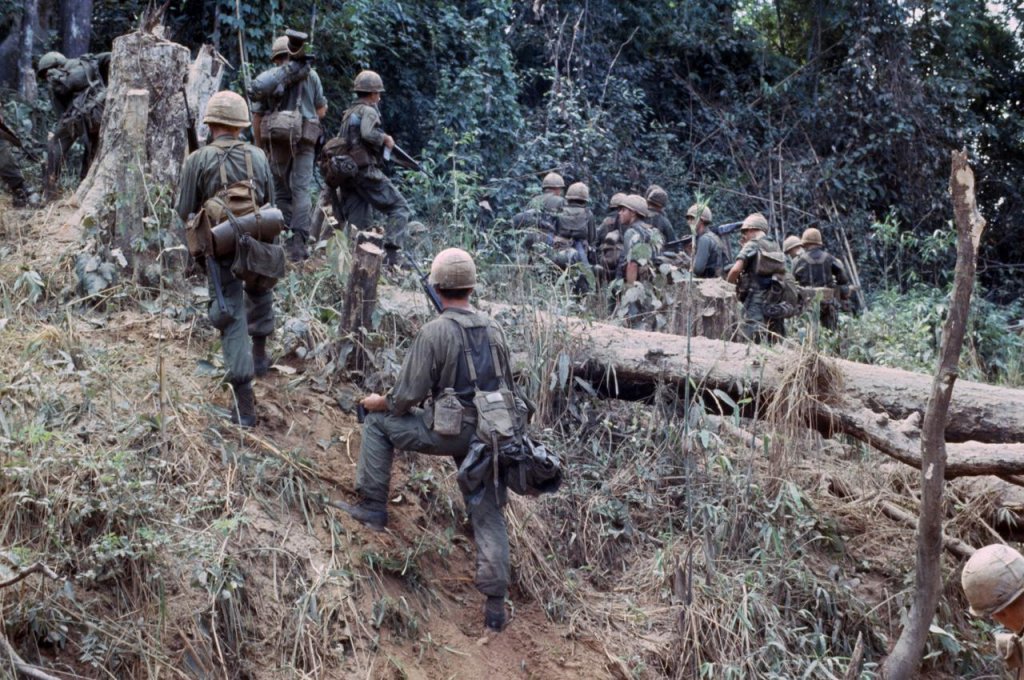
The military measures battles through objectives, enemy strength, ammunition expenditure and casualty totals. Soldiers experience them differently. They remember names, faces, voices and fragments of conversation. They remember who called for a medic, who carried ammunition forward, who remained beside a wounded friend and who was suddenly no longer there. During those hours at Polei Duc, the men of Alpha Company had little reason to think about the broader objectives of Operation Sam Houston or the strategic importance of the Central Highlands. Their world had become the small piece of jungle they were trying desperately to hold.
Bravo Company Tries to Reach Them
Alpha Company was not alone in the jungle, but reaching it proved enormously difficult. Captain Robert Sholly’s Bravo Company heard the battle and began moving toward the trapped soldiers. The distance separating the companies was not enormous on a map, but in the Central Highlands that meant very little.
The North Vietnamese had anticipated the possibility of reinforcement and positioned troops between the two American companies. Bravo Company encountered automatic-weapons fire and snipers as it attempted to advance. Men took cover among bamboo and in a dry creek bed while enemy machine guns blocked their route, and attempts to work around the blocking positions only led to additional fire. What Alpha experienced as isolation, Bravo experienced as frustration because they could hear the battle involving men they knew but could not simply walk through the enemy force standing between them.
Bravo fought its own engagement while trying to reach Alpha. Artillery and air support were brought against the blocking positions, and fighter aircraft and supporting fires gradually weakened the North Vietnamese hold enough for the company to resume its movement. Throughout the day, the sounds of the fighting ahead provided a grim indication of what was happening to their sister company.
Late in the afternoon, Bravo finally broke through and reached Alpha’s position. For the soldiers who had spent the day trying to hold the perimeter, the arrival was more than a tactical linkup recorded on an after-action map. Men from their own battalion had fought their way through to them, and the two companies could now establish a stronger perimeter, care for the wounded and prepare for the difficult work of getting casualties out before darkness completely settled over the battlefield.
Getting the Wounded Out
Surviving the ambush did not automatically save the wounded. They still had to be evacuated from dense jungle while enemy fire remained a threat.
One of the helicopter pilots who repeatedly came into the position was Warrant Officer Donald Rawlinson of the 4th Aviation Battalion. Rawlinson brought badly needed supplies and returned to carry wounded soldiers out. With jungle obscuring Alpha Company’s position, helicopter crews needed a clear visual marker, which led to one of the extraordinary moments later recorded in McNerney’s Medal of Honor citation. The wounded first sergeant exposed himself and climbed high enough to secure an identification panel where pilots could see it.
 As the enemy attacks weakened, McNerney helped create a landing area for the evacuation helicopters. Large trees obstructed the site, so demolition material was needed. He left the relative protection of the perimeter, recovered explosives from abandoned rucksacks under fire and brought them back so the landing zone could be cleared. When offered evacuation, he refused and remained with the company until new command arrived the following day.
Rawlinson and the other aircrews continued returning to the battlefield. The wounded were loaded aboard as crews carried them away from the jungle and toward medical care. It is easy to reduce helicopter evacuation in Vietnam to a phrase such as “the wounded were extracted,” but each extraction required airmen to fly directly toward the place where everyone on the ground desperately wanted to leave.
The Cost of Polei Duc
The cost of the March 22 fighting was severe. Official Army histories record 27 Americans killed and 48 wounded in the Plei Doc fighting involving the 1st Battalion, 8th Infantry, with Alpha Company suffering the overwhelming share of those losses. Twenty-two men associated with Alpha Company were killed during the battle, while Bravo Company and supporting elements also suffered casualties during the effort to reach the trapped company.
Those figures are easy to read on a page and much harder to comprehend in human terms. The dead represented empty bunks, missing voices and men who would no longer answer at formation. Survivors returned without friends whose habits, jokes and complaints had been woven into their everyday lives. Families thousands of miles away would receive official notifications that transformed a battle in an unfamiliar place into the defining event of their lives.
For the men who survived Polei Duc, the casualty total was never simply a number. They remembered individual people. They remembered who had been beside them when the shooting started, who had been wounded, who helped carry another man, and who did not return. Years later, veterans continued preserving the names of those lost because they understood that a statistic could record the scale of the battle but could never preserve the men themselves.
The Problem With Body Counts
Accounts of Polei Duc have frequently cited very high North Vietnamese losses, including claims of 139 bodies found around the American position and hundreds of additional graves discovered afterward. Surviving records, however, do not provide a sufficiently consistent foundation to present all of those larger figures as settled fact.
The official Army campaign history records 136 North Vietnamese dead in the broader March 22 fighting involving the relief force, while later recollections reveal considerable uncertainty surrounding contemporary body counts and battlefield estimates. The precise number of enemy dead therefore remains less certain than some later retellings suggest.
What is not uncertain is that the North Vietnamese 95B Regiment had struck Alpha Company with overwhelming force and had come dangerously close to destroying it. The Americans survived, but survival had come at an enormous price. The significance of Polei Duc does not depend upon proving that one side killed a particular number more than the other. Its meaning lies in what the men did when their company was breaking apart around them.
Valor Inside the Perimeter
The battle produced an extraordinary number of decorations for valor, including a Medal of Honor, Distinguished Service Crosses, Silver Stars, Bronze Stars and Purple Hearts. Those decorations reflected the intensity of the fighting, but even they could capture only individual pieces of what happened inside the perimeter.
First Sergeant David H. McNerney became the best-known participant. On September 19, 1968, President Lyndon B. Johnson presented him with the Medal of Honor for his actions at Polei Duc. His citation described a wounded first sergeant who took command after his leaders fell, personally attacked enemy positions, brought artillery to within yards of his men, exposed himself to mark their position for aircraft, helped prepare an evacuation site and refused to leave while his company still needed him.
McNerney deserved every word of that citation, but even a Medal of Honor story becomes incomplete if the hero is allowed to stand alone. He could not have held Alpha Company by himself. Around him were riflemen returning fire, machine gunners trying to stop enemy assaults, radio operators maintaining communications, medics crawling toward wounded men, artillerymen sending rounds into coordinates frighteningly close to friendly troops, pilots searching for a place to land, and the soldiers of Bravo Company fighting through an enemy force because men from their battalion were trapped ahead of them.
That larger story is what makes Polei Duc more than the story of one extraordinary man.
The Men Behind the Battle
At Ghosts of the Battlefield, we believe military history matters most when large events are connected back to the people who experienced them. Operation names help historians organize a war, maps explain where units moved, and casualty numbers demonstrate the scale of a battle, but none of them by themselves explain what March 22, 1967 meant to the men of Alpha and Bravo Companies.
For Alpha Company, it meant waking in the jungle and, within minutes, finding themselves inside a carefully prepared enemy ambush. It meant seeing friends fall before some men could even identify where the enemy was firing from. It meant commanders and leaders disappearing and other soldiers stepping forward because someone had to assume responsibility. It meant medics answering cries for help while bullets were still passing through the vegetation, artillery exploding close enough to shower friendly positions with debris, and wounded men watching for helicopters while wondering whether those aircraft could reach them in time.
For Bravo Company, Polei Duc meant hearing the battle and knowing their friends were somewhere ahead. It meant discovering that the North Vietnamese intended to prevent them from getting there and fighting through jungle, machine guns and snipers because other Americans were waiting for them.
For the helicopter crews, it meant repeatedly flying toward the wounded while enemy fire remained around the landing zone. For artillerymen and aircrews, it meant placing enormous destructive power almost on top of friendly soldiers because the enemy had moved too close for safer alternatives. For the families at home, the meaning of Polei Duc would arrive later in telegrams, visits and letters that changed their lives forever.
The search for a missing reconnaissance patrol had led two infantry companies into a battle against a powerful North Vietnamese force. By nightfall, Alpha and Bravo Companies were together again, carrying their dead and wounded with them. Official histories would record the engagement as one part of Operation Sam Houston, another violent encounter in the struggle along the Cambodian border during the spring of 1967.
 The men who were there remembered something far more personal. They remembered the men standing beside them when the jungle erupted, the men who answered when someone called for help, the men who fought their way toward them when they were surrounded, and the men who never came home.
Among those who emerged from Polei Duc was David McNerney (Read First Sergeant David H. McNerney's Medal of Honor experience) whose actions inside Alpha Company’s battered perimeter became one of the extraordinary stories of leadership from the Vietnam War. His Medal of Honor tells the story of one man inside the battle. Polei Duc tells us about the company around him, the men who fought beside him, and the terrible circumstances that made such leadership necessary.
The story of Polei Duc deserves to be remembered not simply as a battle fought in the Valley of Tears, but as the story of the men who entered that valley together and paid an extraordinary price to bring one another out.The Battle of Polei Duc became one of the most decorated engagements of the Vietnam War. The soldiers of Alpha Company received:
- 1 Medal of Honor
- 2 Distinguished Service Crosses
- 7 Silver Stars
- 25 Bronze Stars
- 65 Purple Hearts
Your purchase helps preserve the stories behind the artifacts. Click here to shop and support Ghosts of the Battlefield.