Pedro: The HH-43 Huskie and the Men Who Flew Into the Fire
Among the helicopters of the Vietnam War, the Kaman HH-43 Huskie is easy to overlook. It did not have the instantly recognizable profile of the UH-1 Huey, the brute size of the HH-53 Super Jolly Green Giant, or the sleek menace of the AH-1 Cobra.
August 13, 2026

 Among the helicopters of the Vietnam War, the Kaman HH-43 Huskie is easy to overlook. It did not have the instantly recognizable profile of the UH-1 Huey, the brute size of the HH-53 Super Jolly Green Giant, or the sleek menace of the AH-1 Cobra. In fact, with its short fuselage, high landing gear and two rotor systems angled toward one another above the cabin, the HH-43 looked like somebody had designed a helicopter after being given only a vague description of what helicopters were supposed to look like. Yet this strange little aircraft became one of the foundations of U.S. Air Force combat rescue in Southeast Asia. Known to its crews simply as “Pedro,” the HH-43 went from fighting aircraft fires on American airfields to hovering over jungle firefights while pararescuemen descended beneath it to save wounded men. According to the National Museum of the U.S. Air Force, HH-43 crews recorded 888 combat saves between 1966 and 1970 alone, including 343 aircrew rescues and 545 rescues of other personnel. The museum credits the type with more combat saves than any other USAF helicopter.
The aircraft's story began with Charles H. Kaman, one of the more innovative figures in early American helicopter development. Kaman founded his company in 1945 and pursued an unusual system using two counter-rotating, intermeshing main rotors rather than the familiar main rotor and tail rotor arrangement. His first K-125 flew in 1947, followed by progressively refined designs. In 1953 the HOK-1, ordered for the U.S. Marine Corps, made its first flight; the related Air Force version became the H-43A Huskie. Kaman ultimately built about 340 H-43-family helicopters in several versions.
A Helicopter That Looked Like It Should Destroy Itself
The feature that immediately separated the Huskie from almost every other military helicopter was the rotor system. Instead of one large horizontal rotor and a small vertical tail rotor, the HH-43 used two large rotors mounted side by side on pylons angled slightly outward. Their blades overlapped as they turned, but the rotor systems were mechanically synchronized so that the blades passed through one another's arcs without colliding. This arrangement is generally described as an intermeshing rotor, or synchropter, configuration.
It looks deeply wrong the first time you watch one operate. Two sets of enormous blades appear to be repeatedly attempting to occupy the same piece of sky while several people sit underneath them trusting the gearbox to remember its responsibilities. Fortunately, engineering occasionally works.
Because the two rotors turned in opposite directions, their torque reactions canceled one another. The Huskie therefore did not require a conventional tail rotor. That eliminated a component that normally consumes some engine power simply to keep a helicopter from rotating in the opposite direction of its main rotor. The configuration also generated tremendous rotor wash beneath the aircraft, something that became unexpectedly useful when the Air Force developed the Huskie's crash-rescue mission.
Kaman also used his distinctive servo-flap rotor-control system. Rather than relying entirely upon conventional mechanisms to force the main blades through their control movements, Kaman's design incorporated small aerodynamic tabs on the rotor blades. Moving those tabs caused aerodynamic forces to alter or warp the blades and change their lift. The National Museum describes the HH-43's large trailing-edge tabs as controlling the rotor blades sufficiently to make the aircraft climb or descend. Kaman regarded the servo-flap concept as one of the company's foundational technologies.
The result was a helicopter that looked unconventional but developed an enviable reputation. Kaman records that by 1964 the HH-43B had been recognized for an exceptionally strong military helicopter safety record, while individual Huskies also established altitude, climb and endurance records. The HH-43B preserved at the National Museum of the U.S. Air Force, serial number 60-0263, set seven world records in 1961 and 1962 involving altitude, rate of climb and distance.
 Built to Reach a Crash Before the Fire Trucks
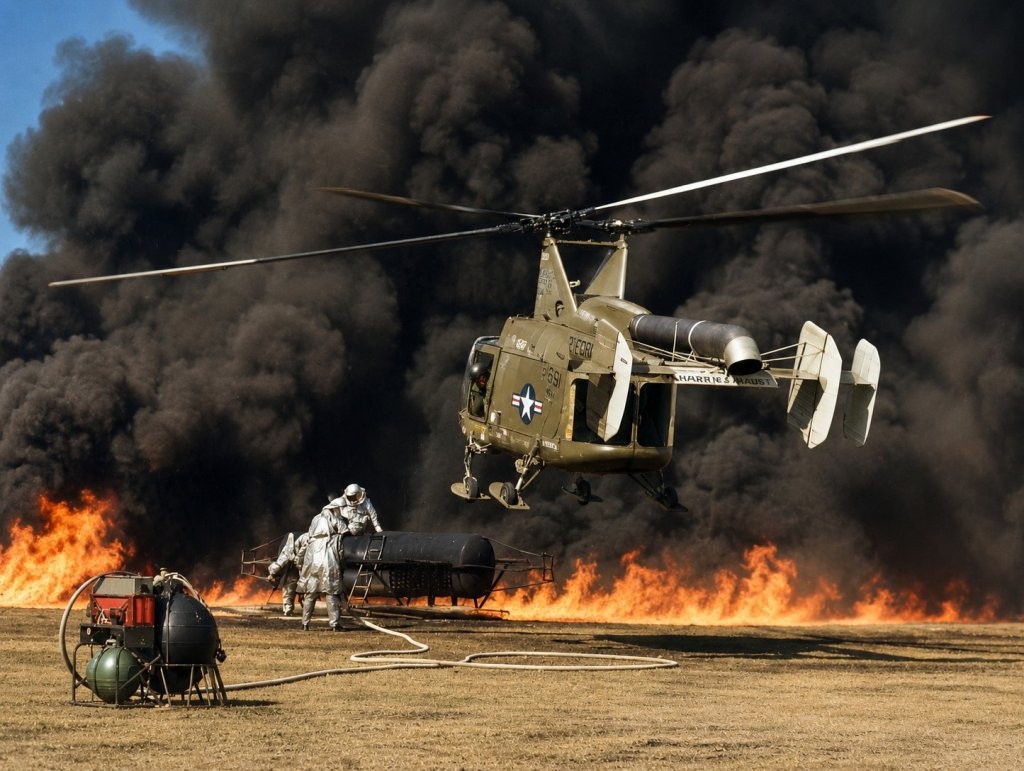
The Air Force did not originally acquire the Huskie to penetrate enemy territory looking for downed fighter pilots. Its principal mission was much closer to home: Local Base Rescue, usually abbreviated LBR, and aircraft crash firefighting.
The idea was wonderfully straightforward. If an aircraft crashed on or near an airfield, the first few minutes could determine whether the crew lived or died. Fire trucks were effective, but they had to follow roads or cross whatever terrain lay between the station and the wreck. A helicopter did not. An HH-43 kept on rescue alert could be airborne in approximately one minute, carrying a fire-suppression system suspended beneath the aircraft.
The special suppression kit developed at Wright-Patterson Air Force Base weighed about 1,000 pounds. Its tank held 83 gallons of water and foam concentrate, but the mixture expanded at the nozzle to produce roughly 690 gallons of firefighting foam. The HH-43 could pick the unit directly from its trailer as an external load and race toward the accident site.
Then the Huskie's peculiar rotor system became part of the rescue technique. The helicopter could hover near the burning wreck while its enormous rotor wash pushed flame, heat and smoke away from a path toward the aircraft. Firefighters on the ground sprayed foam into that corridor and moved toward trapped aircrew. In some emergencies the HH-43 could arrive before conventional crash trucks. The helicopter was not merely transporting rescuers to the fire. Its rotor wash was being deliberately used as a firefighting tool.
That mission became important enough that HH-43s and their suppression kits were placed on precautionary alert for presidential aviation. The National Museum records that HH-43 units at Andrews Air Force Base provided airborne crash-rescue protection for Presidents John F. Kennedy, Lyndon B. Johnson and Richard Nixon, including presidential helicopter movements and Air Force One arrivals and departures at Andrews.
The HH-43B
The turbine-powered HH-43B became one of the best-known versions. The National Museum lists it with a Lycoming T53 turbine producing 860 horsepower, a maximum speed of approximately 120 mph, a range of about 185 miles, and a service ceiling of roughly 25,000 feet. Its intermeshing rotors measured approximately 47 feet in diameter, while the overall aircraft length was also about 47 feet. It carried no fixed armament.
That last point becomes important when discussing what happened next.
For local crash rescue, the Huskie's limited range was perfectly reasonable. The airplane it needed to reach had normally crashed somewhere around the airfield. But the United States was about to send increasingly large numbers of aircraft over an entirely different kind of battlefield, where the people needing rescue might be surrounded by enemy troops many miles from the nearest safe base.
The HH-43 was about to be asked to do considerably more than its designers originally intended.
Pedro Goes to Vietnam
The first USAF H-43As had been delivered in November 1958, followed by the B model in June 1959. In 1962, the Air Force changed the designation from H-43 to HH-43, emphasizing its rescue mission. The final USAF production development was the HH-43F, which incorporated engine changes intended to improve performance.
As American involvement in Southeast Asia expanded, Air Force rescue capability had to expand with it. HH-43s were sent to Da Nang and Bien Hoa in South Vietnam and Nakhon Phanom in Thailand during 1964. The little rescue helicopters became unofficially known as “Pedros,” taken from the radio call sign used by the units. Until larger Sikorsky rescue helicopters began arriving in late 1965, the HH-43 was the Air Force's only dedicated rescue helicopter in the theater.
That was a staggering expansion of mission.
The aircraft built to fly several miles from an airfield and reach a burning jet was now being used to recover men from combat zones. Its lack of armament, modest speed and limited radius imposed serious restrictions. The HH-43 could not simply charge hundreds of miles into North Vietnam and conduct the kind of deep rescue operation later associated with the HH-3 and HH-53 Jolly Green Giants. But around bases and within reachable combat areas, the Pedros began doing something enormously important: they proved that dedicated helicopter rescue could save airmen and ground troops who otherwise had little chance of getting out.
The Vietnam rescue system that eventually developed around Jolly Green helicopters, A-1 Skyraider “Sandy” escorts, HC-130 support aircraft, pararescuemen and fighter protection did not suddenly appear fully formed. It evolved under pressure because men were being shot down and somebody had to figure out how to bring them home. The HH-43 belonged to the earliest phase of that evolution.
 Hanging Beneath a Pedro
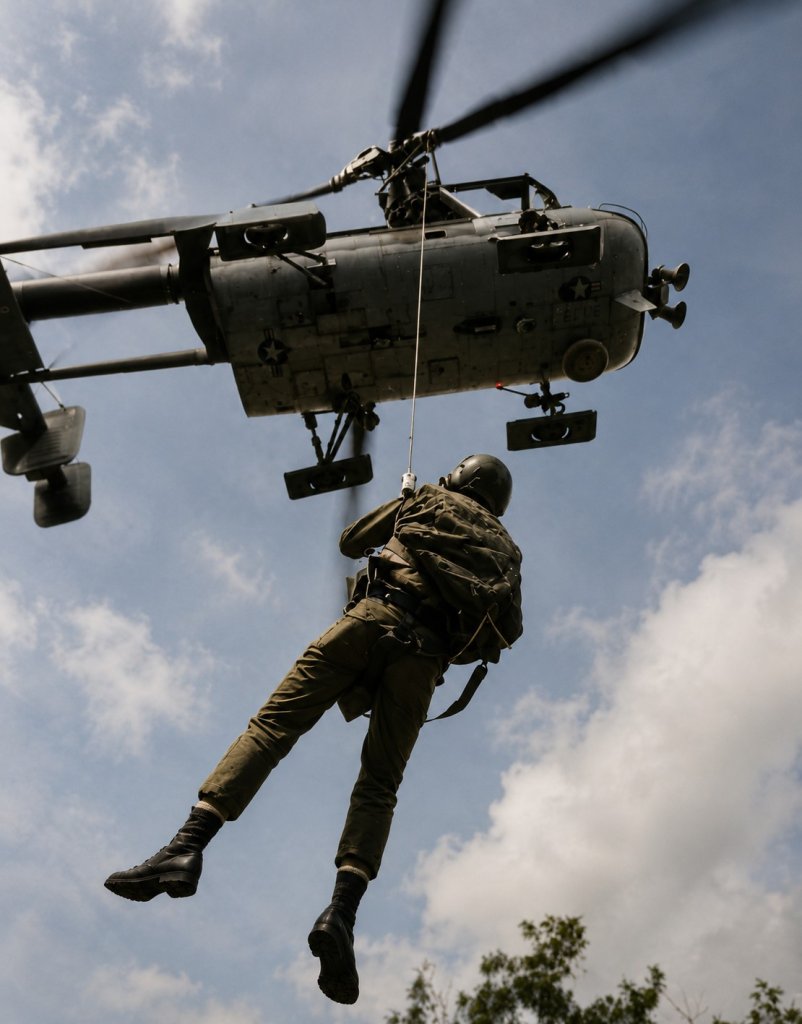
The HH-43's greatest asset in difficult terrain was its rescue hoist. A helicopter did not necessarily need enough open ground to land. If the crew could maintain a hover, a pararescueman could be lowered to the casualty and the injured man could be brought back up.
In Vietnam, that sometimes meant hovering over triple-canopy jungle while a PJ descended through a narrow opening beneath the helicopter. It could mean maintaining a stationary aircraft while enemy soldiers fired upward. It could mean lowering a man into a place so dangerous that everyone else was trying desperately to leave it.
 Few men illustrate that better than Airman First Class William H. “Bill” Pitsenbarger.
Pitsenbarger arrived in Vietnam in August 1965 and had already completed more than 250 missions before his death. On one earlier rescue he had actually hung from an HH-43's cable while helping recover a wounded South Vietnamese soldier from a burning minefield. That action earned him the Airman's Medal as well as South Vietnamese decorations.
Then came April 11, 1966.
Pedro 73
Near Saigon, Charlie Company, 2nd Battalion, 16th Infantry of the 1st Infantry Division became trapped in a vicious battle in dense jungle. Casualties mounted, but the forest canopy prevented conventional Army helicopters from landing. The trees formed several levels, with the tallest reaching around 150 feet. Two HH-43s from Detachment 6, 38th Aerospace Rescue and Recovery Squadron were dispatched to hoist wounded soldiers through the trees. Pitsenbarger was the PJ aboard Pedro 73.
The Pedros hovered in an opening scarcely large enough to contain them and began lifting litter patients from below. The crews could see that the soldiers on the ground were struggling to move and prepare their wounded for evacuation. Pitsenbarger volunteered to go down.
He descended approximately 100 feet carrying medical supplies and weapons and began organizing casualties for the hoist. With his help, the HH-43 crews were able to evacuate nine wounded soldiers over several trips. He could have returned to the helicopter.
He stayed.
When Pedro 73 was badly damaged by ground fire and forced away, Pitsenbarger remained among the infantrymen. As enemy pressure increased and the helicopters could no longer return, he treated the wounded, distributed ammunition and fought alongside the surviving soldiers. He was eventually killed. He was 21 years old.
Years later, infantryman F. David Peters summarized Pitsenbarger's decision in one devastating sentence preserved by the Air Force museum:
“There was only one man on the ground that day that would have turned down a ride out of that hellhole -- and that man was Pitsenbarger.”
Pitsenbarger ultimately received the Medal of Honor. The HH-43 that delivered him into that battle has consequently become part of one of the defining stories in the history of Air Force Pararescue.
The Unarmed Helicopter That Kept Going Back
Pedro crews operated without the defensive firepower later rescue helicopters carried. The HH-43B's official armament was simply listed as none. Its protection lay in crew skill, terrain, supporting aircraft when available and the hope that it could reach the survivor and get away before enemy fire found something critical.
Crew composition depended upon mission. For local base rescue and firefighting, the National Museum lists a six-man crew consisting of pilot, copilot, flight engineer or crew chief, aeromedical technician and two airborne rescuers/firefighters. For aircrew recovery, the normal complement was four: pilot, copilot, pararescue jumper and flight mechanic or engineer.
That last pair deserves attention because the HH-43 story was never merely a pilot's story. Enlisted crew chiefs, mechanics, firefighters, medical personnel and pararescuemen formed much of the Pedro community. When a memorial to HH-43 crews was established at Maxwell Air Force Base, former crewman Len Shults specifically emphasized that most of the personnel who served aboard the helicopters were enlisted Airmen, as were many of the pilots earlier in their careers.
The Pedro crews developed a culture that survived long after the helicopter disappeared from frontline service. The call sign itself outlived the HH-43 and has continued appearing in later Air Force rescue organizations. The aircraft changed. The idea did not: if an American was injured or stranded somewhere dangerous, somebody would launch to get him.
Too Small for the War It Helped Create
The great irony of the HH-43 is that its success helped demonstrate why the Air Force needed something more capable.
As the air war expanded into Laos and North Vietnam, rescue crews needed greater range, payload, survivability and eventually aerial refueling. Larger Sikorsky H-3s began entering the rescue force in late 1965 and became the famous Jolly Green Giants. The still larger HH-53 followed, developing into the heavy combat-rescue helicopter most strongly associated with deep penetration missions.
The HH-43 did not compete with those aircraft because it had never been designed to perform their mission. A 185-mile-range local-rescue helicopter could only be stretched so far before geography won the argument. Instead, Pedros continued serving where their compact size and rescue equipment remained useful, particularly around operating bases and within areas they could reach.
And they kept saving people.
Between 1966 and 1970, Air Force records credited HH-43 crews with those 888 combat saves. Of them, 343 were aircrew and 545 were other personnel. The National Museum describes the HH-43 as both the first USAF rescue helicopter to arrive in Southeast Asia and the last of the type to leave, an extraordinary record for an aircraft that had begun its career primarily as a flying crash truck.
An Odd-Looking Helicopter With an Enormous Legacy
The HH-43 Huskie will probably never occupy the same place in popular memory as the Huey. It was never produced in Huey numbers, did not carry entire infantry squads into landing zones and lacked the cinematic profile of the later Jolly Green Giants. Its intermeshing rotors remain so unusual that photographs of the aircraft often require explanation before people even understand what they are seeing.
That strangeness is part of what makes its history so compelling.
The Huskie was a clever solution to a very specific problem. Two synchronized rotors eliminated the tail rotor. Kaman's servo-flap system controlled the blades. Powerful downwash became an instrument for opening paths through aircraft fires. A helicopter sitting beside a runway could launch in roughly a minute carrying nearly 700 gallons' worth of expanded firefighting foam. Then history changed the assignment. The same aircraft began hovering over jungle clearings while PJs disappeared beneath it on a cable.
The bigger rescue helicopters that followed could fly farther, carry more and survive missions the HH-43 simply could not undertake. They became the giants of Vietnam combat rescue.
But Pedro was there first.
Before the Jolly Green Giant became a symbol of bringing downed airmen home, there was a strange little Kaman helicopter with wooden intermeshing rotors, no tail rotor, no guns and crews willing to hover over places sensible people were trying desperately to escape.
For hundreds of men in Southeast Asia, hearing “Pedro” over the radio meant something remarkably simple.
Somebody was coming to get them.
