Operation Flintlock: The Battle Tarawa Taught America How to Fight
Tarawa was the bloody classroom. Operation Flintlock was the examination, and this time the Americans had learned the material.
August 25, 2026

 Tarawa was not simply a victory. It was a bloody classroom, and the equipment, planning and doctrine that failed there would be changed before the Marines went into the Marshalls. The fighting on Betio ended on November 23, 1943. Little more than two months later, American forces were approaching Kwajalein Atoll. There had barely been time to bury the dead, yet the Navy and Marine Corps were already rebuilding the way America conducted amphibious warfare.
That is what makes Operation Flintlock different from simply being the next island on the map. Kwajalein was where the lessons paid for at Tarawa were put to the test. Those lessons had been purchased during the Battle of Tarawa, Read more about Tarawa here,where Marines attempting to cross Betio's reef were trapped in grounded landing craft or forced to wade hundreds of yards under enemy fire, while surviving Japanese fortifications exposed serious weaknesses in pre-invasion bombardment, reconnaissance and communications. Understanding what changed at Kwajalein begins with understanding what went wrong on Betio.
Rear Admiral Richmond Kelly Turner, who had commanded the amphibious forces at Tara wa and Makin, wasted little time examining what had gone wrong. His November 30 assessment called for better aerial reconnaissance, more submarine scouting, last-minute examination of landing beaches and underwater obstacles, more landing craft, more destroyers available for close gunfire support, and dramatically heavier pre-invasion bombardment. Communications, coordination between ships and troops ashore, control of landing waves, and the ability to move Marines across coral reefs all demanded improvement.
Tarawa had exposed each weakness in the worst possible way. Landing boats had grounded on the reef while Marines waded hundreds of yards under fire. Naval bombardment had appeared devastating from offshore but left too many Japanese bunkers alive. Commanders ashore struggled with radios and communications. No one had adequately examined the reef immediately before the landing to determine exactly what the assault force would encounter.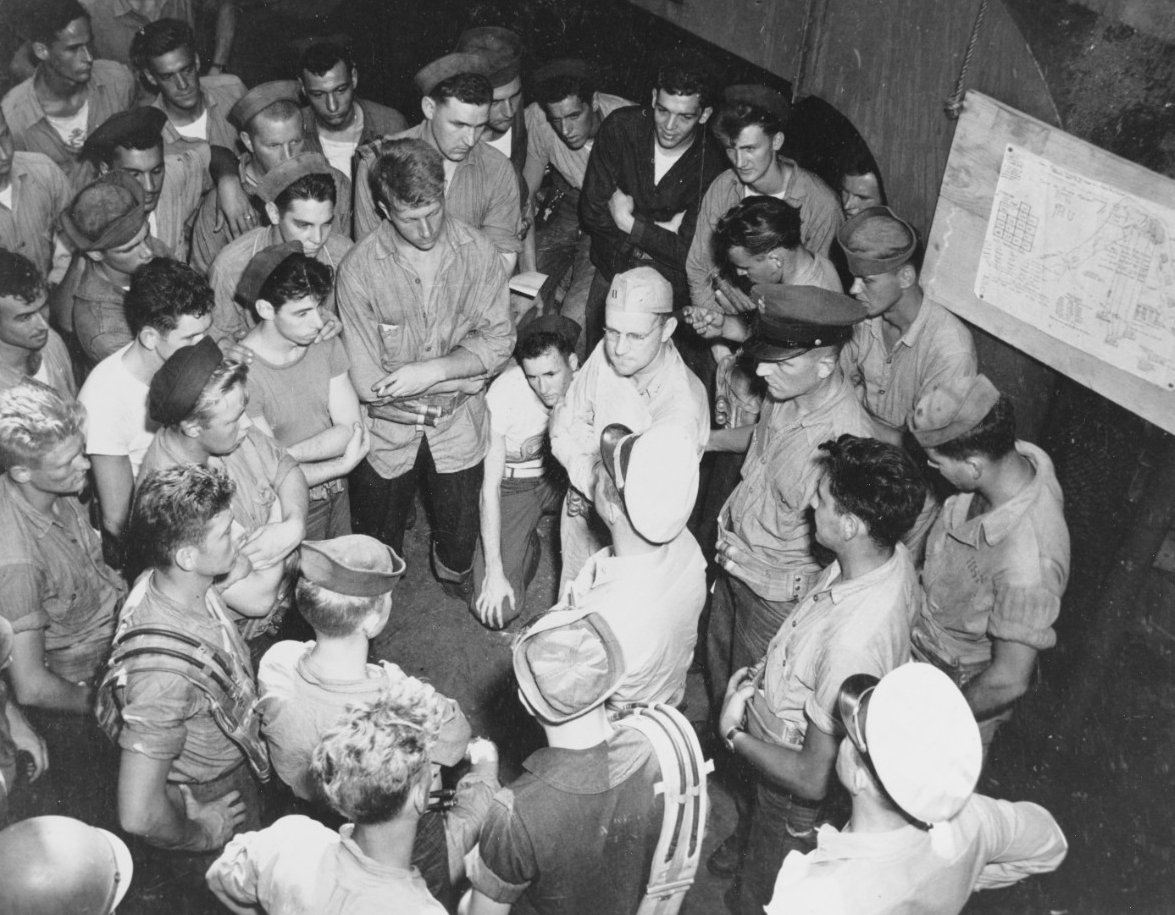
The men headed for the Marshall Islands would carry new answers to nearly all of those problems.
There was also a larger strategic decision to make. Many American commanders believed the prudent approach was to take Japanese-held islands in the outer Marshalls before moving against Kwajalein, near the center of the chain. Vice Admiral Raymond Spruance, Turner, and Marine Major General Holland M. “Howling Mad” Smith all argued for a more cautious advance through Wotje and Maloelap.
Admiral Chester W. Nimitz disagreed.
On December 14, Nimitz ordered his commanders to bypass those heavily defended islands and go directly for Kwajalein. Spruance and Turner considered the idea so dangerous that they continued arguing their case after the meeting. Nimitz finally made it clear that the decision had been made and that, if they did not want to carry it out, he could find commanders who would.
There was a cold logic behind the gamble. If taking another fortified island was going to cost American lives, there was little sense spending those lives capturing places the United States did not actually need. Kwajalein was the objective that mattered. Take it, and the Americans could isolate the Japanese garrisons scattered through much of the rest of the Marshalls rather than assaulting every island one at a time.
For Operation Flintlock, America assembled what was then the largest amphibious assault force of the Pacific war. The Joint Expeditionary Force included nearly 300 ships and approximately 54,000 Army and Marine assault troops. Fast carriers under Rear Admiral Marc Mitscher brought hundreds of aircraft. Battleships, cruisers and destroyers supplied naval gunfire while Army, Navy and Marine aircraft worked to eliminate Japanese air power throughout the region.
But the most important difference was not simply that the force was larger.
It had been redesigned around Tarawa.
More amphibious tractors were available to carry men over the reefs instead of leaving them trapped offshore in conventional landing craft. Newer LVTs carried troops while armored versions provided direct fire support. Landing Craft Infantry had been converted into heavily armed gunboats, some carrying rockets intended to saturate the beaches immediately before the troops arrived. Better command ships and radio procedures addressed the confusion that had plagued earlier assaults. Artillery would be landed on neighboring islands before the principal invasion so that it could fire directly across the lagoon in support of the assault.
 And someone would look at the beaches before thousands of men were ordered onto them.
Out of the disaster at Tarawa had come an urgent requirement for men capable of reconnoitering reefs, locating underwater obstacles and clearing approaches to hostile beaches. The Navy reorganized existing demolition personnel into the first Pacific Underwater Demolition Teams, UDT-1 and UDT-2. They had only weeks to organize and train before Flintlock.
At Kwajalein, the new concept went to war.
The assault began on January 31, 1944, not with a headlong attack on the main islands, but with carefully planned seizures of smaller islands controlling entrances to the enormous lagoon. Once secured, those positions became artillery sites and opened protected passages through which landing ships, troops and supplies could move. The Americans were no longer treating the reef and surrounding islands merely as obstacles. They were using the geography of the atoll as part of the attack.
In the north, the objective was Roi-Namur, two connected islands containing an important Japanese air base. American intelligence suggested they might be even more dangerous than Betio. This time, however, the defenders would not meet Marines emerging from an inadequate bombardment.
American aircraft and warships hammered Roi-Namur for days. Battleships sometimes fired from scarcely a mile offshore. Approximately 6,000 tons of naval ammunition fell on the islands, compared with roughly 2,400 tons used at Tarawa. Japanese aircraft were destroyed and fortifications smashed while Marine artillery, positioned on neighboring islands captured the previous day, added its own fire.
During the early hours of February 1, Navy scouts moved toward the beaches in rubber boats to check the approaches. At daylight, the newly organized underwater demolition men conducted further reconnaissance, looking for obstacles and confirming that the assault force would not encounter another reef-and-tide catastrophe like Tarawa.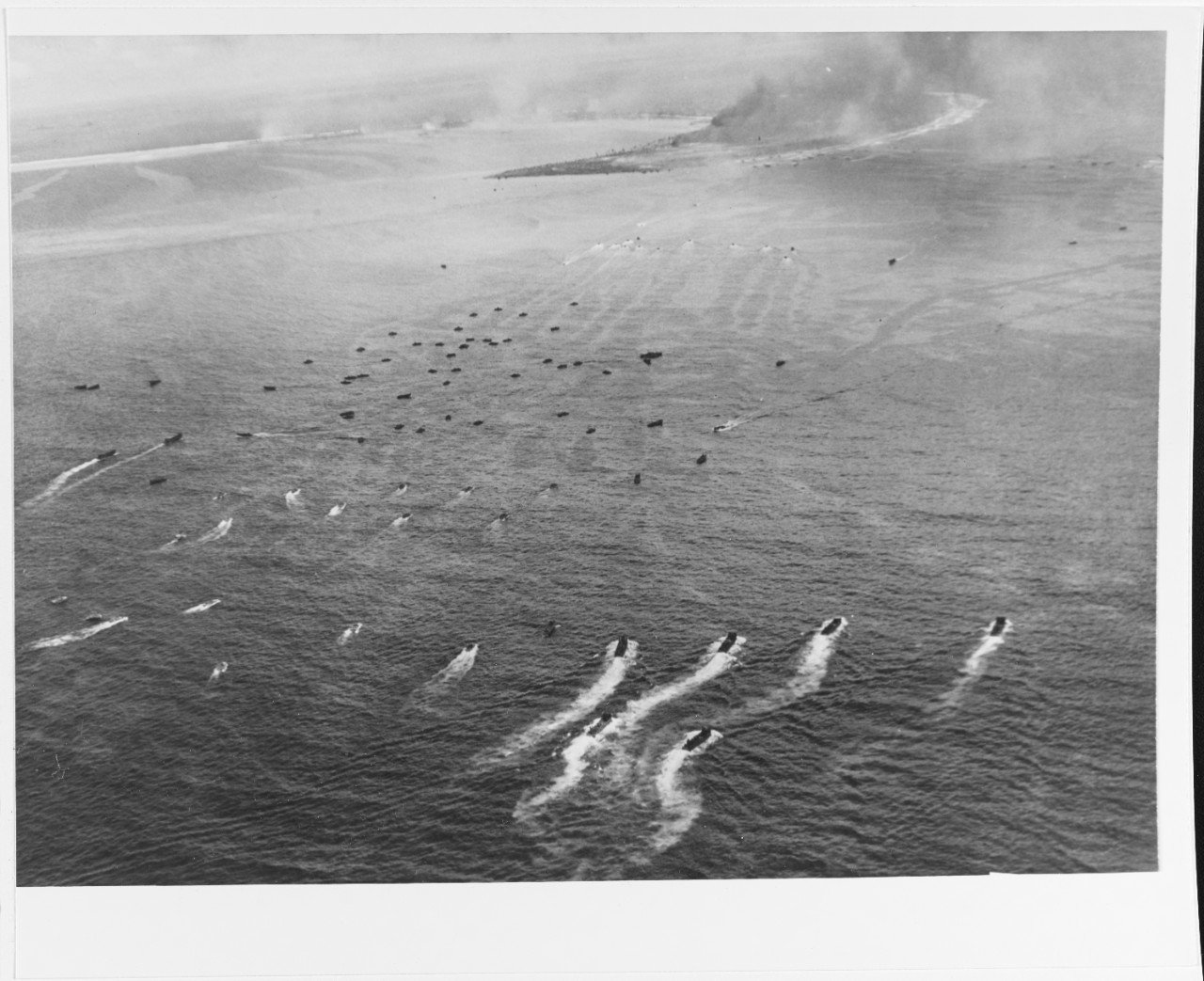
Then the gunfire resumed.
One of the destroyers moving dangerously close to the shoreline was USS Johnston. Her commanding officer, Lieutenant Commander Ernest E. Evans, developed an early reputation during Flintlock for taking his ship closer to enemy-held beaches than seemed particularly healthy for either ship or captain. Marines ashore benefited from the accurate fire of Johnston's guns. Eight months later, Evans and Johnston would charge a vastly superior Japanese fleet off Samar in one of the most extraordinary surface actions in United States naval history.
Shortly before noon on February 1, the 4th Marine Division began landing on Roi and Namur. This was the division's first battle. Activated only months earlier, it had sailed directly from the United States into combat.
The Marines attacking Roi discovered what sustained bombardment could accomplish. Japanese resistance near the beach was initially so weak that elements of the 23rd Marines had to be careful not to advance into their own supporting fire. Tanks and infantry pushed across the devastated airfield, and Roi fell rapidly.
Namur was different. The vegetation was heavier, the defenses stronger and the surviving Japanese more capable of fighting back. The 24th Marines advanced through blockhouses, trenches and shattered defensive positions, using tanks, flamethrowers, demolition charges, rifles and grenades to eliminate strongpoints one by one.
Then the island seemed to explode.
A Marine demolition charge ignited a Japanese munitions bunker containing aerial bombs and torpedo warheads. The resulting detonation killed 20 Marines and wounded approximately 100 more. A black cloud climbed hundreds of feet above the island, debris crashed across the battlefield, and the shock was reportedly powerful enough to knock an American artillery observation aircraft from the sky.
 The bombardment had made the assault possible, but Flintlock was not bloodless. Men still had to walk into the surviving bunkers.
Four members of the 4th Marine Division would receive the Medal of Honor for actions at Roi-Namur: PFC Richard B. Anderson, Lieutenant Colonel Aquilla J. Dyess, First Lieutenant John V. Power and Private Richard K. Sorenson. Power continued attacking Japanese positions after suffering a severe abdominal wound and was killed while assaulting another pillbox. Sorenson survived after throwing himself onto a Japanese grenade to protect the five Marines sharing his shell hole. The improved machinery of amphibious warfare could carry men farther and protect them longer, but eventually the battle still came down to individuals closing with fortified positions at terrifyingly short distances.
By the afternoon of February 2, Roi-Namur was secure.
Forty-five miles to the south, the Army's veteran 7th Infantry Division was conducting the other half of Flintlock against Kwajalein Island. Soldiers had already seized nearby islets and established artillery positions before the main landing. Five artillery battalions on neighboring islands could now fire directly onto the Japanese defenses while warships and aircraft added their own bombardment.
At 7:00 on the morning of February 1, battleships, cruisers and destroyers opened the final preparation. Thousands of naval shells struck the landing area. Artillery from the nearby islands joined them, firing tens of thousands of rounds during the day. Aircraft bombed and strafed the defenses.
At 9:30, the fire shifted inland.
The 7th Infantry Division came ashore.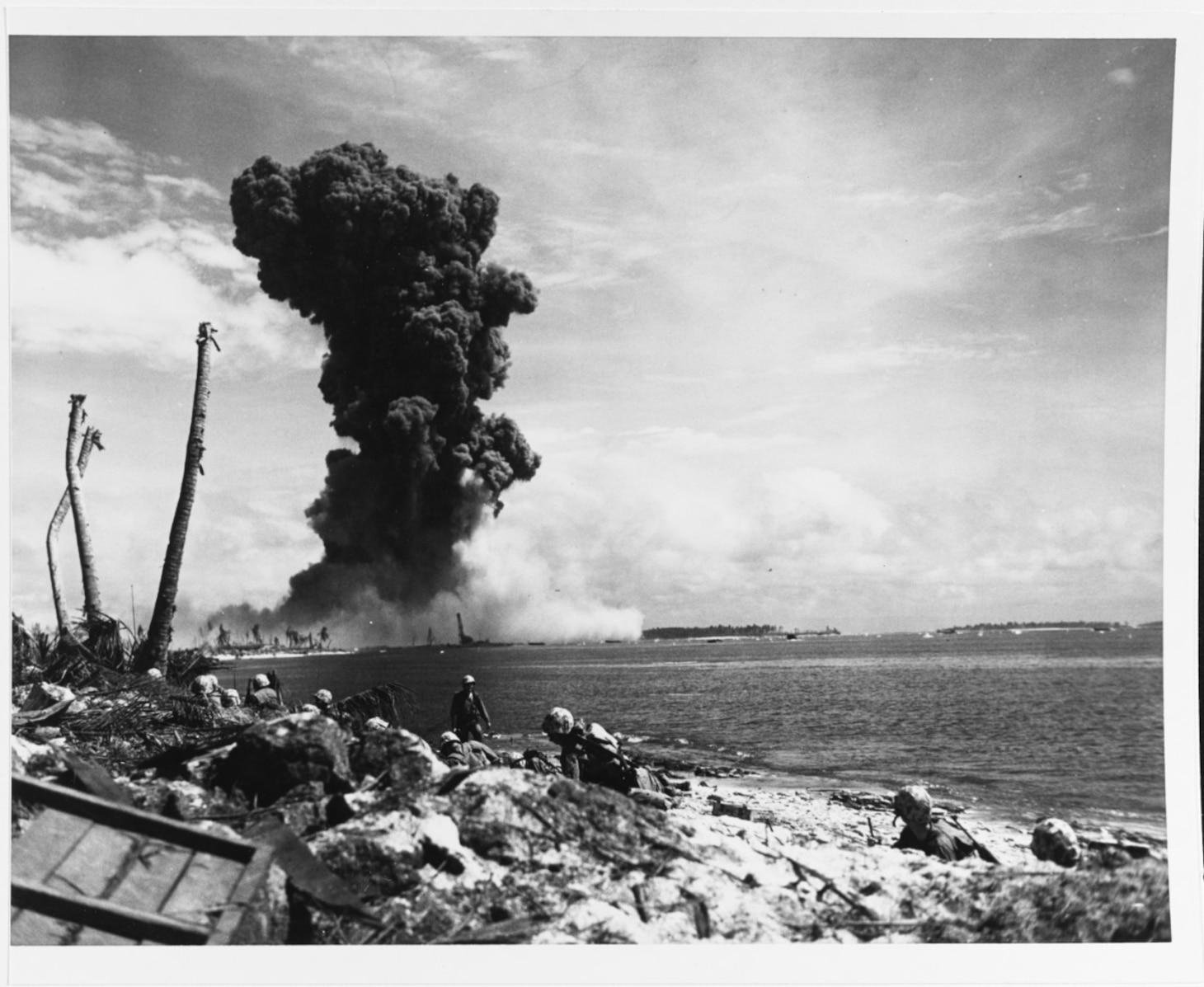
Within approximately twelve minutes, about 1,200 soldiers had landed without suffering a casualty during the initial crossing of the beach. That fact alone provides perhaps the clearest comparison with Tarawa. At Betio, Marines had been dying hundreds of yards offshore as landing craft hung on the reef. At Kwajalein, tracked amphibious vehicles carried the assault force through the approaches while carefully coordinated naval gunfire, artillery and aircraft kept the defenders pinned down.
The battle was not over. Japanese troops survived the bombardment and fought from bunkers, trenches and concealed positions. The soldiers of the 32nd and 184th Regimental Combat Teams used methods they had practiced repeatedly during training in Hawaii. Infantry, tanks, flamethrowers and demolition teams worked together against individual strongpoints. A bunker that resisted grenades might be attacked with flame. If that failed, explosives or an armored vehicle could finish the job. Instead of improvising under fire, the Americans increasingly arrived with a method for solving the problem.
Kwajalein Island was declared secure on February 4. By February 7, American forces had completed landings on some 30 islands around the atoll. No American ship had been sunk during the operation.
The casualty figures show both the success of the new methods and the brutality that remained. Naval History and Heritage Command records 372 American soldiers and Marines killed during the overall operation. The Japanese garrisons and attached labor forces at Roi-Namur and Kwajalein numbered more than 8,600, and only a few hundred survived to become prisoners.
 Those 372 American dead were not evidence that Flintlock had somehow made amphibious warfare easy. Every one represented a family that received the same telegram a family had received after Tarawa. But compared with the roughly 1,000 Marines and sailors killed during the much smaller fight for Betio, the difference was extraordinary.
Tarawa's dead had changed the way the next battle was fought.
Flintlock also produced lessons of its own. The Americans had demonstrated that fortified islands could be overwhelmed through carefully integrated naval gunfire, air power, artillery, armor, amphibious vehicles, reconnaissance and infantry. The Japanese understood the demonstration as well. Trying to stop American assaults at the water's edge had become increasingly suicidal under the weight of American firepower. Future Japanese defenses would increasingly move inland, underground and into caves, forcing American troops to dig them out rather than destroying them from offshore.
That adaptation would help make later battles at places such as Peleliu, Saipan and Iwo Jima very different wars from the one fought at Kwajalein.
Strategically, Flintlock ripped open the Central Pacific. The capture of Kwajalein and essentially undefended Majuro provided fleet anchorages and airfields deep inside territory Japan had controlled before the war. Bypassed Japanese bases elsewhere in the Marshalls could now be isolated and neutralized rather than invaded. Success came so quickly that the planned assault on Eniwetok was moved forward, and American carrier forces were soon striking the great Japanese base at Truk. Beyond the Marshalls lay the Marianas, and beyond the Marianas lay Japan itself.
There is another reason Operation Flintlock deserves to stand beside Tarawa rather than disappear beneath it. One of the organizations born from the lessons of Betio made its first operational appearance here. The men examining those reefs and beaches at Kwajalein belonged to the beginning of the Underwater Demolition Team story, a lineage that would continue through the Pacific War, Korea and Vietnam and ultimately into the modern Navy SEALs. For Ghosts of the Battlefield, where the surviving photographs, uniforms and artifacts of later UDT sailors help preserve that history, Flintlock provides the missing first chapter.
War rarely offers clean lessons. Usually it teaches by exposing a failure and presenting the bill in human lives. Tarawa showed the United States what was wrong with its amphibious warfare system. At Kwajalein, barely two months later, sailors, Marines and soldiers went ashore with many of those failures corrected. They still fought, bled and died, but thousands of men were alive at the end of Flintlock because someone had studied what happened on Betio instead of simply calling it a victory and moving on.
Support the preservation of America's military history.