Green Hornets: The Air Force Hueys That Flew Into the Secret War
The 20th Special Operations Squadron, MACV-SOG, and the Men Who Went Back Into the Fire
August 21, 2026


There were places in Southeast Asia where American troops were fighting a war the United States government did not officially want to admit was being fought. Small reconnaissance teams crossed borders into Laos and Cambodia, searching for enemy troop movements, supply routes, headquarters, truck parks and installations connected to the Ho Chi Minh Trail. Their missions were classified, their teams deliberately small, and once they crossed the fence there was very little separating them from thousands of enemy soldiers except concealment, a radio and the promise that someone would come if everything went wrong. For many of those men, the sound they hoped to hear when that promise was tested was the rotor beat of a U.S. Air Force Huey.
 They were the Green Hornets of the 20th Special Operations Squadron, and they flew some of the most dangerous helicopter missions of the Vietnam War. The Green Hornets carried Special Forces reconnaissance teams into enemy territory and went back after them when those teams were discovered. They provided gunship cover, rescued downed airmen, supported unconventional warfare operations and routinely operated so close to the enemy that their helicopters came home riddled with holes. There was little glamorous about the work. Crews waited at remote forward locations, slept near their aircraft, launched when the call came and sometimes flew directly into places where another helicopter had already been shot down. That was the job. And remarkably, much of it remained largely unknown to the American public for decades because many of the missions themselves were secret.
The unit's story in Southeast Asia actually began before anyone called them Green Hornets. In November 1965, the 20th Helicopter Squadron was activated at Tan Son Nhut Air Base with fourteen Sikorsky CH-3C helicopters. Those larger helicopters provided vertical airlift into remote areas, supported combat control and airfield survey teams, evacuated casualties and performed rescue missions. Within months the squadron was flying an extraordinary tempo, averaging nearly 1,000 sorties per month from locations that included Tan Son Nhut, Da Nang and Cam Ranh Bay. The squadron moved to Nha Trang in 1966 and became increasingly involved in unconventional warfare. A detachment of its CH-3s deployed to Nakhon Phanom Royal Thai Air Force Base and became known as the Pony Express, conducting missions that soon included classified flights into Laos, support for irregular forces and the insertion of reconnaissance teams into areas where American military involvement was deliberately kept out of public view. In June 1966, CH-3 crews of the 20th flew their first infiltration mission from South Vietnam into North Vietnam, inserting a reconnaissance team just north of the Demilitarized Zone. By the end of that year, the H-3 crews had flown hundreds of infiltration sorties. The groundwork had been laid for something even more specialized.
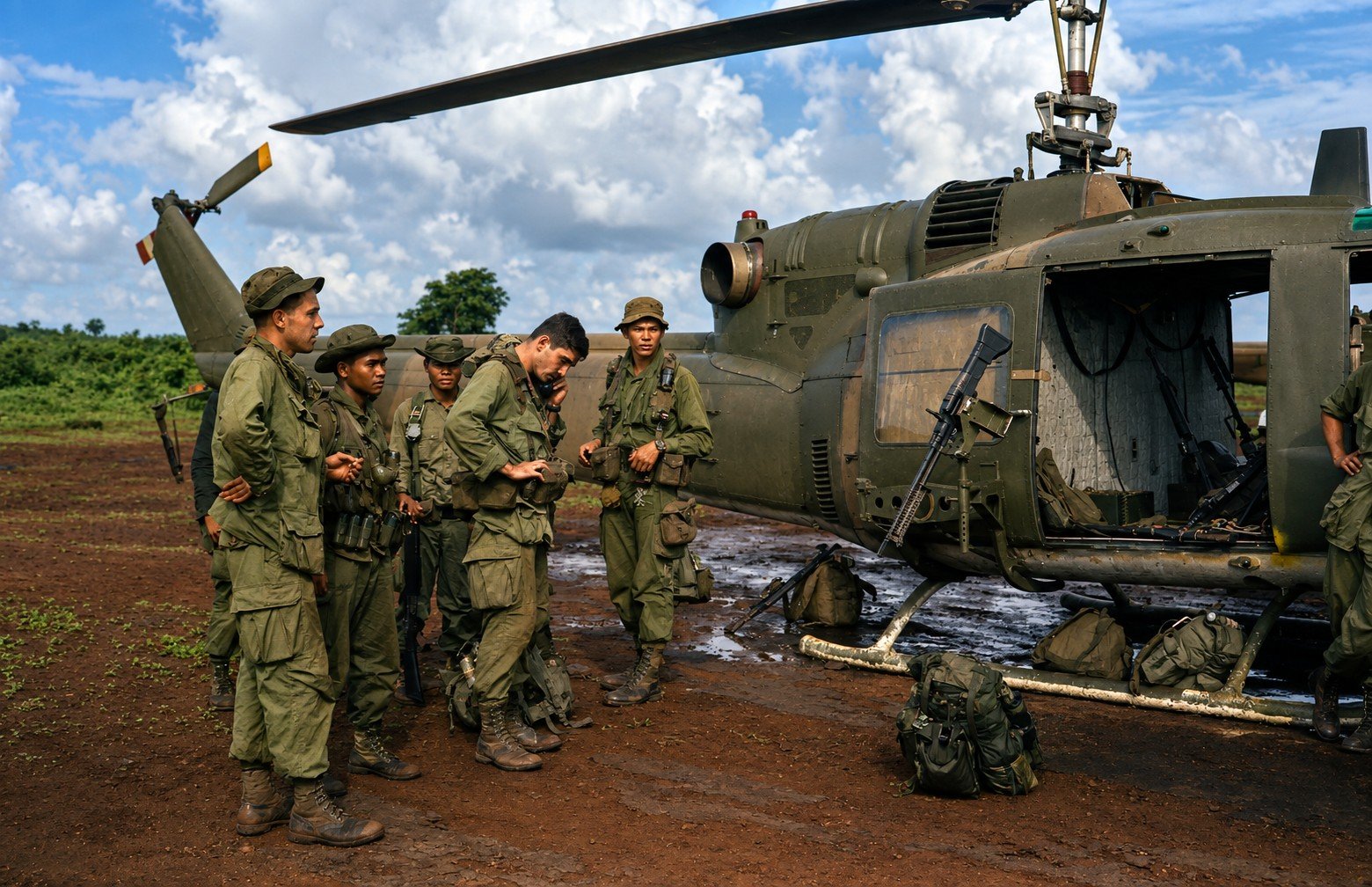
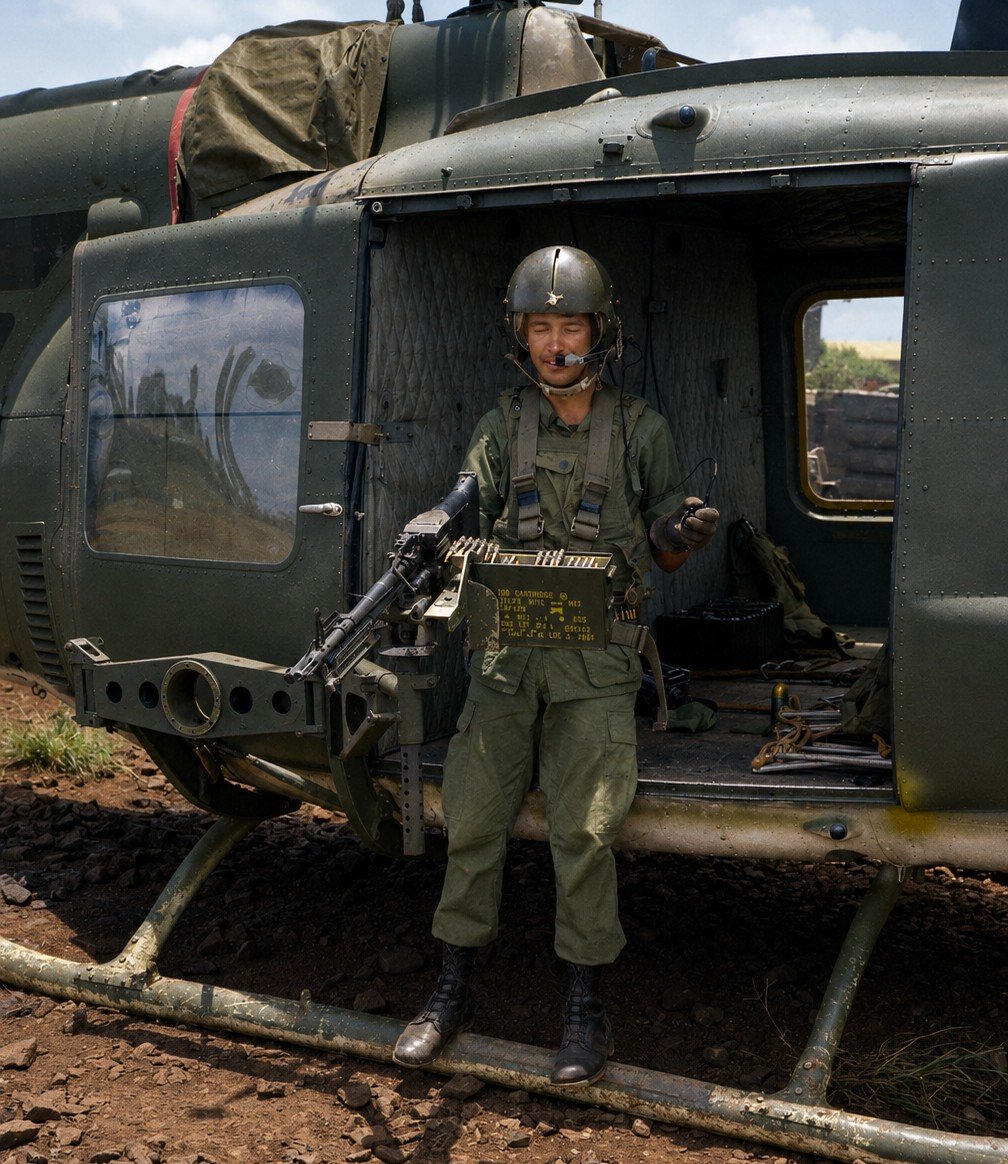
 In June 1967, fifteen UH-1F/P Hueys joined the squadron. With them came a name that would outlive the Vietnam War itself: Green Hornets. These were not quite the same Hueys most people picture when they think about Vietnam. The Air Force UH-1F used a General Electric T58 turbine, and the Green Hornets eventually operated both transport and heavily armed versions of the aircraft. The F-models served principally as troop-carrying slicks, while the P-models became gunships. Early door gunners used M60 machine guns suspended on bungee cords, while gunships eventually carried GAU-2B/A 7.62mm miniguns and pods firing 2.75-inch rockets. The miniguns could be fixed forward for the pilot or aimed from the cabin by the gunners.
Even the aircraft's appearance reflected the nature of the mission. Green Hornet Hueys carried remarkably little identifying information. Most normal markings were removed, leaving serial numbers and a small hornet insignia painted on the aircraft. Sometimes the secrecy went further. Green Hornet personnel occasionally flew missions with civilian crews employed by Air America, and on some of those flights American servicemen wore civilian clothing so the United States could maintain plausible deniability if an aircraft went down. Somewhere in the machinery of the Vietnam War, the United States had created an Air Force helicopter squadron flying minimally marked Hueys, occasionally carrying Americans dressed as civilians into countries where American combat troops were supposedly not operating. Reality had managed to outdo fiction without even breaking stride.
Across the Fence
The reason for all that secrecy lay beyond South Vietnam's borders. North Vietnam's supply network ran through supposedly neutral Laos and Cambodia. What Americans collectively called the Ho Chi Minh Trail was not a single road but an enormous network of trails, roads, storage areas, truck parks, headquarters and concealed facilities feeding men and equipment toward South Vietnam. The United States desperately wanted intelligence from those areas while publicly maintaining the appearance of respecting Laotian and Cambodian neutrality.
Small reconnaissance teams, frequently composed of U.S. Special Forces personnel and indigenous soldiers, therefore crossed the borders on missions whose existence remained highly classified. Operations in Laos carried names including SHINING BRASS and later PRAIRIE FIRE. In 1967, covert reconnaissance expanded into Cambodia under DANIEL BOONE, later renamed SALEM HOUSE. These missions became closely associated with the Military Assistance Command, Vietnam Studies and Observations Group, better known as MACV-SOG.
The Green Hornets became part of the lifeline connecting those men to the outside world. A reconnaissance team might consist of only a handful of men moving through territory filled with North Vietnamese and Viet Cong forces. Their greatest defense was remaining unseen. Once compromised, however, a team could quickly find itself hunted by forces many times its size. Sometimes enemy soldiers would deliberately herd a reconnaissance team toward terrain where they believed helicopters could not reach them. Other times they surrounded the team and simply waited for the Americans to attempt an extraction.
Then the radio call went out.
And helicopters that knew perfectly well what was waiting for them turned toward the sound of gunfire.
One mission came to define the Green Hornets. On November 26, 1968, a flight of five Green Hornet Hueys consisting of two gunships and three transports was returning toward Duc Co to refuel and rearm when an emergency call arrived. A six-man reconnaissance team called RT Chisel was in serious trouble. The team included Staff Sergeant Ancil "Sonny" Franks, Sergeant Charles Hughes, Captain Randolph Harrison and three indigenous Montagnard soldiers. They had been operating as part of the clandestine Daniel Boone program near the Cambodian border when they encountered a much larger enemy force and were driven back toward a river.
The Green Hornets were already low on fuel, but they turned around.
As the helicopters reached Chisel's position, the gunships attacked enemy positions with miniguns and rockets. Almost immediately, one was hit and forced into an autorotation. Another Green Hornet transport went after the downed crew and managed to get them out before enemy soldiers reached the crash site. A second transport eventually had to leave because of its fuel state. That left one gunship and one transport Huey.
 The transport was flown by 1st Lieutenant James P. Fleming.
Fleming attempted to bring his UH-1F into a tiny clearing beside the river. There was no conventional landing zone. He maneuvered the aircraft with its nose toward the bank and much of the helicopter hanging over the water while enemy gunners concentrated their fire on it. The reconnaissance team could not reach him, forcing Fleming to back away. He could have left. His fuel was dangerously low, another helicopter had already been shot down and enemy troops now knew exactly where he was going to return.
Instead, Fleming circled for another attempt.
Major Leonard Gonzales brought the remaining gunship between the enemy and the trapped team and attacked at treetop level while Fleming returned toward the river. The Chisel team had placed Claymore mines around its position. As the men broke for the helicopter with enemy soldiers close behind them, the mines were detonated. Fleming held the Huey while his gunners fired into the enemy and helped drag the reconnaissance soldiers aboard. Staff Sergeant Fred Cook, one of the door gunners, later remembered the incoming fire as being "so thick you could walk on it." Cook fired his M60 with one hand while pulling men into the aircraft with the other.
Then Fleming backed the Huey away over the river. Enemy fire shattered the windshield, yet somehow Fleming, his crew and all six members of RT Chisel escaped without being hit. The helicopter returned to Duc Co carrying numerous bullet holes and with its fuel tanks nearly empty.
James Fleming received the Medal of Honor. Gonzales received the Air Force Cross. Fleming's copilot, Major Paul McClellan, received the Silver Star. Door gunners Fred Cook and Paul Jensen received Distinguished Flying Crosses, while other participating Green Hornets received additional decorations for their roles in the rescue.
Years later, Cook stood in front of a museum display depicting the mission and offered perhaps the best explanation of what made the Green Hornets remarkable. "I would almost say that was our norm." The day before, he remembered, they had flown a mission nearly as bad. The day after Fleming's rescue, another Green Hornet aircraft was shot down. One of the most celebrated helicopter rescues of the Vietnam War had simply been another couple of days at work.
 The Men in the Back
 The Men in the Back
Fleming's mission became famous because it resulted in a Medal of Honor, but focusing only on the pilots misses half the Green Hornet story. The men in the back were flight mechanics, crew chiefs and gunners who often leaned from open helicopters while directing pilots around trees, watching tail-rotor clearance, dragging wounded men aboard and firing machine guns almost completely exposed to enemy fire.
Former Green Hornets Eric L. Roberts II and Ronald W. Brodeur demonstrated exactly what that meant on February 20, 1969. Their crew was sent to rescue another six-man reconnaissance patrol near Duc Lap. The team had been compromised and driven toward a river. Enemy troops set the surrounding field on fire, apparently attempting to force the soldiers from cover while simultaneously making a helicopter landing nearly impossible.
The Green Hornet came anyway.
There was not enough room for a normal landing. Roberts and Brodeur moved onto the helicopter's skids, secured by safety harnesses, where they could help direct the pilots around the trees while firing their M60s. Then a Claymore mine exploded beneath them. The blast threw Brodeur from the helicopter and left him hanging from his harness. Roberts was hurled inward. The copilot's door had been blown open, exposing the copilot to enemy fire. Brodeur hauled himself back toward his weapon while Roberts disconnected his safety harness, climbed outside onto the skid of the hovering Huey under fire, worked his way forward and closed the copilot's door before returning to his gun.
The helicopter remained in position long enough to get the patrol aboard. The final soldier was hit in the back as he climbed into the aircraft, but the bullet struck his radio rather than entering his body. Every member of the patrol survived.
The pilots received Silver Stars in 1969. Roberts and Brodeur did not. Their award paperwork disappeared into a bureaucratic maze complicated by the classified nature of what they had actually been doing. They eventually received Distinguished Flying Crosses in 1984, but efforts to properly recognize their actions continued. It took 46 years. In December 2015, the Chief of Staff of the Air Force finally pinned Silver Stars on Roberts and Brodeur at the Pentagon.
Their story also preserves another side of Green Hornet life, one that decorations rarely capture. The Huey involved was nicknamed Patches, and the name was appropriate. There were periods when the squadron had only a handful of UH-1s available, and those aircraft were used relentlessly. Battle damage could not simply send a helicopter to the back of some enormous replacement line. Maintainers repaired the holes, replaced damaged components, inspected the aircraft and prepared it to fly again. Brodeur remembered Patches returning with large holes in her skin and even branches embedded in the rotor blades. Then the maintenance crews stayed up and repaired her because she might be needed again the next morning.
That small detail says a great deal about the Green Hornets. The spectacular rescues depended upon people whose names rarely appeared in newspapers or medal citations. Mechanics, crew chiefs and support personnel kept battered machines in the air because somewhere beyond the wire another reconnaissance team would eventually make that radio call.
The Price
The Green Hornets' reputation was not created without cost. On March 31, 1967, Major Robert Lanoue Baldwin volunteered to fly an unarmed UH-1F into heavy fire to evacuate wounded American and Allied personnel. His helicopter was repeatedly struck by automatic weapons fire. Baldwin himself was badly wounded, but he managed to deliver ammunition and water and began evacuating casualties before the aircraft was hit again and crashed. Even while seriously wounded, Baldwin attempted to help others until he lost consciousness. He later died from his wounds and was posthumously awarded the Air Force Cross.
Sergeant Russell Melvin Hunt, the helicopter mechanic aboard Baldwin's aircraft, was wounded in the same action. Hunt helped other wounded men after the crash and assisted in carrying the mortally wounded Baldwin toward an extraction point. At the landing zone he exposed himself to hostile fire while directing rescue helicopters and refused evacuation until the seriously wounded had been removed. Hunt also received the Air Force Cross.
Losses accumulated as the missions continued. During just the latter half of 1968, members of the 20th received six Silver Stars and eleven Purple Hearts, while several Air Force Crosses went to squadron airmen during the height of the fighting. By the time the Green Hornets left Southeast Asia, nineteen of their Hueys had been lost, thirteen of them to enemy action.
Beginning in November 1970, the squadron began replacing its single-engine UH-1F/P aircraft with the twin-engine UH-1N. By January 1971 the transition was complete, but the new helicopters did not mean safer work. During their first three months flying the UH-1N, Green Hornet crews flew hundreds of combat missions and thousands of flight hours while expending enormous quantities of minigun ammunition, rockets and 40mm grenades in support of Special Forces, reconnaissance and rescue operations. The machinery had changed. The mission had not.
Find the men on the ground.
Get to them before the enemy did.
Put enough fire around the helicopter to survive.
Bring home everyone who could still be brought home.
 They Went Back
 They Went Back
The 20th Special Operations Squadron was deactivated in 1972 as American involvement in Vietnam drew down, but the Green Hornet name did not disappear. The squadron eventually returned to service and carried its special operations heritage through later generations of aircraft and conflicts. Decades after Hueys slipped across Southeast Asian borders, Green Hornets would fly the MH-53 Pave Low and later the CV-22 Osprey. Aircraft, weapons and technology changed enormously, but the basic idea behind the mission remained remarkably familiar: penetrate hostile territory, deliver special operations forces and return to get them.
For the men who had flown those missions in Vietnam, however, recognition came slowly. In 2016, veterans of the Vietnam-era Green Hornets gathered at the National Museum of the United States Air Force for the dedication of an exhibit depicting the rescue of RT Chisel. Standing beside younger members of the 20th Special Operations Squadron were men who had once flown missions they could barely discuss after returning home.
The secrecy that protected those operations also helped bury their story.
James Fleming's Medal of Honor tells part of it. Robert Baldwin and Russell Hunt tell another. Eric Roberts and Ronald Brodeur tell another. So do Fred Cook, Paul Jensen and Leonard Gonzales. Then there were the maintainers who patched bullet holes through the night, the men who loaded ammunition, the crews waiting beside running helicopters at forward bases and countless others whose names never became famous.
The Special Forces teams crossing the fence knew what discovery could mean. They knew how badly they were outnumbered, and they knew there were places where no helicopter should reasonably have been able to reach them.
But they also knew something else.
Somewhere behind them were crews waiting for the call.
When that call came, the Green Hornets did not ask whether the landing zone was good enough, whether the enemy fire was too heavy or whether another helicopter had already been shot down trying.
They went back.
Again and again, they went back.
And that may be the simplest way to explain why the Green Hornets of the 20th Special Operations Squadron earned their place among the most extraordinary helicopter units of the Vietnam War.
They went back.

Sources
National Museum of the United States Air Force, Secret War: Green Hornets, Dust Devils and Blackbirds.
Air Force Special Operations Command, historical study of the 20th Special Operations Squadron and Air Force special operations in Southeast Asia.
National Museum of the United States Air Force, material on James P. Fleming and the rescue of RT Chisel, November 26, 1968.
Air & Space Forces Magazine, Lifesavers Along the Trail, covering Eric Roberts, Ronald Brodeur and the February 20, 1969 rescue mission.
Air Force Special Operations Command, 20th SOS Salutes Veteran Green Hornets.
Military Times Hall of Valor, citations and biographical information for Major Robert L. Baldwin and Sergeant Russell M. Hunt.
U.S. Air Force historical material concerning Green Hornet UH-1F/P and UH-1N operations in Southeast Asia.