From the Naktong to Inchon: The Story of a Marine
This is the story of a Marine. Not a famous Marine, not a general whose name would eventually appear on maps and monuments, and not even necessarily one man.
September 3, 2026

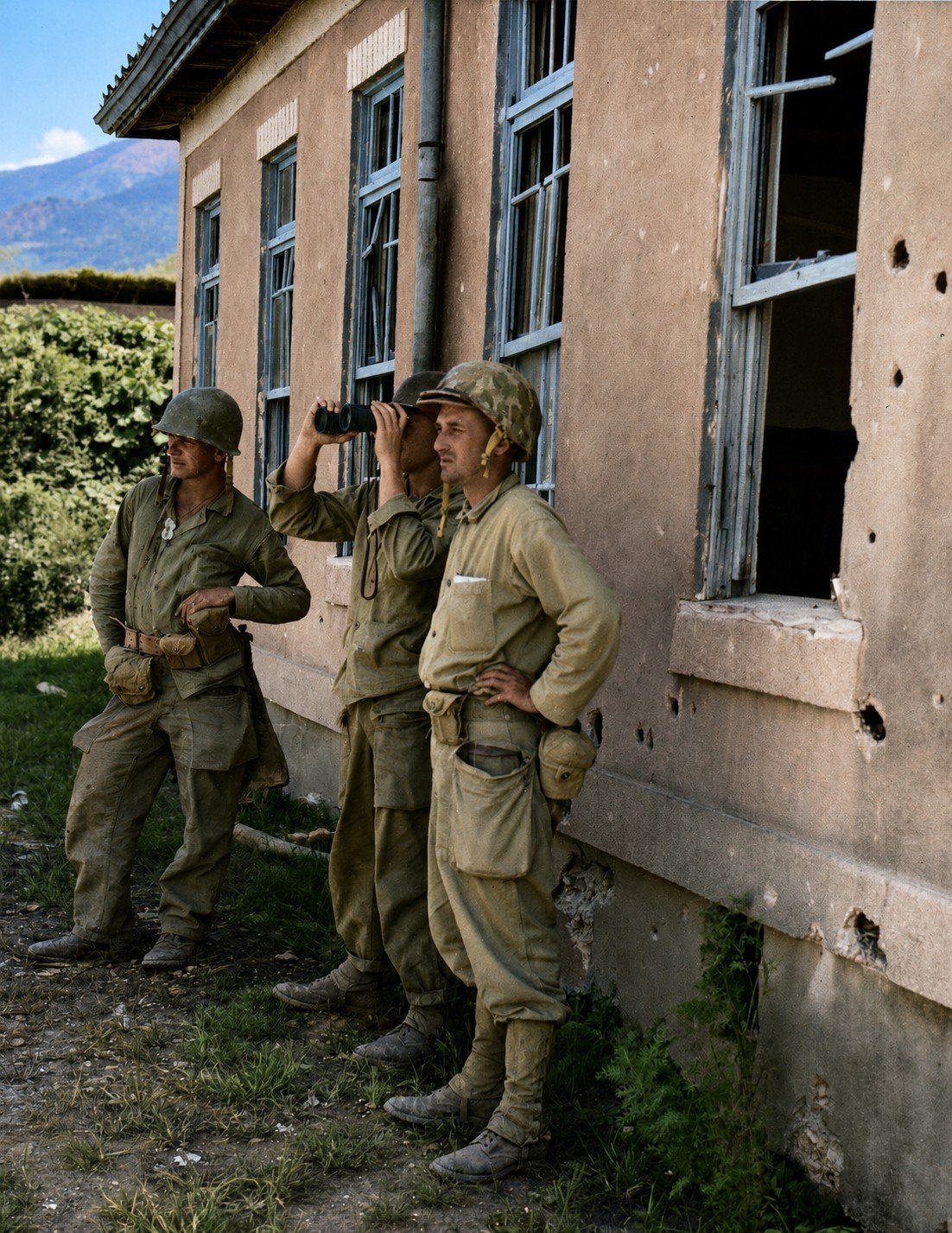
 This is the story of a Marine. Not a famous Marine, not a general whose name would eventually appear on maps and monuments, and not even necessarily one man. He is the Marine I want to walk beside through the first days of September 1950 because hundreds of real men could take his place. He might be eighteen, nineteen, twenty-two, or a little older. He might have joined the Corps because an uncle had been a Marine, because he admired the men who came home from World War II, because there was nothing waiting for him on a farm, or simply because he wanted to wear the uniform. By the time I find him west of Yongsan on September 3, his reasons for joining probably do not matter very much. He is filthy, tired, carrying ammunition, and standing in a country most Americans could not have found on a map three months earlier. His utilities are soaked with sweat, his boots have already learned what Korean mud can do, and somewhere beyond the ridges in front of him men are trying to kill him. He does not know that historians will call what is happening around him the Second Battle of the Naktong Bulge. He knows only that the enemy is ahead, the Pusan Perimeter is behind him, and when the Marine beside him starts forward, he is going too.
I can see Korea around him because the men who were actually there left us their memories. Joseph Dunford Sr. was one of them. He had volunteered for the Marines in 1948 while still a teenager, inspired in part by the World War II veterans he had grown up around. Korea became his first war, and the Second Battle of the Naktong Bulge became his first battle. On the way toward the fighting, he saw the body of a Korean woman and suddenly understood that everything had changed. Years later, when asked what went through the mind of a nineteen-year-old Marine when people began shooting at him, Dunford did not produce some polished description of courage. He remembered responding to his training and his orders. The North Koreans were trying to break through, and there was a job in front of him that had to be done. Fear existed, certainly, but he remembered that there was little time to sit around thinking about it while the battle was happening. That is the Marine I want beside us in this story, because the closer we get to the men who were actually there, the less Korea resembles the clean arrows and unit symbols printed on a battle map.
By September 1950 there was frighteningly little South Korea left to defend. Since crossing the 38th Parallel on June 25, the North Korean People’s Army had driven south with a speed that stunned the United States and its allies. Seoul fell, American troops rushed into Korea piecemeal, and a succession of positions disappeared as badly prepared units were pushed backward. Eventually the retreat stopped around the southeastern corner of the peninsula. The defensive line that became known as the Pusan Perimeter rested partly on the Naktong River and protected the port of Pusan, the lifeline through which reinforcements, tanks, ammunition, fuel, food, and nearly everything required to continue the war entered Korea. If the North Koreans broke the perimeter and reached Pusan, there was no great reserve of Korean territory waiting behind it. There was the sea. So when our Marine looks over his shoulder, he does not need a staff officer to explain the strategic situation. The steady retreat has finally reached the place where there is nowhere useful left to go.
The unit standing with him is the 1st Provisional Marine Brigade, commanded by Brigadier General Edward A. Craig and built around the 5th Marines, supported by Marine artillery, engineers, M26 Pershing tanks, reconnaissance elements, helicopters, observation aircraft, and the Corsairs of Marine Aircraft Group 33. The brigade had been activated only in July and rushed across the Pacific because the situation in Korea deteriorated faster than anyone had expected. Within days of arriving it was thrown into combat. The Marines fought at Chindong-ni and Kosong, then were shifted to the Naktong in August when North Korean forces established a dangerous bridgehead east of the river. The brigade counterattacked there and helped wreck the NKPA 4th Division. Then it was moved again. The Marines began referring to themselves, with considerable justification, as a fire brigade. Whenever another section of the perimeter threatened to collapse, somebody called Craig and sent his Marines toward the smoke.
By late August, however, another battle was already taking shape hundreds of miles away in planning rooms. General Douglas MacArthur intended to land behind the North Korean army at Inchon, and Major General Oliver P. Smith wanted the battle-tested 5th Marines back with his assembling 1st Marine Division. That created a problem because Lieutenant General Walton Walker, commanding Eighth Army inside the Pusan Perimeter, did not want to lose the unit that had repeatedly been thrown into his worst crises. Army and Marine planners argued over the brigade while the men themselves recovered near Masan in an area they called the Bean Patch. Gene Dixon, who served with 1st Battalion, 5th Marines, remembered how little of this larger picture reached ordinary Marines. Men at his level were not briefed on MacArthur’s strategic calculations. They were told where to go, when to pack, and when to move. The Pentagon and Tokyo could debate the future of the 5th Marines. Dixon and the men around him were mostly concerned with the next order.
Then, on September 1, the North Koreans made the debate academic. Nearly 100,000 NKPA troops struck several parts of the perimeter in a final massive effort to destroy the United Nations position before American reinforcements and the planned counteroffensive could change the war. In the Yongsan sector, North Korean forces tore into the U.S. 2nd Infantry Division, drove thousands of yards into its positions, severed units from one another, and created a penetration several miles deep. Obong-ni Ridge, which Marines had fought hard to recover in August, was again in enemy hands. The road through Yongsan toward Miryang and the vital Pusan-Taegu supply route was threatened. Walker faced exactly the situation he had feared, and once again he called for the Marines. The brigade that was supposed to be leaving the perimeter for Inchon turned around and headed toward another emergency.
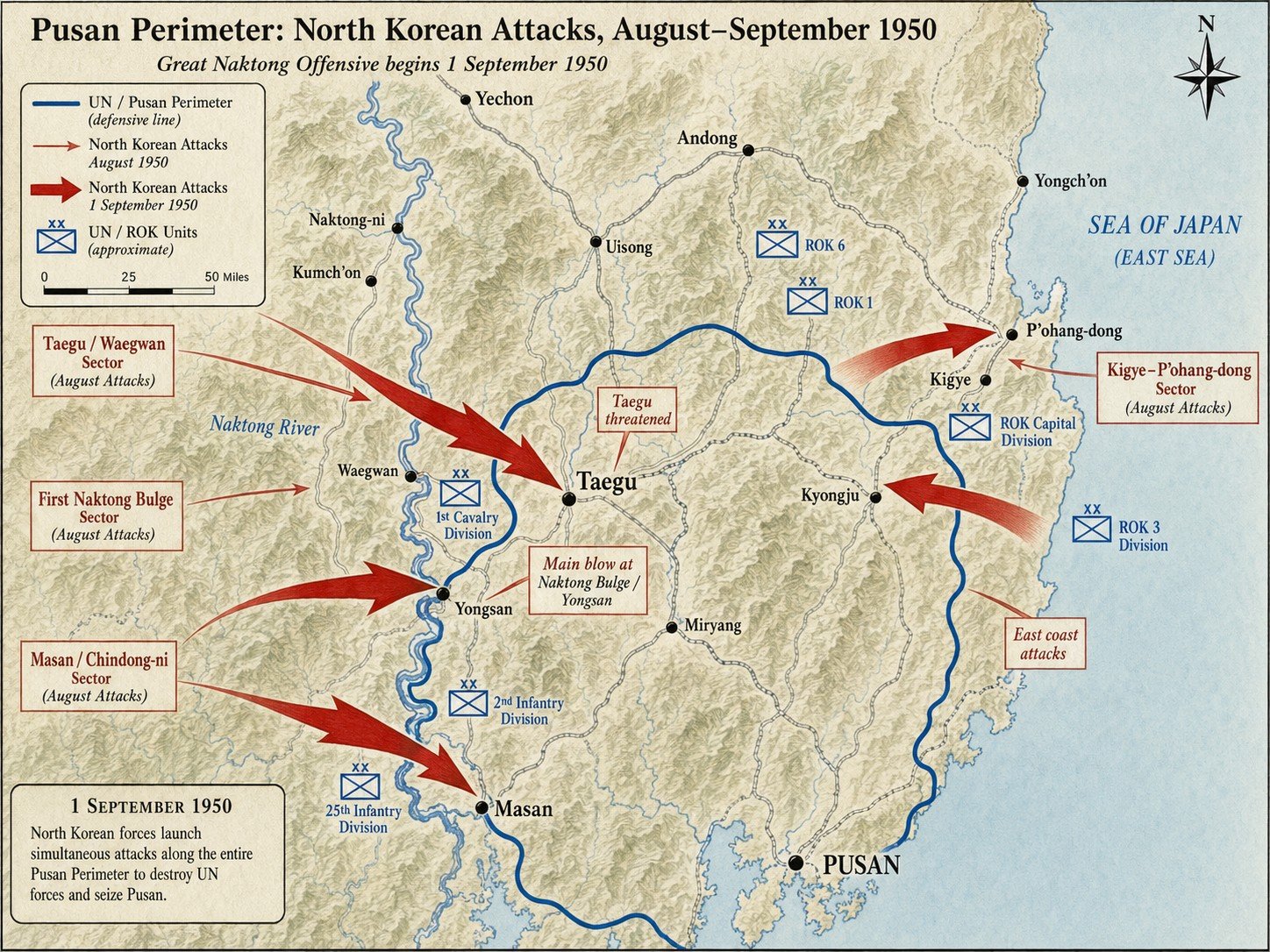
In the darkness before dawn on September 3, I walk with our Marine toward Yongsan. Between 0300 and 0430, 2nd Battalion, 5th Marines moved into an assembly area north of the town while 1st Battalion assembled to the south. The plan was to attack west toward the old Army positions with the 9th Infantry Regiment on the Marines’ right. On paper it looked orderly. At ground level it immediately began changing. Snipers fired at Marines moving through Yongsan, and when the leading elements reached what was supposed to be their line of departure, they discovered that Army troops had been driven another thousand yards backward during the night. The place where the Marine attack was supposed to begin was already enemy-held ground. At 0645, tanks under Second Lieutenant Robert M. Winter were called forward to cover the withdrawal of Army troops. Fifteen minutes could separate the plan drawn the night before from an entirely different battlefield in the morning.
At 0715, 2nd Battalion attacked. The Marines moved through rice paddies while tanks, artillery, mortars, machine guns, and aircraft hammered North Korean positions in front of them. First Battalion moved through its own enormous paddy, at times knee-deep in water and mud, while enemy fire searched for men who had almost no cover. From above came Marine Corsairs, often responding astonishingly quickly to requests from the ground. The official Marine account recorded examples of strikes arriving only minutes after being requested. To an infantryman pinned behind a paddy dike, that was not an interesting innovation in air-ground doctrine. It was the difference between remaining pinned there and moving again. Colonel Paul Freeman of the Army’s 23rd Infantry watched the Marines operate and later marveled at the relationship between their ground units and aircraft, describing Marine air being used almost as if it were artillery. That integration was not accidental. The Marine Corps had spent years developing the idea that the pilot overhead existed partly to help the rifleman below take the next piece of ground.
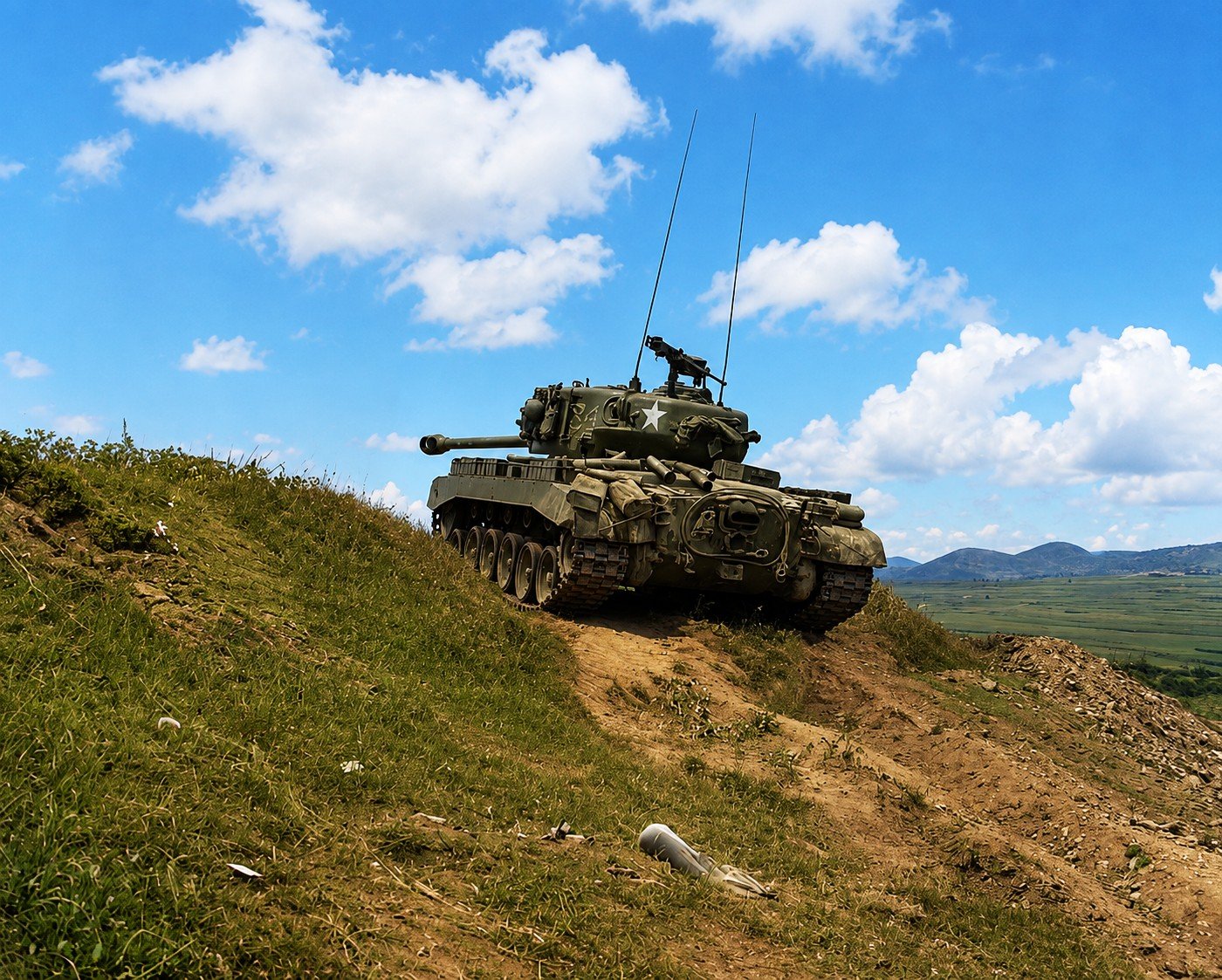
Joshua Maurice Duncan remembered the same relationship from the ground. Duncan had joined the Marine Corps in 1948 and fought with the brigade during the Naktong operations. He remembered the terrible heat of southern Korea, the North Koreans’ Soviet-built T-34 tanks, the Marine M26 Pershings, and the Corsairs overhead. Duncan believed Marine aviation inflicted tremendous losses on the North Koreans when they were exposed, particularly when retreating or attempting to reinforce across open ground near the river. He also watched tank engagements at close range. On one occasion he came around the corner of a hut just as an M26 fired at enemy tanks on a ridge, and the blast knocked him several feet backward. Another time three T-34s came toward the Marines firing their guns until they rounded a curve and found Pershings waiting for them. Duncan remembered the first American tank round passing through the lead T-34 and damaging another behind it. Whatever the exact details of individual engagements remembered decades later, there was no doubt about what the Pershings meant to Marines walking beside them. In Korea, a tank was not a technical specification. It was several inches of armor, a 90mm gun, and a crew willing to move toward the same enemy firing at you.
The battlefield was not always so reassuring. Private First Class Douglas Koch of Company D carried a memory from September 3 that stripped away any notion that friendly fire was an abstract possibility. As his company advanced, American tanks came down a road behind the Marines and suddenly machine-gun fire began striking across the company’s rear. Koch looked back and realized the tanks were firing into Marine positions. Shells followed. One explosion threw him into a gully, and he remembered lying there dazed, convinced for a moment that his own side might kill him. Men were hit before officers could stop the firing and get the company moving again. Koch and the others resumed the attack, but he remembered doing it while still in shock. That is part of the battle too. No one standing in a rice paddy on September 3 possessed the tidy knowledge we have afterward. North Korean fire, American fire, tanks, artillery, aircraft, smoke, dust, rain, radios that failed, and exhausted men all occupied the same few miles of ground.
Company D was moving toward Hill 116 and the northern spur of Hill 117, where it ran into two North Korean battalions and a brutal fight developed. The hill numbers sound almost offensively harmless when read seventy-six years later. On a military map a hill becomes a contour line and a number. To the men climbing it, that number meant machine-gun positions, mortar bursts, men trying to drag wounded Marines downhill, and the knowledge that reaching the crest did not guarantee anyone had checked the reverse slope. Company D eventually gained the northern spur of Hill 117 and dug in several hundred yards from the rest of its battalion. Elsewhere, Marine Pershings attacked enemy antitank weapons and destroyed several T-34s during the day, while Marine aircraft flew seven close-support missions for the assault battalions and knocked out numerous North Korean gun and mortar positions. By the end of the day the brigade had suffered 34 killed and 157 wounded. Those are statistics in an official history. To our Marine, each number had a face.
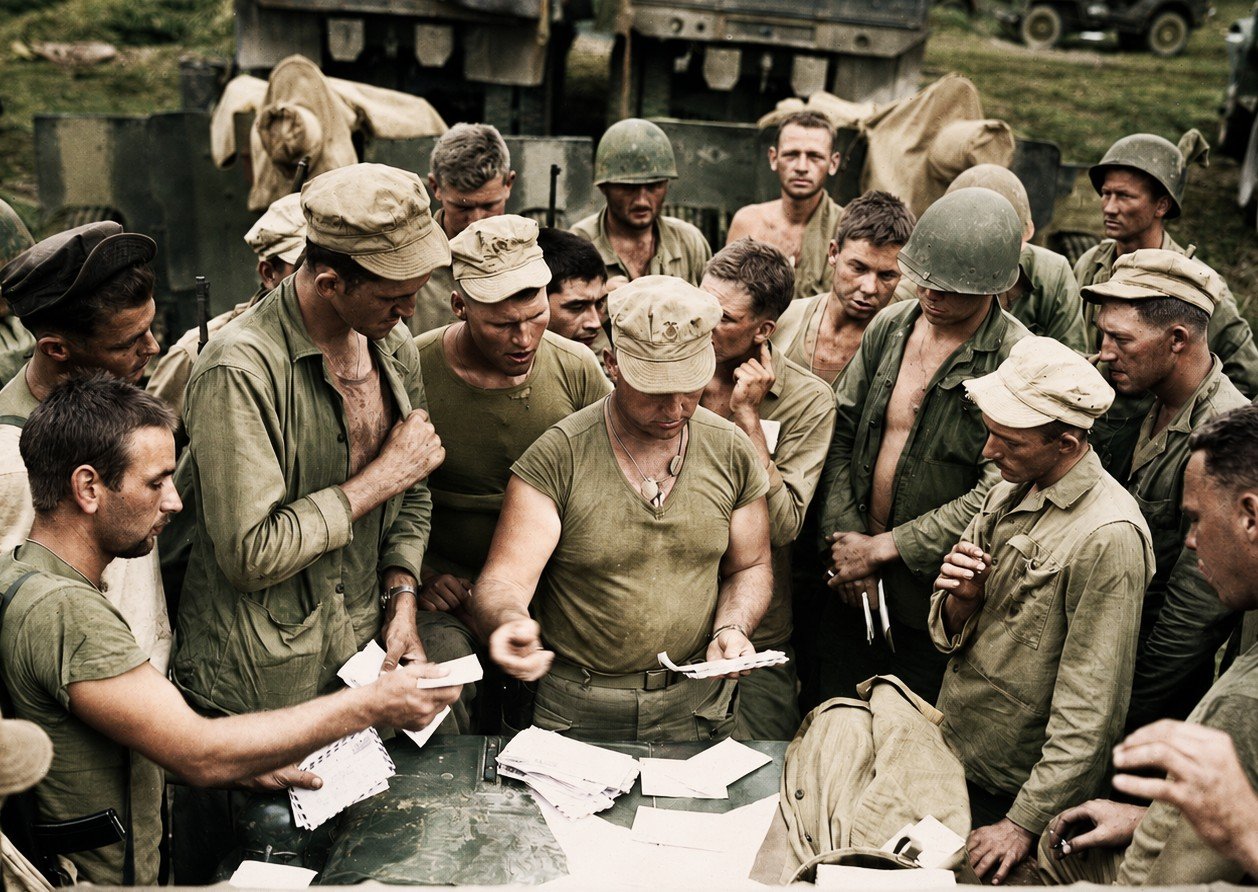
A Marine named Muetzel, serving with 1st Battalion, later described what that kind of sustained combat did to the men. Replacements arrived and disappeared. Friends were wounded or killed and carried away. Clothing and boots wore out, ammunition seemed perpetually inadequate, and eventually the world contracted into something much smaller than the United Nations, Korea, or even the brigade. The squad became the family, then the platoon, the company, the regiment, and the Corps. That shrinking of the universe may be one of the most honest descriptions of prolonged infantry combat. Our Marine does not continue west because he is contemplating the geopolitical future of Asia. He continues because the Marine beside him continues, because somebody has to carry the ammunition, because a wounded man cannot be left where he fell, and because the squad is now the closest thing he has to home.
The rain came, and the night did not offer much rest. Captain Francis “Ike” Fenton remembered one of those moments with the kind of detail that survives precisely because it seems trivial compared with the battle. His men had been through heavy fighting. The radio had failed, ammunition was running low, and rain soaked everything. At one point hot coffee finally reached them, a small miracle after hours of misery, and almost immediately orders arrived to move before the coffee could be distributed. Fenton remembered the disappointment because soldiers and Marines under extreme pressure often remember things like that. A cup of hot coffee can become more important than an operational map when you are soaked, exhausted, and wondering whether another attack is coming. The men moved without it.
While our Marine tried to sleep on wet Korean ground, officers in Tokyo were deciding where he would fight next. On September 3 a compromise had finally been reached. Walker could keep the brigade long enough to deal with the Naktong crisis, but it had to be released by midnight on September 5 so that the 5th Marines could join the 1st Marine Division for Inchon. The remarkable thing is that the men doing the fighting did not have the luxury of finishing one battle before preparations for another began. Heavy equipment was already being shifted. Shipping schedules did not care whether a rifle company had lost men that morning. MacArthur’s plan required the brigade, and the clock was running.
On September 4, our Marine gets up and goes west again. Third Battalion passed through the battered 2nd Battalion and attacked alongside 1st Battalion. The difference from the previous day was startling. Hill 116 fell quickly, then Hill 117. North Korean resistance that had been ferocious on September 3 began turning into withdrawal and, in places, rout. Marines moving forward found evidence of an army coming apart: bodies, abandoned equipment, captured American weapons, and even intact T-34 tanks left behind. Corsairs attacked retreating troops, Marine artillery continued striking targets, and the ground that had nearly become a road to the collapse of the perimeter two days earlier was being reclaimed. The photographs taken that day show Marines topping Korean hills and walking past destroyed equipment. They are extraordinary precisely because the men do not look extraordinary. Their utilities are dirty, helmets sit at odd angles, and fatigue has settled onto them. Nobody in those pictures appears to be thinking, “We have just changed the course of the Korean War.” They look like men wondering how much farther they have to walk.
September 5 brought one final attack. Before 1st Battalion even stepped off, two U.S. Air Force fighters mistakenly strafed Marine positions, fortunately wounding only one man. Then the battalions went forward against increasingly disorganized resistance. Marines took Hill 125 and Observation Hill while other companies maneuvered against remaining North Korean positions. One officer remembered watching an enemy crew try to wheel a Maxim machine gun into position. A Marine recoilless-rifle gunner saw it at the same moment and destroyed it with his first shot, opening the way for the company to surge over the crest. Elsewhere the North Koreans counterattacked hard enough to require riflemen, machine gunners, mortarmen, Army artillery, and Marine 81mm mortars firing dangerously close to friendly positions before the attack finally broke. From the heights, Marines could see North Korean troops pulling away from Obong-ni. The road toward the Naktong was opening.
Then the Marines stopped.
It is one of the strangest moments in the whole story. The enemy in front of them was beaten badly enough that the brigade could likely have continued toward the river, but midnight was approaching and another battle had already claimed them. On September 5 alone the brigade had lost another 35 killed and 91 wounded. At 1600 the battalion commanders received the formal directive: beginning at midnight, the brigade would move by rail and motor transport to Pusan for further operations. The wording was wonderfully sterile. It did not mention that some of the men receiving the order had been fighting almost continuously since arriving in Korea, or that many had friends lying dead on hills they were now being told to leave. It did not mention Inchon by name. It simply told them to move.
Even leaving proved difficult. Army troops arrived late to relieve some Marine positions, and the men coming forward were so thinly equipped that one Marine officer remembered an Army lieutenant appearing with roughly thirty men scraped together from a headquarters unit. The lieutenant had a recoilless rifle but no appropriate ammunition and discovered that his unit’s single machine gun had been left behind. The Marines gave them what they could, including cases of hand grenades, then began walking out. Our Marine joins that column in driving rain and mud. The fighting has stopped for him, but there is no celebration. He walks several miles to the rear, climbs onto a truck west of Yongsan, and by dawn on September 6 is heading toward Pusan. The official Marine history describes those men as bone-tired. That may be an understatement.
 The cost of the brigade’s month inside the perimeter traveled with them. Across its Pusan operations, 148 Marines had been killed in action, another 15 died of wounds, and hundreds more had been wounded. Navy corpsmen who moved with the Marines paid their own price. Every truck heading toward Pusan contained men who could look around and identify spaces once occupied by someone else. Gene Dixon remembered that the fighting had taught them how fragile life was and that the war movies many of them had grown up watching had prepared them poorly for what combat actually felt like. Fear was real even when Marines tried not to show it. Much of combat education, he believed, was simply “on the job training,” except the mistakes made during this particular job could kill you.
There is something almost surreal about what happened when the battered brigade reached Pusan. Men who had just walked out of the Naktong battlefield suddenly entered the frantic machinery of an amphibious invasion. Equipment had to be reorganized, replacements absorbed, transports loaded, and units brought up to strength. More than a thousand fresh Marines joined the 5th Marines, their clean new utilities contrasting sharply with the men coming out of the perimeter. The veterans looked like exactly what they were. They had been fighting a war. Some of the activity around the docks also demonstrated that exhausted Marines remained Marines. Accounts preserved in the official history describe vehicles and supplies being “acquired” with a liberal interpretation of ownership, including Army jeeps, beer, and at least one enormous bridge transporter that ended up blocking a checkpoint until someone could find a driver qualified to move it. One allegedly borrowed jeep received a quick coat of paint and new numbers before being presented to a battalion commander. Human beings apparently retain the capacity for organized mischief even between two battles, which may be one of the more reassuring facts in the entire Korean War.
The serious work never stopped. The brigade ceased to exist as a separate organization and its Marines were folded into the 1st Marine Division. The 5th Marines, finally at full strength, prepared to board ships for Inchon. This is the moment where our anonymous Marine becomes particularly useful, because the history books usually put a chapter break here. One chapter ends with the Pusan Perimeter. The next begins with Inchon. The man loading his gear aboard ship experienced no such division. On September 3 he had been wading through a rice paddy under fire west of Yongsan. On September 4 he had been climbing Korean hills. On September 5 friends were still being killed around him. On September 6 he was riding toward Pusan. Nine days later he would be approaching another Korean shore in a landing craft.
 Joseph Dunford Sr. made that journey. The Second Naktong battle was his first combat, and Inchon followed almost immediately. At Inchon his objective included the heights around Cemetery Hill and Observatory Hill. He later remembered moving after landing and seeing death and fires around him as the Marines secured their objectives. There was almost no time for the nineteen-year-old who had just learned what combat felt like at the Naktong to digest the lesson before he was being asked to do something completely different: assault from the sea, get over a seawall, take high ground, and continue inland. The strategic purpose had changed dramatically. At Pusan, the Marines fought to prevent defeat. At Inchon, they were about to attack deep behind the North Korean army and help reverse the war. For Dunford and the other riflemen, however, the fundamental experience remained stubbornly familiar. Somebody pointed toward the next objective and they went.
Joshua Duncan went with them too. So did Gene Dixon. The same veterans whose memories take us into the heat, tanks, Corsairs, mud, confusion, and fear of the Naktong continued into the Inchon-Seoul campaign. That matters because it exposes the artificial way we sometimes remember wars. We turn battles into separate stories because museums require labels, websites require titles, and books require chapters. The men living through the events did not receive those pauses. Naktong became Inchon, Inchon became Seoul, and for many Marines Seoul eventually became Wonsan and the road north. By late November, Joseph Dunford would be fighting again at the Chosin Reservoir. He turned twenty during that campaign. In the space between his nineteenth and twentieth birthdays, he went from a young Marine entering his first battle to a veteran of Naktong, Inchon, Seoul, and Chosin. That is an almost absurd amount of war to fit into one year of a young man’s life, yet thousands of Marines carried similar timelines.
When we call the 1st Provisional Marine Brigade the “fire brigade,” the nickname can sound almost celebratory. It deserves a harder look. Being the unit commanders trusted to send toward crises meant repeatedly entering situations where somebody else’s line had already broken. It meant climbing into trucks before you had recovered from the last fight because another place was coming apart. It meant learning that success often resulted not in rest but in another assignment. The brigade traveled hundreds of miles during its brief existence and fought three major operations in roughly a month. Marine aviation flew more than a thousand sorties during that period, most of them in close support of troops on the ground. Tanks, artillery, helicopters, observation aircraft, rifle companies, and Navy corpsmen operated as parts of the same improvised but remarkably effective combat system. The official histories can measure those achievements in ground recovered, enemy casualties, and divisions broken. The Marines measured them in men who came back and men who did not.
That is why I do not want to give our Marine a name. Giving him one would make this the story of a single exceptional man, and that misses the point. At different moments he is Joseph Dunford, nineteen years old and discovering that training takes over when there is no time to think about fear. He is Joshua Duncan watching Pershings fight T-34s and Corsairs descend on North Korean troops near the river. He is Douglas Koch lying stunned in a gully after American tanks accidentally fire into his company, then getting up and continuing the attack. He is Ike Fenton watching hot coffee arrive in the rain only to receive orders to move before his soaked Marines can drink it. He is Gene Dixon learning that combat bears little resemblance to the movies and that men can be afraid while still doing what has to be done. He is Muetzel watching his world contract until the squad, platoon, company, regiment, brigade, and Corps become the only family that matters. These are real men and real memories, but together they allow us to see the thousands whose recollections were never recorded.
So I return to September 3 and stand beside our Marine one more time. He is west of Yongsan. An M26 is somewhere nearby, its tracks chewing through Korean earth. Machine guns are firing. A Corsair rolls toward a ridge ahead. The rifle in his hands is dirty, his boots are wet, and he has no idea that officers hundreds of miles away are already deciding that he must leave this battlefield in two days to assault another one. He cannot know that the North Korean offensive will fail, that the Pusan Perimeter will survive, or that Inchon will become one of the most celebrated amphibious operations in American history. He certainly cannot know that Chinese intervention will soon transform the war again and carry some of the men around him into a frozen nightmare at Chosin.
He knows only the Marine next to him.
The man beside him moves, so he moves. They cross the rice paddy together, climb another hill, lose men, spend another wet night in Korea, and get up to do it again. When the enemy finally begins withdrawing, there is no parade. Orders arrive, and the Marines turn around, walk through the mud, climb onto trucks, and head for Pusan. Before anyone can explain that they have helped save the perimeter, they are loading equipment aboard ships and preparing to go back into Korea from the sea.
This is the story of a Marine, any Marine who fought there in those first desperate months of 1950. History remembers Pusan, the Naktong, Inchon, Seoul, and Chosin as separate battles. He did not have that luxury. To him there were no chapter breaks, only different hills, different roads, different orders, and the same familiar faces beside him. The brigade disappeared, the maps changed, and eventually the war moved hundreds of miles north, but the Marine kept going because that was what everyone around him was doing. On September 3, 1950, somebody pointed him west toward the Naktong. Twelve days later, somebody pointed him toward the seawall at Inchon. In between, almost unbelievably, there was barely enough time to clean his rifle.
Sources: The primary operational source for this story is the U.S. Marine Corps History Division publication Fire Brigade: U.S. Marines in the Pusan Perimeter, which documents the 1st Provisional Marine Brigade’s movement to Yongsan, the September 3–5 counterattack, the fighting around Hills 116 and 117, Marine tank and aviation support, brigade casualties, withdrawal to Pusan, and preparations for Inchon. The official history records that the brigade’s September 3 attack began after Army positions had been pushed back during the night, that Marine air flew seven close-support missions for the assault battalions that day, and that the brigade was ordered released by midnight September 5 to join the 1st Marine Division for Inchon. (U.S. Marine Corps)
The firsthand recollections of Joseph Dunford Sr. come from his Korean War Legacy Foundation oral history. Dunford identified the Second Battle of the Naktong Bulge as his first battle and later described his combat experience there, followed by his participation in the Inchon landing, the advance toward Seoul, and later the Chosin Reservoir campaign. (Korean War Legacy)
Joshua Maurice Duncan’s recollections come from his Korean War Educator memoir and online interview. Duncan served in the Marine Corps during the Pusan fighting and described the extreme Korean climate, fighting around the Naktong, Marine Corsair support, encounters between M26 Pershings and North Korean T-34s, and his own close-range experiences around tanks. Some of Duncan’s remembered dates for the “second Naktong” differ from the official operational chronology, so this article uses the official Marine history for dates while using Duncan for experiences he personally described. (thekwe.org)
Additional historical context comes from the Marine Corps’ official histories of the 1st Provisional Marine Brigade and 5th Marines, Naval History and Heritage Command material on the Pusan Perimeter and Inchon campaign, and the U.S. Army Center of Military History’s South to the Naktong, North to the Yalu. These establish the brigade’s role as Eighth Army’s mobile reserve, its integration of ground and aviation elements, the strategic crisis created by the September NKPA offensive, and the rapid transition from the defense of Pusan to the Inchon-Seoul offensive. (U.S. Marine Corps)