Adelbert “Bert” Waldron III: The Sniper Vietnam Almost Forgot
Everyone knows Carlos Hathcock. Far fewer know the name Adelbert "Bert" Waldron III, the Army sniper whose record quietly became one of the most remarkable in American military history.
August 7, 2026

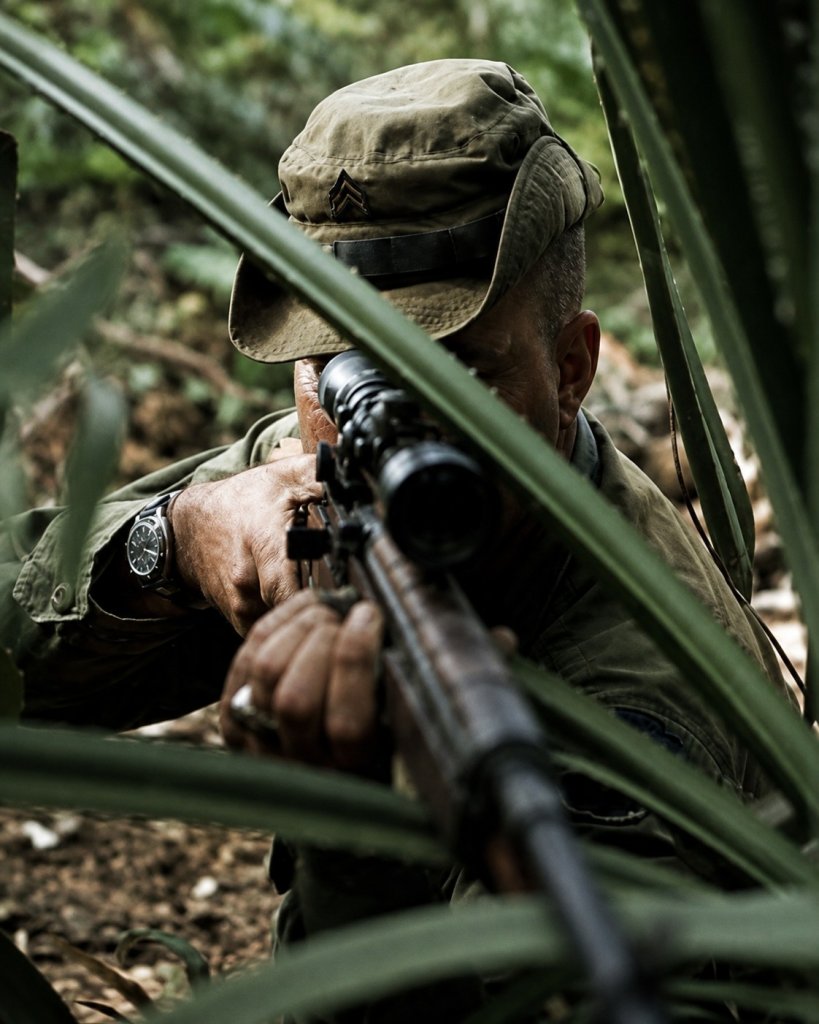
When Americans talk about snipers in Vietnam, one name usually dominates the conversation. Carlos Hathcock became the legend, the Marine in the white feather whose stories were repeated in books, documentaries, gun magazines, and eventually across the internet. Hathcock earned that reputation. But while his name became part of American military folklore, another sniper was working hundreds of miles away in a completely different kind of battlefield, compiling a record that would stand for decades. His name was Adelbert Francis “Bert” Waldron III.
Waldron was not a young infantryman discovering his talent with a rifle in Vietnam. By the time he arrived in Southeast Asia, he was already a mature serviceman with years of military experience behind him. Born in Syracuse, New York, on March 14, 1933, Waldron entered the United States Navy in 1953 and remained there for roughly twelve years. He eventually left the Navy as a petty officer second class. After several years outside the military, he returned to uniform, this time joining the United States Army in 1968. He was 35 years old, an age when many men were beginning to think about slowing down rather than voluntarily starting over in another branch of service.
Waldron did not simply enlist and disappear into the system. He completed airborne training and was sent to Vietnam, where he became associated with the 9th Infantry Division, one of the Army formations conducting extensive operations in the Mekong Delta. There, with the 3rd Battalion, 60th Infantry Regiment, Waldron found himself in an environment that was almost perfectly designed to challenge every traditional assumption about sniping.
This was not the European battlefield of ruined buildings, long streets, and distant tree lines. The Mekong Delta was a maze of canals, rivers, rice paddies, villages, dikes, thick vegetation, mangrove, mud, and water. Visibility could change from hundreds of yards to almost nothing in a matter of steps. American troops moved aboard boats as often as they moved on roads. Viet Cong fighters could disappear into vegetation, tunnels, villages, or waterways with extraordinary speed. In this environment, Waldron became one of the most effective snipers the United States military had ever produced.
He would eventually be credited with 109 confirmed enemy kills, accumulated during a relatively short period of combat operations. For years, that number stood as the highest confirmed total attributed to an American military sniper. Yet the number alone is probably the least interesting part of Waldron’s story. What made him exceptional was how he operated.
The Mekong Delta Was His Hunting Ground
Sniping in the Delta required a different mindset. The great distances sometimes associated with sniper warfare existed, but many engagements were closer, faster, and more chaotic. A sniper might operate from a concealed position along a canal one day and from a patrol boat the next. He might spend hours waiting for a single target, then suddenly find himself supporting an infantry unit fighting off a much larger enemy force. Waldron appears to have been unusually comfortable in that uncertainty.
Accounts of his service describe him operating from positions along waterways and aboard boats of the Mobile Riverine Force. One of the most famous stories associated with him describes a shot taken from a moving riverine craft against an enemy soldier positioned high in a tree at extremely long range. The precise details of that shot have been repeated in several forms over the decades and should be treated cautiously, but the story survived because it captured something genuine about Waldron’s reputation. He was regarded by the men around him as a rifleman capable of making shots under circumstances that would have been difficult even from a stable firing position.
His official decorations tell an even more compelling story. Waldron received two Distinguished Service Crosses, an extraordinary distinction for any American serviceman. The Distinguished Service Cross is the Army’s second-highest decoration for valor, surpassed only by the Medal of Honor. Waldron received two of them for separate periods of combat action in 1969.
His first Distinguished Service Cross covered fourteen sniper missions conducted between January 16 and February 4, 1969. These were not simply solitary hunting expeditions. On January 19, near Ap Hoa in Kien Hoa Province, Waldron’s company was being resupplied when approximately forty Viet Cong opened fire with small arms and automatic weapons. Waldron exposed himself to the enemy fire and began engaging the attackers. His shooting helped break the attack and force the enemy to disengage.
Three nights later, Waldron was operating in terrain filled with enemy soldiers and booby traps when he detected a Viet Cong probing force. Rather than remain in one firing position, he moved across exposed rice paddies from location to location, firing from different points. The effect was deceptive. To the enemy, it appeared as though they were facing a larger American force. Waldron was effectively using marksmanship, movement, and psychology together.
That is an important distinction. A sniper is not merely a soldier who can shoot accurately. The rifle is only part of the weapon. Concealment, observation, patience, movement, judgment, and the ability to manipulate the enemy’s perception are equally important. Waldron’s actions during these missions demonstrate that clearly.
On February 3, when a nearby South Vietnamese unit came under attack, Waldron moved toward the fighting rather than away from it. He identified Viet Cong attempting to maneuver around the Vietnamese soldiers and engaged them before they could complete the flanking movement. Later that same night he observed an enemy soldier attempting to recover weapons from fallen comrades and stopped him as well. These were not sporting shots. They were battlefield interventions. Waldron was identifying the individuals whose actions could change the course of a firefight and removing them.
Eighteen More Missions
His second Distinguished Service Cross covered another series of operations from February 5 through March 29, 1969, during which Waldron participated in eighteen sniper missions in Kien Hoa Province.
On February 14, while his squad was operating at night near Ap Phu Thuan, Waldron observed a larger enemy force maneuvering toward a friendly unit. Once again he moved between firing positions, deliberately creating the impression that the enemy was facing more troops than were actually present. His fire disrupted the attack and helped prevent the enemy from overrunning the position.
Later that month, near Phu Tuc, Waldron detected a Viet Cong team preparing to fire a rocket against elements of the Mobile Riverine Force. He engaged the team before they could launch their weapon. On March 8, near Ap Luong Long Noi, his company came under attack. Waldron again began identifying and engaging enemy troops, helping break the momentum of the assault and contributing to their withdrawal.
These actions reveal something that a simple confirmed-kill figure cannot. Waldron was not merely accumulating numbers from concealed positions. He was repeatedly inserted into situations where friendly soldiers were under attack or were about to be attacked. His shooting prevented ambushes, disrupted assaults, eliminated enemy weapons teams, and protected infantrymen and riverine forces. That is why his decorations matter more than the number 109.
 Three Hours in the Dark
One action in particular demonstrates the almost unnerving patience involved in Waldron’s work. On January 22, 1969, while serving as a sniper during a reconnaissance mission in Kien Hoa Province, Waldron established a position after dark and detected enemy movement. He began engaging the enemy and continued for more than three hours, remaining in the area while the enemy attempted to locate him. Only after his position was finally discovered did he withdraw. Eleven enemy soldiers were killed during the engagement, and for that action Waldron received the Silver Star.
Imagine the mental discipline required. Every shot carried the possibility of revealing his location. Every muzzle flash, movement, sound, or mistake could draw fire. He had to observe, fire, relocate or conceal himself, reacquire targets, and repeat the process while knowing that the enemy was actively trying to find him.
That is sniper warfare stripped of mythology. It is waiting while adrenaline tells you to move, remaining still while insects crawl across you, controlling breathing when people are searching for you, and resisting the urge to fire at the first available target because a better one may appear seconds later. Sometimes it is also firing, moving, and deliberately convincing an enemy force that one rifle is actually several.
America’s Strange Habit of Forgetting How to Snipe
Waldron’s story also belongs to a much larger and rather frustrating chapter in American military history. For much of the twentieth century, the United States repeatedly learned the value of trained snipers during war and then allowed much of that knowledge to disappear when the shooting stopped.
The pattern happened after the First World War. American soldiers entered that conflict facing German marksmen who had already developed sophisticated methods of camouflage, observation, precision shooting, and battlefield stalking. The Allies adapted. Sniper schools were established, rifles were equipped with optics, and men learned how to build concealed positions, observe enemy trenches, and wait for individual targets.
Then the war ended, and sniping once again became something of a specialized wartime skill rather than a permanent institutional discipline.
When the United States entered the Second World War, the same process began again. American forces developed skilled marksmen and snipers in Europe and across the Pacific. They learned the importance of concealment, fieldcraft, range estimation, target selection, and stalking. Men learned to become nearly invisible. Then the war ended, and much of the institutional emphasis disappeared again.
Korea forced another relearning. The static fighting that developed along the front made snipers extremely valuable. Enemy officers, machine-gun crews, observers, and exposed soldiers could be engaged at long distances. American troops experimented with scoped rifles and even adapted heavy weapons for long-range precision fire. Then Korea ended, and once again sniper training faded from priority.
By the time American forces became deeply involved in Vietnam, the United States was rediscovering a skill it had already rediscovered several times. It is one of the stranger recurring themes in American military history. Armies naturally prepare for the war they expect. Snipers, however, often flourish in the war nobody predicted.
Vietnam forced the Army and Marine Corps to rebuild the craft, and it was not simply marksmanship that had to be relearned. It was stalking.
The true sniper does not begin with the trigger. He begins with the ground. He must understand how vegetation moves in the wind, how sunlight changes across terrain, how shadows behave, how equipment reflects light, how clothing collects dust, and how the human eye detects unnatural shapes.
A sniper crawling several hundred yards toward an observation position may move only inches at a time. A careless elbow can flatten grass. A rifle barrel can reflect sunlight. A boot sole can expose a pattern that does not belong in nature. This knowledge is difficult to write into a manual and even harder to preserve between generations.
Vietnam became another brutal classroom. The 9th Infantry Division was particularly aggressive in developing sniper operations. By 1968 it had established formal sniper training in Vietnam, helping produce dozens of trained shooters for operations in the Delta. Snipers were increasingly integrated into night operations, ambushes, patrols, riverine missions, and infantry actions.
Waldron emerged from that environment. He was not a lone phenomenon. He was one extraordinarily talented man operating inside a military organization that was beginning to understand again what trained snipers could do.
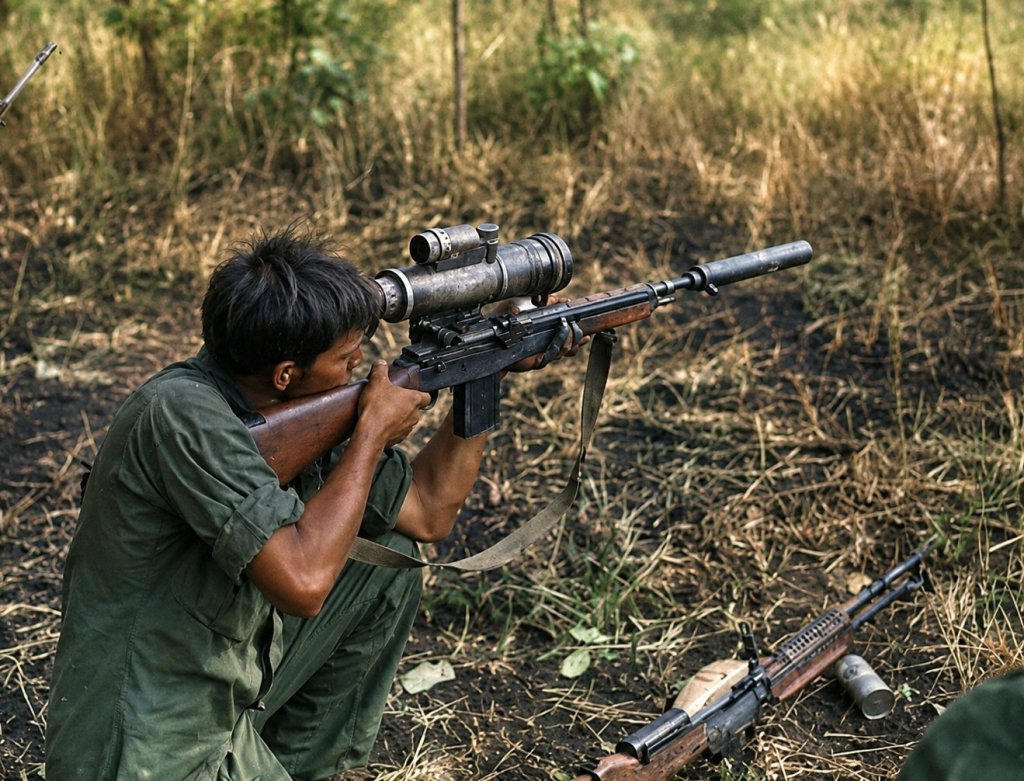 The Rifle
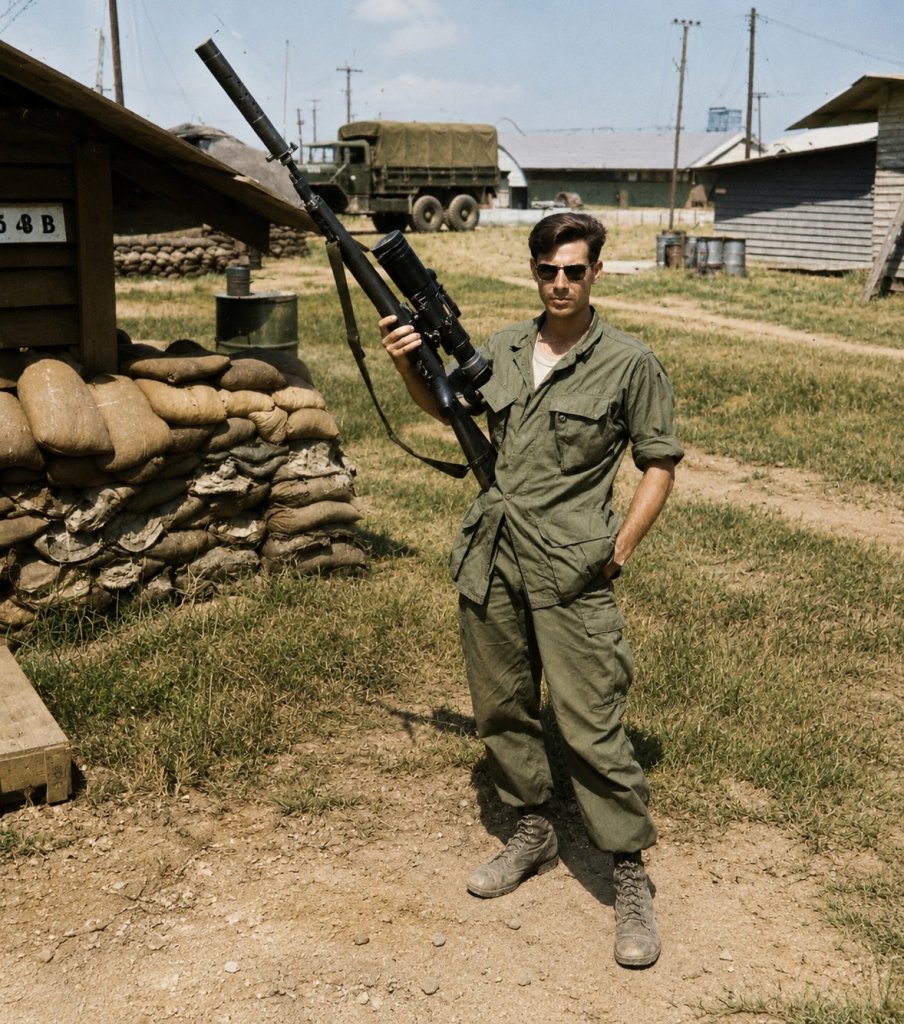
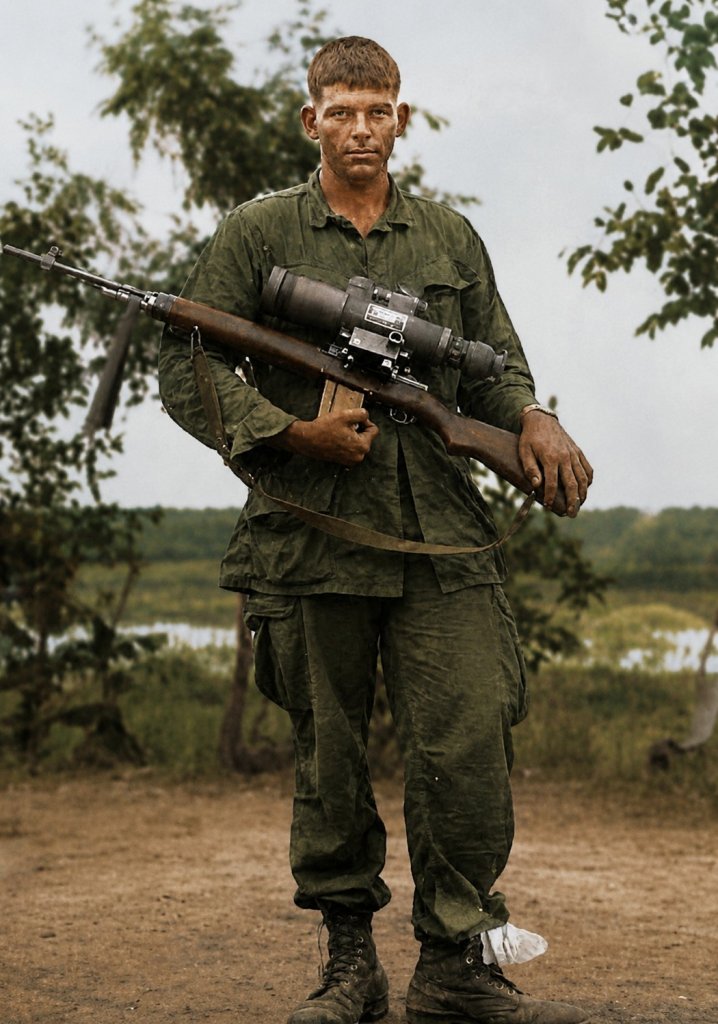
Waldron is strongly associated with the XM21 sniper rifle, the weapon that would eventually become standardized as the M21. The rifle was based on the M14, chambered for the 7.62×51mm NATO cartridge. Unlike the bolt-action rifles associated with many famous Marine snipers, the XM21 was semiautomatic.
That distinction mattered in Vietnam. A bolt-action rifle could deliver exceptional precision, but a semiautomatic sniper rifle allowed rapid follow-up shots. In the Mekong Delta, where engagements could suddenly involve multiple enemy soldiers at relatively close or medium ranges, that ability could be extremely valuable.
The XM21 was paired with a telescopic sight and carefully prepared to improve accuracy. Some sniper rifles were also used with early night-vision devices, allowing American snipers to operate after darkness, when Viet Cong movement often increased. These systems were primitive by modern standards.
Today’s military snipers benefit from advanced optics, laser rangefinders, highly developed ammunition, ballistic computers, thermal imaging, night vision, suppressors, and decades of institutional experience. Waldron had none of that technological luxury. Wind had to be read, range had to be estimated, movement had to be anticipated, targets had to be identified through optics that would seem crude beside modern scopes, and the shooter still had to make the shot.
The Man Behind the Numbers
There is remarkably little mythology surrounding Waldron compared with Hathcock, and perhaps that is part of what makes him fascinating. Waldron did not become a major public figure after Vietnam. He did not build an enormous public persona around his record. After returning from Vietnam, he served as a marksmanship instructor at Fort Benning before leaving the Army in 1970.
Then he largely disappeared from the military spotlight. He died on October 18, 1995, at the age of 62 and was buried at Riverside National Cemetery in California. For decades, his name remained far less familiar than those of other Vietnam snipers. That obscurity has produced another problem.
 Finding the Real Bert Waldron
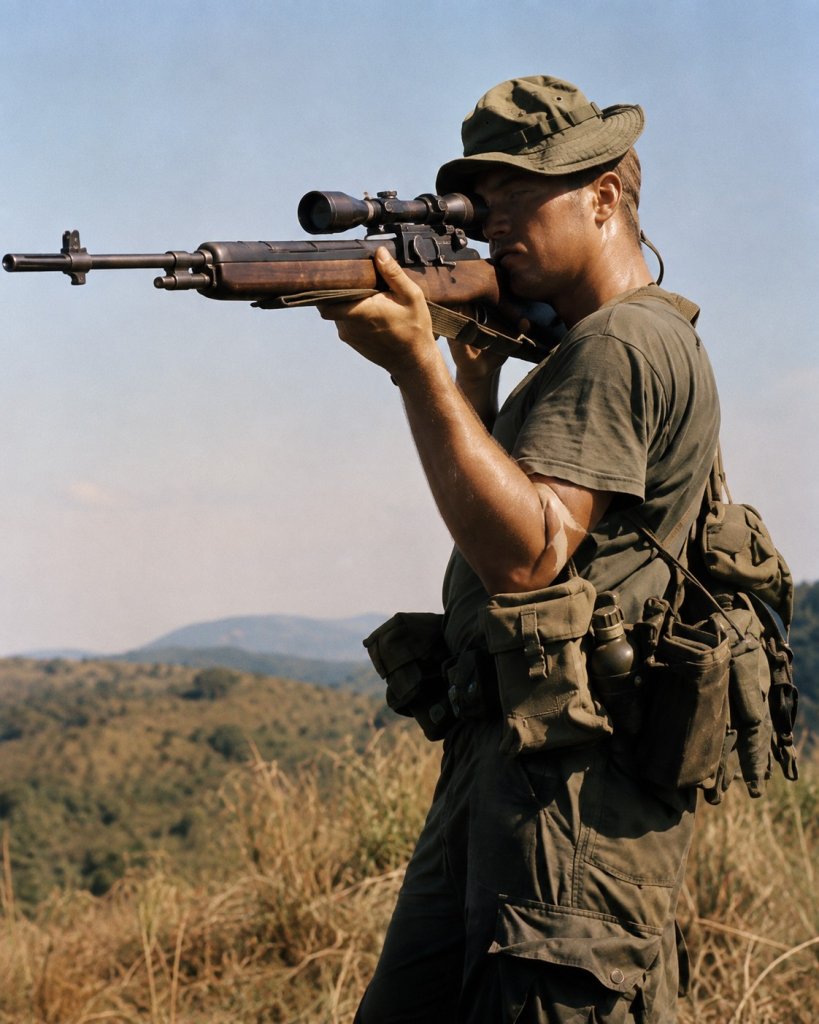
Anyone researching Waldron eventually discovers something irritating: his photographs are frequently mislabeled.
The internet is filled with images identified as Adelbert Waldron that are either incorrectly captioned, copied from unrelated pages, or attached to his story with little documentation. Some photographs circulate under the names of multiple Vietnam-era snipers. Others appear on websites that simply repeat captions from earlier sites without determining who is actually shown.
This problem is particularly severe with historical military photographs. Once an incorrect caption enters the internet, it begins reproducing itself. A website copies another website, a social media account copies the website, an image search indexes the caption, and then another writer sees the image appear repeatedly under the same name and assumes repetition equals confirmation. Eventually the mistake begins to look like fact.
Waldron is an excellent example of why historical photographs deserve the same scrutiny as written records. There are genuine, documented photographs of him, but there are far fewer than an ordinary image search would suggest. That matters. A museum, historian, or battlefield researcher is not preserving history by attaching the wrong man’s face to another man’s story. The photograph is part of the evidence, and the face matters.
109
Eventually every discussion of Waldron returns to the number: 109 confirmed kills.
It is a staggering figure, particularly considering the relatively short period in which they were recorded. But military sniper statistics require context. A confirmed kill was not simply whatever a sniper claimed. Confirmation procedures varied by unit and circumstance, and many kills made deep in enemy territory were impossible to verify. Consequently, confirmed totals should never be treated as a perfect accounting system or as a sports leaderboard.
Snipers did not fight under identical conditions. A sniper operating around Da Nang faced a different battlefield from one operating in the Mekong Delta. A Marine stalking through mountainous jungle had different opportunities and limitations than an Army sniper traveling with the Mobile Riverine Force. Comparing totals therefore tells us surprisingly little about who was the “best.”
Carlos Hathcock had 93 confirmed kills. Chuck Mawhinney would eventually be credited with 103. Waldron had 109. Those numbers are historically interesting, but they are not the men. What matters is what they did for the soldiers around them.
A sniper might kill one enemy machine gunner and save an entire squad. He might kill an observer before artillery could be adjusted. He might stop a rocket team before it fired. He might identify an ambush before infantry walked into it. Waldron did exactly those kinds of things.
His official record repeatedly describes enemy attacks disrupted, friendly units protected, ambushes prevented, and hostile forces deceived about American strength. That is his real legacy.
Patient. Precise. Deadly.
There is a temptation when writing about snipers to turn them into mythical assassins, but the truth is more interesting. Sniping is an exercise in discipline. The shooter must be aggressive enough to act but disciplined enough not to act too soon. He must be confident enough to take a difficult shot but cautious enough to understand when not to take one. He must be capable of violence while remaining extraordinarily controlled.
Few soldiers illustrated that contradiction better than Bert Waldron. He went to Vietnam as a 35-year-old veteran serviceman in a young man’s war. In the waterways and rice paddies of the Mekong Delta, he became one of the most effective precision riflemen the United States had ever fielded.
He received the Silver Star and two Distinguished Service Crosses, accumulated 109 confirmed kills, and somehow, while other snipers became household names among military-history enthusiasts, largely slipped into the background. Perhaps that is why his story is worth telling now, not because he had a higher number and not because we need another argument over who was the deadliest sniper in Vietnam, but because Waldron represents something larger.
He belonged to a generation of American snipers who once again had to recover a battlefield craft their military had repeatedly allowed to fade between wars. They relearned how to stalk, how to hide, and how one disciplined rifleman could influence a fight far beyond the physical space he occupied. In the flooded fields, canals, villages, and darkness of the Mekong Delta, Adelbert “Bert” Waldron III became one of the finest examples of that craft, and history very nearly allowed him to disappear into the same silence in which he had once worked.
Today, Bert Waldron's name is finally beginning to receive the recognition it deserves. His record speaks for itself, but his true legacy extends far beyond a number. He belonged to a generation of American snipers who rebuilt a forgotten craft, mastering patience, concealment, observation, and precision under some of the harshest conditions imaginable. Their success was measured not only by the targets they engaged, but by the lives they protected.
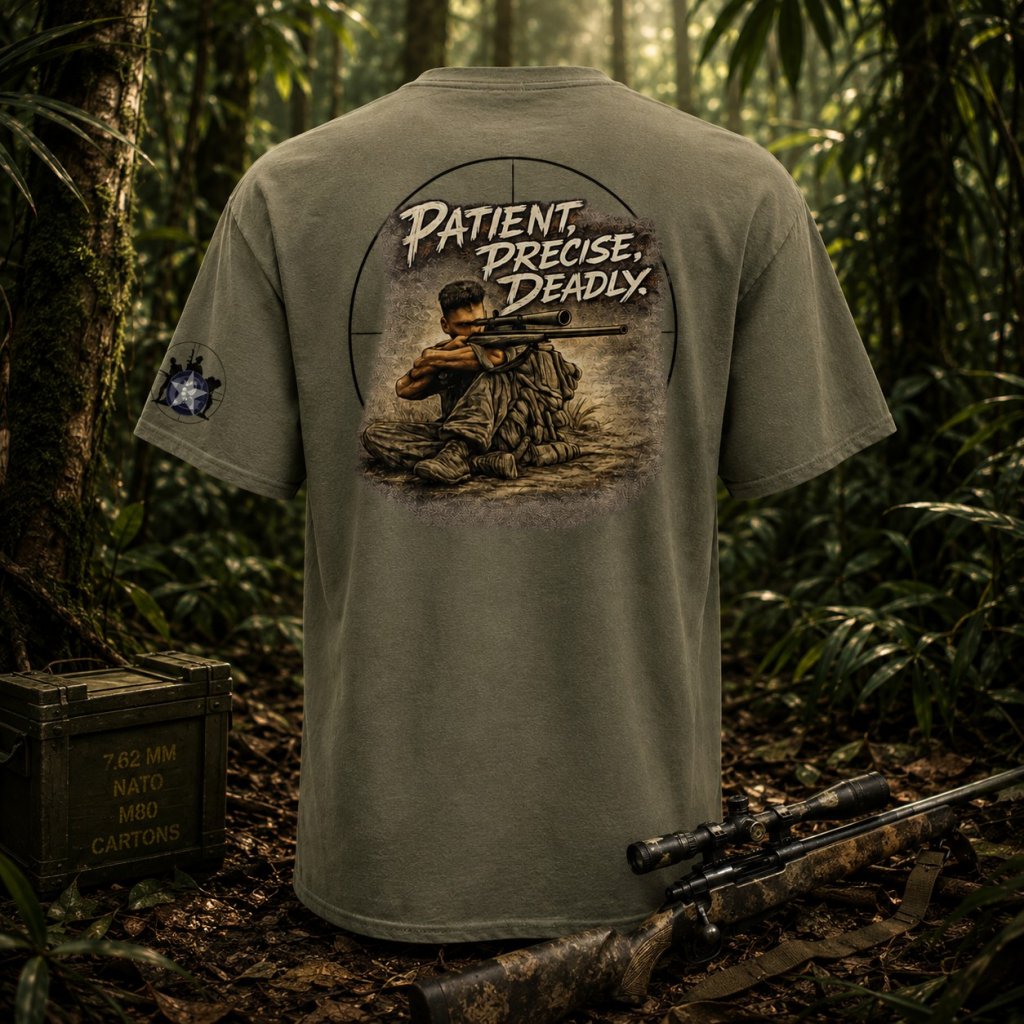
At Ghosts of the Battlefield, we believe those stories deserve to be remembered. That's why we've created our "Patient. Precise. Deadly." Vietnam Sniper T-shirt, inspired by a historic photograph of U.S. Marine Corps Lance Corporal Dalton Gunderson and dedicated to the professionalism, discipline, and fieldcraft of the American snipers who served in Vietnam. It is more than a shirt. It is a tribute to the men whose quiet skill often changed the course of a battle without ever making the headlines.
Every purchase helps support Ghosts of the Battlefield and our mission to preserve military artifacts, tell the stories behind them, and ensure that the men who served are remembered not only for what they carried, but for what they accomplished. In doing so, we hope that soldiers like Adelbert "Bert" Waldron III will never again become the forgotten legends of American military history.
Shop the Patient. Precise. Deadly. Vietnam Sniper T-Shirt