AI Slop, Missing Straps, and the Faces We Refuse to Lose
AI restoration is not perfect, but it can bring damaged and fading faces back into view before they disappear from memory entirely. At Ghosts of the Battlefield, we combine modern technology with decades of human knowledge to preserve the person first.
August 10, 2026

AI Slop! Pure Shit! Your Dishonoring History! Ive heard it all. Five years ago when only a handful of "color artists" as they were known at the time labored for days restoring a picture and still got things wrong they were hailed as mast craftsmen. Times have changed and depending on what program you use and how well you train it everyone can do this.
First things first! We never, ever completely fabricate any photo, we do original artwork for incidents such as a helicopter crash or other event. The restorations are ALWAYS from an actual photo.
At Ghosts of the Battlefield, these images do not simply come out of a computer and get thrown onto the internet without anyone examining them. Behind every restoration is decades of accumulated human experience with military history, uniforms, weapons, aircraft, vehicles, camouflage, insignia, field equipment, and the countless variations that appeared during wartime service. We compare the restored image to the original, examine the details, research anything questionable, and use that knowledge to verify, correct, and authenticate what we are seeing as carefully as possible. Artificial intelligence may be the tool helping reconstruct the photograph, but human knowledge remains an essential part of determining whether the result makes historical sense.
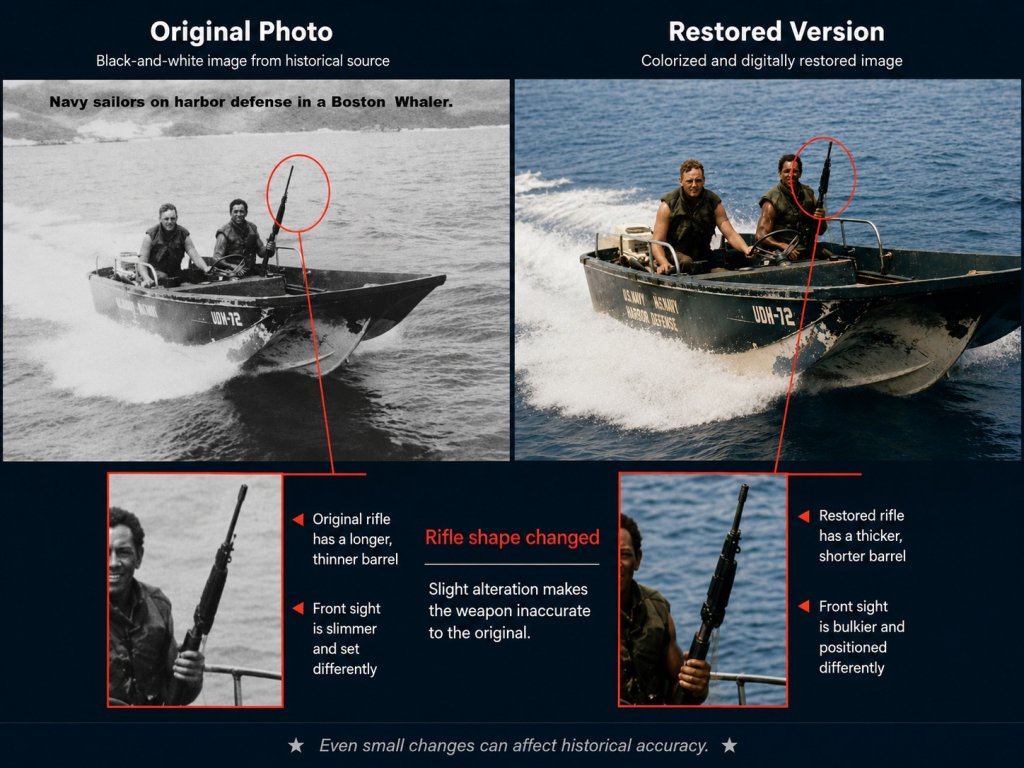
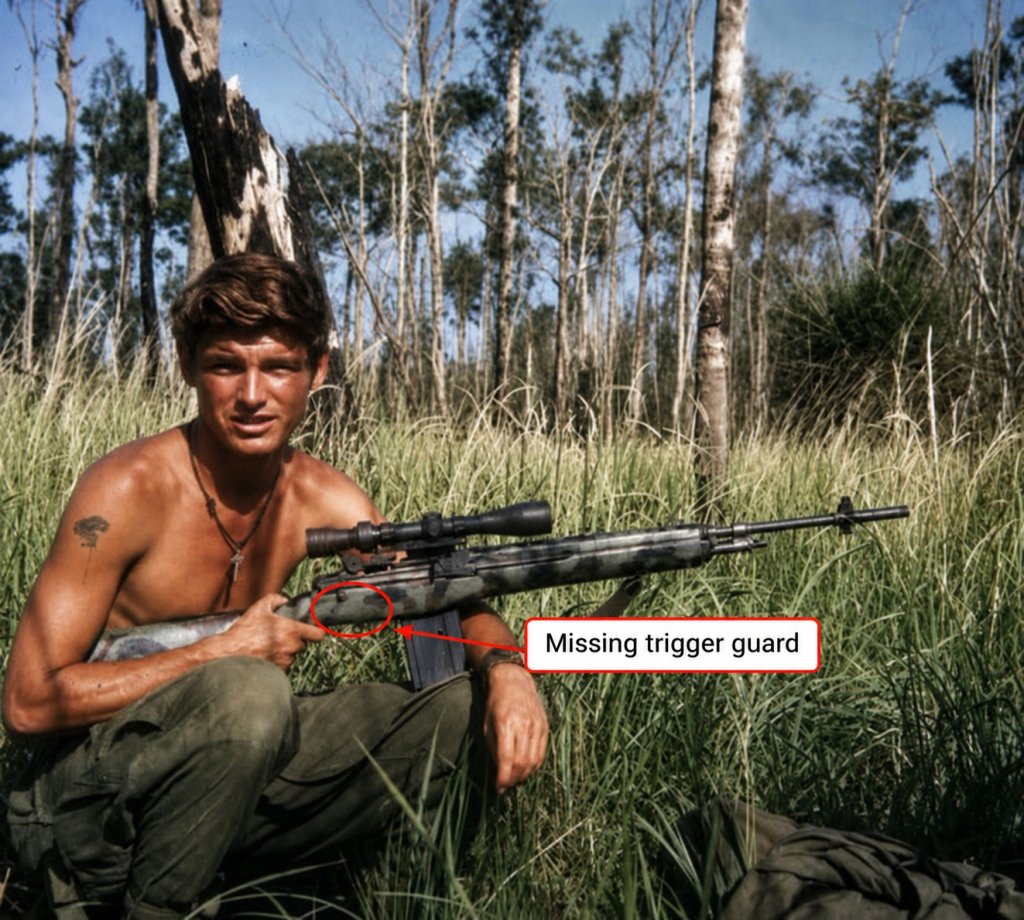
That does not mean we catch everything every single time. There are days when we have spent twelve, fourteen, or sixteen hours researching a man, writing his story, searching archives, restoring photographs, building museum displays, answering questions, and trying to put all of those pieces together before an image finally reaches the public. Occasionally a trigger guard is missed, a strap ends up routed incorrectly, a bootlace changes shape, or a shade of green in an ERDL pattern comes out slightly too green. Those mistakes matter and we want to correct them, but they also need to be viewed in proportion to what the restoration is attempting to accomplish.
 If someone notices something we overlooked, there are two very different ways to respond. A person who actually cares about preserving history can simply tell us, “Hey, I noticed this strap looks wrong,” or “Take another look at this part of the rifle.” We can investigate it, compare references, correct the image if necessary, and everyone involved has contributed to the preservation process. None of us knows everything, and military history is far too broad for anyone to pretend otherwise. Veterans, collectors, historians, researchers, families, museums, and people with highly specialized knowledge all possess pieces of information that can improve the final result. That collective knowledge is valuable, and we welcome it.
The alternative is to immediately start shouting “AI slop,” write a rant demonstrating how much more you supposedly know than everyone else, and completely ignore the human being whose photograph you are criticizing. At that point you are no longer helping preserve history. You are mostly announcing to the internet that you spotted a buckle. There is a considerable difference between correcting a mistake and trying to humiliate the person who made it. One contributes something useful to the historical record, while the other mostly contributes noise. If you genuinely care about accuracy, join the effort. Help identify the error, provide the information, and become part of the process. Otherwise, to put it plainly, you can choose to be a jackass instead.
 What makes that behavior particularly frustrating is that many of these photographs attracted almost no attention before they were restored. Nobody was debating the exact color of the web gear because almost nobody was looking at the photograph in the first place. A badly faded image might sit in an archive, family album, unit publication, or forgotten database for fifty years while the man's face gradually disappears. Then restoration allows people to see his expression again, someone stops scrolling long enough to look at him, and suddenly the discussion becomes dominated by whether a pack strap is sitting two inches too high. The technical detail may deserve correction, but it should never become more important than discovering who the man was.
We care enormously about those details. We want the weapon to be right, the camouflage to be right, the helmet to be right, the aircraft to be right, and the equipment to belong to the correct place and period. We spend an absurd amount of time checking those things precisely because accuracy matters. But the equipment exists inside the photograph because a human being was wearing or carrying it, and preserving that human being is ultimately why we are doing this work. A misplaced strap can be corrected tomorrow. A slightly incorrect shade of camouflage can be adjusted. A missing trigger guard can be restored. Once the connection between a man's face and his name disappears, recovering that identity may be impossible.
That is the balance we are trying to maintain. Use the technology, apply decades of human knowledge to it, verify what we can, correct what we find, acknowledge mistakes when they occur, and continue improving as the tools improve. If somebody sees something we missed, we genuinely want them to tell us. We would much rather have another knowledgeable person standing beside us helping preserve the photograph than standing across the room throwing rocks at the effort. The goal is not to prove who knows the most about a piece of web gear. The goal is to make sure that fifty years from now somebody still knows the name of the man who wore it.
Ghosts of the Battlefield is not approaching these images from behind a computer screen with no understanding of the objects being reconstructed. Our museum collection contains hundreds of original firearms, helmets, uniforms, field equipment, and examples of virtually every major type of American web gear from the early 1900s forward. We preserve dozens upon dozens of camouflage patterns and uniform variations, along with the equipment, insignia, weapons, and personal artifacts that allow us to physically compare what appears in a photograph against the real thing. When we say we use decades of accumulated human knowledge to examine these restorations, we mean it literally. Much of the equipment we are trying to identify on a screen is sitting on shelves, mannequins, displays, and racks around us.