Present Where He Was Needed Most: The Artifacts and Witness of LCDR Ray W. Stubbe
Ray Stubbe’s artifacts, battlefield cross, famous wartime photograph, and lifelike mannequin bring his service as a chaplain at Khe Sanh vividly to life.
August 11, 2026

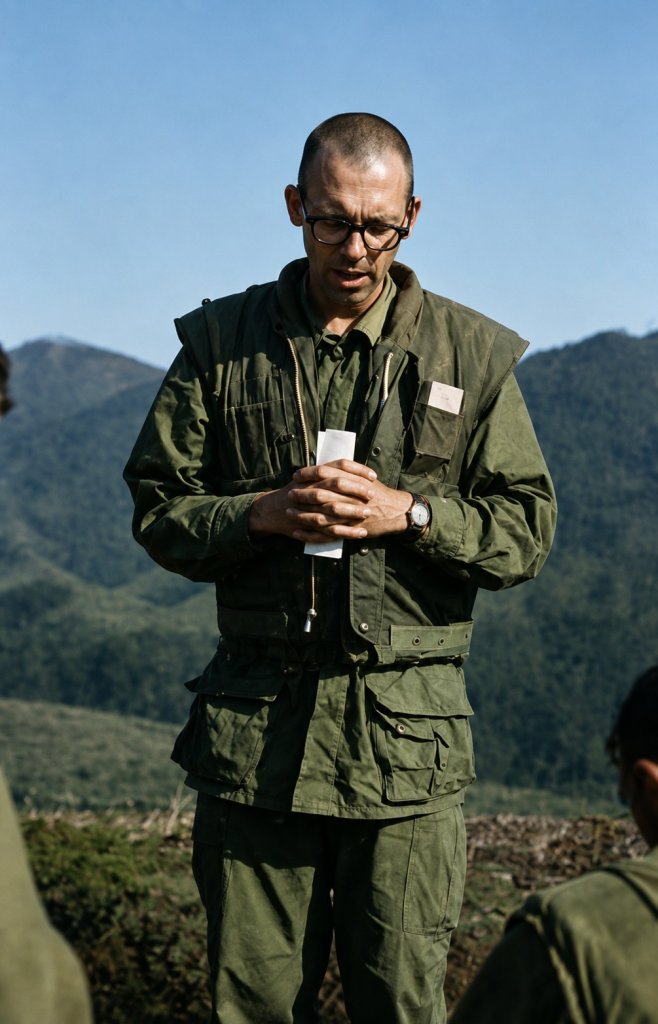
Some additions transform a museum collection because they bring with them far more than objects. They connect uniforms, equipment, photographs, memories, and documented history to the life of one person, allowing visitors to understand not simply what an artifact is, but why it mattered. The collection of retired U.S. Navy Chaplain Lieutenant Commander Ray W. Stubbe did exactly that for Ghosts of the Battlefield. His helmet, boots, Ka-Bar knife, medals, dress uniform, field equipment, he carried with him are now preserved together in one of the most historically significant and personally meaningful displays we have created.
Ray Stubbe was born and raised in Wauwatosa, Wisconsin. His relationship with the Navy began early when he joined the Naval Reserve while still in high school in 1955 and later spent time on active duty. Civilian life initially appeared to be taking him in a very different direction. He attended St. Olaf College, studied philosophy, continued his education at Northwestern Lutheran Theological Seminary, and was ordained as a Lutheran minister in June 1965. He helped establish All Saints Lutheran Church near Milwaukee and later entered a doctoral program in ethics and society at the University of Chicago. He could easily have remained on that path, but the war in Vietnam and the need for military chaplains drew him back into uniform.
Stubbe volunteered to return to active military service because he believed that ministry required more than speaking to people from a distance. If young Marines were going into dangerous places, he believed a chaplain had an obligation to be present with them. In 1967, the young Navy lieutenant was sent to Vietnam and eventually assigned to support Marines at Khe Sanh. Although administrative arrangements placed him within the Navy chaplain system and connected him to Marine organizations serving in the area, Stubbe functioned as the Protestant chaplain for the Marines of 1st Battalion, 26th Marines during much of his time at Khe Sanh. He served there from the summer of 1967 until March 1968, which meant his experience began well before the famous siege that would make the name Khe Sanh known throughout the world.
When Stubbe arrived, Marines were already occupying positions around the combat base and on the surrounding hills. Some of these outposts were isolated, exposed, and difficult to reach. Rather than expecting Marines to come to him, Stubbe traveled to them. He rode helicopters to distant positions, visited reconnaissance Marines, and went to Hill 881 South, one of the areas that had already seen brutal fighting earlier in 1967. These trips forced Stubbe to understand quickly that serving as a chaplain in Vietnam could not be separated from the physical conditions under which the Marines lived.
An early experience on Hill 881 South became especially important in shaping his understanding of the men he was trying to serve. During one visit, Stubbe conducted a religious service and spoke about a young man living miserably in a distant country. Afterward, the company commander challenged him to consider whether he truly understood what the Marines around him were experiencing. The commander then offered him a simple way to learn: a patrol was going out, and Stubbe could accompany it. He accepted.
Moving down the slopes around Hill 881 gave Stubbe a very different understanding of the environment. The terrain was steep, difficult, and covered with vegetation that made movement exhausting and dangerous. Men slipped, fell, fought through brush, and moved across ground that had recently been contested in deadly fighting. The experience helped remove whatever distance may have remained between the seminary-trained minister who had arrived from the United States and the Marines whose lives he hoped to understand. From that point forward, Stubbe's ministry increasingly centered on one principle: he would go where the Marines went.
As a chaplain, Stubbe was a noncombatant. He did not carry a weapon for combat and was not there to participate in offensive operations, but noncombatant status did not remove him from danger. Chaplains in Vietnam traveled with units, visited isolated positions, moved aboard helicopters, lived on combat bases, and endured artillery, mortars, rockets, mines, and the uncertainty of war alongside the people they served. At Khe Sanh, Stubbe lived within the same defensive perimeter as the Marines and experienced the same incoming fire that threatened everyone else.
 A chaplain's work extended far beyond formal religious services. Some Marines sought prayer, scripture, or spiritual guidance. Others wanted to talk about fear, guilt, family, death, or questions they could not easily discuss with friends or commanders. Many did not consider themselves particularly religious at all, but still found value in the presence of someone who would listen without judgment. Stubbe could become counselor, confidant, witness, and a steady presence for young men carrying burdens far beyond what most people their age had ever experienced. He was only in his late twenties during the siege, but many of the Marines around him were barely out of high school. To some of them, he became something close to an older brother.
The situation at Khe Sanh changed dramatically on January 21, 1968. Before dawn, North Vietnamese forces began a massive bombardment of the combat base. Rockets, mortars, and artillery rounds struck throughout the installation. Ammunition exploded, fuel burned, bunkers shook, and the landscape around the Marines became a battlefield of dirt, smoke, shattered timber, and constant uncertainty. The siege of Khe Sanh had begun.
For the next seventy-seven days, Khe Sanh became one of the most closely watched battles of the Vietnam War. American leaders feared that the isolated combat base might become another Dien Bien Phu. Marines and supporting personnel lived under repeated bombardment while American artillery and aircraft struck surrounding North Vietnamese positions. The battle entered newspapers and television broadcasts around the world, but for Stubbe and the men around him it was not an abstract military event. It was the place where they ate, slept, prayed, worked, and waited for the next incoming round.
Stubbe attempted to reassure his family in letters home, but he later acknowledged that there were things he deliberately did not tell them. Some experiences were too frightening to describe while they were happening. On one occasion, an incoming round penetrated several feet of dirt and sandbags before entering his living area while he was eating. It failed to explode. The difference between an unexploded shell and a functioning one could be the difference between an ordinary letter home and a name added to a casualty list.
The dangers faced by chaplains at Khe Sanh became painfully clear in February 1968 when Navy Catholic chaplain Father Robert R. Brett was killed while caring for wounded Marines. His death was a reminder that neither clerical status nor the symbols of faith offered physical protection against artillery and gunfire. Stubbe continued moving among the Marines, conducting services, visiting the wounded, speaking with men who were frightened or grieving, and trying to provide some measure of stability in an environment where very little felt stable.
One of the hardest parts of a combat chaplain's role was knowing the men before they became casualties. Chaplains heard about girlfriends, wives, parents, hometowns, plans for the future, private fears, and things that might never be written in an official report. When men were killed, those relationships did not disappear simply because a casualty report had been filed. Stubbe sometimes knew exactly who had been lost, what they had spoken about days earlier, and who would be waiting for them at home. The emotional burden of remembering those men became something he carried long after leaving Vietnam.
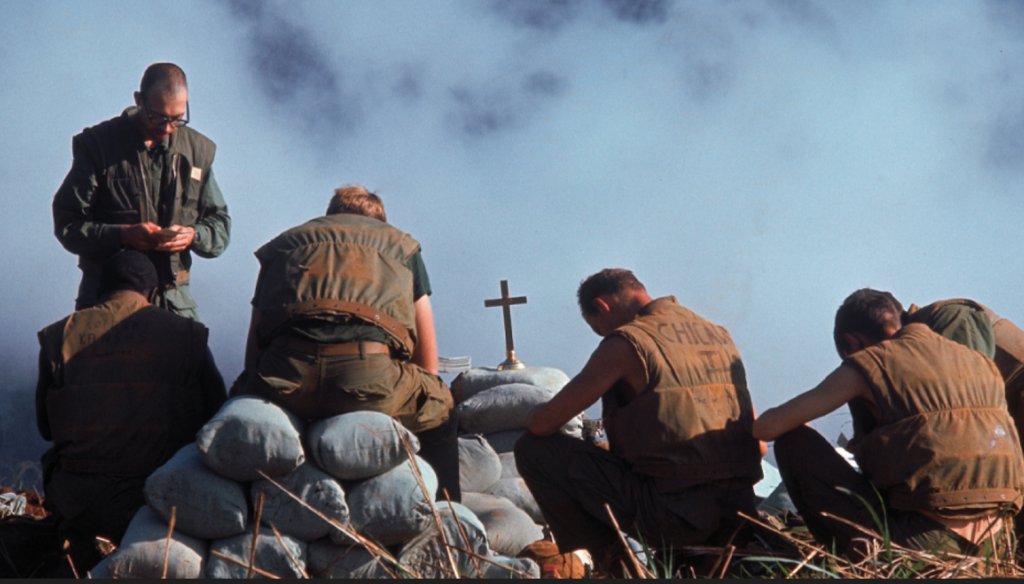
A famous photograph of Stubbe at Khe Sanh gives the collection an even stronger connection to that history. The image shows him conducting a service among Marines in the combat environment, not observing the war from some distant or protected location. The photograph places the man back into the world from which his artifacts came and allows visitors to see the equipment, surroundings, and atmosphere associated with his service.
When the Stubbe collection arrived at Ghosts of the Battlefield, it quickly became obvious that simply placing the individual artifacts inside a display case would not fully communicate their story. The historic photograph offered the foundation for something more immersive. We enlarged the image to serve as the backdrop for a diorama and began developing a full-size representation of Stubbe standing within the scene.
That decision produced one of those unusual moments that sometimes happens in museum work. For several years, we had owned a mannequin that never seemed suited to any particular exhibit. Various uses had been considered, but nothing felt right, so it remained unused. When we began studying the photograph of Stubbe, someone remembered the mannequin. Its face, build, and expression bore a remarkable resemblance to the young chaplain in the photograph. A figure that had waited for years without any clear purpose suddenly seemed perfectly suited for this one display. Whether that was simply coincidence is impossible to say, but it allowed the exhibit to come together in a way none of us could have planned when the mannequin first entered the museum.
 The finished display now combines Stubbe's original artifacts with the historic photograph and a full-size figure representing him in the environment of Khe Sanh. His helmet and boots speak to the physical reality of life in the field. His dress uniform and medals preserve the formal record of his military service. His Ka-Bar and other field equipment remind visitors that even a chaplain had to live and function in the same harsh environment as the Marines around him. At the center of the exhibit remains the wooden cross.
Stubbe's story did not end when he left Khe Sanh in March 1968. He continued serving Marines in Vietnam and later returned to the United States, where his career remained closely connected to Marines, veterans, and military history. Over time, he became increasingly committed to preserving the history of Khe Sanh and the experiences of the men who had served there.
That work grew from something Stubbe had begun while the war was still happening. He kept a diary in Vietnam and tried to record events as they occurred. When circumstances prevented him from writing immediately, he reconstructed what had happened as soon as possible afterward. He understood even then that the events surrounding him were historically important and that details easily forgotten in later years might someday matter.
 After the war, Stubbe continued gathering information. He collected documents, photographs, letters, official reports, personal accounts, and veterans' memories. He contacted former Marines and their families and conducted hundreds of interviews connected with Khe Sanh. His research expanded far beyond his own personal experience and eventually became one of the most substantial private efforts to document the battle and the men who fought there.
Stubbe helped establish the Khe Sanh Veterans Association, giving men who had shared the experience of the battle a way to reconnect with one another. He also became an important historian of both Khe Sanh and Marine reconnaissance. His research contributed to published histories of the battle and to the preservation of Force Reconnaissance history. Over the years, he donated significant archival material so that future historians, researchers, veterans, and families would have access to records that might otherwise have disappeared.
This part of Stubbe's life makes his collection particularly meaningful to Ghosts of the Battlefield. After surviving Khe Sanh, he spent decades doing something very similar to what we attempt to do today. He preserved things because he understood that objects and records become more meaningful when the people behind them are remembered. He knew that a casualty figure could not explain a Marine he had spoken with personally, and that a battle map could never reproduce the experience of sitting in a bunker listening to incoming artillery. Official histories could describe what happened at Khe Sanh, but photographs, diaries, letters, artifacts, and personal memories could help explain what it felt like to be there.
 That is why we do not preserve Stubbe's helmet simply because it is a Vietnam-era helmet, or his uniform simply because it belonged to a Navy officer. Those objects belonged to a specific man who carried them through a specific place and time. His boots walked the ground at Khe Sanh. His field equipment accompanied him among Marines under fire. His medals represent the formal record of his service, while his diary and later historical work represent his determination to preserve the experiences of others.
The wooden cross brings all of those elements together. It once stood on makeshift altars where young Marines gathered during one of the most difficult periods of their lives. It survived the siege and traveled home with the chaplain who carried it. Decades later, it remains connected to photographs, memories, documents, and the story of the man who placed it before Marines in the field.
Ray Stubbe went to Vietnam believing that his responsibility as a chaplain was to be present with the men entrusted to him. At Khe Sanh, he lived that belief under some of the harshest conditions of the war. Afterward, he spent decades making certain that the people he had known and the events he had witnessed would not simply disappear into statistics and fading memory.
 Today, visitors to Ghosts of the Battlefield can stand before his display, see the equipment he wore and carried, view the image of him among the Marines at Khe Sanh, and look upon the same wooden cross that once rested on makeshift altars inside a besieged combat base. It is a simple artifact, but it carries the memory of the men who stood before it, the chaplain who carried it, and the battlefield on which it served.
That is why the cross means so much to this collection. It is not simply an object associated with Khe Sanh. It is a surviving witness to the fear, faith, grief, companionship, and humanity that existed there alongside the weapons and the war.