The Rescue at Bu Dop: Captain William Walker and the Crew of UH-1C 66-00692
On the morning of August 8, the 173rd was supporting South Vietnamese troops operating near Bu Dop in Phuoc Long Province, close to the Cambodian frontier. The ARVN force was being advised by American SF personnel. Captain Walker was one of them.
August 8, 2026

 On August 8, 1970, Captain William Wayman Walker was not aboard the helicopter that was shot down near Bu Dop.
That matters.
Walker did not survive a crash and then attempt to save the men around him. He was aboard another helicopter, saw what had happened, landed near the burning wreckage, climbed out, and went toward it.
Within minutes he would be dead.
The men he was trying to save were the crew of U.S. Army UH-1C Iroquois serial number 66-00692, a gunship belonging to the 173rd Assault Helicopter Company. Its four-man crew consisted of aircraft commander WO1 Jimmy C. Graham, pilot 1LT Jol Nebane Smith, crew chief SP4 Sammy Pina Rodriguez, and gunner SP4 William Emmett Barritt. Only Graham would survive what happened that day.
The 173rd Assault Helicopter Company was based at Lai Khe and was known collectively as the “Robin Hoods,” but there was an important distinction within the unit. Its troop-carrying Hueys flew as the Robin Hoods while its gun platoon was known as the “Crossbows.” Graham himself used the call sign Crossbow 39. The UH-1C was purpose-built for the gunship role, escorting troop carriers, reconnoitering landing zones, and putting rockets and machine-gun fire onto enemy positions before and during combat assaults. Aircraft 66-00692 had entered Army service in December 1966 and had accumulated approximately 2,185 flight hours by August 1970.
On the morning of August 8, the 173rd was supporting South Vietnamese troops operating near Bu Dop in Phuoc Long Province, close to the Cambodian frontier. The ARVN force was being advised by American Special Forces personnel. Captain Walker was one of them. He served with Detachment B-33 at Hon Quan, Company A, 5th Special Forces Group, and was serving as the S-3, or operations officer, with the Special Forces command party taking part in the mission.
Walker was already an experienced infantry officer. Born March 6, 1937, with Jacksonville, Florida, listed as his home of record, he had graduated from Infantry Officer Candidate School with Class 6-65 in 1965. That particular OCS class would eventually lose seventeen graduates in Vietnam. Walker had gone on to serve with Special Forces and, by August 1970, had reached the rank of captain. He was 33 years old.
The helicopter operation that morning involved a formation of troop-carrying Hueys accompanied by gunships. Contemporary accounts refer to an eight-ship lift, while the air mission commander later remembered a formation of roughly eight to ten “slicks.” The exact number matters less than the basic arrangement: troop helicopters were moving ARVN soldiers while the armed Crossbows searched ahead, examined prospective landing zones, and covered the formation.
Captain John E. Horn, flying the Command and Control helicopter as “Robin Hood 3,” was directing the aviation portion of the operation. Captain Jim Roop, the 173rd AHC executive officer, was beside him. Also aboard were members of the Special Forces command party, including a lieutenant colonel serving as the airmobile mission commander, Captain Walker as his S-3, and two Special Forces NCOs.
Ahead of them, Jimmy Graham and his light fire team were checking the next landing zone.
Then came the Mayday.
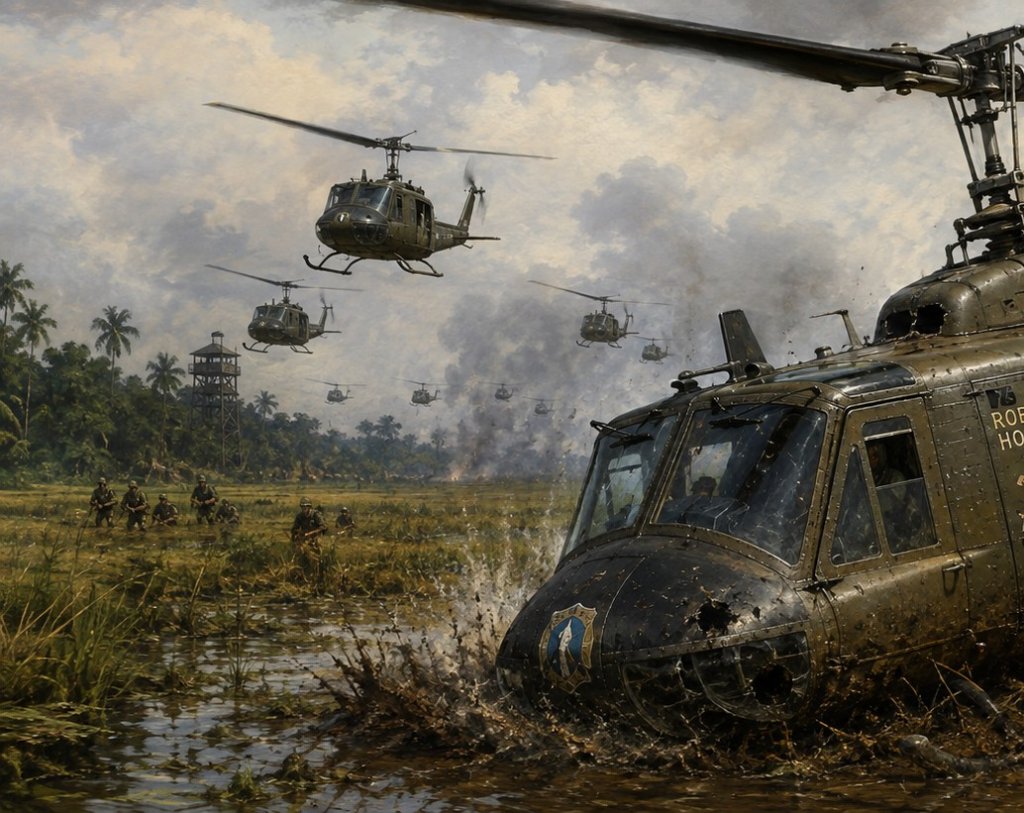
Graham reported that his UH-1C was receiving heavy, accurate enemy fire. The helicopter had been struck while operating roughly four miles west of Bu Dop Airfield. Horn remembered the fire as coming from the western tree line, in an area so close to the international border that he believed the trees themselves were effectively in Cambodia. Graham's damaged gunship plunged into a swampy clearing and began burning.
Horn immediately turned toward the crash. He transferred control of the larger troop formation to Captain Richard Johnson, leader of the White flight, and told him to prepare the ARVN troops for insertion around the crash area. Reinforcements and additional gunships were requested. Artillery support was called for.
Meanwhile, another Huey was already moving.
WO Dick Crow, flying the trail aircraft with pilot Doug Trump, had just completed an insertion when Graham's Mayday came over the radio. Crow broke away and headed directly for the wreck.
What he found was already becoming an inferno.
The UH-1C was burning fiercely. Graham, Smith and Rodriguez were trapped inside. Barritt had managed to get himself out despite serious burns. Crow's crew jumped from their aircraft and ran toward 692. One pulled Barritt farther from the flames while others climbed onto or into the wreckage and began trying to free Rodriguez and the two pilots.
Barritt could easily have remained where he was. He did not.
Although badly burned himself, witnesses remembered him attempting to help move Rodriguez away from the wreck until another rescuer joined him. It is one of those small details easily swallowed by the larger story, yet it says quite a bit about the men involved. The helicopter beside them contained fuel, ammunition and rockets. Ammunition was already detonating in the fire. Barritt was injured badly enough that he would eventually die from his burns, and he was still trying to help another member of his crew.
Horn's Command and Control Huey arrived moments later.
He landed beside the crash and ordered Captain Roop to lead everyone aboard who could be spared into the rescue effort. Walker and the other Special Forces soldiers went with him.
There was still enemy fire coming from the western tree line. Horn repositioned his Huey so that his crew chief could bring a .50-caliber machine gun to bear against it. The weapon suppressed the enemy fire while another gunship covered the opposite side of the clearing and coordinated artillery support.
The battlefield was now compressed into a few acres of swamp: a burning helicopter, rescuers working almost beneath its rotor blades, Hueys hovering or landing nearby, ARVN troops being moved toward the site, artillery being coordinated, enemy fire coming from the trees, and ammunition inside 692 beginning to cook off.
And the fire kept getting hotter.
Horn later recalled that the heat became so intense that the rescuers repeatedly had to lie down in the swamp water simply to cool themselves enough to go back to the wreck.
Walker did exactly that.
The official citation for the Distinguished Service Cross later awarded to him describes Walker soaking himself in the marsh water so he could withstand the heat before returning to the aircraft. He helped free an injured crewman and carry him away. Then, despite knowing that the gunship was filled with burning ammunition and rockets, Walker went back.
The main rotor blades were becoming another danger. Heat from the fire caused one of them to begin drooping toward the men working below. Witnesses remembered Walker and other rescuers physically getting beneath the blade and holding it up with their bare hands so the effort to free the trapped pilots could continue.
One by one, they were getting men out.
WO Jimmy Graham was freed with a severe back injury.
SP4 William Barritt was pulled clear with burns covering approximately 35 percent of his body.
SP4 Sammy Rodriguez was finally removed with burns over more than half his body.
That left 1LT Jol Smith.
And time had almost run out.
 Smith was 25 years old, from Santa Fe, New Mexico. He had been in Vietnam for only 68 days. Fellow members of the 173rd remembered him as a relatively new pilot who was well liked and already being considered to eventually lead the Crossbow gun platoon. Before the Army, he had been remembered by at least one young man in Santa Fe as a swimming coach and mentor. He had married before leaving for Vietnam, and a fellow officer who later escorted Smith's remains home remembered that Smith never lived to see his unborn child.The rescuers were still working to free him when the inevitable finally happened.
A rocket aboard 692 began to cook off.
Then the rocket load exploded.
The concussion was powerful enough to nearly knock one of the hovering Hueys out of control. Horn's aircraft jumped violently upward from the blast. Men around the wreck were struck and injured.
Captain William Walker was mortally wounded.
Smith was still trapped inside the gunship. He could not be reached before the explosion and died in the wreckage. The rescue did not stop.
The wounded were loaded aboard the available helicopters and flown to medical facilities at Quan Loi. Graham survived his injuries.
Sammy Rodriguez did not.
Rodriguez was only nineteen years old. Born August 27, 1950, and from San Antonio, Texas, he was still nineteen when he died from his burns on August 8. Horn knew him personally because Rodriguez had previously served as his crew chief in the gun platoon. Years later, Horn remembered Rodriguez as an exceptional mechanic, calling him the best minigun maintainer he had encountered in Vietnam.
William “Bill” Barritt initially appeared to have a chance.
 Barritt was 24 years old and came from Meridian, Mississippi. Within the 173rd he was more than another name on a flight roster. Horn remembered him as a budding country singer who performed for enlisted men, NCOs and officers alike. After the crash he was sent to a field hospital at Long Binh.
Horn visited several days later expecting to find him recovering. Instead, a nurse told him that Barritt had died the previous day.
William Emmett Barritt died on August 14, 1970, six days after the crash.
For the 173rd Assault Helicopter Company, August 8 had become one of those days that refused to end. Horn later remembered it as one of the worst of his 22 months in Vietnam. The unit had already dealt with enemy rocket fire at Lai Khe, and SP4 David Leroy Climer, another member of the 173rd AHC, was also killed that day after being struck by shrapnel during a rocket attack.
There was also heroism everywhere around the wreck of 66-00692, much of it performed by men whose names barely survived in the written record.
Captain Jim Roop and one of the C&C aircraft's gunners received Silver Stars for their actions. John Horn received the Distinguished Flying Cross for directing the rescue and security effort while remaining exposed beside the burning gunship. Dick Crow and his crew repeatedly approached the wreck and carried wounded men away despite the ammunition exploding around them. ARVN troops were inserted to secure the crash site. Gunships and the C&C aircraft remained overhead or on the ground to suppress enemy fire while men worked beside a helicopter everyone knew could explode at any moment.
 Captain Walker received the Distinguished Service Cross posthumously.
The award was authorized in Headquarters, U.S. Army Vietnam General Orders No. 4465 on September 21, 1970. The citation did not celebrate a successful attack, the taking of an objective, or the destruction of an enemy position. It recognized something much simpler.
Walker saw men trapped inside a burning helicopter and went to them.
He knew what was aboard that aircraft. He could hear ammunition detonating. He could see the fuel burning. He knew rockets were exposed to the flames. He had already reached relative safety after helping remove one man.
And he went back.
There is another reason the story of August 8, 1970 deserves to be remembered as more than the “final mission” of one man.
It was the final mission of a crew.
Jimmy Graham survived, severely injured, and lived with the memory of the three men who had been aboard 692 with him. Jol Smith was 25 and had barely begun his Vietnam tour. Sammy Rodriguez was nineteen and was remembered years later not merely as a crew chief but as an extraordinarily talented young mechanic. Bill Barritt was 24, sang country music for his fellow soldiers, survived the crash and initially survived the rescue before dying six days later.
And William Walker was not part of their crew at all.
He did not have to be.
That may be the most important detail in the entire story.
On August 8, 1970, somewhere in a swamp west of Bu Dop, the distinctions between aviator, crew chief, gunner, Special Forces officer and helicopter passenger ceased to matter. There were simply men inside a burning aircraft and other men trying desperately to get them out.
For several terrible minutes, they refused to leave one another behind.