The M21 Sniper Rifle: The Weapon That Rebuilt the U.S. Army Sniper Program
Its development was driven by Vietnam. The Army entered that war having largely allowed the sniper skills developed during World War II and Korea to atrophy.
August 8, 2026

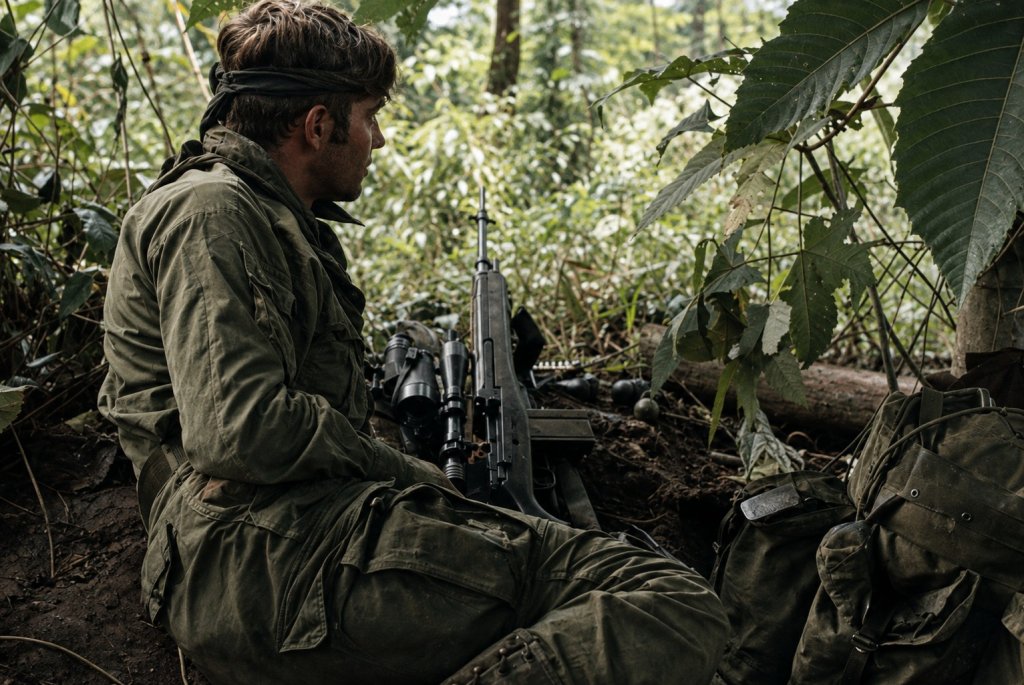
The M21 occupies an unusual place in American military firearms history. It was neither the first American sniper rifle nor, by modern standards, the most sophisticated. It was not designed from a blank sheet of paper as a precision weapon. At its heart was the M14, the U.S. Army's short-lived standard battle rifle of the early 1960s. Yet the M21 became something far more important than an M14 with a telescope screwed to it. It represented the return of serious sniper doctrine to the United States Army and combined a precision rifle, specialized ammunition, an innovative optical sight and formally trained snipers into what the Army increasingly treated as a complete weapon system.
Its development was driven by Vietnam. The Army entered that war having largely allowed the sniper skills developed during World War II and Korea to atrophy. Within only a few years, however, American soldiers were carrying highly accurized semiautomatic rifles capable of effective fire hundreds of meters beyond the ordinary infantryman's engagement range. The rifle that emerged from that hurried wartime effort became the XM21 and subsequently the M21, and it remained the Army's principal sniper rifle until the adoption of the M24 in 1988. The U.S. Army Marksmanship Unit, whose gunsmiths and competitive marksmen played a major role in its development, still lists the M21 among the weapon systems developed and tested by its Custom Firearms Shop.
Before the M21: The M1903A4 and the Army's First Modern Sniper Rifles
The M21's ancestry reaches farther back than the M14. During World War II the Army adopted the bolt-action M1903A4 Springfield as a purpose-built sniper version of the M1903. It was essentially a wartime expedient. The rifle itself could be accurate, but its early Weaver 330C telescope, standardized as the M73B1, was a relatively low-powered commercial optic adapted for military service. Its small field of view, limited light-gathering ability and modest magnification restricted what an otherwise capable rifle could accomplish.
That problem would repeatedly appear in the history of American sniper weapons: a good rifle is only as useful as the sighting equipment mounted on it. The M1903A4 demonstrated that accuracy alone was not enough. A sniper also had to identify a target, estimate distance, observe conditions and place a precise aiming point on something that might be several hundred yards away.
 Late in World War II the semiautomatic M1 Garand was adapted for sniping as the M1C and M1D. These rifles were important conceptual predecessors of the M21 because they demonstrated the attraction of combining precision fire with a semiautomatic action. Rather than manually cycling a bolt after every shot, the sniper could remain behind the rifle and fire another round immediately.
The M1C used a receiver-mounted telescope system, while the simpler M1D employed a mounting block attached to a specially configured barrel. Both normally carried their scopes offset to the left because the Garand had to be loaded from the top with eight-round en-bloc clips. The M84 telescope eventually became common on these rifles. Although rugged enough for military use, the M84 provided only approximately 2.2-power magnification. By Vietnam, the Army was attempting to conduct twentieth-century sniping with an optical system rooted firmly in World War II.
The M1C and M1D served through Korea and survived into the early Vietnam period. They could kill at considerable distances in skilled hands, but the limited magnification, awkward cheek position caused by the offset telescope and age of the system were increasingly obvious disadvantages. The M1D was not a terrible rifle. It had simply reached the limits of what could reasonably be expected from a design conceived more than twenty years earlier.
The M14 Arrives, but the Sniper Disappears
The M14 was standardized as the Army's new service rifle at the end of the 1950s. Chambered for the 7.62×51mm NATO cartridge and fed from a detachable 20-round magazine, it was essentially the final evolution of the Garand concept. It had excellent conventional sights, a powerful cartridge and considerable inherent accuracy.
Oddly, however, the Army did not immediately develop a corresponding M14 sniper rifle.
That decision reflected doctrine more than technology. During the 1950s the Army increasingly envisioned a future battlefield dominated by nuclear weapons, mechanization and massive firepower. Traditional sniper programs received little institutional attention. The old idea of a specially trained soldier patiently identifying and engaging individual targets seemed less important in an era obsessed with tactical nuclear weapons and large-scale maneuver.
Vietnam exposed the weakness of that assumption.
American infantrymen soon found themselves fighting an enemy adept at concealment, ambush and carefully controlled small-arms fire. Viet Cong and North Vietnamese marksmen could fire from tree lines, villages, bunkers and dense vegetation, sometimes forcing American units to expend enormous quantities of ammunition against a target that might actually consist of one man.
The Army suddenly needed snipers again. Unfortunately, armies being armies, it had largely dismantled the machinery required to produce them.
Vietnam Forces the Army to Relearn Sniping
The Army began experimenting with available weapons and optics. Old M1D Garands were used, as were other combinations assembled from weapons already in inventory. Early attempts were made to mount the M84 telescope on the M14, but the 2.2-power optic was plainly inadequate for the ranges at which trained snipers were expected to operate. Tests also showed that ordinary M80 ball ammunition could not provide the consistency desired from a sniper weapon.
The answer was not simply an M14. It was an accurized M14.
In early 1967 the U.S. Army Concept Team in Vietnam evaluated sniper requirements and concluded that an accurized M14 was suitable for the mission. The Army's official history Tactical and Materiel Innovations records that National Match-grade M14 rifles were subsequently used. Actions were carefully fitted, rifles were glass bedded into moisture-resistant stocks, and National Match ammunition was employed to achieve the consistency ordinary service rifles and ammunition could not provide.
At the same time, the Army was rebuilding the human portion of the system. In June 1968 the 9th Infantry Division established what became one of the most significant Army sniper programs of the Vietnam War. A cadre from the Army Marksmanship Training Unit at Fort Benning brought competitive shooting expertise, gunsmithing knowledge and a level of precision-rifle experience rarely found in conventional units. Candidates were selected from expert riflemen and subjected to demanding training. According to the Army's history, only about half successfully completed the course.
The results were difficult to dismiss. The first graduates were assigned to maneuver units in November 1968. Through March 10, 1969, the 54 snipers of the 9th Infantry Division recorded 135 contacts resulting in 211 confirmed enemy dead. Division commander Lieutenant General Julian Ewell later called the sniper program his division's most effective single program.
The rifle was becoming only one component of something larger. Training, observation, fieldcraft, special ammunition and precision gunsmithing were being combined with the weapon. That concept is one reason the term Sniper Weapon System matters when discussing the M21.
From National Match M14 to XM21
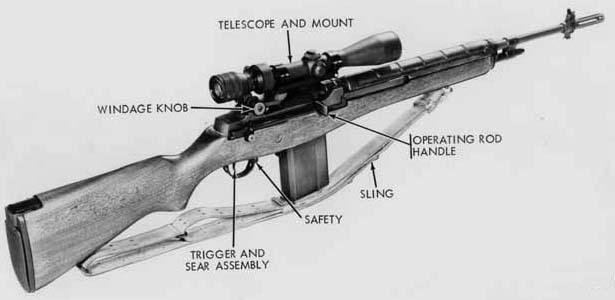
The M14 National Match rifles used for sniper work were extensively refined compared with ordinary service rifles. The Army's later M21 manual describes selected barrels, individually fitted receivers, epoxy-impregnated walnut stocks, fiberglass bedding, reworked firing mechanisms, carefully fitted flash suppressors, modified gas systems and selected components. The trigger was tuned to approximately 4.5 to 4.75 pounds. These were not rifles being pulled randomly from an arms room and fitted with scopes. Considerable hand fitting and specialist labor went into producing them.
Rock Island Arsenal became deeply involved in the conversion effort, with roughly 1,400 National Match M14 rifles commonly cited as having been converted for sniper use. The resulting rifle entered combat service as the XM21 Sniper Weapon System during 1969. The "X" indicated its developmental status.
The precise date when XM21 officially became M21 is annoyingly inconsistent among secondary histories. Dates of 1972 and 1975 are both frequently repeated. What can be established is that Army manuals were using the M21 designation by the mid-1970s, while rifles actually encountered during the Vietnam combat period are properly described as XM21s in many contemporary contexts. Calling every Vietnam rifle an M21 is understandable shorthand, but it erases an interesting part of the weapon's development.
The Leatherwood ART: The Other Half of the M21
Perhaps the most innovative component of the XM21 was not the rifle at all. It was the telescope.
Army Lieutenant James Leatherwood developed the Adjustable Ranging Telescope, or ART, around an ingenious concept. Rather than requiring the sniper to estimate a distance, consult elevation data and manually dial the corresponding correction into the telescope, Leatherwood linked the telescope's magnification system to a ballistic cam.
The early ART was based around a commercially produced 3-to-9-power variable telescope modified for military use. The sniper adjusted the magnification until a known dimension of the target fitted between reference marks in the reticle. Because the magnification ring and ballistic cam were mechanically linked, adjusting the image to determine range simultaneously changed the telescope's elevation. In simplified terms, the shooter ranged the target and the telescope automatically compensated for the bullet's expected drop.
For the ART I, the Army manual described using approximately 30 inches, roughly the distance from a man's belt line to the top of his head, as one ranging reference. The ART II used a different reticle and separated the power ring and ballistic cam so the shooter could range the target and then alter magnification without changing the elevation setting. The system was designed to provide automatic elevation compensation from approximately 300 to 900 meters.
This was remarkable technology for the late 1960s. Modern shooters accustomed to laser rangefinders, ballistic computers and first-focal-plane reticles can easily miss how revolutionary the concept was. Leatherwood was attempting to solve several separate problems mechanically: magnification, range estimation and ballistic compensation.
It was not magic. The system depended upon the apparent size of an object whose actual dimensions had to be reasonably understood. A crouching man, partially concealed target or unusually sized object could introduce error. Wind still had to be judged. Ammunition had to perform consistently with the ballistic cam. The rifle still had to be properly zeroed. But compared with a 2.2-power M84 telescope sitting on a World War II-vintage Garand, the ART represented an enormous leap forward.
The M118 Match Cartridge
The rifle and telescope would have been wasted without consistent ammunition.
The XM21 was associated with the 7.62×51mm M118 Match cartridge, using a 173-grain boat-tail bullet. Match ammunition offered substantially greater consistency than ordinary M80 ball and allowed the accuracy potential of the carefully built rifle to be exploited.
This was another important step toward the modern concept of a sniper system. Ammunition was no longer treated as an interchangeable afterthought. Rifle, telescope and cartridge were expected to function together.
That sounds obvious today. It was considerably less obvious to an Army that had entered Vietnam without a standardized modern sniper system at all.
What the XM21/M21 Actually Was
Physically, the M21 remained recognizably an M14. It was approximately 44 inches long with a 22-inch barrel and normally fed from the same detachable 20-round magazine used by the service rifle. Depending upon configuration and optic, the complete system weighed roughly eleven and a half pounds or more. It retained the M14's gas-operated action and rotating bolt.
The differences were hidden largely inside the quality of assembly. The barrel was selected for proper tolerances. The action was fitted into its stock rather than simply dropped into one. The trigger was refined. The gas cylinder and associated components were modified to reduce their negative effect on accuracy. The flash suppressor was fitted and reamed to avoid alignment problems. National Match iron sights remained available as a backup sighting system.
This distinction is important. There are photographs from Vietnam of scoped M14s that are casually identified today as XM21s or M21s even when they represent earlier or locally assembled configurations. An M14 wearing a telescope is not automatically an XM21.
The Great Advantage: A Sniper Rifle That Could Fire Again Immediately
The defining operational advantage of the XM21 was its semiautomatic action.
The Marine Corps followed a different path in Vietnam and ultimately adopted the bolt-action M40, based on the Remington Model 700. Marine snipers such as Carlos Hathcock and later Charles Mawhinney became famous using bolt-action weapons. The Army's XM21 represented a different philosophy.
After firing, the XM21 automatically extracted and ejected the empty case, chambered the next cartridge and was immediately ready to fire again. The shooter did not have to move his firing hand to operate a bolt.
That mattered whenever a first shot missed, more than one target appeared, a moving target required another attempt or the sniper suddenly found himself involved in a general firefight. With a 20-round magazine the XM21 possessed an amount of immediate firepower almost unheard of in Western sniper rifles of the period.
It also reduced movement by the shooter between shots. A bolt-action rifle requires physical manipulation of the action. A semiautomatic permits the sniper to remain in position, maintain visual contact through or around the optic and fire again.
In the Mekong Delta, where Army snipers sometimes operated from boats or accompanied highly mobile infantry formations, those advantages were more than theoretical.
The Other Advantage: It Was Still an M14
The XM21 inherited considerable logistical and ergonomic familiarity from the M14. Armorers already understood the basic weapon. Soldiers understood its controls. Magazines and many components already existed in the supply system. The rifle fired the same basic 7.62×51mm NATO cartridge family already used by other American weapons.
The standard M14's excellent iron sights were retained in National Match form. If an optic became unusable, the rifle did not become an eleven-pound club. The Army's sniper manual specifically described the iron sights as a backup system and provided procedures for calibrating them for long-range use.
The 7.62mm cartridge also provided useful retained energy and exterior ballistic performance at distances beyond the normal effective employment of the M16. The Army's own Vietnam history recorded sniper engagements extending to approximately 900 meters.
Night Fighting and the Starlight Scope
Vietnam also accelerated the development of night sniping. XM21 rifles could be paired with early-generation night-vision equipment such as the AN/PVS-2 Starlight scope.
By modern standards these devices were enormous, heavy and crude. By Vietnam standards they were almost science fiction.
They amplified available light and allowed American snipers to observe and engage targets after darkness. The Army experimented with infrared illumination and other methods of extending the practical usefulness of night-vision equipment. This transformed the sniper from a daylight specialist into a potential twenty-four-hour threat.
The weight penalty was substantial. An M14-based sniper rifle was already a long and relatively heavy weapon. Put a large first-generation night sight on top of it and nobody was going to mistake the result for a lightweight stalking rifle. Nevertheless, the capability mattered enormously.
 Suppressed M-21s
Vietnam also saw experimentation with sound-suppressed precision weapons. Suppressors were never the defining standard feature of every XM21, but photographs and accounts show suppressed M14-family sniper rifles and specialized configurations.
The purpose was not the Hollywood fantasy of making a full-powered rifle completely silent. A 7.62mm bullet traveling at supersonic velocity still produced a ballistic crack. Suppression instead reduced muzzle blast and flash and made the exact origin of a shot more difficult to identify. In darkness or dense vegetation, that could significantly complicate an enemy's attempt to locate the sniper.
The broader importance is that the Army was experimenting with combinations of precision rifles, optics, night vision and sound suppression during the same period. Vietnam was becoming a laboratory for concepts that would eventually become normal elements of modern sniper equipment. Contemporary historical studies of Vietnam-era sniping specifically identify the XM21, ART and sound-suppression work as important parts of that development.
The M21's Greatest Weakness: Precision Was Fragile
The qualities that made the M21 accurate also created its greatest weakness. A standard infantry M14 was designed to be stripped, cleaned, assembled and kept running by soldiers in the field. A National Match-quality M14 depended upon extremely precise relationships between components. The receiver was carefully bedded into the stock. The gas system, stock pressure and other fitted components influenced the rifle's consistency. Take the system apart casually and that carefully established relationship could be disturbed.
The Army's own M21 instructions are revealing. Snipers were specifically told not to disassemble the rifle for ordinary cleaning and lubrication. Disassembly was supposed to be performed by an armorer during scheduled inspection or repair. If certain problems developed, the rifle had to be turned over to a school-trained National Match armorer.
That is a remarkable limitation for a combat weapon.
It meant that the M21 could be extremely capable while properly maintained but was far less forgiving logistically than an ordinary infantry rifle. The rifle needed craftsmen, not merely replacement parts. That weakness eventually became one of the strongest arguments for replacing it.
Glass Bedding: Solution and Problem
Glass bedding illustrates the contradiction perfectly. The M14 receiver does not naturally provide the rigid bedding arrangement of a modern precision bolt action seated in a chassis. Accuracy was improved by fitting the receiver extremely tightly into the stock using fiberglass or epoxy bedding material. The result minimized movement and helped the rifle return to a consistent relationship between receiver and stock every time it fired.
It worked.
But bedding could deteriorate through repeated disassembly, recoil and hard service. If the fit changed, accuracy could change with it. Maintaining a fleet of rifles built this way demanded skilled armorers and careful handling.
Vietnam's moisture created another complication. Wood changes dimension as humidity changes. The Army therefore used specially treated or impregnated stocks and eventually composite materials to reduce environmental effects. The fact that the Army went to such lengths demonstrates just how much effort was required to turn the M14 into a precision rifle. The M21 was accurate not because the M14 effortlessly happened to be a sniper rifle, but because talented armorers fought the basic design until it behaved like one.
The Scope Mount Was Another Compromise
The M14 had not originally been designed around a telescopic sight. Its receiver geometry therefore forced designers to develop specialized side-mounted telescope bases.
The ART system used a lightweight mount attached to mounting points on the left side of the receiver. The later ART II mount added another attachment point through the stripper-clip guide area to increase stability.
This was clever engineering applied to an existing rifle, but it was still adaptation. Modern precision rifles are usually designed from the beginning around rigid optical rails, adjustable cheek positions and scopes centered naturally over the shooter's line of sight. The M14's traditional stock had been designed for excellent iron-sight shooting. Add a telescope above the receiver and achieving exactly the same comfortable cheek weld was more difficult.
Again, the M21 worked. It simply required compromises that a purpose-built sniper rifle could avoid.
Weight, Length and Movement
At approximately 44 inches long and well over eleven pounds once equipped, the M21 was not a small rifle.
The basic rifle could be manageable, but sniper equipment did not stop with the rifle. Add the telescope, ammunition, binoculars, spotting equipment, camouflage, radio equipment and possibly a massive night-vision sight and the sniper's load became considerable.
In jungle, swamp and riverine terrain this mattered. A weapon optimized for deliberate shooting could become cumbersome while climbing aboard boats, crawling through vegetation or moving with conventional infantry.
The same 20-round magazine that gave the rifle tremendous firepower also protruded significantly beneath the receiver. From the prone position it could interfere with very low firing positions compared with the smaller internal magazines commonly found on bolt-action sniper rifles.
These were not fatal flaws. They were simply costs attached to the rifle's advantages.
Accuracy Versus Reliability
The M21 also embodied a fundamental engineering conflict.
Loose tolerances generally help a military rifle continue operating when filthy. Tight, carefully controlled relationships generally help a precision rifle shoot consistently. The M21 attempted to obtain both qualities from a service rifle whose basic operating system contained a moving gas piston, operating rod, detachable stock and numerous contact points.
The Army Marksmanship Unit and Rock Island Arsenal did an impressive job of reconciling those requirements, but they could not repeal physics.
As components wore, bedding deteriorated or the rifle was repeatedly subjected to field conditions, maintaining match-grade accuracy became increasingly difficult. The Army's experience ultimately demonstrated that a semiautomatic precision rifle could be extraordinarily useful, but the particular architecture of the M14 was expensive in skilled maintenance.
Ironically, the Army would eventually return to the semiautomatic sniper concept with rifles designed from the beginning to accommodate modern optics and precision requirements.
The M21 had been right about the concept before technology was quite ready to make the concept easy.
Adelbert “Bert” Waldron: The Man Most Closely Associated with the XM21
 If one name belongs beside the XM21, it is Staff Sergeant Adelbert F. “Bert” Waldron III of the 9th Infantry Division.
Waldron served with the division's sniper program in the Mekong Delta and became its most successful sniper. Army historical accounts credited him with 109 confirmed enemy kills. Unlike the better-known Marine snipers of Vietnam, who generally became associated with bolt-action Winchester and Remington rifles, Waldron is strongly linked to the semiautomatic XM21.
That alone makes him important to the rifle's history. The XM21 was not simply tested on a range. One of the most successful American snipers of the war demonstrated what it could accomplish under some of Vietnam's most difficult conditions.
Waldron operated extensively in the riverine environment. Lieutenant General Julian Ewell later related one of his most remarkable engagements. While aboard a moving river craft, Waldron's boat came under fire from an enemy sniper concealed in a tree roughly 900 meters away. Waldron located him and killed him with a single shot despite firing from a moving platform. Whether every remembered detail of such wartime accounts can be reconstructed decades later is another matter, but the story appears in the Army's own historical discussion of Waldron's extraordinary shooting ability.
Waldron's association with the XM21 is especially important because his record shows what the semiautomatic system offered an experienced marksman. He was working in a combat environment of waterways, dense vegetation, fleeting targets and uncertain ranges rather than firing exclusively from carefully prepared static hides.
In many ways, Waldron and the XM21 were perfectly matched: both highly effective, both Army products, and both largely overshadowed in popular memory by the much better publicized Marine sniper tradition.
 Sergeant Jim Titus and the Transitional M14 Sniper Rifles
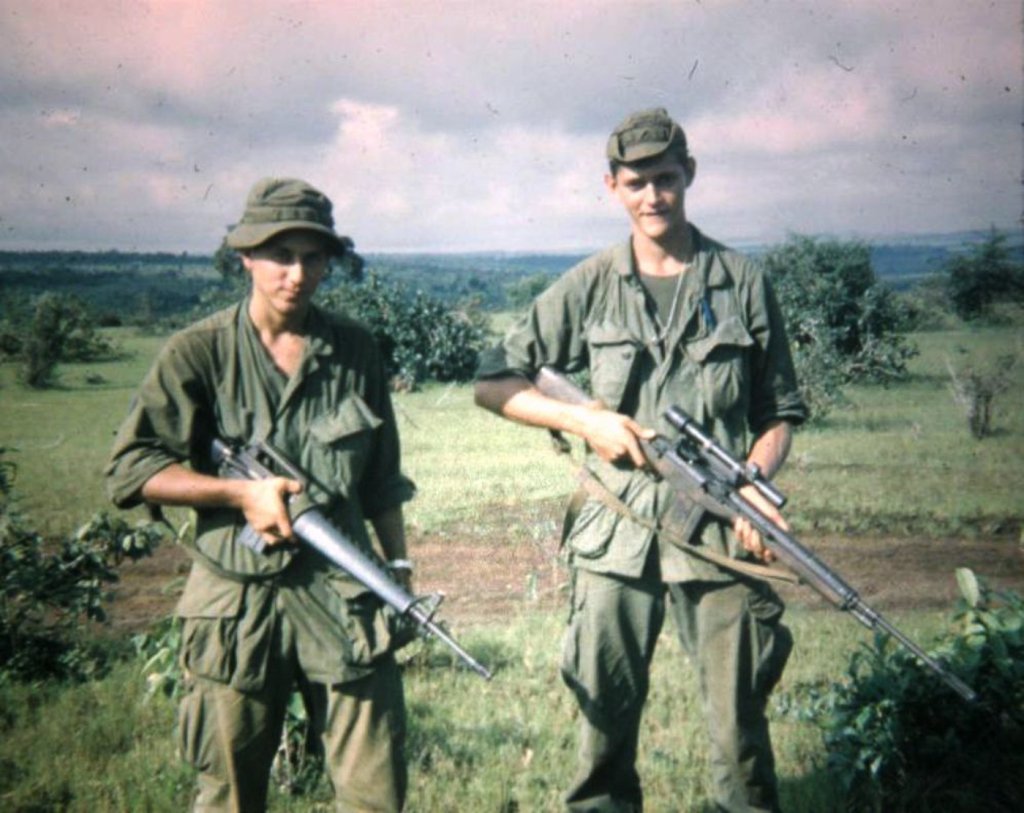
Another useful figure in understanding the M21 story is Sergeant Jim Titus of E Company, 3rd Battalion, 7th Infantry, 199th Light Infantry Brigade. Period photographs show Titus with an accurized M14 fitted with the World War II-era M84 telescope.
That rifle represents the messy transitional period that existed before the XM21 configuration became standardized. It visually demonstrates why simply identifying every scoped M14 in Vietnam as an “M21” can produce bad history. Some rifles were National Match M14s wearing older optics. Others used experimental mounts or commercial telescopes. Eventually the ART-equipped XM21 became the recognizable standard.
Those transitional rifles are every bit as historically interesting as the final XM21 because they show the Army solving the problem in real time.
Who Did NOT Become Famous with the M21
The amount of bad photo captioning surrounding Vietnam snipers makes this distinction worth stating plainly.
Carlos Hathcock was not famous for using the M21. Hathcock was a United States Marine and is most strongly associated with the Winchester Model 70 and the Marine Corps M40, as well as his famous use of a scoped M2 .50-caliber machine gun.
Charles “Chuck” Mawhinney was not an M21 sniper. He was a Marine scout sniper principally associated with the M40.
Eric England was also a Marine sniper, not an example of the Army XM21 program.
These men sometimes appear in online M21 histories simply because an article writer wants recognizable sniper names. That is how the internet eventually ends up making every man in Vietnam Carlos Hathcock and every scoped rifle an M21.
The actual M21 story does not need borrowed legends. It has Bert Waldron.
 The 9th Infantry Division: The M21's Most Important “User”
In some respects the most important famous user of the XM21 was not an individual at all. It was the 9th Infantry Division's sniper program.
The division demonstrated that organized sniper teams could produce results disproportionate to their numbers. Its school became an important model for other Army sniper programs in Vietnam. Personnel and methods spread to other divisions, helping create a wider sniper capability that had barely existed when major American ground combat began.
The 9th Division's snipers did not simply kill enemy personnel. They performed reconnaissance, counter-sniper missions, ambush work and area denial. Army histories describe snipers being positioned near suspected tunnel entrances, caches, infiltration routes and areas used by enemy personnel. The sniper became an intelligence collector and psychological presence as well as a precision shooter. This is the environment in which the XM21 proved itself. The rifle therefore cannot be understood separately from the revival of the Army sniper profession. The Army had built a weapon at roughly the same moment that it rediscovered how to employ the man carrying it.
After Vietnam
The M21 survived the war that created it. Army sniper programs declined again after Vietnam, but the rifle remained in inventory. During the late 1970s and early 1980s interest in formal sniper capability revived, particularly in specialized formations. The 1st and 2nd Ranger Battalions employed the M21, and Ranger snipers carried the system during the 1983 invasion of Grenada, Operation Urgent Fury.
By then the M21 was becoming an old system. Optical technology had advanced considerably, bolt-action precision rifles could provide excellent accuracy with far simpler mechanical architecture, and the Army wanted a rifle that could be maintained and supported more easily.
The result was the M-24 Sniper Weapons System, based upon the Remington 700 bolt action.
In 1988 the M24 formally replaced the M21 as the Army's standard sniper rifle. The decision might superficially appear to have been a technological step backward. The Army gave up a 20-round semiautomatic rifle for a manually operated bolt action with far lower magazine capacity.
But the M24 was a purpose-built precision system. It could maintain extremely high accuracy without the M21's complicated relationship between gas system, stock bedding and action fit. It was simpler for armorers to maintain, easier to equip with modern optics and inherently suited to the deliberate precision-fire role.
The M21 had demonstrated the value of rapid follow-up shots. The M24 demonstrated the value of simplicity. Neither concept was entirely wrong.
 The M21 Refuses to Die
Official replacement did not mean disappearance. M21s and various accurized M14 derivatives continued to surface in specialized units and reserve inventories. M14-based precision rifles evolved into systems such as the M25 and later designated-marksman configurations. Then the wars in Iraq and Afghanistan produced another surprise.
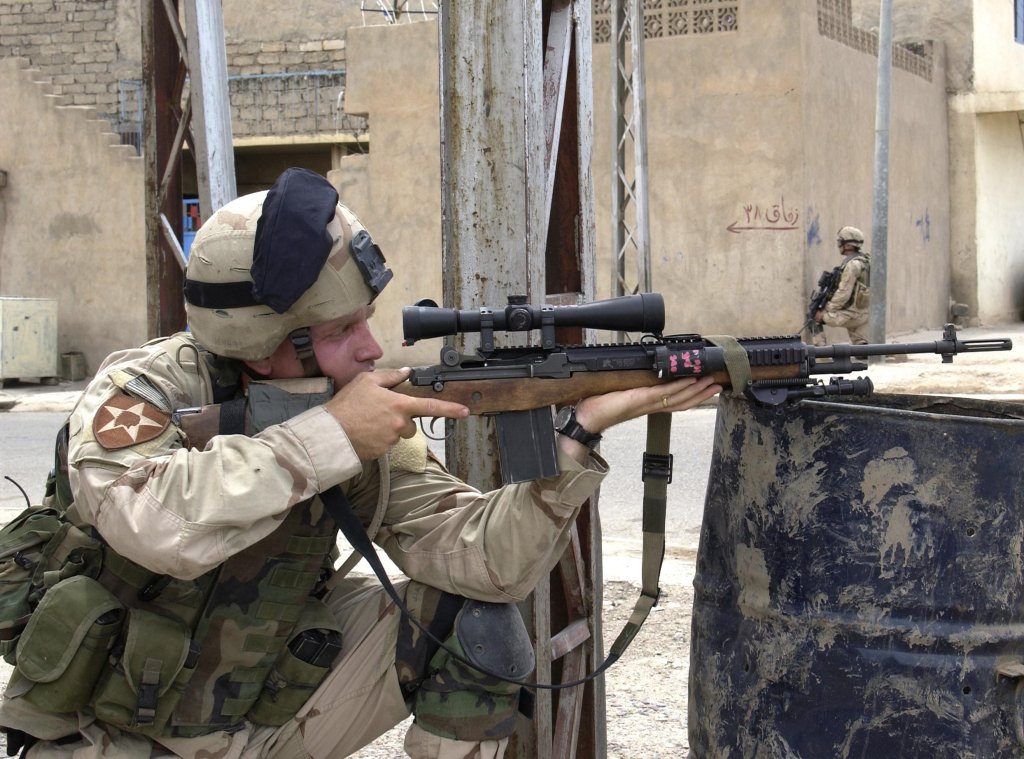
American soldiers once again found themselves needing powerful semiautomatic rifles capable of reaching beyond ordinary 5.56mm carbines. Old M14s were pulled from storage and rebuilt into designated marksman rifles and Enhanced Battle Rifles. Some actual M21s also reappeared. An official Army history of operations in Iraq even includes a photograph of a 1st Battalion, 23rd Infantry sniper using an M21 during operations in Mosul.
The irony is difficult to miss.
The Army had replaced the M21 with a bolt-action rifle because the M14-based system was complicated and maintenance-intensive. Less than two decades later, battlefield requirements again created demand for semiautomatic 7.62mm precision fire.
Eventually weapons such as the M110 Semi-Automatic Sniper System provided that capability in a rifle designed from its inception around modern optics, detachable magazines and precision semiautomatic fire.
Conceptually, the M110 was solving many of the same problems the XM21 had confronted in Vietnam.
Advantages of the M21
The M21's greatest strength was its combination of precision and immediate follow-up fire. A trained sniper could engage a distant target and fire again without breaking position to operate a bolt. Twenty-round magazines gave him tremendous reserve firepower if a precision engagement suddenly became a close fight.
Its 7.62×51mm cartridge offered excellent useful range and was already in the Army supply system. M118 Match ammunition significantly improved consistency. National Match iron sights provided a genuinely capable emergency backup. The ART telescope combined variable magnification, range estimation and ballistic compensation in a remarkably innovative package for its time.
The rifle was also built upon a weapon already familiar to the Army. Much of the institutional knowledge, supply system and manual of arms already existed.
Most importantly, the XM21 proved that a semiautomatic rifle could serve as a serious sniper weapon. That lesson would outlive the rifle itself. Its disadvantages were largely consequences of converting a service rifle into something it had never originally been designed to become.
The M21 was long and heavy. Its stock geometry had been intended for iron sights rather than large optical systems. Its precision depended upon careful glass bedding, selected components and specialist gunsmithing. Ordinary field stripping could compromise the carefully fitted action, which is why Army manuals restricted routine disassembly.
The gas system and operating mechanism introduced additional variables that a simple bolt-action rifle avoided. Maintaining a fleet of highly tuned M21s therefore required expertise and time.
The ART telescope was extremely clever but depended upon correct calibration and reasonably accurate target-size estimation. It compensated for elevation, not judgment. Wind, target movement, unusual target dimensions and environmental conditions could still defeat the shooter.
The M21 was therefore neither an indestructible battle rifle with a telescope nor a benchrest rifle that happened to carry twenty rounds.
It was a compromise.
It was simply a very successful compromise.
The M21's Real Legacy
The most important thing about the M21 is not its confirmed-kill total, its 20-round magazine or even Leatherwood's ingenious ART scope. Its importance lies in what it represented.
The Army entered Vietnam without a coherent modern sniper capability. Within a few years it had developed sniper schools, selection standards, specialized doctrine, match ammunition, night-fighting techniques, precision gunsmithing practices and a standardized semiautomatic sniper weapon.
The XM21 stood at the center of that transformation.
It also challenged the assumption that a sniper rifle had to be a bolt action. The M24 eventually replaced it, but history circled back. Modern American forces now routinely employ semiautomatic precision rifles because the ability to combine accuracy with rapid follow-up shots is simply too useful to ignore.
In that sense the M21 was ahead of its time. The rifle itself was imperfect. It was heavy. It demanded skilled maintenance. Its accuracy depended upon bedding and painstaking gunsmithing. Its scope mounting system was an adaptation to a receiver never originally intended to carry modern optics. The entire weapon could be temperamental compared with a purpose-built bolt action.
And yet, in the hands of men such as Adelbert Waldron, it worked. That may be the best way to understand the M21. It was not a perfect sniper rifle designed under perfect conditions. It was a weapon created because American soldiers in Vietnam had an immediate problem and needed an answer. Competitive shooters, Army armorers, engineers and combat veterans took an existing service rifle and pushed it far beyond the role for which it had originally been intended.
Out of that improvisation came one of the most important American sniper systems of the Cold War. The M21 was the bridge between the M1D Garand of World War II and Korea and the purpose-built sniper systems that followed. More importantly, it helped rebuild an American Army sniper culture that had nearly been allowed to disappear.
The M21 did not merely give the Army a better rifle.
It helped give the Army its snipers back.