The F-4 Phantom II: The Fighter That Went to War and Changed American Airpower
Few combat aircraft have become as recognizable as the McDonnell Douglas F-4 Phantom II. Its enormous engine intakes, bent outer wings, downward-angled stabilators, tandem cockpit, black exhaust trails.
August 9, 2026

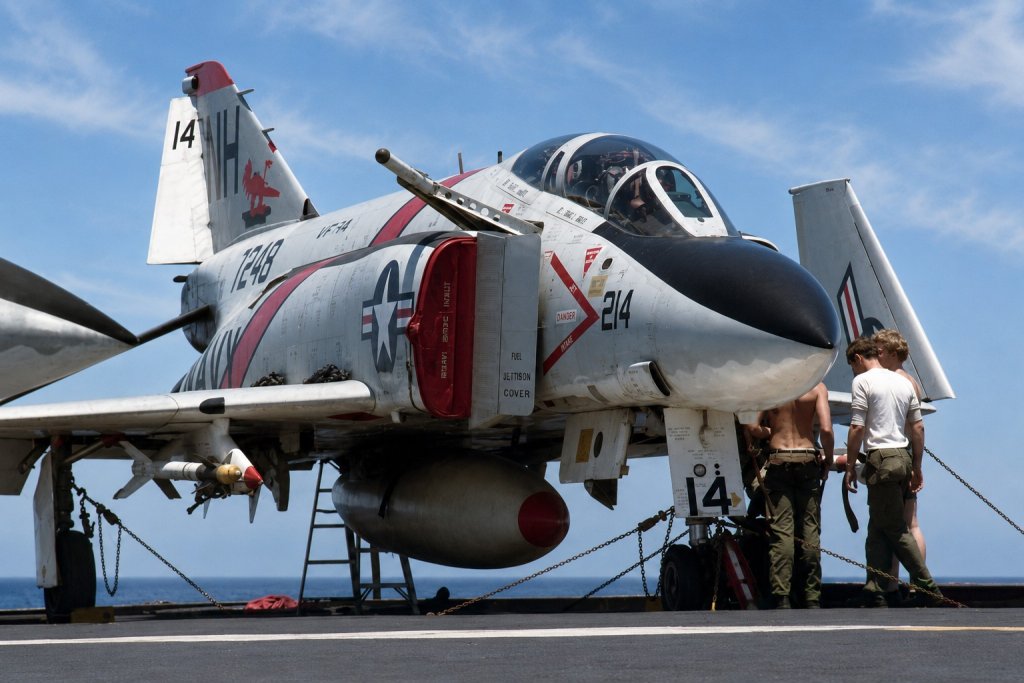
Few combat aircraft have become as recognizable as the McDonnell Douglas F-4 Phantom II. Its enormous engine intakes, bent outer wings, downward-angled stabilators, tandem cockpit, black exhaust trail and two General Electric J79 engines created an airplane that looked unlike almost anything else in the sky. It was large for a fighter, extraordinarily powerful, capable of exceeding twice the speed of sound and designed during an era when many military planners believed radar and guided missiles were about to fundamentally change aerial warfare. The Phantom would eventually prove both the brilliance and the limitations of that belief. Conceived primarily as a United States Navy fleet-defense interceptor, it became a fighter, bomber, reconnaissance aircraft, close-air-support platform, nuclear strike aircraft and suppression-of-enemy-air-defenses aircraft. It fought over Vietnam and the Middle East, served throughout the Cold War, returned to American combat during Operation Desert Storm and remained in foreign service long after newer fighters supposedly made it obsolete. By the time production ended, 5,195 Phantoms had been built, making the aircraft one of the most important Western combat airplanes of the Cold War.
 The Phantom's ancestry can be traced to McDonnell Aircraft Corporation's earlier naval fighters. The company had produced the FH-1 Phantom, F2H Banshee and F3H Demon, gaining considerable experience building high-performance jet aircraft capable of operating from aircraft carriers. The F3H Demon in particular helped lead toward what followed. Although the Demon suffered badly from engine problems and never achieved everything originally expected of it, McDonnell engineers began examining improved and more powerful developments of the design during the early 1950s. Those studies gradually moved away from simply improving the Demon and toward creating an entirely new aircraft. Navy requirements were also evolving. The growing threat from Soviet bombers and air-launched anti-ship weapons meant that protecting an aircraft carrier increasingly required fighters capable of detecting and destroying attackers at considerable distance. Speed, radar performance, altitude and missile armament became more important than the traditional image of two fighters circling each other within machine-gun range.
McDonnell's developing aircraft eventually became the F4H-1. It was a large twin-engine, two-seat fighter built around powerful radar and guided missiles. Its primary purpose was interception. The aircraft would use radar to locate an approaching enemy, close rapidly at tremendous speed and attack with missiles before the hostile aircraft could threaten the fleet. Close-range dogfighting was not the mission around which the Phantom was designed, and this assumption influenced almost every aspect of the early aircraft, including one decision that would become particularly controversial during Vietnam: the Phantom carried no internal gun.
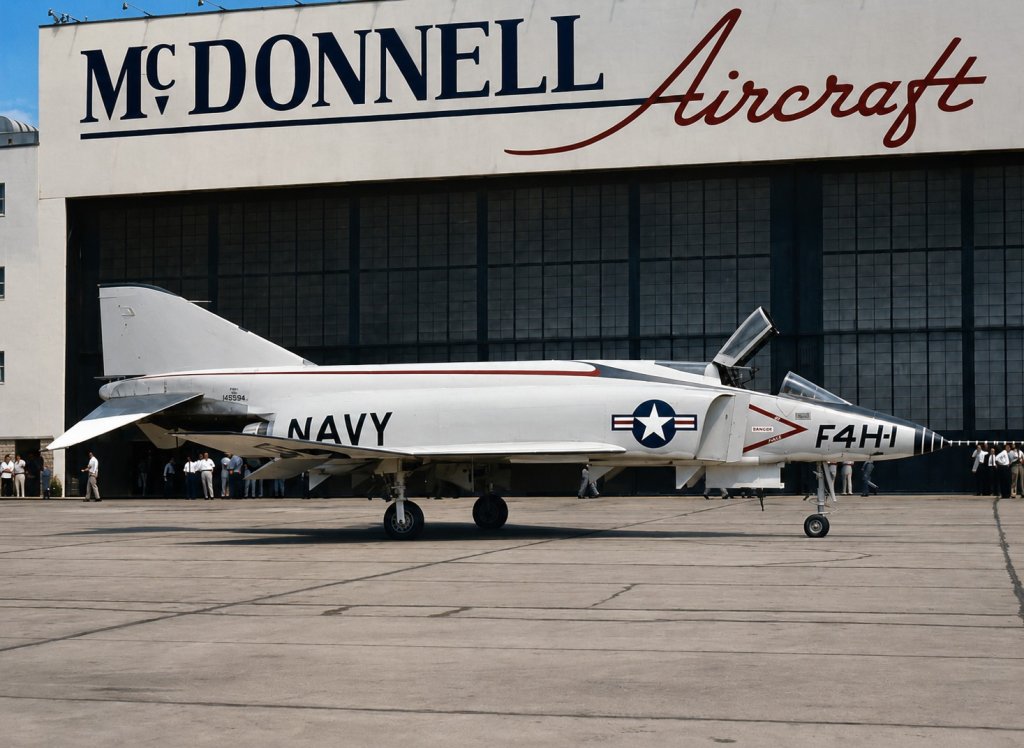
The prototype first flew on May 27, 1958, with McDonnell test pilot Robert C. Little at the controls. Almost immediately, the aircraft demonstrated extraordinary potential. Its two General Electric J79 turbojet engines provided enormous power, allowing the Phantom to exceed Mach 2 and climb rapidly to extreme altitude. During the late 1950s and early 1960s, the aircraft established a series of impressive aviation records. In December 1959, during Project Top Flight, a Phantom climbed to more than 98,000 feet. During Operation Sageburner in 1961, another Phantom established a low-altitude speed record of more than 900 miles per hour. Later that year, a Phantom exceeded 1,600 miles per hour over a measured course. These demonstrations were not merely publicity stunts. They showed that the Navy had acquired an aircraft with remarkable reserves of performance, although nobody yet understood how many missions would eventually be forced upon it.
Many of the Phantom's unusual visual characteristics resulted directly from engineering solutions developed during testing. The outer sections of its wings angled upward while its all-moving horizontal stabilators angled downward. These features helped provide the necessary stability and control without requiring McDonnell to completely redesign the aircraft. Large variable-geometry intake ramps  controlled airflow entering the J79 engines as the Phantom accelerated toward and beyond Mach 2. Its wings folded to conserve precious space aboard aircraft carriers, while its landing gear and structure had to withstand repeated catapult launches and arrested landings. The second crew position reflected the increasing complexity of radar, navigation, communications and weapons systems. Operating all of those systems while simultaneously flying a high-performance fighter was simply too much to reasonably demand from one person using the technology of the period.
The early Phantom's lack of an internal cannon has often been portrayed as one of the great mistakes of American fighter design, but the original decision made considerably more sense in the environment for which the aircraft had been created. The F4H was expected primarily to intercept bombers. Its radar could locate targets at distances impossible for earlier fighters, while the AIM-7 Sparrow radar-guided missile offered the possibility of attacking from beyond traditional gun range. AIM-9 Sidewinders provided a shorter-range infrared-guided weapon. Military planners increasingly believed that future aerial combat would be dominated by missiles, particularly when confronting large bombers carrying nuclear or anti-ship weapons. A cannon and its ammunition consumed space and added weight to an aircraft whose designers believed it would rarely need one. The Phantom therefore entered service as a missile fighter built for a new age of aerial warfare. The problem was not that the reasoning was foolish. The problem was that the next major American air war did not resemble the one the Phantom had been designed to fight.
The Phantom entered operational Navy service in the early 1960s and quickly demonstrated that it possessed capabilities far beyond fleet interception. Then an unusual development occurred in the often fiercely territorial world of American military aviation: the United States Air Force adopted a Navy fighter. The Phantom's combination of speed, range, payload and radar capability was difficult to ignore, while Secretary of Defense Robert McNamara encouraged greater commonality among the armed services. The Air Force version became the F-4C. Under the standardized aircraft designation system introduced in 1962, the Navy's F4H designation also became F-4. The Phantom would ultimately serve operationally with the Navy, Marine Corps and Air Force, with each service adapting the basic aircraft to its own requirements.
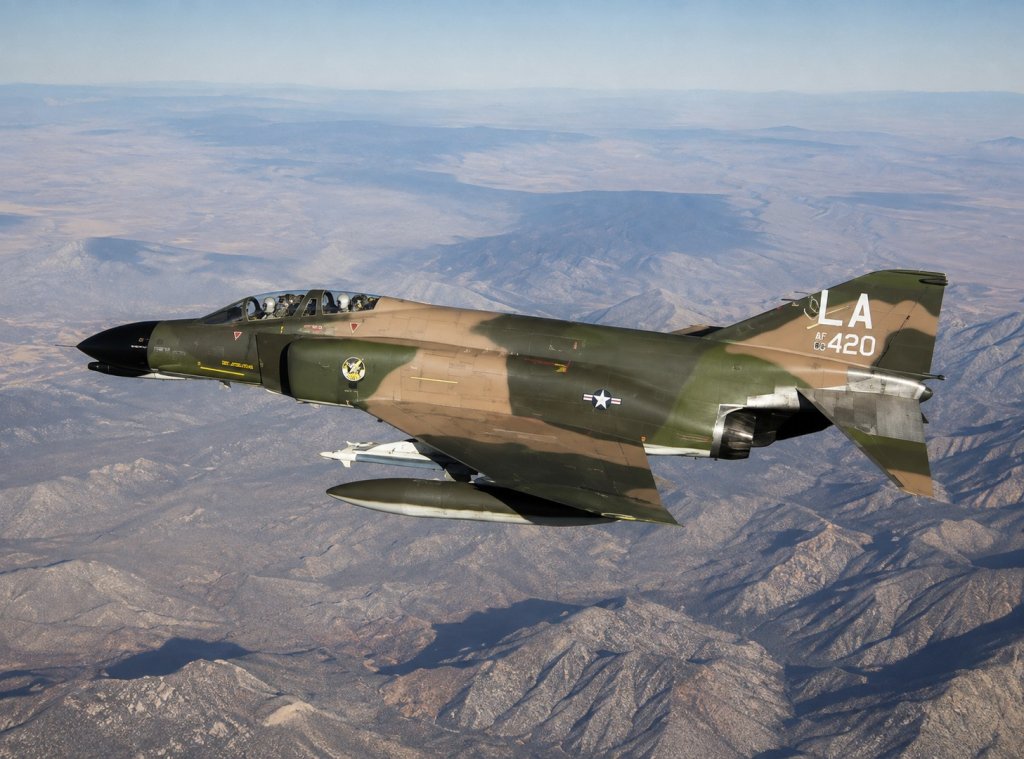
Vietnam transformed the Phantom from an impressive interceptor into a combat legend. Navy F-4s operated from aircraft carriers in the Gulf of Tonkin, Air Force Phantoms flew from bases in South Vietnam and Thailand, and Marine Corps aircraft operated from both land bases and carriers. The fighter designed to intercept Soviet bombers suddenly found itself carrying conventional bombs against bridges, roads, supply areas, troop concentrations and other ground targets. Phantoms performed combat air patrol, fighter escort, interdiction, reconnaissance support and close air support. They fought MiGs, attacked targets deep inside North Vietnam and operated within one of the most heavily defended air-defense environments encountered by American aviators.
North Vietnam developed an increasingly sophisticated defensive network incorporating radar, surface-to-air missiles, anti-aircraft artillery and fighter aircraft. Phantom crews could encounter several threats during the same mission. Radar warnings might indicate that a surface-to-air missile battery was tracking them. Diving toward lower altitude to escape a missile could bring the aircraft into the effective range of dense anti-aircraft artillery. MiG-17s, MiG-19s and MiG-21s could exploit the confusion and attack American formations. Weather frequently complicated navigation, target identification and formation flying, while fuel consumption remained an ever-present concern. The Phantom's tremendous speed offered an important advantage, but speed alone could not protect an aircraft from a coordinated defense system.
 The two-man crew became one of the Phantom's greatest strengths. In Navy service, the rear-seat crewman was the Radar Intercept Officer, while Air Force terminology and responsibilities evolved over time, eventually making the Weapon Systems Officer closely associated with the rear cockpit. The relationship between the two men was much more important than the terminology. The pilot flew and maneuvered the aircraft while the rear-seater managed radar, navigation, communications, weapons information and other systems while helping maintain situational awareness. During combat, the man in the rear cockpit might spot an approaching fighter, monitor radar, warn of threats or help the pilot keep track of an engagement unfolding at hundreds of miles per hour. Successful Phantom crews operated as teams, and some of the aircraft's greatest air-combat achievements would demonstrate how important that partnership could be.
Vietnam also exposed serious weaknesses in American assumptions about missile warfare. Early air-to-air missiles were considerably less reliable under combat conditions than their advocates had expected. AIM-7 Sparrows and AIM-9 Sidewinders could fail for numerous reasons, and pilots often found themselves attempting to employ weapons outside the ideal conditions experienced during testing. The Sparrow required radar support, while the Sidewinder depended upon obtaining a suitable infrared target. Mechanical failures, environmental conditions, maneuvering targets and complicated engagement geometry all reduced effectiveness. Rules of engagement could also require visual identification before firing, undermining one of the supposed advantages of beyond-visual-range radar missiles. A Phantom might possess the technology to attack an enemy aircraft at considerable distance but still be required to approach closely enough to confirm what it was.
The result was that Phantom crews sometimes found themselves in exactly the kind of close-range maneuvering combat that designers had expected missiles to make increasingly unnecessary. Against the small and agile MiG-17 in particular, the large Phantom could enter a fight where instantaneous turning performance mattered enormously. The Phantom was not incapable of dogfighting, as later mythology sometimes suggests. In skilled hands it possessed tremendous power, acceleration and vertical performance, but pilots had to understand how to exploit those advantages rather than simply attempting to out-turn a lighter opponent. Energy management became crucial. A Phantom crew that maintained speed and used the aircraft's power intelligently could be extremely dangerous. A crew drawn into a slow turning contest could rapidly find itself in trouble.
The absence of a gun became particularly frustrating when a Phantom reached firing position but its missiles could not achieve a suitable shot or failed after launch. External gun pods were introduced, including pods carrying the 20mm M61 Vulcan cannon, but these were compromises. They created drag, occupied a weapons station and were generally less satisfactory than a properly integrated gun. Experience eventually contributed to the development of the F-4E, which incorporated an internally mounted M61A1 Vulcan cannon beneath an elongated nose. The six-barrel weapon gave Air Force Phantom crews approximately 600 rounds of 20mm ammunition and restored a capability that missile-age doctrine had once considered increasingly unnecessary.
Yet Vietnam's most important lesson was not simply that fighters needed guns. Training mattered just as much. American aircrews had entered the war with limited preparation for the kind of dissimilar air combat they encountered against North Vietnamese MiGs. The Navy examined its combat performance and concluded that fighter crews needed far more realistic training against aircraft using tactics similar to those of potential enemies. The result was the establishment in 1969 of the Navy Fighter Weapons School, better known as TOPGUN. Phantom crews trained intensively in air-combat maneuvering, threat recognition, missile employment and tactics against dissimilar aircraft. The improvement demonstrated that technology alone did not win air battles. A sophisticated fighter was only as effective as the people who understood how to use it.
The Air Force also drew hard lessons from Southeast Asia. Training, tactics, weapons and doctrine evolved, contributing to the later development of increasingly realistic exercises such as Red Flag. The experience of Vietnam helped reinforce the importance of preparing aircrews for the confusion and complexity of actual combat rather than assuming superior technology would compensate for inadequate tactical preparation. These lessons extended far beyond the Phantom and influenced the generation of American fighters that followed.
Despite its difficulties, the Phantom achieved numerous air-to-air victories in Southeast Asia. Some crews became famous. Air Force Captain Richard "Steve" Ritchie became America's first Air Force pilot ace of the Vietnam War, credited with five MiG victories. Captain Charles "Chuck" DeBellevue, a Weapon Systems Officer, became the highest-scoring American ace of the war with six victories. Captain Jeffrey Feinstein, another WSO, was credited with five. Their records also illustrated an important truth about the Phantom: the man in the rear cockpit was not simply a passenger. Air victories belonged to crews whose survival and effectiveness depended upon cooperation.
The Navy produced its own famous Phantom team when Lieutenant Randy "Duke" Cunningham and Lieutenant Junior Grade William "Willie" Driscoll of VF-96 became the first American aces of the Vietnam War to achieve their fifth victory during a dramatic mission on May 10, 1972. Flying an F-4J from USS Constellation, Cunningham and Driscoll fought North Vietnamese MiGs during one of the most intense days of aerial combat of the war. Their aircraft was later damaged by a surface-to-air missile, forcing both men to eject over the Gulf of Tonkin. The episode captured the extraordinary range of threats Phantom crews faced. A crew could fight enemy aircraft successfully and still be brought down minutes later by the ground defenses beneath them.
 The Phantom's Vietnam story extended far beyond MiG combat. Most Phantom missions did not end with dramatic fighter victories. Crews attacked ground targets, escorted strike packages, supported troops and flew dangerous missions in poor weather over hostile territory. Marine Corps Phantoms became especially important in close air support and strike operations. For troops on the ground, the most important Phantom was not necessarily the aircraft chasing a MiG. It was often the one arriving with bombs when an American or allied unit needed immediate help.
Reconnaissance versions of the Phantom performed an equally dangerous mission while receiving considerably less public attention. The Air Force RF-4C and Marine Corps RF-4B replaced much of the fighter's normal weapons capability with cameras and specialized reconnaissance equipment. Their job was to photograph enemy positions, roads, installations, troop movements and the results of previous strikes. Reconnaissance crews sometimes entered heavily defended areas precisely because commanders needed to know what was there. Information was their weapon, and bringing that information home could require flying directly through the same defenses other aircraft were attempting to destroy.
The Phantom also became closely connected with another of the most dangerous missions in modern air warfare: suppression of enemy air defenses. The Wild Weasel concept had begun with other aircraft during Vietnam, but the Phantom eventually became one of its most capable platforms. The F-4G Advanced Wild Weasel was developed from the F-4E and replaced the internal cannon with sophisticated electronic equipment designed to locate, identify and attack hostile radar emitters. F-4G crews deliberately entered areas defended by surface-to-air missiles, attempting to detect enemy radar systems and destroy or suppress them using anti-radiation weapons. It was a peculiar form of aerial combat in which success sometimes depended upon convincing an enemy radar operator to turn on the very system capable of shooting you down.
The Wild Weasel Phantom carried weapons including the AGM-45 Shrike, AGM-78 Standard ARM and eventually the AGM-88 HARM. Its crews worked in an electronic battlefield of radar signals, warning receivers and rapidly changing threats. The mission required extraordinary cooperation between pilot and Electronic Warfare Officer. Their presence could force enemy SAM operators to shut down radars, reducing the threat to the strike aircraft following behind. A Wild Weasel did not always have to physically destroy a missile battery to accomplish its mission. Sometimes preventing that battery from effectively engaging the strike force was enough.
The Phantom's adaptability produced an extraordinary family of variants. Navy versions progressed through the F-4B, improved F-4J and modernized F-4N and F-4S. The Air Force operated the F-4C, F-4D and cannon-equipped F-4E, along with the RF-4C reconnaissance aircraft and F-4G Wild Weasel. The Marine Corps operated fighter and reconnaissance Phantoms. Individual versions incorporated improvements in radar, avionics, engines, structural components, maneuverability and weapons capability. Later F-4Es received leading-edge maneuvering slats that improved handling during air combat, although at some cost in maximum speed and other performance characteristics.
The aircraft's weapons capability also expanded enormously. What had begun as a missile interceptor could carry AIM-7 Sparrows, AIM-9 Sidewinders and, on some Air Force versions, the problematic AIM-4 Falcon. It could carry conventional bombs, cluster munitions, rockets, guided weapons and nuclear ordnance. Later Phantoms employed increasingly sophisticated precision-guided weapons and anti-radiation missiles. The aircraft's ability to carry large external loads made it a remarkably effective strike platform, and the Phantom routinely demonstrated that an airplane designed for one mission could become extremely useful at several others.
Flying the Phantom was a physical experience that numbers on a specification sheet cannot completely describe. The J79 engines produced a distinctive howl and enormous thrust, particularly in afterburner. Early versions were notorious for producing thick black exhaust smoke at certain power settings, sometimes making formations visible from considerable distance. The airplane consumed fuel enthusiastically, particularly when afterburner was used. Its size and weight demanded respect during carrier operations, and landing aboard a moving aircraft carrier at night or in poor weather remained one of aviation's least forgiving jobs. The Phantom was powerful, but it did not conceal mistakes simply because its engines were impressive.
 Carrier operations placed extraordinary demands on Navy and Marine Phantom crews and on the aircraft themselves. Every launch subjected the airplane to the violence of a catapult. Every recovery ended with a tailhook catching an arresting wire and rapidly dragging thousands of pounds of aircraft to a stop. Saltwater attacked metal and electronics. Deck crews worked among jet exhaust, turning propellers, moving aircraft and live weapons on a crowded flight deck where a moment's inattention could kill. The famous Phantom crews could not have flown without the maintainers, plane captains, ordnance crews, catapult personnel and countless sailors who kept aircraft operational.
Maintenance was a war of its own. The Phantom contained complex radar, hydraulic, electrical and weapons systems packed into an aircraft expected to fly repeatedly under demanding conditions. J79 engines had to be inspected and replaced. Radar systems failed. Hydraulic leaks appeared. Electronics misbehaved. Combat damage had to be assessed and repaired. Weapons needed to be loaded and checked. Tires, brakes and landing gear endured enormous punishment. For every hour a Phantom spent roaring through the sky, many more human hours were spent keeping it capable of doing so.
The Phantom also carried nuclear weapons as part of its Cold War mission. American and allied aircraft stood alert at bases where crews trained for a war everyone hoped would never occur. Tactical nuclear strike remained an important part of NATO planning, and the Phantom's combination of speed, range and payload made it suitable for nuclear delivery. These missions rarely produced the dramatic photographs associated with MiG combat, but they represented one of the aircraft's most consequential responsibilities. For years, Phantom crews prepared to launch into a conflict that could have escalated into a nuclear catastrophe.
The aircraft's success attracted foreign customers, and the Phantom became one of the most widely used Western fighters of its generation. Britain adopted heavily modified Phantoms for the Royal Navy and Royal Air Force. British versions incorporated Rolls-Royce Spey turbofan engines and substantial structural and systems changes. Germany operated large numbers of Phantoms, particularly the F-4F, and continued flying the type until 2013. Japan built F-4EJ aircraft under license and operated Phantoms for decades, finally retiring them from operational service in the twenty-first century. Greece, Turkey, South Korea, Spain and Australia were among the other nations that operated versions of the aircraft.
Israel became one of the Phantom's most important combat operators. Known in Israeli service as the Kurnass, or "Sledgehammer," the aircraft entered a region where it would be used extensively in both air-to-air and strike operations. Israeli Phantoms fought during the War of Attrition and the 1973 Yom Kippur War, facing fighters, anti-aircraft artillery and increasingly dense Soviet-supplied surface-to-air missile defenses. The Yom Kippur War in particular demonstrated the danger posed by modern integrated air-defense systems. Israeli aircraft suffered serious losses while attacking heavily defended targets, reinforcing lessons already being learned by American aviators in Southeast Asia.
Iran acquired F-4D, F-4E and RF-4E Phantoms under Shah Mohammad Reza Pahlavi, giving the Imperial Iranian Air Force one of the most capable combat fleets in the region. The 1979 Iranian Revolution transformed the political relationship between Iran and the United States, but the Phantoms remained. When Iraq invaded Iran in 1980, Iranian F-4s became important combat aircraft during the Iran-Iraq War. They flew strike, reconnaissance and air-combat missions and attacked Iraqi targets at considerable distances. Maintaining the American-built aircraft became increasingly difficult because of sanctions and disrupted access to spare parts, yet Iran managed to keep significant numbers operational. The Iranian Phantom story became one of the strangest chapters in the aircraft's history: an American fighter supplied to a close ally continued fighting for decades after that ally became one of America's principal regional adversaries.
By the 1970s and 1980s, newer fighters were beginning to replace the Phantom in American frontline service. This next generation incorporated many lessons learned during the Phantom era. The F-14 Tomcat provided the Navy with a powerful fleet-defense fighter possessing long-range radar and missiles while also emphasizing air-combat maneuverability. The Air Force's F-15 Eagle was designed around air superiority, excellent visibility, tremendous thrust and an internal cannon. The lightweight F-16 emphasized maneuverability, pilot visibility and advanced flight controls. These aircraft were not simply replacements for an aging fighter. They emerged from a period in which Vietnam had forced American military aviation to reconsider assumptions about training, maneuverability, weapons, situational awareness and the realities of aerial combat.
The Phantom nevertheless refused to disappear. The F-4G Wild Weasel remained particularly valuable because its specialized mission was difficult to replace. During Operation Desert Storm in 1991, F-4Gs returned to combat against Iraqi air defenses. Working frequently with other strike aircraft, Wild Weasel crews detected and attacked surface-to-air missile radars with AGM-88 HARMs and other weapons. Nearly three decades after the Phantom's first operational deployments, descendants of the original fleet interceptor were deliberately hunting sophisticated enemy radar systems in a completely different kind of air war.
Desert Storm became the Phantom's final major American combat campaign. The F-4G's performance provided a fitting conclusion to U.S. combat service because the mission demonstrated just how far the aircraft had evolved. The Phantom that entered Navy service had been designed primarily to use radar and missiles to intercept enemy aircraft threatening a carrier. The Phantom that went to war in 1991 carried specialized electronics designed to locate hostile radar emitters and destroy the systems controlling surface-to-air missiles. The basic airframe had survived long enough to fight in an electronic battlefield its original designers could barely have imagined.
 American operational Phantom service eventually ended, but even retirement became another chapter. Numerous F-4s were converted into QF-4 full-scale aerial targets. Painted in distinctive schemes and equipped for remote operation, these aircraft were used to test weapons and provide realistic targets for modern fighters and missile systems. Some were destroyed during testing, an undignified but useful final assignment for aircraft that had spent decades preparing for or participating in combat. Manned QF-4 flights also kept the sight and sound of the Phantom alive in American skies long after frontline squadrons had transitioned to newer aircraft.
The Phantom's international career lasted even longer. Modernization programs gave some foreign aircraft new radar, avionics and weapons. Turkey and Greece extended the usefulness of their fleets, while Japan maintained its Phantoms into 2021. Iran continued operating surviving aircraft under circumstances that made determining their exact readiness difficult. More than half a century after the type entered service, Phantoms could still be found performing military duties. Few designers working in the 1950s could have imagined that their carrier interceptor would remain relevant in the twenty-first century.
Statistics help explain the Phantom's importance but can also obscure the human story. Behind every aircraft were two crewmen and an enormous network of people who made each flight possible. Pilots and RIOs or WSOs lived with the knowledge that combat might require them to eject over hostile territory. Reconnaissance crews flew toward places commanders specifically needed photographed, regardless of how heavily defended those places were. Wild Weasel crews deliberately challenged missile batteries. Carrier deck crews worked within feet of running engines and loaded weapons. Maintainers repaired aircraft through heat, rain, cold, darkness and exhaustion so another crew could fly the next mission.
Not every crew returned. Phantoms were lost to MiGs, surface-to-air missiles, anti-aircraft artillery, accidents and mechanical failures. Some men were rescued. Others became prisoners of war. Some were killed. Some disappeared with their aircraft and left families waiting years or decades for answers. The Phantom's history cannot be told solely through victories, speed records and specifications because the airplane was ultimately a machine operated by human beings, and military aviation extracts its price from human beings when machines fail or combat goes wrong.
That human connection is particularly important at Ghosts of the Battlefield. Within the museum's collection is the restored leather flight jacket of Lieutenant Commander Clyde Kennedy "Ken" Hogendobler, known by the callsign "Hogie," a Virginia Beach resident and United States Navy aviator who flew the F-4 Phantom from the aircraft carrier USS America. His jacket provides something specifications cannot. Leather worn by an actual Phantom pilot connects the enormous history of the aircraft to one individual who climbed into its cockpit, launched from a carrier deck and became part of that history. Objects like Hogendobler's jacket remind us that the story of an aircraft is ultimately the accumulated story of the people who flew, maintained and lived around it.
The Phantom also left an enormous cultural legacy. Its shape became synonymous with American airpower during Vietnam and the Cold War. Photographs of Phantoms launching from carrier decks, trailing black smoke across Southeast Asian skies or climbing away in afterburner became some of the defining images of military aviation. The aircraft accumulated nicknames and affectionate insults from those who operated it. Its ungainly appearance inspired the famous description of the Phantom as proof that with enough thrust even a brick could fly, along with countless variations invented by generations of crews. Yet beneath the humor was genuine affection. The airplane earned loyalty because it was powerful, adaptable and, when properly understood, extraordinarily capable.
Its greatest legacy may be what happened because the Phantom was imperfect. Vietnam demonstrated that sophisticated missiles did not eliminate the need for close-range combat skills. It showed the importance of realistic fighter training. It exposed limitations in weapons reliability and doctrine. It reinforced the value of crew coordination and situational awareness. It helped inspire TOPGUN and contributed to the thinking that produced Red Flag. Experience gained with the Phantom influenced tactics, weapons and the design philosophy of later American fighters. In that sense, some of the aircraft's shortcomings became as historically important as its strengths.
The F-4 Phantom II was therefore much more than a successful fighter. It was an aircraft caught at a turning point in military aviation. It was born when engineers believed electronics and missiles were fundamentally changing aerial warfare, entered combat when those theories collided with reality and survived long enough to participate in the increasingly electronic and precision-guided warfare those early designers had anticipated. It began without a gun because close-range air combat appeared to be disappearing, then gained one because combat proved otherwise. It began as a carrier interceptor and became a bomber, reconnaissance aircraft, dogfighter, nuclear strike aircraft and radar hunter. It entered service before America's major involvement in Vietnam and was still fighting for the United States during the Gulf War.
 More than 5,000 Phantoms were built, but their significance cannot be measured merely by production totals, victories or years of service. The Phantom helped teach an entire generation of aviators how different real war could be from the war predicted by doctrine. Those lessons changed training, tactics, weapons and aircraft design. The fighters that followed benefited from knowledge purchased at considerable cost by the men who fought in Phantoms over Vietnam and elsewhere.
Today the roar of the J79 has largely disappeared from American skies, but the Phantom remains one of those rare machines that became larger than its original purpose. It belonged to the Navy, Air Force and Marine Corps. It belonged to pilots and back-seaters, maintainers and ordnance crews, carrier sailors and rescue forces. It belonged to Vietnam, the Cold War, the Middle East and Desert Storm. It served allies and, through the strange turns of history, eventually flew in the hands of nations that became American adversaries.
The F-4 Phantom II was designed to intercept the future. Instead, history kept changing around it, and the Phantom kept finding another way to fight.
Bring the Phantom Home: Shop Our F-4 Phantom II Shirt and Help Support Ghosts of the Battlefield.