Eyes Ahead of the Fight: SFC David Edward Carter and the Road from the LRPs to Papa Company Rangers
On August 10, 1969, Sergeant First Class David Edward Carter died of wounds received in hostile action in Quang Tri Province, South Vietnam. He was twenty-eight years old.
August 10, 2026

 On August 10, 1969, Sergeant First Class David Edward Carter died of wounds received in hostile action in Quang Tri Province, South Vietnam. He was twenty-eight years old. The official casualty record describes multiple fragmentation wounds suffered in a ground action. His death came after nearly two years in Vietnam and after a military career that had already taken him from conventional infantry into one of the most demanding and dangerous forms of reconnaissance practiced by the United States Army during the war.
Today his name appears on Panel 20W, Line 121 of the Vietnam Veterans Memorial. It is also the first name appearing on the 75th Ranger Regiment Association’s casualty roll for P Company, 75th Infantry. That simple position on a list hides a much larger story. Before David Carter became a Ranger with Papa Company, he had already spent much of his Vietnam tour going into places where American commanders needed eyes but did not necessarily want large units announcing their presence.
Carter was born February 27, 1941, and grew up around Hamilton, Ohio. A local newspaper published shortly after his death described him as a nine-year Army veteran who had intended to make the service his career. His surviving award documentation supports the picture of a professional soldier rather than a man passing briefly through the Army. By 1967 he was a Staff Sergeant, Ranger qualified, airborne qualified, and serving in an organization whose missions demanded experienced noncommissioned officers capable of making decisions far from conventional support.
His Vietnam tour began on September 16, 1967. Carter’s military occupational specialty was 11F, Infantry Operations and Intelligence Specialist, with the parachutist identifier. The title sounds almost bureaucratic until one looks at where he was assigned: Company F, 51st Infantry, Long Range Patrol, operating for II Field Force Vietnam.
F Company was not an ordinary infantry company.
The Army had created corps-level long-range patrol organizations because commanders needed soldiers who could penetrate areas beyond the normal reach of conventional units, observe enemy activity, identify routes and base areas, and report what they found without being detected. Company F, 51st Infantry was formed in the fall of 1967 for II Field Force Vietnam and operated primarily from Bien Hoa. Its overriding mission was to provide reconnaissance and intelligence protecting the region around Saigon, but combat quickly blurred the neat distinctions found in field manuals. Army historical research records that F Company teams frequently located enemy soldiers and then destroyed them through ambushes, artillery, helicopter gunships, and air support.
The company was enormous by later perceptions of a reconnaissance unit. An Army Combat Studies Institute history describes corps-level LRP companies as organizations of roughly 230 men, with four line platoons and as many as seven six-man patrols in each. F/51 also had unusually substantial support available to it, including dedicated helicopter lift, gunships, a cavalry reaction force, forward air control, and artillery liaison. Altogether, as many as 500 personnel could be involved in supporting the operations of the reconnaissance company.
Yet when a patrol disappeared into the field, all that machinery became distant.
 The basic element was still a handful of men carrying everything they needed and attempting to move through enemy territory without being seen. They observed trails, listened for movement, identified positions, counted troops, plotted routes, established ambushes, and maintained radio contact with headquarters. Getting discovered could transform an intelligence mission into a desperate fight for survival within seconds.
David Carter led those men.
One surviving photograph gives us an unusually direct glimpse of him doing it. It appeared in the May 1968 issue of The Hurricane, a publication of II Field Force Vietnam, with the caption “On Patrol with F Co, 51st Infantry.” Carter is shown in profile holding a radio handset, his attention fixed somewhere beyond the camera. It is not a posed studio portrait taken before deployment. It is a photograph of him in the field doing the work for which his unit existed.
An Army photojournalist named Paul Temple later remembered spending approximately a week accompanying one of Carter’s missions. Temple identified Carter as the leader of an F/51 heavy twelve-man LRP team and remembered him not simply for courage, but for professionalism, dignity and the way he treated the men around him. Most importantly, Temple recalled that Carter had earned the respect of the soldiers he led.
We do not have to rely solely upon somebody’s memory to know how Carter behaved under fire.
On December 4, 1967, only a few months into his Vietnam tour, Staff Sergeant Carter was leading a reconnaissance patrol approximately five kilometers north of Tan Uyen when his patrol encountered a Viet Cong platoon. Carter’s men opened fire, killed two enemy soldiers, and suppressed the remainder of the force. Then Carter noticed an enemy weapon lying abandoned on the trail.
He went after it.
According to his official Army Commendation Medal with “V” Device citation, Carter deliberately exposed himself to enemy fire in order to retrieve the weapon. Once he had it, he directed his men to use grenades and Claymore mines to break contact. Carter then led the patrol toward a small landing zone while simultaneously directing helicopter gunships against the enemy pursuing or opposing them.
That action tells us more about Carter than any list of qualifications ever could.
A patrol leader in that situation was responsible for several things at once. He had to understand where his own men were, where the enemy was, how to disengage without allowing the patrol to be surrounded, how to move toward an extraction point, and where supporting aircraft could safely place their fire. Carter was doing all of it while under enemy fire. And somewhere in the middle of that fight, he exposed himself to retrieve an enemy weapon because captured weapons and equipment could provide valuable intelligence.
For those actions Carter received the Army Commendation Medal with “V” Device for valor.
F Company developed an extraordinary reputation within II Field Force. Lieutenant General Frederick Weyand later praised the unit for reconnoitering enemy base areas and routes of movement and recommended greater use of such units. Army research also shows the uncomfortable reality of what the supposedly reconnaissance-oriented LRP units actually became in Vietnam: they were gathering intelligence, certainly, but they were also fighting frequently. The line between finding the enemy and destroying him became increasingly thin.
By the end of 1968, F Company’s existence was coming to an end. It was replaced in the II Field Force mission by Company D, 151st Infantry, an Indiana National Guard long-range patrol company. But experienced F/51 men were valuable commodities, and many did not simply disappear into ordinary Army assignments. Their hard-earned knowledge moved with them.
One of those men was David Carter.
The 1st Brigade, 5th Infantry Division had arrived in northern South Vietnam during the summer of 1968 and was operating in Quang Tri Province near the Demilitarized Zone. The brigade needed its own deep reconnaissance capability. The 79th Infantry Detachment was created for that purpose in December, but the new organization lacked enough experienced personnel. Veterans transferred from F Company, 51st Infantry helped provide the experience needed to build the new force.
Then, on February 1, 1969, Company P, 75th Infantry was activated.
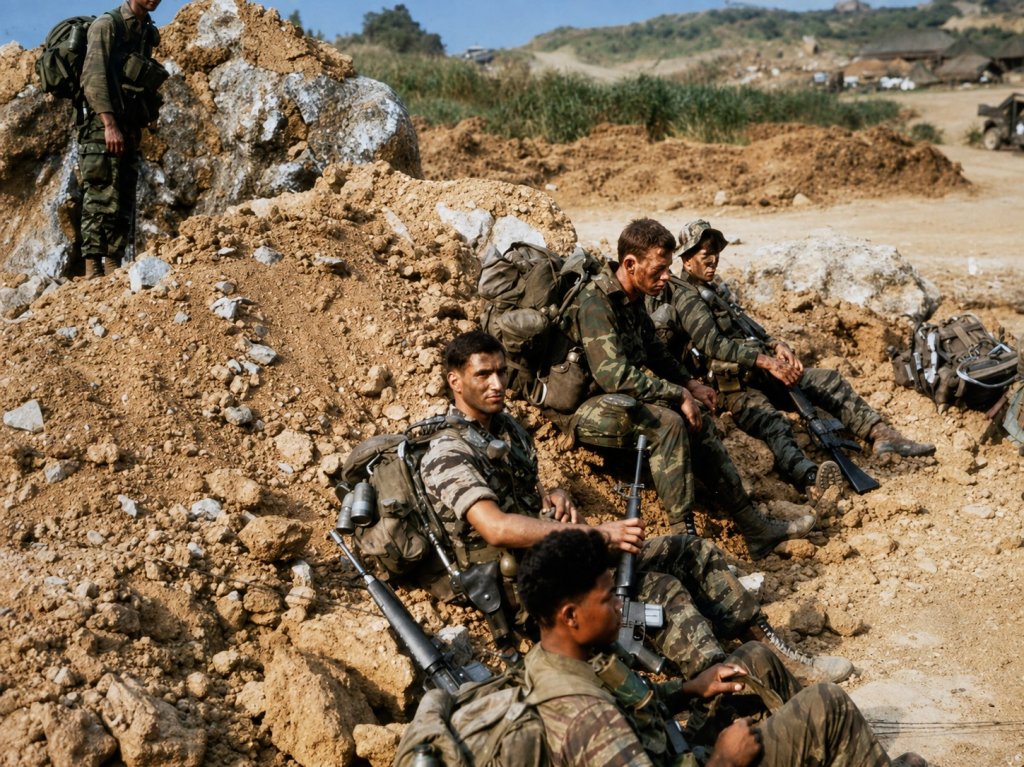
Papa Company Rangers.
The Army had reorganized its long-range patrol organizations under the newly restored 75th Infantry, carrying forward the lineage associated with Merrill’s Marauders. P Company was assigned to the 1st Brigade, 5th Infantry Division and given responsibility for reconnaissance, surveillance, and target acquisition in some of the most dangerous territory in South Vietnam. The Army’s official lineage confirms that Company P was activated in Vietnam on February 1, 1969.
A fellow F/51 veteran later remembered the day he and Carter separated for new assignments. Carter went north to Papa Company, while his friend went to O Company Rangers. Years later the veteran still remembered learning that Carter had been killed and the pain felt among the men who had served beside him in F/51.
Carter was moving into a very different battlefield.
F/51 had operated largely around the capital region. Papa Company worked in northern I Corps, where the terrain ran from the coastal lowlands toward the mountains and the Laotian frontier. The DMZ lay immediately to the north. Khe Sanh, the Rockpile, Quang Tri, and a collection of firebases and remote positions formed part of the landscape in which these Rangers worked. The enemy encountered there increasingly meant trained North Vietnamese Army regulars rather than local Viet Cong guerrillas.
Papa Company usually maintained around six combat-ready six-man Ranger teams. A typical team consisted of a team leader, assistant team leader, radio operator and three scout-observers. At any given time, two teams might be operating in the field, two held on alert as a reaction force, and two standing down to rest, repair equipment and prepare for the next mission.
Their assignments often came as a small square drawn on a map.
The Rangers called it a box, normally an area of approximately four to six square kilometers. A team might be inserted into that box and remain there for five days and four nights. Their first task was generally observation. They watched trails, searched for signs of movement, located enemy positions and tried to understand what was happening without revealing that Americans were there. If circumstances allowed, the mission might culminate in an ambush shortly before extraction.
Six men could nevertheless summon staggering firepower.
Papa Company teams could call artillery from firebases near the DMZ. Helicopter gunships and aviation units supported their operations. Forward air controllers could relay communications and direct strikes. Naval gunfire from ships offshore was available under appropriate circumstances, as were tactical aircraft. The six men hiding quietly in a patch of vegetation might therefore become the eyes directing weapons located miles away.
That was exactly the type of work for which Carter’s experience with F/51 had prepared him.
By the summer of 1969 he had been in Vietnam for almost twenty-three months. He had led long-range patrols, fought the enemy, coordinated gunships under fire, survived the violence of the Tet era around II Field Force, and transitioned into the newly organized Ranger system. He had already received a Bronze Star Medal and the valorous Army Commendation Medal. His qualifications included the Combat Infantryman Badge, Parachutist Badge and Ranger Tab.
Then came August 10, 1969.
This is where the documentation suddenly becomes frustratingly thin.
The casualty record establishes that SFC David Edward Carter was wounded by multiple fragments during hostile ground action in Quang Tri Province and died of those wounds. His remains were recovered. What I have not found is a trustworthy patrol report or after-action record that allows us to reconstruct precisely where his team was, what weapon caused the wounds, who was beside him, or exactly how the engagement unfolded.
And we should leave it there until we find that record.
There are modern retellings that attempt to fill those final minutes in, but Carter’s story is too well documented everywhere else to suddenly start guessing at the most important moment of his life.
What we do know is that his death was immediately recognized as more than an ordinary battlefield loss. In July 1970, the Army notified his mother that Carter had posthumously received a second Bronze Star Medal for heroism, a second Army Commendation Medal, and the Purple Heart. The surviving notification lists his earlier Bronze Star, Army Commendation Medal, National Defense Service Medal, Vietnam Service Medal, Republic of Vietnam Campaign Medal, Combat Infantryman Badge, Parachutist Badge, Ranger Tab and weapons qualifications.
The Ranger Association casualty roll places Carter first among Papa Company’s dead. The next five losses listed came together on December 21, 1969. Papa Company would continue operating along the DMZ, around Khe Sanh, the Rockpile and surrounding areas until 1971, but David Carter did not live to see what the organization he helped populate would become.
There is another part of the story that survives outside Army reports.
A childhood friend remembered Carter before the uniforms, before Vietnam and before the Rangers. Vic Edwards had grown up near him in Ohio. They lived on neighboring farms and rode the school bus together. Edwards remembered his easy laugh, his smile and a man who was approachable and kind. He later served in Vietnam himself and was badly wounded there. Decades afterward, he was still trying to understand why he had come home and David had not.
Carter’s sisters never stopped remembering him either. Donna Carter Mainous repeatedly left memorial messages for her brother over the years, on his birthday, Memorial Day, Veterans Day and Christmas. Those messages transformed the formal entry “SFC David Edward Carter, 20W121” back into somebody’s brother.
That may ultimately be the most important reason to tell his story.
David Carter was not famous. There are no shelves of books devoted to him. He was not turned into a Vietnam legend whose name became synonymous with an entire branch of warfare.
He was something far more representative of how the war was actually fought.
He was an experienced Army NCO who kept volunteering for difficult work. He led men beyond the relative safety of conventional formations. He fought when reconnaissance became combat. He exposed himself to enemy fire to retrieve intelligence. He guided his patrol toward extraction while directing gunships overhead. When the Army reorganized its reconnaissance forces, he carried his experience into the new Ranger companies. And by the time he died at twenty-eight, he had spent almost two years doing the kind of work in which survival often depended upon six men trusting one another completely.
On August 10, 1969, SFC David Edward Carter became the first name on Papa Company’s casualty roll.
Fifty-seven years later, on August 10, 2026, we can do something considerably more meaningful than simply read that name from a list.
We can tell people who he was.
Sergeant First Class David Edward Carter.
F Company, 51st Infantry, Long Range Patrol.
P Company, 75th Infantry Rangers.
Hamilton, Ohio.
February 27, 1941 – August 10, 1969.
Remember his name.