War in the Movies: Panic in Year Zero! — The Movie That Somehow Feels Different at 3 A.M.
There is something about an old movie coming on television at three in the morning that can completely change the way you experience it.
July 31, 2026

 There is something about an old movie coming on television at three in the morning that can completely change the way you experience it. Maybe you fell asleep watching something else. Maybe you are the only person awake in the house, flipping through channels you barely knew existed, when suddenly some forgotten black-and-white movie catches your attention. There is no introduction and no context. You just stumble into it.
And somehow, at three in the morning, everything feels a little darker.
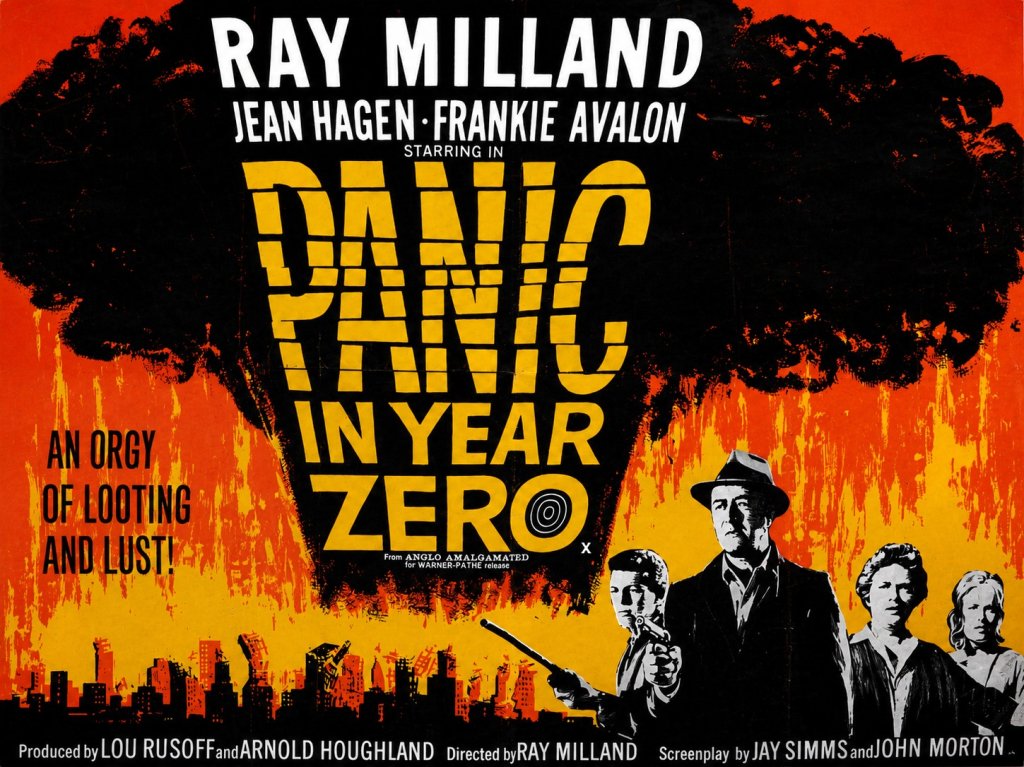
That is how I have always thought about Panic in Year Zero!, the 1962 nuclear-war survival film starring Ray Milland. Maybe it is the black-and-white photography. Maybe it is the emptiness of those California roads and mountains. Maybe it is the subject itself. Or perhaps it is because the movie was made during an era when nuclear annihilation was not simply science fiction. Whatever the reason, Panic in Year Zero! has always had a strange, sinister quality to me that newer and far more expensive apocalyptic films rarely manage to capture.
I have always loved this movie.
The story begins about as normally as possible. Harry Baldwin, played by Ray Milland, loads his wife Ann, their son Rick, and daughter Karen into the family car for a fishing trip away from Los Angeles. Jean Hagen plays Ann, Frankie Avalon is Rick, and Mary Mitchel plays Karen. They have a camper behind them, fishing gear packed, and absolutely no idea that within hours their old life will essentially cease to exist.
Then the sky flashes.
Radio stations disappear. Something enormous has happened behind them. Eventually Harry stops the car, and the family looks back toward Los Angeles to see the unmistakable shape of a mushroom cloud climbing into the sky.
Nuclear war has begun.
 Harry initially wants to turn around. Ann's mother is still in Los Angeles, and the instinct to go back for her is immediate. But this is where Harry Baldwin becomes one of the most interesting characters in the movie. He begins thinking several steps ahead. Los Angeles has been hit. Fallout is coming. Highways will soon be filled with people fleeing the city. Food, gasoline, medicine, weapons and everything else necessary to survive will become scarce.
Going home may feel like the right thing to do.
Harry realizes it will probably get all of them killed.
So he turns toward the mountains.
That decision establishes the central question running through the entire film: How much of the civilized world can you abandon in order to survive long enough to rebuild it?
Harry begins buying supplies before most people understand what has happened. He tries to obtain guns and ammunition. He gets gasoline. He watches prices begin to rise and sees normal rules becoming meaningless almost by the hour. At times he crosses lines that would have been unthinkable that morning. He takes things when people refuse to sell them. He uses force. Yet he continues leaving money when he can and repeatedly insists that what he takes will someday be paid for.
That distinction matters.
Harry is not celebrating the collapse of civilization. He is trying to keep his family alive through it.
And Ray Milland is absolutely believable doing it.
 The film never tells us that Harry Baldwin was a veteran, and there is no hidden scene explaining that he fought across Europe or the Pacific during World War II. But I have always gotten that feeling from him. Milland plays Harry like a man who has seen enough of human beings under pressure to know what is coming. He recognizes danger quickly. He understands security. He knows that food, shelter and weapons mean very little if you allow strangers to discover where you have hidden them. He is decisive without being fearless and ruthless without becoming completely heartless.
You almost get the feeling that somewhere before we met Harry Baldwin, somebody had already taught him how quickly normal life can disappear.
That may just be my interpretation, but it adds enormously to the character.
Jean Hagen's Ann provides an important counterweight. Harry is concentrating almost entirely on survival, while Ann repeatedly reminds him—sometimes without saying much at all—that surviving physically and surviving as human beings are not necessarily the same thing. Harry sees threats. Ann still sees people. Their conflict gives the movie considerably more depth than its low-budget apocalyptic premise might suggest.
Then there is Frankie Avalon as their son Rick.
Yes, Frankie Avalon manages to make it through an entire movie without breaking into song or finding a beach blanket.
And he is actually pretty good.
 Rick begins the film as a teenager still living in his father's world. But that world disappears almost overnight. Harry hands him responsibilities that suddenly carry life-and-death consequences, and Rick gradually becomes his father's partner in protecting the family. Avalon is young enough to make Rick's transition believable. This is not a hardened survivor from the opening scene. He becomes one because circumstances demand it.
Mary Mitchel's Karen experiences the collapse from a far more frightening direction. As organized society disappears, the threat to the family becomes increasingly human rather than nuclear. Three young criminals—Carl, Mickey and Andy, played by Richard Bakalyan, Rex Holman and Neil Nephew—represent what happens when people decide that the disappearance of law means the disappearance of restraint.
Their presence changes the movie.
The mushroom cloud may have destroyed Los Angeles, but Panic in Year Zero! understands that the bomb is only the beginning. The real horror comes afterward, when gasoline becomes precious, highways become dangerous, families become isolated and nobody knows whether the stranger approaching your camp wants help or wants what you have.
 Eventually the Baldwins discover Marilyn Hayes, played by Joan Freeman, a young woman whose family has been murdered by the same gang terrorizing the area. She becomes part of the Baldwin group and gradually forms a bond with Rick. So yes, Frankie Avalon even manages to get the girl before somebody shoots him.
Rick is wounded during the final confrontation with Carl, and suddenly Harry's carefully constructed world of self-sufficiency fails. A rifle cannot remove a bullet wound. Stored food cannot replace a blood transfusion. Survival ultimately requires other people.
That may be one of the film's most important points.
Harry spends much of Panic in Year Zero! withdrawing his family from society because society is collapsing. Yet eventually he has to trust society again. They seek help from Dr. Powell Strong, played by Willis Bouchey, and learn that Rick needs medical treatment beyond what the doctor can provide. The family heads toward an Army hospital and eventually encounters American soldiers restoring order.
After everything that has happened, seeing those uniforms is almost comforting.
Civilization survived.
Perhaps bruised, frightened and badly damaged, but it survived.
That is why I do not consider Panic in Year Zero! an entirely hopeless movie, despite how bleak much of it feels. It is really a movie about what people do between the moment everything falls apart and the moment somebody begins putting it back together.
And that was an incredibly powerful subject in 1962.
The film arrived at the height of the Cold War, when Americans lived with nuclear attack as a genuine possibility. Fallout shelters were part of public conversation. Civil-defense instructions were everywhere. The United States and Soviet Union were building enormous nuclear arsenals, and just months after Panic in Year Zero! reached theaters, the Cuban Missile Crisis would bring the world terrifyingly close to exactly the sort of nightmare the movie imagined.
There were plenty of nuclear movies during the era, but Panic in Year Zero! does something different. There are no giant irradiated insects. No mutated monsters. No scientists attempting to stop a glowing creature created by atomic testing.
The monster is panic. The monster is scarcity.
The monster is the person standing beside you when both of you realize there is only enough gasoline, food or medicine for one family. That makes the film strangely timeless.
Harry's solutions are sometimes harsh, and modern viewers can certainly debate his decisions. That is part of what makes the character so fascinating. He believes there is a difference between temporarily breaking the rules and abandoning them forever. He takes what his family needs, but he does not convince himself that theft has suddenly become a virtue. He teaches his family to protect themselves, but he also insists upon routine, cleanliness, discipline and even giving thanks for what they still have.
He is trying to preserve a small piece of the America that existed before the mushroom cloud.
There is patriotism in that, but not the flag-waving Hollywood kind. It is the quieter idea that the country is ultimately more than buildings, highways and institutions. If those disappear, America still exists wherever Americans continue behaving as though civilization is worth rebuilding.
That is what I think Panic in Year Zero! is really about.
The movie was directed by Ray Milland himself, and its relatively small budget actually works in its favor. Instead of showing entire cities being destroyed for two hours, the film stays with one family. Los Angeles disappears behind a mushroom cloud, and much of the rest is left to our imagination. Empty roads, isolated camps, radio broadcasts and frightened faces do most of the work.
And because it is black and white, it somehow feels even colder.
There is also Les Baxter's wonderfully strange score, which sometimes seems completely at odds with what we are watching. At moments the music sounds more suited to teenage rebellion than nuclear Armageddon. Yet even that has become part of the movie's personality. Panic in Year Zero! could only have been made when it was made.
It is a Cold War time capsule.
It is also one of those movies that I think benefits from being discovered rather than introduced.
Don't watch it at two o'clock on a sunny Saturday afternoon while answering texts and checking your phone.
Find it late at night. Turn the lights off. Let the house get quiet.
Watch that family car roll down a black-and-white California highway while the radio begins cutting out. Watch Harry Baldwin stop the car and stare toward the horizon. Then watch the mushroom cloud rise over the world he thought he would be returning to in a few days.
Suddenly that little fishing trip becomes an evacuation.
A father becomes a survivalist.
A teenage son becomes an armed protector.
Normal Americans become refugees inside their own country.
And you begin wondering what you would have done. Would you turn back? Would you keep driving? Would you share your supplies? Would you trust strangers? How long would you continue following rules written for a world that no longer existed? And perhaps the hardest question of all: if civilization disappeared tomorrow morning, how much of yourself would you be willing to surrender to survive until it returned?
More than sixty years later, Panic in Year Zero! still makes me think about those questions.
Maybe that is why I have always loved it.
Or maybe it is just one of those movies that was meant to find you on some long-forgotten television channel at three o'clock in the morning, when the house is dark, everyone else is asleep, and a black-and-white mushroom cloud suddenly starts climbing across the screen.
Enjoy Our Content? Join The Fight With Your Support