The Brothers Who Remember - SP4 Thomas William Mitchell
A steady, trusted soldier of D Company's 1/50th Infantry, SP4 Thomas Mitchell was killed in action in Binh Dinh on December 2, 1967. His brothers carried his memory home — not as a name on a wall, but as a friend they never forgot.
December 3, 2025

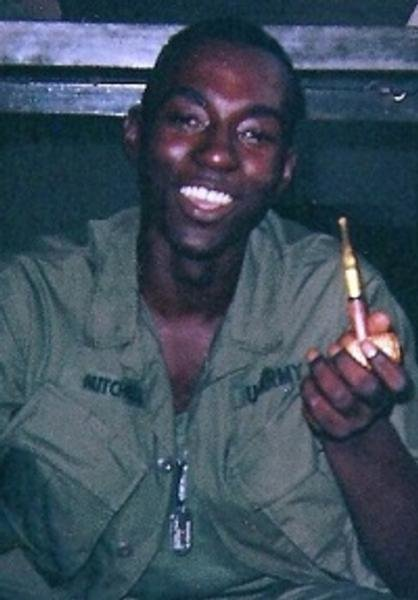 The Brothers Who Remember - SP4 Thomas William Mitchell
 The Brothers Who Remember - SP4 Thomas William Mitchell
In the rugged country of Binh Dinh Province — a land of steep hills, narrow valleys, and enemy forces that moved silently through the tree lines — the soldiers of D Company, 1st Platoon, 1st Battalion (Mechanized), 50th Infantry forged a bond that was stronger than steel. Among them was Specialist Four Thomas William Mitchell, a young man born March 30, 1947, whose quiet resolve and steady heart made him a pillar within the platoon long before anyone realized how much they depended on him.
Like countless young Americans drawn into the Vietnam War, Mitchell came of age far from the place where he would ultimately give his life. Yet he brought with him the qualities of the citizen-soldier: humility, purpose, endurance, and the willingness to shoulder responsibilities that most men never face. In Vietnam, these traits became more than admirable — they became essential.
The men of D Company were a mechanized infantry outfit, operating M113 armored personnel carriers through some of the harshest and most unforgiving terrain in the Central Highlands. Their mission pushed them into remote hamlets, ambush-laced valleys, and areas where the Viet Cong and North Vietnamese Army had spent years building networks of bunkers, fighting holes, and interlocking defenses. Movement was never easy. Danger was never absent. And trust — real trust — was the only thing that kept men steady when the world around them erupted in fire.
In that world, Thomas Mitchell became not just another soldier in the formation, but a brother.
A Soldier Shaped by Responsibility
Those who served in Vietnam often speak of how quickly boys became men. The demands of combat — especially in infantry and mechanized infantry units — gave little room for hesitation. Mitchell adapted quickly. He learned the rhythms of the bush, the sounds that mattered, the silence that warned of disaster. He understood the weight of caring for the man on his left and the man on his right, and he carried that weight without complaint.
The young soldiers who filled the ranks of the 50th Infantry came from every corner of America, yet they shared a common reality: the longer they served together, the more they depended on one another not just to survive, but to endure emotionally, mentally, spiritually. Mitchell was one of the steadying forces — the teammate whose presence made others feel more grounded, more prepared, more capable of facing whatever awaited them beyond the next ridge.
These bonds did not form in moments of triumph; they formed in the unglamorous grind of daily patrols, in the shared exhaustion of long movements, in the tense stillness of night ambushes where time seemed to stop. Mitchell understood this better than most. He wasn't a man driven by glory. He was driven by duty — and by loyalty to his platoon.
December 2, 1967 - A Day in Binh Dinh
Binh Dinh Province was among the most fiercely contested regions in South Vietnam. Its geography favored the enemy. Its villages held long histories of conflict and allegiance. Its hills concealed movement. Its valleys channeled patrols into predictable patterns. For mechanized infantry, the terrain was especially treacherous. The M113 could be both a shield and a trap; its armor could save lives, or its silhouette could draw fire.
On December 2, 1967, SP4 Thomas William Mitchell and the men of D Company were operating in this unforgiving environment. The exact details of the engagement that took his life have faded with the decades — as so many Vietnam actions have — but the essence remains clear: the platoon came under hostile fire, sudden and violent. Like so many battles in Binh Dinh, it was fast, chaotic, and unforgiving.
Mitchell was killed in action that day.
He was 20 years old.
For his family, the news arrived as a telegram — the kind delivered to far too many American homes during those years. But for his platoon, the loss was something more personal, more immediate, more enduring. It was the loss of a brother.
In combat units, grief is rarely spoken aloud. But it takes root in the quiet spaces — in the empty seat on the track, in the missing voice during the nightly check-in, in the sudden realization that someone you depended on is no longer there to steady the line. Mitchell's death struck deep because he was more than a name on a roster. He was a presence, a teammate, a friend who had shared the same dangers and sweat and exhaustion.
Those who served with him never forgot.
A Name Etched in Stone — And in Memory
Today, the name Thomas William Mitchell rests on Panel 31E, Line 25 of the Vietnam Veterans Memorial in Washington, D.C. Visitors come to the Wall and feel its solemn gravity; they trace names with their fingertips, trying to grasp the stories behind them. The Wall is powerful because of its silence — because it invites the living to fill in its meanings with memory, love, or reflection.
For strangers, Mitchell's name may blend among thousands.
For Delta Company, it never did.
His brothers carried his memory home. They spoke of him at reunions. They recalled the small moments — the humor, the professionalism, the reliability that marked him. In the shared remembrance of veterans, time does not erase the faces or the voices of those who mattered. It sharpens them. It preserves them.
The men who survived the war — the ones who grew older while Mitchell remained forever 20 — kept him alive in the stories they told and the silence that followed when his name came up. The bond forged in Binh Dinh did not break when he fell. It endured.
Mechanized Infantry in the War's Harshest Terrain
To understand Mitchell's service is to understand the nature of mechanized infantry in Vietnam. Unlike armored units that fought along major roads or open plains, the 1st Battalion (Mechanized), 50th Infantry pushed deep into contested terrain where roads did not always exist. Their tracks acted as transport, firepower, and fragile sanctuary.
Enemy forces understood this.
They targeted the M113s relentlessly.
Mines, RPG ambushes, command-detonated charges — these were the daily threats.
The men inside the vehicles were not isolated spectators. They dismounted for firefights, cleared villages house by house, patrolled in the heat and rain, and faced the same dangers as any infantry platoon — only with the additional risk of riding inside a vehicle that could become a coffin if struck.
Mitchell's role within this environment underscored his character. His platoon needed men who could stay calm under pressure, who could shoulder responsibility, who could work seamlessly as part of a team whose lives depended on mutual trust. Mitchell was such a man.
The Brothers Who Remember
Soldiers who survive a war often describe a lifelong sense of unfinished conversation with those who did not. It is not guilt — though some call it that — but a recognition that the fallen remain part of the living. They continue shaping the way their comrades view the world. They remain present in memory, in ritual, in reunion, in the quiet moments when old soldiers reflect on the years that followed.
For the men of Delta Company, Mitchell lives not only in the record books of the 50th Infantry or the archives of the war, but in the stories they continue to tell when they gather and reminisce. His memory is bound to theirs — to the nights spent under monsoon skies, to the long patrols through enemy territory, to the knowledge that every man depended on the others.
In this way, he is not truly gone.
He is carried.
He is honored.
He is remembered as he lived — a soldier among brothers.
The Legacy of SP4 Thomas William Mitchell
Though his life ended far too young, Thomas Mitchell's legacy is one of courage, loyalty, and devotion to duty. He served in a unit that demanded much and gave little comfort. He faced an enemy skilled in concealment, ambush, and surprise. And he walked into danger because others depended on him.
His name on the Wall is not just a marker of loss. It is a testament to who he was and the men who refused to let his memory fade.
He gave his life in service to his country, and the echo of that sacrifice still resonates in the hearts of the men who survived him.