Final Flight Through the Clouds of Secrecy — Sgt. Stephen F. Robar, USMC
Killed aboard a covert Air America flight in 1969, Sgt. Stephen F. Robar's mission was never acknowledged — but his sacrifice will not be forgotten.
January 8, 2026

FINAL FLIGHT
REMEMBERING SGT. STEPHEN F. ROBAR, USMC
January 16, 1969 — Hai Van Pass, South Vietnam
 On January 16, 1969, a weather-beaten Douglas C-47A Skytrain lifted off under gray skies in South Vietnam. It carried no visible military markings. There was no unit crest painted on its fuselage, no national insignia, no indication of the mission it served. Officially, it was a civilian aircraft. Unofficially, it was something else entirely.
The aircraft—Air America C-47A, tail number 43-15949—was covertly owned and operated by the Central Intelligence Agency. Like hundreds of similar flights during the Vietnam War, it operated in the shadows, supporting missions that could not be publicly acknowledged, transporting personnel whose presence was never meant to be recorded, and flying routes where visibility was poor and danger was constant.
That afternoon, the aircraft departed Quang Tri, bound south for Da Nang, with an intended stop at Phu Bai. Somewhere along the rugged spine of the Hai Van Pass, roughly fifteen miles southeast of Phu Bai in Thừa Thiên Province, the flight ended abruptly. At approximately 2:06 PM, the aircraft struck the mountainside.
There were no survivors.
Among those killed was Sergeant Stephen F. Robar, United States Marine Corps.
A WAR FOUGHT IN SHADOWS
To understand the significance of this loss, one must understand the world in which Air America operated.
Air America was not a traditional airline. Though its aircraft were registered as civilian and its crews often wore no military uniforms, it was deeply embedded in U.S. intelligence and military operations throughout Southeast Asia. Controlled by the CIA, Air America served as a logistical lifeline for covert operations in Laos, Vietnam, Cambodia, and beyond.
Its missions included:
-
Transporting intelligence operatives and special personnel
-
Resupplying isolated outposts and reconnaissance teams
-
Flying into denied or politically sensitive airspace
-
Evacuating personnel under fire
-
Supporting special operations where official military involvement was denied
Flights often carried unmanifested passengers—individuals whose names never appeared on official flight rosters. These could include intelligence officers, special operations forces, military specialists, or couriers carrying sensitive materials. When such flights went down, the losses were rarely announced publicly. Sometimes they were not acknowledged at all.
The men aboard were real. Their deaths were real. But their stories were often erased by necessity.
THE AIRCRAFT: A WORKHORSE TURNED GHOST
The Douglas C-47 Skytrain was one of the most reliable aircraft of the Second World War. Derived from the civilian DC-3, it had carried paratroopers over Normandy, towed gliders, hauled cargo across every major theater of war, and proven itself nearly indestructible.
By Vietnam, the C-47 was an aging veteran—but still invaluable.
Air America used these aircraft precisely because they were rugged, familiar, and capable of operating from rough airstrips and marginal conditions. But age came with risk. Combined with unpredictable monsoon weather, mountainous terrain, and the pressures of clandestine scheduling, each flight was a calculated gamble.
On January 16, 1969, weather conditions were poor. Low clouds clung to the mountains. Visibility was degraded. The Hai Van Pass—already infamous for sudden fog, high winds, and steep terrain—offered little margin for error.
The aircraft never made it through.
THE HAI VAN PASS: A NATURAL KILL ZONE
The Hai Van Pass runs along the Annamite Range, separating Thừa Thiên Province from Quảng Nam. Its name translates to “Ocean Cloud Pass,†a fitting description for a place where mountains plunge toward the sea and weather can change without warning.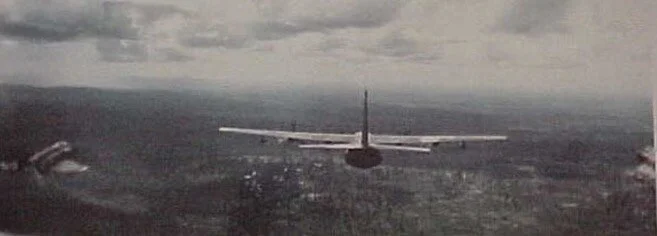
For centuries, the pass had been both a strategic chokepoint and a graveyard. During the Vietnam War, it remained treacherous—particularly for aviation. Low ceilings, rapidly forming clouds, and jagged ridgelines made navigation perilous, especially for aircraft flying without the full navigational aids available to conventional military flights.
Many aircraft were lost in these mountains—not to enemy fire, but to terrain and weather.
Air America crews knew the risks. So did the passengers who boarded.
UNMANIFESTED, UNACKNOWLEDGED
At the time of the crash, the aircraft was reported to be carrying an unknown number of unmanifested passengers. That single phrase—unknown number—speaks volumes.
Among those confirmed lost were five U.S. service members:
-
SGT Stephen F. Robar, United States Marine Corps
-
PFC Christabol T. McClure, United States Marine Corps
-
CM2 James D. Laser, United States Navy
-
HM2 Raymond C. Minks, United States Navy
-
CE2 Robert W. O'Neil, United States Navy
Their presence aboard a civilian CIA aircraft raises questions that may never be fully answered. Why were Marines and sailors traveling on this flight? What mission required such deniability? What work were they doing that demanded silence?
The records do not say.
And that silence is part of the story.
SERGEANT STEPHEN F. ROBAR
Sergeant Stephen F. Robar was a United States Marine serving during one of the most complex and morally ambiguous conflicts in American history. Like so many Marines of his generation, he answered the call without knowing exactly where it would lead—or how quietly it might end.
His assignment placed him aboard an aircraft that did not officially exist, on a mission that was never fully documented, flying a route that offered no second chances.
There was no mayday call recorded. No distress beacon activated. No chance for rescue.
His death did not come during a firefight or in a named operation. It came in the fog and mountains, far from cameras, headlines, or ceremony.
And yet, his service was no less real.
DEATH WITHOUT HEADLINES
When conventional military aircraft were lost in Vietnam, the events were often recorded, investigated, and publicly acknowledged. Families received notifications that—while devastating—at least carried clarity.
But deaths tied to covert operations occupied a gray space.
Air America crashes were sometimes reported simply as “civilian aircraft accidents.†The presence of military personnel was often omitted. Next-of-kin notifications could be vague, delayed, or stripped of detail. In some cases, families were left with more questions than answers.
For decades, many of these men existed only as footnotes—if they were mentioned at all.
This is what makes remembrance essential.
THE OTHERS WHO NEVER CAME HOME
Sergeant Robar did not die alone.
Each of the men aboard that aircraft carried his own story, his own family, his own future that ended on that mountainside. Navy corpsmen, construction electricians, machinist's mates—specialists whose skills were critical to operations that history has not fully revealed.
They served across branches, unified not by unit patches or shared ranks, but by a mission that demanded silence.
Their names deserve to be spoken together.
WHY WE REMEMBER
At Ghosts of the Battlefield, we believe that history does not belong only to the famous battles or decorated heroes whose stories fit neatly into textbooks. It belongs equally to those whose service was obscured, whose missions were classified, and whose sacrifices were buried beneath layers of secrecy.
The Vietnam War was fought on many levels:
-
On jungle trails and firebases
-
In the skies above contested terrain
-
In briefing rooms where maps bore no labels
-
And in aircraft like this one—unmarked, unacknowledged, and unforgiving
Sergeant Stephen F. Robar stood in that hidden space.
SAYING HIS NAME
Today, we say his name aloud.
Stephen F. Robar.
We say it because silence should never be the final chapter.
We say it because service does not require recognition to be honorable—but remembrance does.
We say it because men who died in the shadows deserve light.
This was his final flight.
And he will not be lost to history.