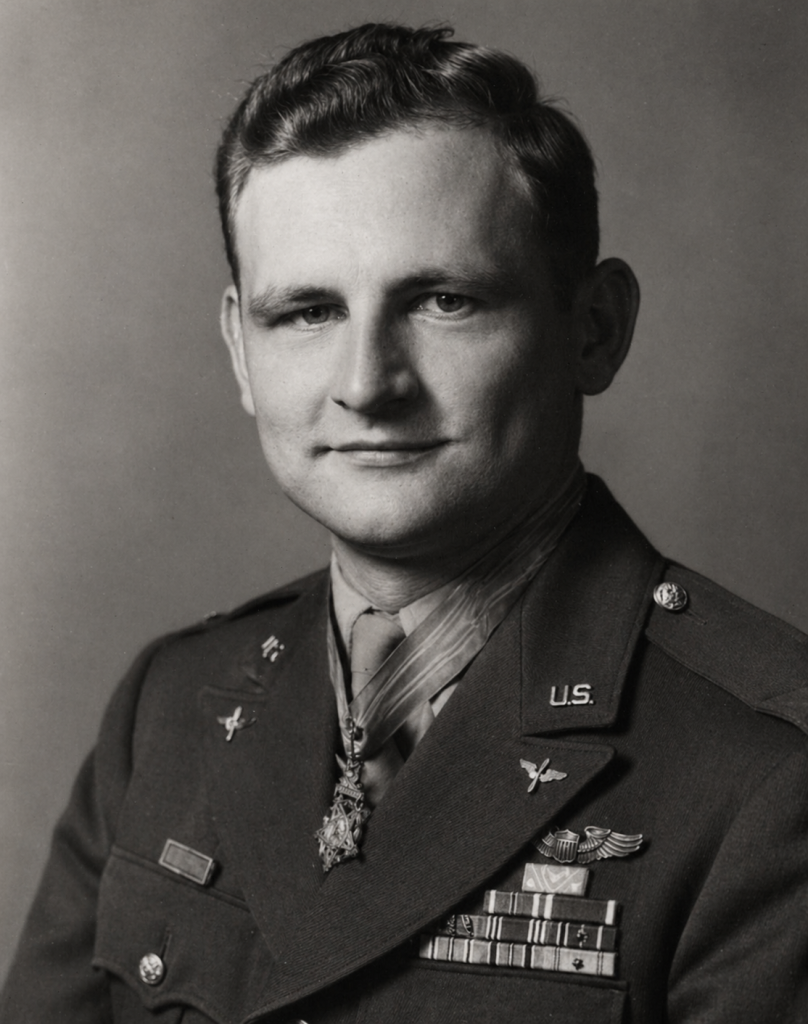
 Name: Edward S. Michael
Rank: First Lieutenant
Branch: U.S. Army Air Corps
War: World War II
Unit: 364th Bomber Squadron, 305th Bomber Group
Date of Action: April 11, 1944
Location: Over Germany
Summary of Action
On 11 April 1944, First Lieutenant Edward S. Michael served as pilot of a B-17 Flying Fortress on a heavy bombardment mission over Germany.
His bomber group was attacked by a swarm of enemy fighters, and Michael's aircraft became the focus of repeated assaults.
The B-17 was riddled from nose to tail by exploding cannon shells and knocked out of formation.
A shell burst inside the cockpit, wounding the copilot, destroying instruments, and blowing out a side window.
Michael himself was seriously wounded in the right thigh.
Hydraulic fluid coated the windshield, smoke filled the cockpit, and the controls stopped responding.
The aircraft lost 3,000 feet before Michael managed to level it off.
Then came worse news: three cannon shells had ignited incendiary bombs in the bomb bay, and the entire compartment was on fire.
With a full bomb load and fuel tanks still carrying fuel, the aircraft could explode at any moment.
When the emergency bomb release failed, Michael ordered the crew to bail out.
Seven men escaped.
One remained—the bombardier.
When told to jump, the bombardier discovered his parachute had been shredded by 20mm fragments and was useless.
Michael immediately understood the choice before him.
If he abandoned the aircraft, the bombardier would die.
Ignoring his own severe wounds and heavy blood loss, he stayed at the controls and fought to save the aircraft and the remaining crewman.
For forty-five minutes he evaded relentless fighter attacks in a crippled bomber.
After shaking the enemy in cloud cover, he flew at treetop level through anti-aircraft fire and continued toward France, then England.
Eventually, weakened by blood loss, he lost consciousness.
The copilot guided the aircraft toward an RAF field near the English coast.
Regaining consciousness, Michael insisted on taking back the controls for landing.
The undercarriage was useless, bomb bay doors jammed open, hydraulics destroyed, altimeter gone, airspeed indicator inoperative, ball turret jammed downward, and flaps unresponsive.
Despite every obstacle, he landed the B-17 safely without mishap.
His courage, leadership, and refusal to abandon a crewman reflected the highest traditions of the United States Army Air Forces.
Medal of Honor Citation
MICHAEL, EDWARD S. (Air Mission)
Rank and organization: First Lieutenant, U.S. Army Air Corps, 364th Bomber Squadron, 305th Bomber Group.
Place and date: Over Germany, 11 April 1944.
Entered service at: Chicago, Ill.
Born: 2 May 1918, Chicago, Ill.
G.O. No.: 5, 15 January 1945.
Citation:
For conspicuous gallantry and intrepidity above and beyond the call of duty while serving as pilot of a B17 aircraft on a heavy-bombardment mission to Germany, 11 April 1944. The group in which 1st Lt. Michael was flying was attacked by a swarm of fighters. His plane was singled out and the fighters pressed their attacks home recklessly, completely disregarding the Allied fighter escort and their own intense flak. His plane was riddled from nose to tail with exploding cannon shells and knocked out of formation, with a large number of fighters following it down, blasting it with cannon fire as it descended. A cannon shell exploded in the cockpit, wounded the copilot, wrecked the instruments, and blew out the side window. 1st Lt. Michael was seriously and painfully wounded in the right thigh. Hydraulic fluid filmed over the windshield making visibility impossible, and smoke filled the cockpit. The controls failed to respond and 3,000 feet were lost before he succeeded in leveling off. The radio operator informed him that the whole bomb bay was in flames as a result of the explosion of 3 cannon shells, which had ignited the incendiaries. With a full load of incendiaries in the bomb bay and a considerable gas load in the tanks, the danger of fire enveloping the plane and the tanks exploding seemed imminent. When the emergency release lever failed to function, 1st Lt. Michael at once gave the order to bail out and 7 of the crew left the plane. Seeing the bombardier firing the navigator's gun at the enemy planes, 1st Lt. Michael ordered him to bail out as the plane was liable to explode any minute. When the bombardier looked for his parachute he found that it had been riddled with 20mm. fragments and was useless. 1st Lt. Michael, seeing the ruined parachute, realized that if the plane was abandoned the bombardier would perish and decided that the only chance would be a crash landing. Completely disregarding his own painful and profusely bleeding wounds, but thinking only of the safety of the remaining crewmembers, he gallantly evaded the enemy, using violent evasive action despite the battered condition of his plane. After the plane had been under sustained enemy attack for fully 45 minutes, 1st Lt. Michael finally lost the persistent fighters in a cloud bank. Upon emerging, an accurate barrage of flak caused him to come down to treetop level where flak towers poured a continuous rain of fire on the plane. He continued into France, realizing that at any moment a crash landing might have to be attempted, but trying to get as far as possible to increase the escape possibilities if a safe landing could be achieved. 1st Lt. Michael flew the plane until he became exhausted from the loss of blood, which had formed on the floor in pools, and he lost consciousness. The copilot succeeded in reaching England and sighted an RAF field near the coast. 1st Lt. Michael finally regained consciousness and insisted upon taking over the controls to land the plane. The undercarriage was useless; the bomb bay doors were jammed open; the hydraulic system and altimeter were shot out. In addition, there was no airspeed indicator, the ball turret was jammed with the guns pointing downward, and the flaps would not respond. Despite these apparently insurmountable obstacles, he landed the plane without mishap.
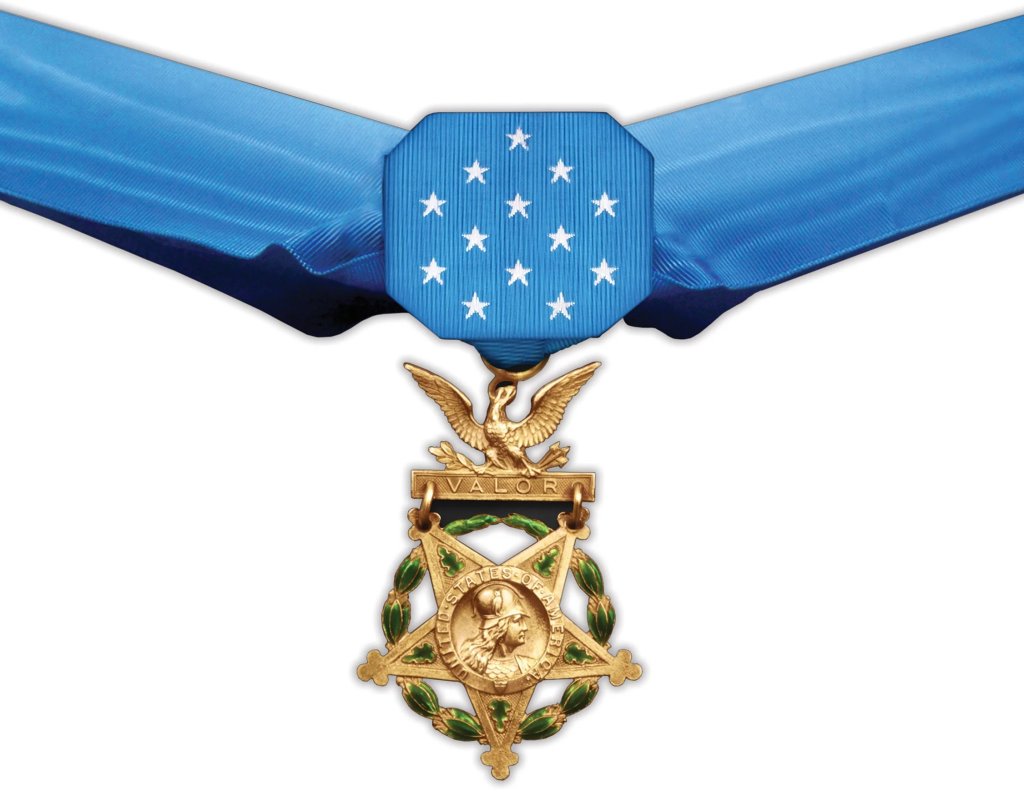

 Name: Edward S. Michael
