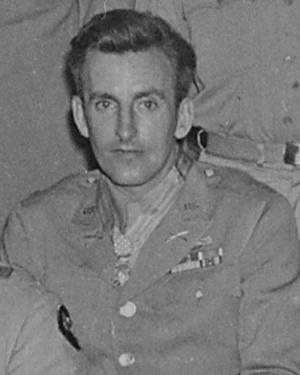
 Name: Edward C. Dahlgren
Rank: Second Lieutenant (then Sergeant)
Branch: U.S. Army
Unit: Company E, 142d Infantry Regiment, 36th Infantry Division
Place: Oberhoffen, France
Entered Service At: Portland, Maine
Born: Perham, Maine
Summary of Action
During a fierce German counterattack at Oberhoffen, France, Sgt. Edward C. Dahlgren led the 3d Platoon to rescue another American unit that had been surrounded.
Spotting German troops crossing a field, he took position in a barn window and swept them with submachine-gun fire, killing six and scattering the rest. Pressing forward through sniper fire, his platoon linked up with the besieged Americans.
Dahlgren then led aggressive house-to-house assaults through the town. Charging an enemy-held building under heavy fire, he hurled a grenade through the door and stormed inside, forcing eight Germans to surrender. When pinned by machine-gun fire, he stepped into the open and calmly launched rifle grenades until he destroyed the weapon and killed its crew.
He continued clearing buildings with relentless momentum—overrunning machine-gun nests, storming barns, tossing grenades into cellars, and compelling surrender after surrender. In one action alone, he forced sixteen German soldiers to emerge with their hands raised.
His fearless leadership and repeated single-handed assaults broke the enemy counterattack and saved the surrounded American platoon.
Medal of Honor Citation
DAHLGREN, EDWARD C.
Rank and organization: Second Lieutenant (then Sergeant), U.S. Army, Company E, 142d Infantry, 36th Infantry Division.
Place and date: Oberhoffen, France, 11 February 1945.
Entered service at: Portland, Maine.
Birth: Perham, Maine.
G.O. No.: 77, 10 September 1945.
Citation:
He led the 3d Platoon to the rescue of a similar unit which had been surrounded in an enemy counterattack at Oberhoffen, France. As he advanced along a street, he observed several Germans crossing a field about 100 yards away. Running into a barn, he took up a position in a window and swept the hostile troops with submachine gun fire, killing 6, wounding others, and completely disorganizing the group. His platoon then moved forward through intermittent sniper fire and made contact with the besieged Americans. When the 2 platoons had been reorganized, Sgt. Dahlgren continued to advance along the street until he drew fire from an enemy-held house. In the face of machine pistol and rifle fire, he ran toward the building, hurled a grenade through the door, and blasted his way inside with his gun. This aggressive attack so rattled the Germans that all 8 men who held the strongpoint immediately surrendered. As Sgt. Dahlgren started toward the next house, hostile machinegun fire drove him to cover. He secured rifle grenades, stepped to an exposed position, and calmly launched his missiles from a difficult angle until he had destroyed the machinegun and killed its 2 operators. He moved to the rear of the house and suddenly came under the fire of a machinegun emplaced in a barn. Throwing a grenade into the structure, he rushed the position, firing his weapon as he ran; within, he overwhelmed 5 Germans. After reorganizing his unit he advanced to clear hostile riflemen from the building where he had destroyed the machinegun. He entered the house by a window and trapped the Germans in the cellar, where he tossed grenades into their midst, wounding several and forcing 10 more to surrender. While reconnoitering another street with a comrade, he heard German voices in a house. An attack with rifle grenades drove the hostile troops to the cellar. Sgt. Dahlgren entered the building, kicked open the cellar door, and, firing several bursts down the stairway, called for the trapped enemy to surrender. Sixteen soldiers filed out with their hands in the air. The bold leadership and magnificent courage displayed by Sgt. Dahlgren in his heroic attacks were in a large measure responsible for repulsing an enemy counterattack and saving an American platoon from great danger.

 Name: Edward C. Dahlgren
