The German Mauser C96 from WWI
Innovation, Empire, and the Changing Face of War
March 17, 2026

 At the turn of the 20th century, the world stood at the threshold of profound transformation. Industrialization had reshaped economies, empires extended across continents, and technological innovation was accelerating at an unprecedented pace. Among these advancements was a new class of weapon that would redefine personal firepower on the battlefield—the semi-automatic pistol. The Mauser C96, introduced in 1896 by the German firm Mauser, emerged as one of the earliest and most influential examples of this new technology.
Its design was both distinctive and unconventional. The pistol featured a long barrel, a fixed internal magazine positioned ahead of the trigger, and a sharply angled grip that gave rise to its enduring nickname, the “Broomhandle.†While its appearance set it apart, its true significance lay in its function. The C96 was capable of self-loading fire, allowing a shooter to discharge multiple rounds in rapid succession without the need to manually cycle the action after each shot. At a time when revolvers still dominated military service, this represented a significant leap forward.
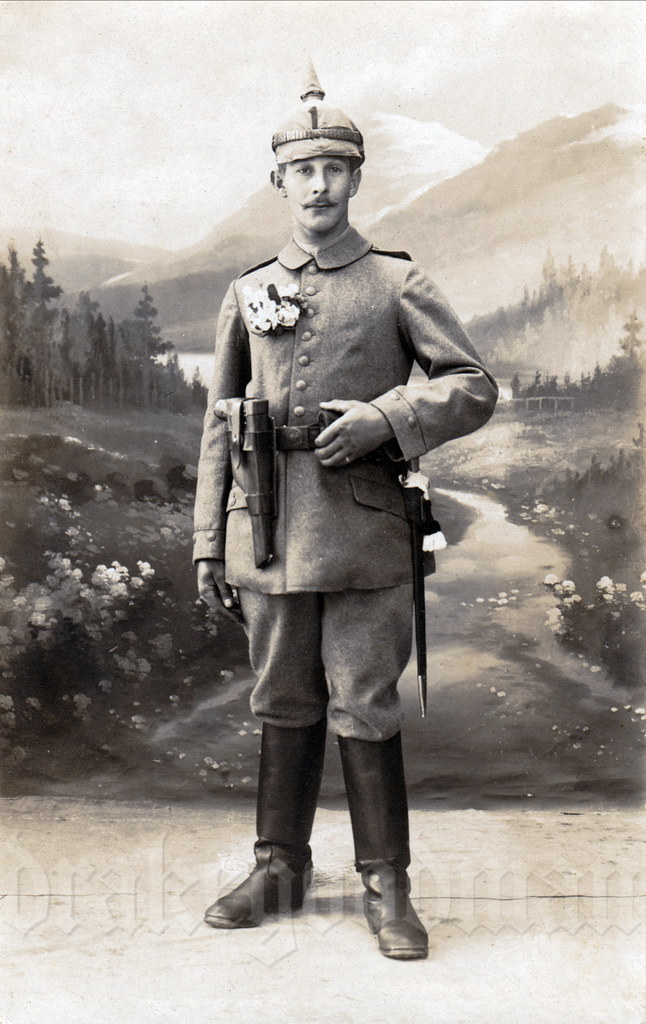
When World War I erupted in 1914, the Mauser C96 was already well established, though it was not the primary standard-issue sidearm of the German Army. That distinction belonged to the Luger P08. However, the scale of the conflict quickly overwhelmed existing supply systems. As millions of men were mobilized and equipped for a war that would span continents and years, the German military increasingly relied on a wide range of available weapons. The C96 was among those pressed into service, issued to officers, artillery crews, and specialized troops who required a reliable secondary weapon.
The conditions of the Great War gave new relevance to the pistol. Combat in the trenches was defined by proximity, unpredictability, and violence at close range. Soldiers operated within confined systems of earthworks, where visibility was limited and engagements could occur with little warning. In such environments, the ability to deliver rapid, successive fire was of considerable value. The C96, chambered in the high-velocity 7.63×25mm Mauser cartridge, offered both speed and striking power, capable of penetrating barriers and engaging targets at distances beyond those typical of revolvers.
In some cases, the pistol was paired with a detachable wooden shoulder stock that doubled as a holster. This adaptation allowed the weapon to function as a compact carbine, increasing stability and extending its effective range. For troops operating in communication trenches, rear areas, or fluid engagements where a full-length rifle was impractical, this capability provided a notable advantage. It also reflected the experimental nature of the period, as military forces sought to adapt to a rapidly evolving battlefield.
Beyond its use by German forces, the Mauser C96 achieved a remarkable degree of global distribution. Prior to and during World War I, it was exported widely and adopted by a variety of military and paramilitary groups. It appeared in the hands of Russian soldiers and revolutionaries during the upheavals of 1917, and later became a common sight in conflicts across Asia, particularly among Chinese warlord factions. Its widespread presence underscores the increasingly interconnected nature of warfare in the early 20th century, where weapons moved across borders as readily as ideas and alliances.
 From a technical perspective, the C96 represents a critical stage in the evolution of modern firearms. Its recoil-operated mechanism and semi-automatic functionality demonstrated the viability of self-loading pistols at a time when such designs were still emerging. Although later developments would favor detachable magazines and more compact forms, the principles embodied in the C96 helped shape the trajectory of handgun design for decades to come.
This artifact stands as a witness to a period of transition. It bridges the gap between the weaponry of the 19th century and the mechanized warfare of the 20th. It existed in the hands of individuals who experienced the upheaval of World War I firsthand—soldiers navigating the uncertainty of trench combat, officers leading men in environments where survival often depended on seconds, and participants in a conflict that reshaped the global order.
Preserved within the collection of Ghosts of the Battlefield, this Mauser C96 is not simply an example of early semi-automatic design. It is a tangible connection to a moment in history when technology, conflict, and human experience converged in ways that would define the modern age.